

 Français
  Deutsch
  Українська
Opening or modernising a hair salon in France can involve substantial expenditure. Professional chairs and wash units, electrical installations, ventilation, styling equipment, point-of-sale systems, booking software, signage, accessibility improvements, energy-saving investments, and refurbishment can quickly turn a relatively small business project into a significant investment.
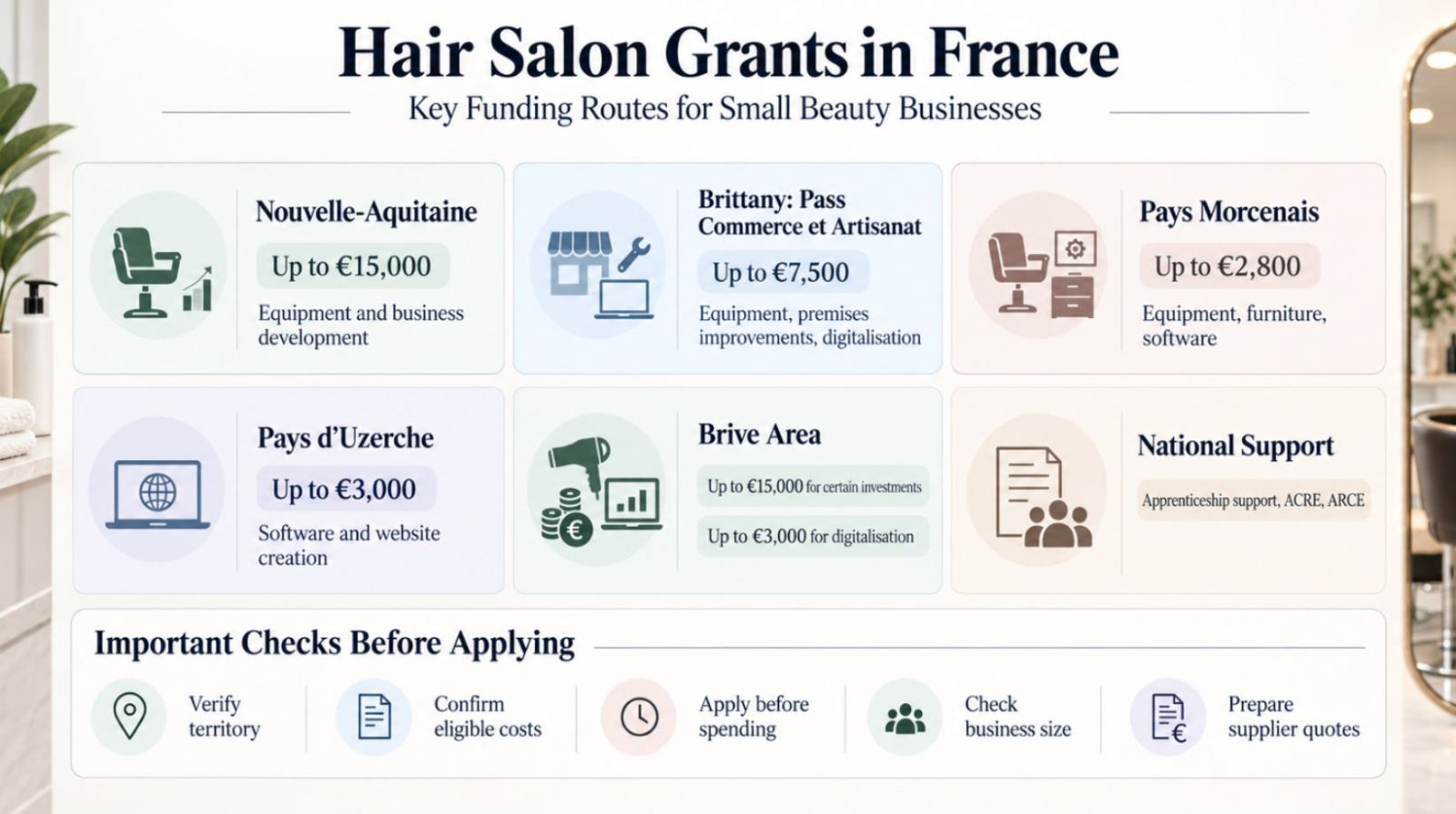
France does not have one universal national grant that automatically gives every hair salon money for equipment or renovation. Instead, funding is fragmented across regional authorities, intermunicipal bodies, municipalities, employment schemes, startup support mechanisms, and programmes designed for small local businesses.
For a hair salon owner, this makes location almost as important as the business activity itself.
A salon in Brittany may qualify for a programme that does not exist in Nouvelle-Aquitaine. A business in Pays Morcenais may be able to obtain support for furniture and professional equipment, while a salon in Pays d'Uzerche may find a separate programme focused mainly on digitalisation. Another business in Brive may be able to finance both productive investments and certain digital tools under a local SME support scheme.
The correct question is therefore not simply, "Are there grants for hair salons in France?"
A more useful question is: "Which grants and support programmes are available to a hair salon with this legal status, this address, this investment plan, and this development stage?"
That distinction is the foundation of an effective funding strategy.
The French hairdressing sector is large enough to justify this detailed approach. According to industry figures published by UNEC using 2024 data, France had 111,177 hairdressing establishments and registered hairdressing activities. Of these, 69,556 operated as physical salons, while 31,501 represented home-based hairdressing activity. During 2024, 9,823 new establishments were recorded and 8,149 closures took place.
This means that funding questions affect not only established salon chains or large beauty businesses. They are relevant to tens of thousands of very small enterprises, independent salon owners, business buyers, new entrepreneurs, and professionals planning to modernise existing premises.
This guide examines the main funding routes that a small hair salon in France can realistically explore, explains which expenses may be supported, identifies important geographical restrictions, and shows how actual French salons have received approved financial assistance.
1. Why Hair Salon Funding in France Is Highly Local
France has an extensive system of regional and local economic support. For small retail and craft businesses, this often means that the most useful funding does not come from a single central government programme.
Instead, a salon may need to investigate support offered by the region, département, intermunicipal authority, municipality, local development agency, or chamber representing craft businesses.
This creates both an opportunity and a challenge.
The opportunity is that many local authorities actively support businesses that maintain services in town centres, rural areas, neighbourhood shopping districts, or territories where economic activity is considered strategically important.
Hair salons frequently fit this profile because they provide an everyday local service, operate from physical premises, create employment, attract customers to commercial streets, and often require regular investment in equipment and premises.
The challenge is that programmes can differ even between nearby territories.
A grant advertised for small businesses in Nouvelle-Aquitaine is not necessarily available throughout the entire region. A programme may apply only to specified municipalities, rural territories, priority neighbourhoods, or member communities of a particular intermunicipal body.
A salon owner should therefore avoid starting with the largest advertised grant amount. The first step is to identify the exact geographical authorities responsible for the salon's location.
Table 1. Main Funding Routes for Hair Salons in France
| Programme | Territory | Potential support | Relevant salon expenditure | Key limitation |
|---|---|---|---|---|
| Aide aux commerces TPE & services du quotidien | Eligible municipalities and priority neighbourhoods in Nouvelle-Aquitaine | Up to 50 percent of eligible expenditure, maximum €15,000 | Essential professional equipment, software, certain business development investments | Minimum eligible project and strict geographical conditions |
| Pass Commerce et Artisanat | Participating territories in Brittany | Generally 30 percent, up to €7,500 | Equipment, premises improvements, digital tools, certain environmental investments | Participation and detailed rules vary by local authority |
| Aide à l'économie territoriale | Pays Morcenais | 35 percent, up to €2,800 | Professional equipment, furniture, software, till systems | Only businesses located in the eligible territory |
| Aide à la transition numérique des entreprises | Pays d'Uzerche | 30 percent, up to €3,000 | Professional software and professionally created websites | Ordinary subscriptions and recurring website costs may be excluded |
| Fonds d'aide aux TPE | Brive area | Digital support up to €3,000; certain investment support up to €15,000 | Digital tools, equipment and some eligible works | Separate rules apply to each investment category |
| ACTe, Aide aux Commerces des Territoires | Évreux Portes de Normandie | Up to 45 percent for some existing businesses | Premises modernisation, equipment, shopfront, safety and accessibility | New businesses can face different support rates |
| Aide à l'investissement matériel | Creuse Sud-Ouest | Support ceilings can reach €15,000 for productive and digital investment | Professional equipment and digital investment | Exact aid rate must be confirmed locally |
These programmes should not be added together as if one salon could automatically access all of them.
They are examples of different territorial funding systems. Eligibility depends on where the salon operates.
2. Who Can Apply for Hair Salon Grants?
The definition of an eligible business varies from programme to programme, but many local schemes target microenterprises and very small businesses.
A typical programme may impose conditions concerning employee numbers, annual turnover, legal registration, financial health, business independence, location, commercial premises, or the minimum size of the planned investment.
For example, one support programme in Nouvelle-Aquitaine targets very small local businesses with fewer than ten full-time-equivalent employees and turnover or balance sheet totals not exceeding €2 million.
Pass Commerce et Artisanat in Brittany also targets relatively small independent businesses and applies its own limits on employee numbers and turnover.
This matters because "small business" is not enough as an informal description.
A salon with two employees, an independent owner and €180,000 in annual turnover may fit comfortably within the limits of many local schemes. A much larger multi-location beauty company may not.
The business must also carry out an eligible activity.
Hairdressing is a regulated craft activity in France. Professional qualification requirements apply, and foreign qualifications may need to be recognised through the relevant French procedures.
For international entrepreneurs, this should be checked before relying on a business grant as part of a salon launch plan.
As of 2026, the relevant French activity classification for conventional hairdressing remains APE 96.02A. A new classification is expected to introduce code 96.21G from 2027, so applicants preparing documentation in 2026 should not prematurely use the future code as if it were already in force.
A funding application should use the business information that is legally valid at the time of submission.
3. Nouvelle-Aquitaine: Support That Can Reach €15,000
One of the more substantial possibilities identified for small local service businesses is the regional support mechanism Aide aux commerces TPE & services du quotidien.
Hair salons are among the types of local service businesses that can fall within the eligible scope when all other conditions are satisfied.
The programme can cover up to 50 percent of eligible expenditure, subject to a maximum grant of €15,000.
However, the support is not available to every salon in Nouvelle-Aquitaine.
The business must be located in an eligible municipality or qualifying priority area, and the investment project must meet the programme's minimum financial threshold.
For a salon, relevant expenditure may include essential professional equipment and eligible software connected to the business activity or digital and environmental improvement.
This could potentially make the programme relevant to a salon replacing outdated professional equipment, installing new digital management systems, or making a broader qualifying investment.
But the distinction between eligible equipment and ordinary operating costs is critical.
A salon cannot assume that every chair, hairdryer, decorative item, subscription, renovation expense, or piece of furniture will qualify.
Programmes of this type often exclude routine replacement, minor equipment, property acquisition, certain construction costs, operating expenses, or expenditure incurred before the application process has reached the required stage.
There is also an important timing rule.
Entrepreneurs creating or acquiring a business may need to contact the relevant support organisation before registering the business or completing the acquisition.
This reflects a principle that appears repeatedly across French business support schemes: do not begin the investment too early.
Buying the equipment first and applying for the grant later can make otherwise eligible expenditure ineligible.
4. Brittany: Pass Commerce et Artisanat
Pass Commerce et Artisanat is particularly valuable for this article because hair salons have not only been theoretically eligible. There are documented examples of salon projects receiving approved assistance.
The programme supports small commercial and craft businesses across participating territories in Brittany.
Under the general structure, support can cover around 30 percent of eligible expenditure, with aid of up to €7,500.
Eligible investment can include professional equipment, improvements to business premises, certain accessibility measures, digitalisation, and some investments designed to reduce energy or water consumption.
For a hair salon, this creates several possible project types.
A business might want to replace inefficient equipment, redesign customer areas, improve accessibility, install an upgraded checkout and management system, introduce customer relationship software, or undertake eligible improvements to its commercial premises.
The business still has to satisfy local conditions.
Pass Commerce et Artisanat is not one automatic Brittany-wide entitlement with identical rules everywhere. Participating local authorities can apply additional requirements, including minimum investment thresholds.
For example, in Quimper Bretagne Occidentale, an eligible investment project can be subject to a minimum project size of €6,000.
This is why the location of the salon must be checked before a budget is prepared.
5. Real Hair Salons That Received Approved Support
Official local government decisions provide unusually useful evidence that these programmes are not merely theoretical.
Several French hair salons have appeared in formal funding decisions under Pass Commerce et Artisanat.
Table 2. Documented Hair Salon Funding Examples in France
| Business | Location | Programme | Documented support | What the official record confirms |
|---|---|---|---|---|
| Oleksa | Guengat, Brittany | Pass Commerce et Artisanat | Up to €2,551.27 | Grant approval for creation of a hair salon |
| Détente Coiffure | Plaudren, Brittany | Pass Commerce et Artisanat | €6,509.76 | Approved support based on €21,699.20 of eligible investment |
| Jenny's Barber | Quimper area | Pass Commerce et Artisanat | Individual amount not published in the reviewed material | Listed among supported local businesses |
| Le salon d'Emma | Quimper area | Pass Commerce et Artisanat | Individual amount not published | Listed among supported local businesses |
| Karocoiff | Quimper area | Pass Commerce et Artisanat | Individual amount not published | Listed among supported local businesses |
| Natura Coiffure | Quimper area | Pass Commerce et Artisanat | Individual amount not published | Listed among supported local businesses |
The Oleksa case is especially useful.
In May 2025, a local authority approved support of up to €2,551.27 for the creation of a hair salon in Guengat.
The wording of the decision is important. The grant was approved, but payment was linked to the submission of paid invoices.
This illustrates a common feature of small-business grants: approval does not always mean that the money is transferred before the business spends anything.
The entrepreneur may need to finance the expenditure first, then submit evidence for reimbursement.
That creates a cash-flow requirement even when a grant has been approved.
Détente Coiffure provides an even clearer financial example.
The salon had €21,699.20 of eligible investment and received approved support of €6,509.76.
That amount corresponds to 30 percent of the eligible investment.
The decision also established implementation and documentation requirements. If final eligible expenditure were lower than planned, the final assistance could be recalculated.
This is an important lesson for applicants.
The maximum approved amount is not necessarily guaranteed regardless of actual expenditure. A grant based on a percentage of eligible costs can decrease if the final qualifying investment decreases.
Local reporting from the Quimper area provides broader programme context. Since 2019, the programme had supported 164 businesses and generated approximately €940,940 in financial commitments, according to the local authority's reporting. The same reporting linked the programme to the creation or preservation of 167 jobs.
These figures cover all supported business types, not only hair salons.
Still, they demonstrate that Pass Commerce et Artisanat operates as a significant local small-business investment tool rather than a one-off beauty-sector initiative.
6. Pays Morcenais: A Smaller Grant for Practical Salon Investments
Not every useful grant needs to be large.
For a small salon planning a limited investment, a local grant covering a few thousand euros may be more realistic and easier to match to the actual project.
The Aide à l'économie territoriale in Pays Morcenais is a good example.
Hair salons are explicitly included among eligible businesses.
The programme can cover 35 percent of eligible expenditure, up to a maximum of €2,800.
Potentially eligible costs include professional equipment, furniture used for fitting out the business, computer equipment, software, and cash register systems.
For a small salon, these are practical categories.
A new business may need reception furniture, professional workstations, business software, payment equipment, and specialised tools. An existing salon may want to replace or modernise part of its equipment.
The programme also illustrates how digitalisation can carry additional conditions.
Where a business applies only for digital equipment, a prior assessment of the company's digital needs may be required.
This prevents applicants from simply buying technology without demonstrating that it corresponds to a genuine business requirement.
As with other programmes, location is decisive. A salon elsewhere in France cannot apply merely because its investment resembles that of an eligible business in Pays Morcenais.
7. Digitalisation Support: Booking Systems, Websites and Salon Management Software
Digitalisation has become increasingly relevant to small beauty businesses.
A salon may use online appointment systems, automated reminders, customer databases, digital payment solutions, stock management systems, online gift vouchers, websites, or customer communication tools.
French support programmes can sometimes finance parts of these investments.
However, one of the most important findings from the available programmes is that the definition of an eligible digital expense varies considerably.
Pays d'Uzerche offers local support for the digital transition of businesses. The scheme can cover 30 percent of eligible expenditure, up to €3,000.
Potentially eligible expenditure includes professional software and a website created by a professional provider.
For a salon, this could be relevant when introducing a new management or booking system.
But ordinary subscription fees and recurring website maintenance may not qualify.
This is particularly important because many modern salon software products use monthly subscriptions rather than one-time licences.
A business owner who assumes that "booking software is eligible" without checking the payment model may prepare an incorrect budget.
The Brive area demonstrates that different local programmes can take a different approach.
Its small-business support scheme provides a digitalisation category with support of 30 percent and a maximum amount of €3,000.
Certain professional software subscription costs, including a first-year subscription in some cases, can be treated differently from those under other local schemes.
The lesson is straightforward: the name of the expense is not enough.
Applicants need to verify whether the programme accepts a licence purchase, implementation fee, website development cost, subscription, maintenance payment, equipment purchase, or all of these categories.
Table 3. Examples of Salon Investments and Their Potential Funding Treatment
| Investment | Why a salon may need it | Possible funding route | Main issue to verify |
|---|---|---|---|
| Professional salon chairs and workstations | Capacity and customer experience | Local equipment investment grant | Whether ordinary replacement is excluded |
| Hair-washing units | Modernisation and service capacity | Equipment or premises support | Whether installation costs are eligible |
| Booking and salon-management software | Appointments, customer records, scheduling | Digitalisation support | Licence purchase versus recurring subscription |
| Professionally developed website | Visibility and online bookings | Digital transition grant | Website creation may qualify while maintenance may not |
| Energy-efficient equipment | Lower energy use and operating costs | Local investment or environmental support | Technical eligibility and evidence of savings |
| Accessibility improvements | Customer access and regulatory compliance | Local commercial investment programmes | National accessibility grant is no longer open |
| Till and payment system | Business administration | Local equipment or digital programme | Hardware and software may be treated separately |
| Interior refurbishment | Modernisation of commercial premises | Certain territorial schemes | Decoration alone may be excluded |
| Used equipment | Lower-cost salon expansion | Some programmes may allow only under strict conditions | Warranty, supplier status and programme rules |
| Consumables and cosmetics | Normal salon operations | Usually not eligible | Operating expenses are commonly excluded |
This table should be used as a screening tool, not as confirmation that a particular purchase will be financed.
Each expense must be checked against the current rules of the relevant programme.
8. Brive: Combining Business Investment and Digital Modernisation
The Fonds d'aide aux TPE in the Brive area offers a useful example of a broader local support structure.
It contains separate support mechanisms for different types of investment.
Digitalisation and cybersecurity expenditure may receive support of 30 percent up to €3,000.
Productive investment and certain eligible works can receive support at 30 percent with a substantially higher ceiling, potentially reaching €15,000.
For a salon, this can create a more flexible planning environment than a programme focused on only one narrow expenditure category.
A business might, for example, need a combination of professional equipment and digital management tools.
However, a salon owner should not assume that maximum amounts under separate programme components can always be stacked.
The administrator must confirm whether the relevant categories can be combined within the same project, whether separate applications are necessary, and whether cumulative aid limits apply.
The business must also satisfy local eligibility conditions, including its place of registration, number of employees, turnover, financial position, and tax and social obligations.
The current programme information indicates availability through the end of 2026, but businesses should confirm that the budget remains available before committing to expenditure.
9. Normandy: ACTe and Different Rules for New Businesses
The ACTe programme in Évreux Portes de Normandie demonstrates another important principle: a new salon and an established salon may not receive the same support rate.
The programme supports the modernisation of local retail and craft businesses, and hair salons are included within the eligible categories.
For certain existing businesses, the overall public contribution can reach 45 percent of eligible expenditure.
This figure combines regional and local components within one support structure. It should not be interpreted as two separate grants that the salon owner can independently add together.
For business creators and certain mobile activities, the applicable maximum rate can instead be limited to 30 percent.
Local guidance also identifies an eligible investment range beginning at €2,500 and extending to €20,000 before VAT for relevant projects.
Potential salon investments can include professional equipment, modernisation of the premises, shopfront improvements, safety measures, and accessibility.
One detail deserves particular caution.
Different official information sources have presented different maximum commercial surface thresholds. Where programme sources are inconsistent, applicants should ask the programme administrator to confirm the current rule before relying on it.
This is better than silently choosing the more favourable interpretation.
10. Creuse Sud-Ouest: Investment Support for Hair Salons
Creuse Sud-Ouest also offers an investment support mechanism that explicitly includes hair salons among potentially eligible activities.
The programme can support professional equipment and certain digital investments.
Published information identifies a maximum support ceiling of €15,000 for productive and digital investment and a separate ceiling for related intangible expenditure.
However, the available public summary does not provide enough information to treat one universal reimbursement rate as confirmed for every applicant.
The correct approach is therefore to state the available ceiling but calculate an actual expected grant only after the local authority confirms the applicable rate.
This distinction is essential in grant writing.
A maximum programme ceiling of €15,000 does not mean that every approved business receives €15,000.
If a programme funds only a percentage of qualifying expenditure, a small project may generate a much smaller award.
11. National Support: Hiring an Apprentice
Not all useful financial support for a hair salon concerns equipment.
Hairdressing businesses frequently train apprentices, making employment support particularly relevant.
French national policy provides financial support to eligible employers that hire apprentices under qualifying contracts.
For businesses with fewer than 250 employees, the principal apprenticeship support for eligible qualifications can reach €5,000 for the first year of the contract, subject to the rules in force.
Higher support can apply in specific circumstances, including contracts involving an apprentice with a recognised disability.
This can be financially significant for a small salon.
A salon may not find a local grant for a new workstation, yet it may still reduce the cost of expanding its team through apprenticeship support.
The business must comply with the administrative process. The apprenticeship agreement needs to satisfy the relevant requirements and must be transmitted to the appropriate skills operator within the required time.
The support should not be described as an equipment grant.
It is employment-related financial assistance linked to the apprenticeship contract.
Table 4. National Support Mechanisms Relevant to Hair Salon Owners
| Support mechanism | Main benefit | Typical user | Important classification |
|---|---|---|---|
| Apprenticeship employer support | Up to €5,000 for the first year under relevant 2026 conditions | Small salon hiring an eligible apprentice | Employment aid, not equipment funding |
| Higher apprenticeship aid in disability cases | Can reach €6,000 under specific conditions | Employer hiring an eligible apprentice with a disability | Employment support |
| ACRE | Partial reduction in social contributions for eligible business creators or buyers | New entrepreneur | Contribution relief, not cash grant |
| ARCE | Capital payment based on part of remaining unemployment benefit entitlement | Eligible unemployed person creating or acquiring a business | Conversion of existing benefit entitlement into capital |
These mechanisms can be financially valuable, but they should not be marketed as conventional grants if that is not their legal or economic structure.
12. ACRE and ARCE for Someone Opening a Salon
For someone creating or acquiring a salon, startup support can be as important as an investment grant.
ACRE provides eligible business creators or buyers with temporary relief from certain social contributions.
Rules changed during 2026, making older online explanations potentially misleading.
For eligible micro-entrepreneurs beginning activity from July 2026, the reduction is 25 percent rather than the older reductions that may still appear in historical guides.
The application must also be made within the applicable deadline.
ACRE does not place cash into the entrepreneur's bank account. Its value comes from reducing compulsory social charges.
ARCE works differently.
An eligible unemployed person creating or acquiring a business may be able to receive part of their remaining unemployment benefit entitlement as capital.
The calculation is based on 60 percent of the relevant remaining entitlement, subject to the applicable deductions and rules.
Payment is normally split into two instalments.
The second instalment is subject to continued business activity and other applicable conditions.
For a salon founder, this can provide capital that helps cover startup costs.
However, it should not be presented as free money in addition to the full unemployment benefit that would otherwise be paid monthly.
It represents a different way of using part of an existing benefit entitlement.
13. A Grant That Is No Longer Available: Accessibility Funding
Older online articles about French small-business funding often mention the Fonds territorial d'accessibilité.
This programme supported accessibility improvements in certain establishments receiving members of the public.
For a hair salon, that could previously have been relevant to entrances, circulation space, sanitary facilities, or other accessibility improvements.
However, applications closed on 7 January 2026.
Therefore, an article published in September 2026 should not tell a salon owner to apply for this programme now.
This is an important example of why grant research must be date-sensitive.
The fact that an official webpage still describes the former funding mechanism does not make the application window open.
Some local programmes continue to support certain accessibility expenditure, so accessibility improvements may still be fundable through a territorial business investment programme.
The national fund itself, however, should be treated as closed.
14. What Expenses Are Commonly Excluded?
One of the easiest ways to lose a grant is to build a project around costs that the programme does not finance.
Local schemes differ, but several patterns appear repeatedly.
Ordinary operating expenditure is often excluded. This can include day-to-day consumables, cosmetics, shampoo stock, disposable materials, general marketing expenditure, ordinary rent, utility bills, debt repayment, or general administration.
Some programmes exclude expenditure made before submission or formal confirmation of eligibility.
Routine replacement of equipment can also be treated differently from genuine investment or modernisation.
Self-performed renovation works may be excluded where the programme requires invoices from external contractors.
Recurring software subscriptions can qualify under one territorial programme and be excluded under another.
Used equipment can be subject to warranty, supplier, or documentation requirements.
The safe approach is to obtain a written eligibility decision for each major budget line before committing the expenditure.
15. How Much Money Could a Salon Actually Receive?
There is no single answer.
A salon in Pays Morcenais might be considering a programme capped at €2,800.
A qualifying Brittany project may potentially receive up to €7,500.
A salon located in an eligible Nouvelle-Aquitaine territory may find a programme with a €15,000 ceiling.
A qualifying digital project in Pays d'Uzerche may be capped at €3,000.
These figures cannot be combined into a theoretical "€28,300 available to every French salon".
They apply to different territories and different schemes.
The final grant also depends on eligible project expenditure.
A programme offering 30 percent support with a maximum grant of €7,500 would require €25,000 in fully eligible expenditure to reach the ceiling.
If the project contained only €10,000 of eligible costs, a 30 percent grant would amount to €3,000.
The Détente Coiffure case shows the percentage mechanism clearly.
Eligible investment of €21,699.20 resulted in approved assistance of €6,509.76, corresponding to 30 percent of the qualifying expenditure.

16. Example Funding Scenarios
Consider a salon in a participating Brittany territory planning €18,000 of eligible equipment and premises improvements.
At a 30 percent support rate, the theoretical assistance would be €5,400, assuming all expenditure remains eligible and all programme conditions are met.
Now consider a salon in Pays Morcenais with €6,000 of qualifying equipment investment.
At 35 percent, the mathematical amount would be €2,100, below the programme ceiling of €2,800.
If the same owner expanded the project to €10,000 of fully eligible expenditure, 35 percent would equal €3,500. The programme ceiling would then limit the grant to €2,800.
A third salon in Pays d'Uzerche may be developing a digital project worth €8,000.
At 30 percent, the theoretical support would be €2,400, assuming the expenditure fits the programme's digital rules.
These examples illustrate funding mechanics only. They are not grant offers and do not confirm the eligibility of an individual salon.
17. Documents a Salon Should Prepare
The precise document list depends on the programme, but small-business grant applications commonly require evidence that the business exists, that the investment is real, and that the applicant has the financial capacity to complete it.
A salon should be prepared to provide supplier quotations, business registration evidence, bank details, financial statements for an established business, and a business plan or forecast for a new enterprise.
The programme may also request proof of tax and social compliance, professional qualifications, information about employees, evidence of the right to use the premises, descriptions of the planned investment, and confirmation of any other public aid already received.
For renovation projects, plans, photographs, contractor quotations, permits, or accessibility documents may also be necessary.
The quality of the project description matters.
A strong application should not say simply that the salon "needs new equipment".
It should explain what the existing limitation is, which investment will address it, how the investment supports the business model, and what measurable improvement is expected.
A digital project should explain how the new system changes appointment management, customer communication, stock control, sales administration, or productivity.
An energy project should describe the existing energy use problem and the expected improvement.
18. A Practical Application Roadmap
For a French hair salon, the grant search should follow the structure of the business rather than a generic national list.
First, identify the municipality, intermunicipal authority, département, and region in which the salon operates or will operate.
Second, confirm the legal structure, business registration, activity classification, employee count, turnover, and professional qualification requirements.
Third, define the investment before searching for money. Separate professional equipment, premises works, digitalisation, accessibility, energy efficiency, employment, and startup costs.
Fourth, identify only programmes that match both the territory and the investment.
Fifth, contact the programme administrator before signing purchase orders or beginning work whenever the eligibility date is unclear.
Sixth, obtain supplier quotations and prepare a financing plan showing the grant, the business's own contribution, and any other financing sources.
Finally, submit the application and retain all invoices, payment evidence, contracts, photographs, and implementation records required for the eventual claim.
This order is important because many grant programmes are designed to support new investment, not reimburse decisions that were completed before the funder became involved.
19. Cash Flow: The Hidden Problem Behind Reimbursement Grants
A business can receive grant approval and still face a financing problem.
Many local grants reimburse expenditure only after the business submits paid invoices.
This means a salon may need enough cash, bank financing, or other resources to pay contractors and suppliers before receiving the public contribution.
The Oleksa and Détente Coiffure cases illustrate this structure.
Both official decisions linked payment to documentary evidence of expenditure.
A salon owner should therefore distinguish between a grant that is paid in advance and one that reimburses eligible costs.
A €7,000 approved grant does not solve a €20,000 cash requirement if the owner must first pay the full €20,000 and wait for reimbursement.
The financing plan should address this before contracts are signed.
20. Can Several Types of Support Be Combined?
Sometimes, but not automatically.
A salon owner may potentially combine a local investment grant with apprenticeship support because the two mechanisms finance different purposes.
A business creator might also use ACRE while receiving a territorial investment grant, subject to the rules of each programme.
More complex issues arise when two grants would finance the same piece of equipment or the same renovation invoice.
Public support schemes can impose cumulation rules, maximum aid intensities, and European state-aid limits.
Many programmes operate within the EU de minimis framework.
The general de minimis ceiling is €300,000 for a single undertaking over any rolling three-year period.
For an ordinary independent hair salon, this ceiling is unlikely to be reached through one small local grant alone. Nevertheless, the salon must disclose previous public support when the application requires it.
The €300,000 figure should never be interpreted as a grant amount available to a hair salon.
It is a regulatory ceiling on qualifying cumulative aid.
21. Three Salon Profiles and Their Likely Funding Search
A useful way to understand the system is to compare three hypothetical businesses.
A new salon in a small Brittany municipality should first investigate whether its intermunicipal authority participates in Pass Commerce et Artisanat. The owner should then check the minimum investment threshold and whether planned equipment, premises works, or digital investments qualify. The documented Oleksa case shows that salon creation can receive approval under this model.
An established salon in Pays d'Uzerche planning a new booking system and professionally built website should investigate the local digital transition programme. The owner needs to verify whether the software is purchased or subscription-based because recurring subscription costs may be treated differently from an eligible software investment.
A salon in the Brive area planning both professional equipment and digital management tools can examine the local TPE support programme. However, the owner should confirm whether both categories can be supported within the same project and how the various ceilings interact.
These examples demonstrate why a generic search for "France hair salon grant" often produces poor results.
The most useful funding appears after the search is narrowed to a specific territory and specific investment.
22. Common Mistakes Hair Salon Owners Should Avoid
The first mistake is assuming that a programme available somewhere in France is available everywhere in France.
The second is purchasing equipment before confirming the eligible expenditure date.
The third is confusing a maximum grant ceiling with the amount the business will actually receive.
The fourth is treating employment aid, contribution relief, loans, and unemployment benefit capitalisation as if they were all conventional grants.
The fifth is preparing a budget around recurring operating costs that the programme does not finance.
The sixth is relying on an old article without checking whether the application window is still open.
For 2026, the closed national accessibility fund is a clear example of the last problem.
23. Is a Hair Salon a Good Business for Grant Funding in France?
A hair salon is not automatically a highly subsidised business.
Compared with research-intensive technology companies or industrial decarbonisation projects, ordinary hairdressing activities usually do not have access to very large national innovation grants.
However, salons have another advantage.
They fit the target profile of many local programmes designed to preserve neighbourhood services, strengthen small-town commercial activity, support craft businesses, modernise customer-facing premises, encourage digitalisation, and maintain employment.
This creates a potentially diverse funding environment.
The available grant may be only €2,000 or €5,000 rather than €500,000, but for a microenterprise those amounts can still materially reduce the cost of an investment.
The practical opportunity becomes stronger when the salon has a clearly defined modernisation project rather than a general request for working capital.
Equipment replacement, customer management systems, eligible premises improvements, energy-saving measures, accessibility, and apprentice employment can each connect to different support mechanisms.
24. How to Decide Whether an Application Is Worth Preparing
A salon owner should compare the likely grant with the application burden and project timing.
A €2,000 grant may be attractive for a small business if the application is straightforward and the planned investment would happen anyway.
It may be less attractive if obtaining the grant requires a major delay, substantial consultant fees, or expensive project changes that have no commercial value.
Similarly, a programme offering €15,000 is not automatically better if the business needs to spend €50,000 on investments it cannot afford or does not need.
A good funding strategy does not maximise the theoretical grant.
It reduces the cost of a commercially justified project.
This is where professional grant support can be particularly valuable.
A grant writer or funding specialist can help verify eligibility, distinguish eligible from ineligible expenditure, interpret local programme rules, prepare the project description, structure the budget, and reduce the risk of losing funding through procedural mistakes.
25. Funding Status Matters More Than Old Grant Lists
French business support changes regularly.
Programmes open and close. Budgets can be exhausted. Local authorities revise eligibility conditions. National employment aid changes. Regional schemes are extended, replaced, or restructured.
For this reason, a responsible funding search should always record the date on which programme information was checked.
As of September 2026, several local programmes discussed in this guide remain relevant or are listed with future validity periods, while the national territorial accessibility fund is closed.
A future applicant should still verify the exact status immediately before beginning an application.
Even a programme officially scheduled to operate until 2027 or 2029 may depend on annual budgets, local approvals, or available appropriations.
Conclusion
Hair salons in France can access meaningful public support, but there is no single nationwide grant programme that provides a standard amount to every business in the sector.
The strongest funding opportunities are often territorial.
In eligible parts of Nouvelle-Aquitaine, a very small local business may be able to explore investment support reaching €15,000. In Brittany, Pass Commerce et Artisanat can support equipment, premises improvements, digitalisation, and other eligible investments, with documented examples of real hair salons receiving approved assistance. Pays Morcenais offers a smaller programme that explicitly includes hair salons and can provide up to €2,800. Pays d'Uzerche provides a separate digital support route of up to €3,000, while Brive, Évreux Portes de Normandie, and Creuse Sud-Ouest operate their own local investment systems.
National mechanisms broaden the picture.
A salon hiring an eligible apprentice may receive employment support. A qualifying entrepreneur creating or acquiring a salon may benefit from ACRE, while an eligible jobseeker may be able to use ARCE to convert part of existing unemployment benefit rights into business capital.
These mechanisms should be treated separately from investment grants, because their objectives and financial structures are different.
The most important lesson is geographical precision.
Two nearly identical hair salons located in different French towns may have completely different funding options.
A successful search therefore begins with the business address, legal status, development stage, planned investment, and current programme status.
Only after these factors are confirmed should the owner begin building the grant budget.
For salon owners planning equipment purchases, renovation, digitalisation, energy improvements, or business expansion, i-grants.com can help connect applicants with professional grant writers who can research applicable programmes, assess eligibility, prepare funding strategies, and support the application process.
No funding result can be guaranteed, but a properly researched application can prevent one of the most common mistakes in small-business grant funding: preparing the wrong project for the wrong programme.