

 Français
  Deutsch
  Українська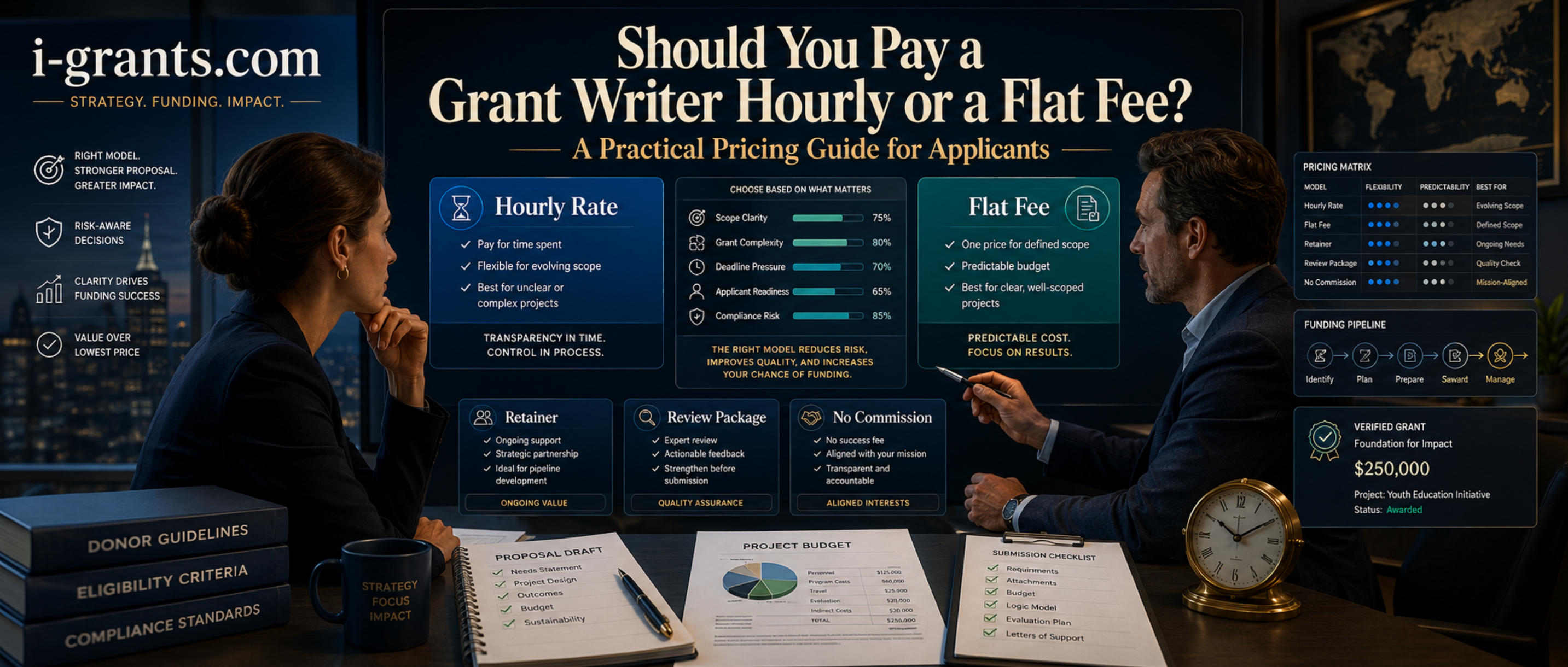
Hiring a grant writer is not only a question of price. It is a question of risk allocation. When an applicant chooses between an hourly rate, a fixed fee, a monthly retainer, or a proposal review package, they are not simply choosing how to pay. They are choosing who carries uncertainty: the applicant, the writer, or both.
This is why the question “Should we pay a grant writer hourly or a flat fee?” deserves a serious answer. A cheap fixed fee can become expensive if the scope was misunderstood. A flexible hourly arrangement can become stressful if hours are not capped. A retainer can build long-term funding capacity, but it may be unnecessary for a single small application. A review package can be excellent value, but only if the applicant already has a real draft.
The right model depends on the grant opportunity, the applicant’s readiness, the complexity of the funder’s rules, the deadline, and the level of professional responsibility expected from the grant writer.
Many applicants begin with the wrong question: “What is your lowest price?” A better question is: “Which payment model matches the real work required to make this application submission-ready?”
For i-grants.com, this is a central marketplace issue. Applicants do not only need to find a grant writer. They need to understand which type of professional support fits the grant, the project, the deadline, and the internal capacity of the organization. A funding opportunity is not ready for outsourcing until the applicant understands what kind of work must be done.
The Four Main Ways to Pay a Grant Writer
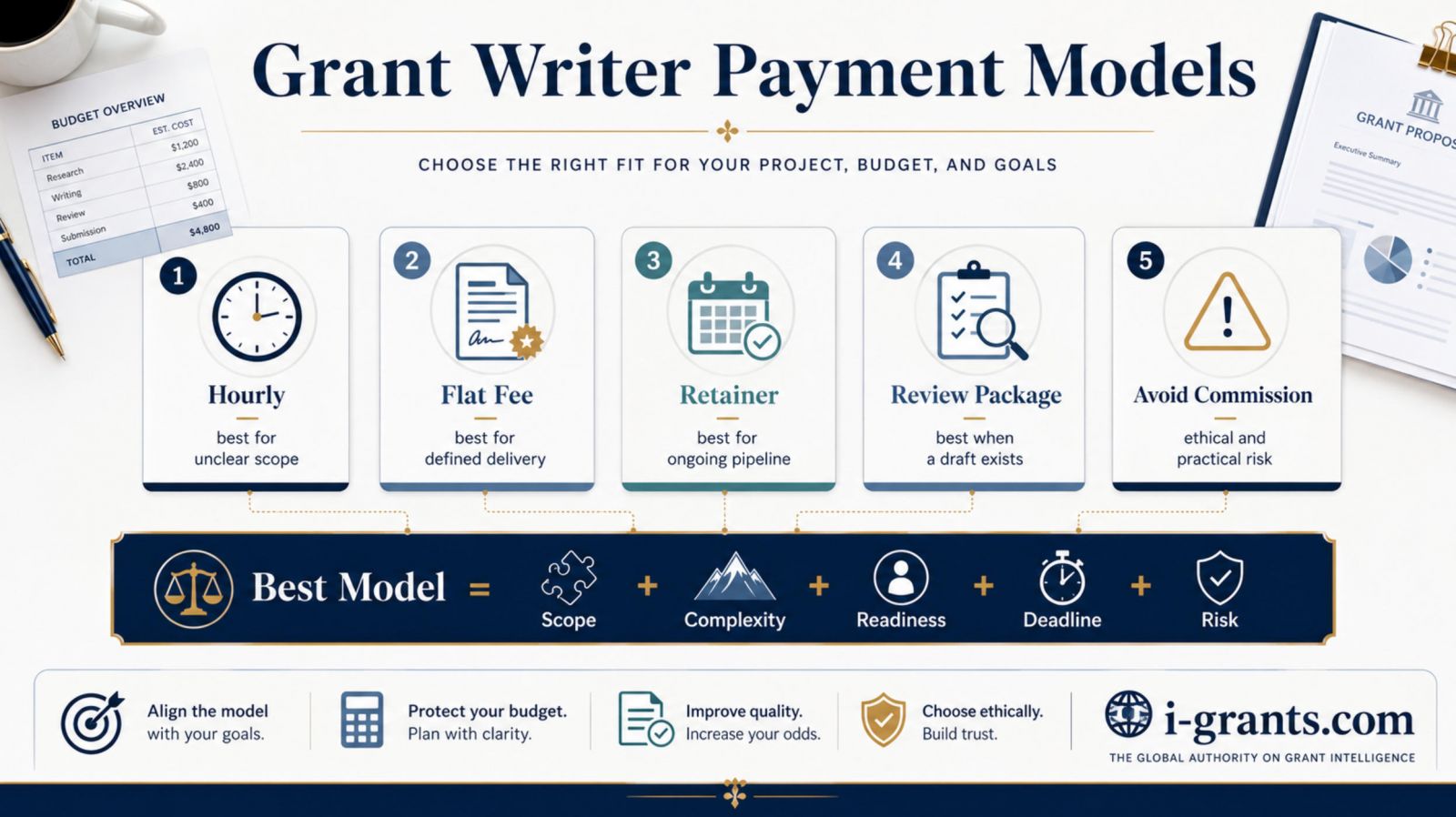
Most professional grant writing arrangements fall into four practical models: hourly rate, fixed project fee, monthly retainer, and proposal review package. A fifth model, success-based compensation, is often discussed by applicants but is usually problematic and should be treated with caution.
Each model answers a different situation.
| Payment model | Best use case | Main advantage | Main risk |
|---|---|---|---|
| Hourly rate | Unclear scope, research, strategy, complex or changing work | Flexible and fair when the work is uncertain | Final cost can rise without a cap |
| Fixed fee | Clear grant, defined deliverables, known deadline | Predictable budget | Scope creep can create disputes |
| Monthly retainer | Ongoing grant pipeline, multiple applications, donor research | Builds long-term capacity | Can be excessive for one small grant |
| Proposal review package | Applicant has a draft and needs expert improvement | Lower cost and targeted value | Does not replace full proposal development |
| Success fee or commission | Payment only if funding is awarded | Attractive to cash-limited applicants | Ethical and practical risks |
The first four models can be professional and fair when they are clearly defined. The fifth model requires special caution because major professional ethics frameworks discourage or prohibit percentage-based compensation tied to grant awards.
Why Hourly Pricing Can Be the Fairest Model
Hourly pricing is often the fairest model when the work is not yet clear. This happens more often than applicants expect.
An organization may say, “We need a grant writer for this opportunity.” But after reading the guidelines, the writer may discover that the applicant is not fully eligible, the budget is incomplete, the project is underdeveloped, partners are not confirmed, the funder requires attachments that do not exist yet, or the deadline is too close for a normal process.
In that situation, a fixed fee would be a guess. Hourly pricing allows the writer to begin with diagnosis before committing to full proposal development.
Hourly pricing works especially well for:
-
grant opportunity research;
-
eligibility review;
-
project strategy;
-
early proposal planning;
-
budget clarification;
-
technical or scientific applications;
-
multi-partner coordination;
-
urgent troubleshooting;
-
rewriting a weak internal draft;
-
funder fit assessment.
Hourly pricing is not automatically expensive. It can be efficient when the applicant only needs a limited number of hours. For example, an organization may need five hours of expert review before deciding whether a grant is worth pursuing. Paying hourly for that decision may save the organization from wasting several weeks on the wrong opportunity.
The weakness of hourly pricing is uncertainty. If the applicant approves work without a limit, costs may grow. The solution is not to reject hourly pricing. The solution is to structure it properly.
A good hourly agreement should include:
-
hourly rate;
-
estimated number of hours;
-
first work phase;
-
approval point before additional work;
-
maximum hours without written permission;
-
deliverables for each phase;
-
billing frequency;
-
revision expectations.
A strong hourly structure might look like this:
Phase 1: Eligibility and grant-fit review - up to 6 hours.
Phase 2: Proposal outline and budget assumptions - up to 10 hours after approval.
Phase 3: Full draft and revision process - estimated 25 to 40 hours, approved separately.
This gives flexibility without losing cost control.
When Fixed Fees Are Better
A fixed fee is often better when the grant opportunity is already selected, the scope is clear, and the applicant has the necessary materials. In this model, the grant writer quotes one total price for a defined result.
Fixed fees are attractive because they create budget certainty. The applicant knows the cost in advance, and the writer agrees to deliver specific work within that price.
Fixed pricing works best when:
-
the grant guidelines are available;
-
the deadline is clear;
-
the application structure is known;
-
the applicant is eligible;
-
the project is already defined;
-
budget information is ready or mostly ready;
-
required documents are available;
-
the number of revision rounds is limited;
-
submission support is clearly included or excluded.
A fixed fee is not just a number. It is a promise around scope. If the scope is vague, the fixed fee becomes dangerous.
A good fixed-fee agreement should define:
| Contract element | Why it matters |
|---|---|
| Exact grant opportunity | Prevents confusion about which application is covered |
| Deliverables | Clarifies whether the writer provides narrative, budget support, attachments, or submission help |
| Applicant responsibilities | Defines what the applicant must provide |
| Revision rounds | Prevents endless rewriting |
| Budget role | Clarifies whether the writer builds, reviews, or only describes the budget |
| Timeline | Protects both sides from missed internal deadlines |
| Exclusions | Prevents unexpected work from being assumed |
| Change process | Explains what happens if the scope expands |
For example, a fixed fee may include the main narrative, one budget narrative, one document checklist, and two revision rounds. It may exclude full budget construction, partner coordination, translation, graphic design, and portal submission. That is acceptable if both sides understand it.
The problem arises when the applicant assumes “grant writing” means everything. The writer may believe they are providing text. The applicant may expect strategy, budget, compliance, evidence collection, partner letters, and submission support. A fixed fee without scope clarity can damage the relationship.
The Hidden Danger of Scope Creep
Scope creep is the silent enemy of fixed-fee grant writing. It happens when the project grows beyond the original agreement.
At first, the applicant asks for a proposal narrative. Then the writer discovers that the project logic is weak. The budget has not been prepared. The funder requires letters from partners. The applicant changes the target population. The board asks for revisions. The finance team rewrites the cost categories. The donor portal requires extra forms. A partner misses the deadline. Suddenly, the “writing project” has become a project development, budget, coordination, and compliance assignment.
This is not always anyone’s fault. It is normal in grant work. But it must be priced and managed.
Scope creep is most likely when:
-
the applicant has never applied to this funder before;
-
the project is still conceptual;
-
multiple people must approve the text;
-
partners are involved;
-
the budget is not ready;
-
the funder has complex forms;
-
the deadline is close;
-
the applicant changes strategy during writing;
-
the writer is expected to solve missing internal work.
The best way to prevent scope creep is to separate grant work into stages.
Stage 1: Grant-fit and readiness review
Stage 2: Proposal plan and budget logic
Stage 3: Drafting and revisions
Stage 4: Compliance check and submission support
This staged approach works well for both hourly and fixed-fee arrangements. It also helps applicants understand what they are actually buying.
When a Monthly Retainer Makes Sense
A monthly retainer is often misunderstood. It is not simply a more expensive way to pay for one grant application. It is a funding development model for organizations that need continuous grant capacity.
A retainer can make sense for nonprofits, universities, cultural institutions, social enterprises, municipalities, research centers, and growing organizations that pursue several grants per year. Instead of hiring a writer only when a deadline appears, the organization keeps professional support available for donor research, pipeline planning, proposal development, reporting, and strategic positioning.
A monthly retainer may include:
-
donor research;
-
grant calendar management;
-
eligibility screening;
-
preparation of reusable organizational language;
-
project concept development;
-
proposal drafting;
-
budget narrative support;
-
review of internal drafts;
-
reporting support;
-
renewal planning;
-
funder communication preparation.
Retainers are most useful when the applicant wants to build a grant system, not just submit one application.
The value of a retainer is preparation. Organizations that wait until two weeks before a deadline often pay more and produce weaker proposals. Organizations that maintain a grant pipeline can prepare evidence, budgets, partner language, and institutional documents before the deadline pressure begins.
A retainer may not make sense when:
-
the applicant has only one small grant target;
-
there is no internal person to coordinate with the writer;
-
the organization cannot provide documents on time;
-
the funding strategy is unclear;
-
the expected grant value is too low;
-
the organization does not plan to apply regularly.
A retainer should also have clear boundaries. Monthly payment does not mean unlimited work. The agreement should specify hours, deliverables, response time, number of applications, and what happens when work exceeds the monthly scope.
When a Proposal Review Package Is Enough
Not every applicant needs full proposal writing. Sometimes the best option is a professional review package.
A review package is useful when the applicant already has:
-
a selected grant opportunity;
-
a clear project;
-
a written draft;
-
a working budget;
-
basic documents;
-
enough time to revise before the deadline.
In this model, the grant writer does not create the whole application. Instead, the writer improves the applicant’s draft and identifies weaknesses before submission.
A review package may include:
-
eligibility risk check;
-
clarity review;
-
alignment with funder priorities;
-
budget consistency check;
-
review against scoring criteria;
-
missing document list;
-
final improvement memo;
-
one follow-up call.
This can be excellent value for small organizations, early-stage businesses, universities, and applicants with internal writing capacity. It is also a good option when the grant amount is too small to justify full external proposal development.
However, review packages have limits. A review cannot turn an unclear project into a strong application overnight. It cannot fix missing data, unconfirmed partners, an unrealistic budget, or ineligibility. Review works best when the draft is imperfect but real.
Why Success Fees Are Usually the Wrong Answer
Many applicants ask whether they can pay a grant writer only if the application is successful. The appeal is obvious: if the organization has limited cash, it wants to avoid paying before funding is secured.
But success fees create serious ethical and practical problems.
A grant writer does not control the funder’s decision. The final result depends on eligibility, competition, geography, funder priorities, available budget, scoring panels, organizational track record, political context, timing, and many factors outside the writer’s control.
A strong proposal can lose. A weak proposal can sometimes win because it fits a priority, geography, or applicant category better.
Professional ethics also matter. The Grant Professionals Association states that members should not accept or pay finder’s fees, commissions, or percentage compensation based on grants. The Association of Fundraising Professionals also states that proposal writers must not receive compensation calculated as a percentage of funds sought or raised.
This does not mean applicants cannot structure performance expectations. They can ask for milestones, deadlines, quality standards, review steps, and transparent deliverables. But tying payment to a percentage of the grant award is a risky model and often conflicts with professional standards.
A better approach is to pay fairly for defined work. If a bonus is considered, it should be non-percentage-based, compliant with funder rules, and ethically reviewed. Even then, the safest model is usually fee-for-service, not commission.
The Decision Formula: Which Model Fits Your Grant?
Applicants need a simple way to choose. The following formula helps:
Best Payment Model = Scope Clarity + Grant Complexity + Applicant Readiness + Deadline Pressure + Funding Value + Compliance Risk
If scope clarity is low, hourly pricing is usually safer.
If scope clarity is high, a fixed fee may work well.
If the organization applies regularly, a retainer may be better.
If the applicant has a strong draft, a review package may be enough.
If the applicant wants to pay only after winning, the model should be reconsidered.
Here is a practical decision table:
| Situation | Best model | Reason |
|---|---|---|
| The applicant is unsure which grant to pursue | Hourly | Research and strategy are needed before writing |
| The grant is selected and the project is clear | Fixed fee | Scope can be defined |
| The applicant has many grants per year | Retainer | Continuous pipeline work is needed |
| The applicant has a draft | Review package | Full writing may be unnecessary |
| The grant is complex and rules are unclear | Hourly or staged fixed fee | The real workload must be discovered |
| The deadline is very close | Hourly with cap or premium fixed fee | Urgency increases risk |
| The grant amount is small | Review or limited fixed fee | Full proposal development may not be economical |
| The grant amount is large and competitive | Full fixed fee or staged hourly | Professional preparation may be justified |
| The applicant has no documents ready | Hourly strategy first | Writing cannot solve missing organizational readiness |
| The applicant wants percentage-based payment | Avoid | Ethical and practical concerns are high |
This table is not a pricing rule. It is a decision guide. The applicant should choose the model that matches the work, not the model that looks cheapest at first glance.
How to Compare Quotes From Grant Writers
Applicants often receive very different quotes for the same grant. One writer may quote 1,000 USD, another 4,000 USD, another 8,000 USD. This does not automatically mean one is overpriced or one is underpriced. The quotes may include different work.
Before comparing price, compare scope.
Ask each grant writer:
-
Have you reviewed the official grant guidelines?
-
What exactly is included in your fee?
-
Do you help with budget development or only the narrative?
-
Do you check eligibility before drafting?
-
How many revisions are included?
-
Do you provide a document checklist?
-
Do you coordinate with partners?
-
Do you support portal submission?
-
What do you need from us before starting?
-
What work is excluded?
A higher quote may include strategy, budget support, compliance review, and submission assistance. A lower quote may cover only narrative drafting. Both can be valid, but they are not the same product.
A fair comparison should look like this:
| Quote element | Writer A | Writer B | Writer C |
|---|---|---|---|
| Narrative writing | Yes | Yes | Yes |
| Eligibility review | No | Yes | Yes |
| Budget support | No | Limited | Full |
| Partner coordination | No | No | Yes |
| Compliance checklist | No | Yes | Yes |
| Submission support | No | Limited | Full |
| Revision rounds | One | Two | Three |
| Price | Lower | Medium | Higher |
This kind of comparison protects the applicant from choosing the cheapest quote for the wrong reason.
A Practical Example
Imagine an NGO wants to apply for a 75,000 USD community development grant. The project is clear, the organization has financial documents, and the funder requires a ten-page narrative, budget, attachments, and two partner letters.
A fixed fee may be appropriate because the scope is fairly clear. The agreement might include narrative writing, budget narrative support, two revision rounds, and a final checklist.
Now imagine the same NGO wants to apply for a 1,500,000 USD government programme with a complex scoring system, multi-year budget, procurement rules, and several partners. A simple fixed fee may be risky unless the scope is broken into stages. The better model may be hourly for the first phase, followed by a fixed fee once the proposal architecture is clear.
Now imagine a startup wants to apply for an innovation grant but has no market analysis, no milestone plan, and no budget. In that case, paying a fixed fee for writing may be premature. The first step should be hourly strategy work or a readiness assessment.
The right model changes because the risk changes.
What Applicants Should Put in the Agreement
Whether the applicant chooses hourly or fixed fee, the agreement should be precise. A vague agreement creates conflict.
A professional grant writing agreement should include:
-
grant name and link;
-
scope of work;
-
deliverables;
-
timeline;
-
applicant responsibilities;
-
fee model;
-
payment schedule;
-
revision rules;
-
communication process;
-
confidentiality;
-
ownership of final materials;
-
exclusions;
-
process for additional work;
-
cancellation terms;
-
submission responsibilities.
The agreement should also state that funding is not guaranteed. No ethical grant writer can promise an award. The writer can improve quality, fit, clarity, competitiveness, and compliance. The funder makes the final decision.
How i-grants.com Can Turn Pricing Into a Better Marketplace Experience
A grant marketplace becomes more useful when it does not treat every grant writing request as identical. The platform can help applicants classify the opportunity before hiring.
For example, each grant opportunity can be assessed by:
-
donor type;
-
grant amount;
-
applicant eligibility;
-
sector;
-
deadline;
-
required documents;
-
budget complexity;
-
partner requirements;
-
compliance risk;
-
likely preparation workload.
Then applicants can be guided toward the right support model:
-
hourly grant-fit review;
-
fixed-fee proposal writing;
-
retainer for ongoing funding development;
-
expert review package;
-
specialist support for EU, research, government, or startup grants.
This is where i-grants.com can create value beyond a directory. It can help applicants understand what they need before they hire, and it can help grant writers receive better-scoped projects.
Better scoping means fewer misunderstandings, better pricing, stronger applications, and more professional relationships.
Do Not Choose the Cheapest Model, Choose the Right Risk Model
Hourly and fixed-fee grant writing are both legitimate. The right choice depends on uncertainty.
Use hourly pricing when the scope is unclear, the project needs strategy, the grant is complex, or the applicant is not ready. Use a fixed fee when the grant is selected, the deliverables are clear, and the applicant can provide documents on time. Use a retainer when the organization needs ongoing grant development. Use a review package when the applicant already has a draft and needs expert improvement. Avoid percentage-based compensation because it creates ethical and practical problems.
The cheapest model can become expensive if it ignores risk. The most expensive model can be unnecessary if the grant is small and simple.
The practical rule is this:
Pay hourly when you are buying discovery. Pay a fixed fee when you are buying defined delivery. Pay a retainer when you are buying continuity. Pay for review when you already have a draft. Do not pay by commission when professional ethics and funder expectations are at stake.
Grant writing is not just writing. It is judgment, structure, compliance, strategy, and deadline management. The payment model should reflect that reality.