

 Français
  Deutsch
  Українська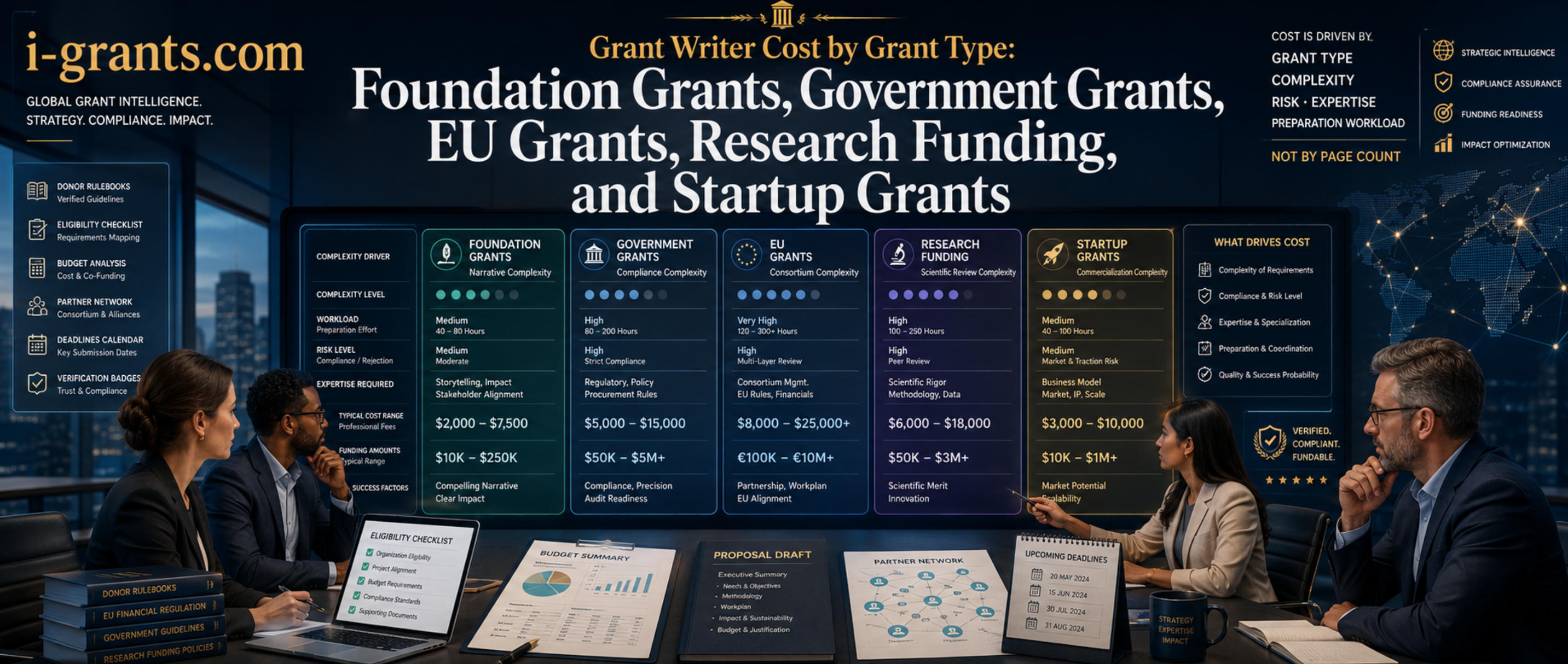
The cost of hiring a grant writer does not depend only on the writer’s hourly rate. It depends on the type of grant. A local foundation proposal, a federal government grant, a Horizon Europe application, a university research proposal, and a startup innovation grant may all be called “grant applications”, but they are not the same kind of work.
This is where many applicants make their first budgeting mistake. They ask, “How much does a grant writer cost?” before asking, “What type of grant are we applying for?” The second question is usually more important.
A short foundation proposal may need a clear project story, a modest budget, and proof that the organization can deliver. A federal grant may require formal application forms, detailed budget narratives, compliance documents, evidence of organizational capacity, and strict submission procedures. An EU grant may require international partners, work packages, deliverables, milestones, impact logic, dissemination planning, and budget allocation across several organizations. A research grant may require scientific method, investigator credibility, facilities, ethics, data management, and highly technical peer-review logic. A startup grant may require technology validation, commercialization potential, intellectual property awareness, market analysis, and a convincing case for non-dilutive funding.
The writing cost changes because the work changes.
For i-grants.com, this distinction is central. The platform is not only about finding a grant writer. It is about helping applicants understand whether a specific funding opportunity is simple, strategic, technical, competitive, or institutionally complex. Only after that can an applicant decide whether to write internally, request expert review, hire a freelance grant writer, or build a full proposal team.
The Cost Question Starts With Grant Type
A grant writer’s fee is not simply payment for producing words. It is payment for interpreting a funding opportunity, checking eligibility, shaping the project, building the narrative, aligning the budget, reducing compliance risk, and helping the applicant submit a credible proposal.
Different grant types place different pressure on each part of that process.
A foundation grant may be narrative-heavy. A government grant may be compliance-heavy. A research grant may be evidence-heavy. An EU grant may be coordination-heavy. A startup grant may be strategy-heavy. A community grant may be local-need-heavy. A large institutional grant may be governance-heavy.
That is why two applications of similar length can require completely different budgets. A ten-page proposal to a private foundation may be simpler than a five-page technical concept note for a scientific innovation programme. A short government application may require more work than a long community story if it includes federal forms, budget attachments, procurement assumptions, and eligibility certifications.
The real unit of cost is not the page. It is the decision burden behind the page.
A Practical Cost Range by Grant Type
The following table provides a practical market-oriented framework. These ranges are not universal prices. They are working estimates for applicants who need to understand how grant type affects professional preparation cost.
| Grant type | Typical grant writer cost | Why the cost changes |
|---|---|---|
| Small local foundation grant | 500 to 2,000 USD | Shorter narrative, simpler budget, limited compliance |
| Larger private foundation grant | 1,500 to 5,000 USD | Stronger evidence, outcomes, organizational capacity, funder alignment |
| Local or regional government grant | 2,000 to 7,500 USD | Formal eligibility, public rules, budget detail, required attachments |
| U.S. federal grant | 5,000 to 15,000 USD or more | Federal forms, budget narrative, compliance, scoring criteria, agency-specific requirements |
| EU grant or multi-partner international grant | 8,000 to 30,000 USD or more | Consortium work, work packages, impact logic, deliverables, partner coordination |
| Research grant | 5,000 to 25,000 USD or more | Scientific rationale, methodology, investigator profile, budget justification, peer-review expectations |
| Startup innovation grant | 2,500 to 15,000 USD or more | Technology risk, commercialization, market logic, milestones, non-dilutive funding case |
| Proposal review only | 500 to 3,000 USD | Expert feedback, eligibility check, budget consistency, scoring alignment |
The upper end of these ranges can rise significantly when the proposal is urgent, technical, multi-country, multi-partner, or tied to a large funding amount. A complex proposal may also require more than one professional: a lead grant writer, budget specialist, technical expert, evaluator, partner coordinator, or compliance reviewer.
Foundation Grants: Usually Lower Cost, But Not Always Simple
Foundation grants are often the entry point for nonprofits, cultural organizations, schools, community groups, and social enterprises. They can be relatively affordable to prepare because many foundations use shorter application forms and place strong emphasis on mission fit, community need, outcomes, and organizational credibility.
For small foundation grants, a freelance grant writer may charge a modest fixed fee, especially if the applicant already has a clear programme description, budget, previous impact data, and basic documents. The work may include reviewing the funder’s priorities, shaping the story, writing the narrative, improving the budget language, and preparing attachments.
But foundation grants are not always easy. Larger private foundations may expect a sophisticated theory of change, strong evidence, measurable outcomes, equity logic, sustainability planning, and proof that the organization can manage funds responsibly. In some cases, a foundation proposal can require as much strategic thinking as a public-sector grant.
A simple foundation proposal may cost less because the structure is clear and the compliance burden is lower. A major foundation proposal may cost more because the applicant must show deep alignment with the funder’s mission, not just present a good project.
The key question is: does the foundation want a short application, or does it expect a full institutional case for investment?
If the foundation grant is small, local, and mission-aligned, a basic grant writer package may be enough. If the foundation grant is large, competitive, invitation-based, or linked to multi-year funding, the applicant should budget for deeper strategic work.
Government Grants: More Forms, More Rules, More Risk
Government grants are usually more expensive to prepare than simple foundation proposals because they often involve formal rules, application forms, budget categories, eligibility certifications, and public accountability requirements.
In the United States, Grants.gov provides federal grant forms and application package infrastructure. Federal applications can include standard forms, budget attachments, assurances, certifications, and agency-specific instructions. Even when the narrative is not extremely long, the administrative structure can be demanding.
This is why a government grant writer is not only a storyteller. They must also be a rules interpreter.
A government grant may require the writer to align the proposal with scoring criteria, cost categories, performance measures, procurement assumptions, reporting obligations, and the language of the public agency. The applicant may need to provide legal documents, financial statements, organizational history, staff qualifications, partnership letters, indirect cost information, or evidence of previous grant management.
The cost rises when:
-
the application has multiple forms;
-
the funder uses strict scoring criteria;
-
the budget must be detailed by category and year;
-
match funding or cost share is required;
-
the applicant has limited internal documents;
-
the deadline is close;
-
the submission portal is complex;
-
compliance errors can disqualify the proposal.
A local government grant may still be manageable with a moderate fixed fee. A federal grant, however, may require a larger professional budget because the writer must coordinate narrative quality, budget logic, documentation, and formal submission requirements.
The applicant should never evaluate government grant writing cost only by word count. A short federal form can still carry high compliance risk.
EU Grants: The Cost Is in Coordination, Not Only Writing
EU grants, especially Horizon Europe, Erasmus+, Interreg, Creative Europe, and other cross-border programmes, often require a different level of preparation. The cost is not only in writing the proposal. It is in building a coherent project system.
Horizon Europe is one of the largest research and innovation funding programmes in the world. The European Commission describes Horizon Europe as the EU’s key funding programme for research and innovation for 2021-2027, with an indicative funding amount of EUR 93.5 billion after the Multiannual Financial Framework midterm review. Erasmus+ also operates at major scale, with an estimated 2021-2027 budget of EUR 26.2 billion.
Large programmes create opportunity, but they also create complexity.
A Horizon Europe proposal may require excellence, impact, and implementation logic. Applicants often need to describe objectives, methodology, work packages, deliverables, milestones, risks, dissemination, exploitation, communication, consortium structure, ethics, open science, and budget allocation. A proposal is not only a text. It is a project architecture.
This is why EU grant writing can cost significantly more than local or national grants. A strong EU proposal may require:
-
call analysis;
-
partner mapping;
-
consortium coordination;
-
work package design;
-
role allocation among partners;
-
impact pathway development;
-
budget distribution;
-
timeline and milestone planning;
-
risk matrix;
-
ethics and data considerations;
-
partner input management;
-
final consistency check across all sections.
The lead writer may spend as much time coordinating information as writing sentences. If the consortium includes five, ten, or twenty partners, every section becomes a coordination exercise.
For i-grants.com, this is a strong marketplace use case. An applicant may not need just “a grant writer”. They may need a Horizon Europe specialist, a consortium strategist, a budget coordinator, and a technical editor. The platform can help applicants understand that EU grant preparation is a team-based process, not a simple outsourcing task.
Research Grants: Scientific Credibility Drives the Cost
Research grants are a special category because the proposal must survive expert review. The writing must be clear, but clarity is not enough. The application must show scientific merit, methodological rigor, investigator capacity, institutional support, feasibility, ethics, budget justification, and contribution to the field.
For research funding, the writer often works with scientists, principal investigators, research administrators, finance officers, and institutional leadership. In some cases, the grant writer does not invent the scientific idea. Instead, the writer translates complex research logic into a proposal structure that reviewers can evaluate.
This work can be expensive because the margin for vagueness is small. A research grant proposal may need:
-
specific aims or research objectives;
-
literature-based rationale;
-
methodology;
-
work plan;
-
expected results;
-
data management;
-
ethics or human subjects considerations;
-
facilities and equipment description;
-
investigator biosketches;
-
budget and justification;
-
institutional letters;
-
peer-review alignment.
The U.S. National Science Foundation requires proposal budgets to include detailed justification of budget line items, typically up to five pages. This illustrates a broader point: research proposals are not only scientific arguments. They are also administrative and financial arguments.
A research grant writer’s cost depends heavily on how much scientific content the research team can provide. If the principal investigator already has a strong concept, preliminary data, methodology, and budget assumptions, the writer can focus on structure, clarity, and reviewer alignment. If the research idea is still vague, the writer may need to facilitate proposal development, not simply edit a document.
For small institutional research grants, a limited support package may be enough. For major national research grants, a full proposal development process can require a much larger budget.
Startup Innovation Grants: The Writer Must Understand Both Technology and Market
Startup grants are different from nonprofit or academic grants. They often sit between research, product development, commercialization, and public policy. A startup grant writer must understand the technology, but also the business case.
In the United States, SBIR and STTR programmes are major examples of non-dilutive funding for early-stage research and development. SBIR.gov describes the SBIR and STTR programmes as America’s Seed Fund, providing non-dilutive funding to develop technology and support commercialization. NIH states that SBIR and STTR applications may follow budget guidelines such as Phase I at 323,090 USD and Phase II at 2,153,927 USD, with individual institutes able to set specific limits.
This matters because startup grants are not charity grants. Funders want to see technical feasibility, innovation, commercialization potential, team capability, development milestones, and market relevance. A startup application may fail if it sounds like a sales pitch without technical depth. It may also fail if it sounds like academic research without a credible path to market.
A startup grant writer may need to help with:
-
technology description;
-
innovation claim;
-
problem-solution fit;
-
technical feasibility;
-
development milestones;
-
market opportunity;
-
commercialization plan;
-
competitive landscape;
-
intellectual property position;
-
team capability;
-
use of funds;
-
risk mitigation.
The price rises when the technology is complex, the market is regulated, the applicant lacks documentation, or the funder expects a strong commercialization plan. Deep-tech startups, medical technology companies, climate technology ventures, defence-related innovators, and advanced manufacturing startups may need specialized grant writers who understand both technical and commercial language.
For early-stage startups, the key decision is not whether to hire the cheapest writer. The key decision is whether the writer can translate technology risk into funder logic.
Small Business Grants: Often Misunderstood and Often Underbudgeted
Small business grants are one of the most searched grant categories, but also one of the most misunderstood. Many entrepreneurs search for grants hoping to find simple “free money”. In reality, credible small business grants usually have specific eligibility rules, sectors, regions, purposes, deadlines, and reporting obligations.
The cost of a grant writer for a small business grant depends on the type of funding. A local economic development grant may be relatively simple. A women-owned business grant may require ownership proof, business plan clarity, impact logic, and eligible cost categories. A green energy grant may require technical data, environmental impact assumptions, equipment quotes, and compliance documentation. A startup innovation grant may require technical and commercialization depth.
Many small business applicants underbudget grant preparation because they treat the application as paperwork. But a strong small business grant may require:
-
business profile;
-
eligibility proof;
-
project description;
-
market need;
-
job creation or community impact;
-
budget and quotes;
-
implementation schedule;
-
tax or registration documents;
-
financial statements;
-
owner background;
-
post-award reporting plan.
A grant writer may charge less for a simple local grant if the applicant has documents ready. The same writer may charge much more for a technical business grant because the project needs positioning, budget logic, evidence, and compliance review.
The applicant should compare grant value with preparation cost. Paying 2,500 USD to apply for a 5,000 USD grant may not make sense unless the work creates reusable material. Paying 4,000 USD to apply for a 100,000 USD innovation grant may be reasonable if the grant is strategically important and the application is competitive.
International Foundation and Donor Grants: The Hidden Cost Is Funder Fit
International donor grants often combine mission logic, development language, regional eligibility, partnership requirements, and reporting expectations. These may include grants from international foundations, embassies, development agencies, cultural institutes, humanitarian donors, and civil society programmes.
The visible application may be short, but the hidden work can be substantial. The writer must understand how the donor frames the problem. A human rights donor, a climate donor, a youth donor, an education donor, and a local democracy donor may all use different language, evidence standards, and impact expectations.
The cost rises when the grant requires:
-
country or regional eligibility interpretation;
-
local partner coordination;
-
logframe or results framework;
-
safeguarding policies;
-
gender or inclusion logic;
-
monitoring and evaluation plan;
-
security or risk assessment;
-
language adaptation;
-
donor-specific terminology;
-
proof of previous capacity.
For international donors, generic writing is especially dangerous. The same project may need different framing for different funders. A proposal to a humanitarian donor should not read like a startup pitch. A cultural diplomacy proposal should not read like an academic research abstract. A democracy programme should not read like a local charity appeal.
A strong grant writer adjusts the project to the donor’s logic without distorting the applicant’s mission. That strategic translation is part of the cost.
Why Page Count Is the Wrong Pricing Method
Applicants sometimes ask, “How much do you charge per page?” This question is understandable but misleading. Grant writing is not a page-production service.
A one-page letter of inquiry may require deep funder research and careful positioning. A thirty-page application may be relatively straightforward if the organization has strong existing materials. A technical budget justification may take longer than a narrative section. A partner letter may require more coordination than a project summary. A two-hour eligibility review may save the applicant from wasting forty hours on an impossible grant.
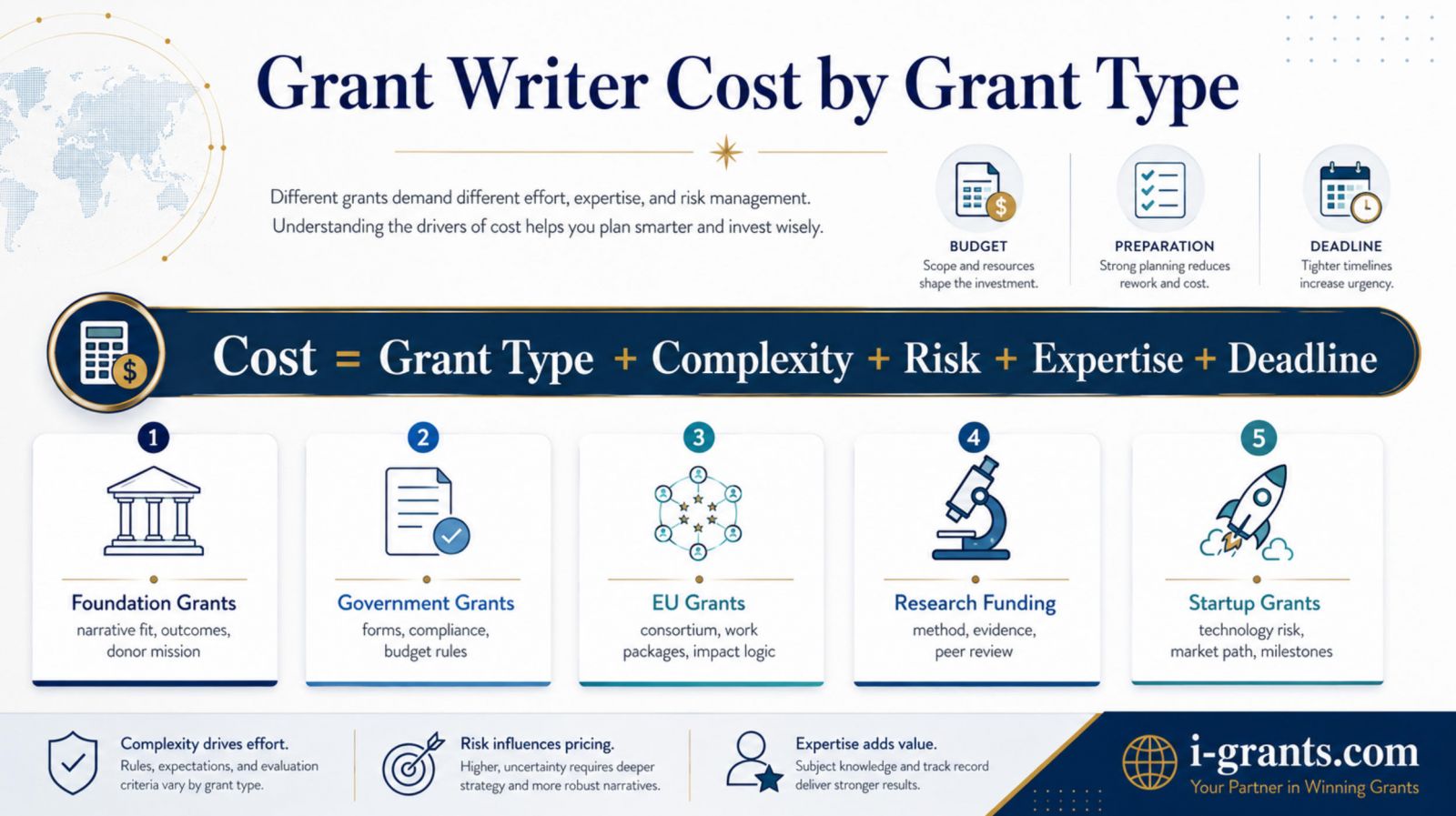
A better pricing logic is based on workload and risk:
Grant Writer Cost = Grant Type + Scope + Complexity + Applicant Readiness + Deadline Pressure + Compliance Risk + Expected Grant Value
This formula is more useful than page count because it reflects the real work behind the application.
If an applicant wants a fair quote, they should send the grant writer:
-
the official grant link;
-
application guidelines;
-
deadline;
-
expected award amount;
-
applicant profile;
-
project summary;
-
existing documents;
-
budget status;
-
partner list;
-
submission requirements.
Without this information, any price is only a guess.
When to Hire a Specialist Instead of a Generalist
Not every grant requires a specialist. A strong general grant writer can handle many foundation grants, local grants, and standard nonprofit proposals. But certain grant types justify specialized expertise.
Hire a specialist when the grant involves:
-
EU programmes;
-
federal government grants;
-
scientific research;
-
clinical or health innovation;
-
SBIR or STTR;
-
climate technology;
-
defence or aerospace innovation;
-
international development;
-
humanitarian response;
-
multi-country partnerships;
-
large budgets;
-
complex compliance.
A specialist costs more because the learning curve is shorter. They know the language of the programme, common reviewer expectations, budget issues, and typical weaknesses. In complex grants, paying more for the right specialist can reduce risk.
However, specialist pricing should still be tied to clear deliverables. Applicants should ask what the fee includes: strategy, writing, budget, partner coordination, review, submission support, or only narrative editing.
How i-grants.com Can Use This Cost Logic
This article cluster is not only informational. It supports the core marketplace logic of i-grants.com.
When an applicant finds a grant, the next question is not simply, “Who can write this?” The better sequence is:
-
What type of grant is this?
-
Is the applicant eligible?
-
How complex is the application?
-
What documents are already available?
-
What expertise is required?
-
What is the expected grant value?
-
Does professional preparation make financial sense?
-
Should the applicant hire a grant writer, request a review, or prepare internally?
A platform that classifies grant opportunities by donor, geography, eligibility, sector, deadline, amount, and source verification can also help estimate preparation complexity. That is where the marketplace becomes more valuable than a simple directory.
The applicant does not just hire a writer. The applicant matches the grant type with the right level of professional support.
A Decision Table for Applicants
The following table can help applicants decide how much support they may need.
| Grant situation | Suggested support level |
|---|---|
| Small foundation grant, clear project, documents ready | Basic fixed-fee writing or review package |
| Larger foundation grant, strategic relationship with funder | Full proposal writing with strategy session |
| Local government grant with formal forms | Fixed fee plus compliance checklist |
| Federal government grant | Experienced grant writer with budget and submission support |
| Horizon Europe or EU consortium grant | EU specialist, partner coordination, proposal architecture |
| Research grant | Research grant editor or proposal development specialist |
| SBIR/STTR or startup innovation grant | Technical grant writer with commercialization experience |
| Applicant has a strong draft | Expert review package |
| Applicant has no clear project yet | Hourly strategy and grant-fit assessment |
This is the practical heart of grant writer cost by grant type. The applicant should not pay the same way for every grant because every grant does not create the same workload.
The Grant Type Determines the Real Cost
Grant writer cost by grant type is not random. Foundation grants are often less expensive because they may require less formal compliance. Government grants cost more because they involve public rules, forms, budgets, and accountability. EU grants cost more because they require project architecture and partner coordination. Research grants cost more because they must satisfy expert reviewers and scientific standards. Startup grants cost more when they require both technical and commercialization logic.
The right question is not, “What is the cheapest grant writer?” The right question is, “What level of professional work does this funding opportunity require?”
For a small local grant, a simple review may be enough. For a complex federal, EU, research, or startup innovation grant, a low-cost writing package may be too risky. The applicant should evaluate grant value, complexity, readiness, deadline, compliance burden, and internal capacity before choosing a pricing model.
A serious grant writer does not merely fill out forms. A serious grant writer helps the applicant understand the funder, sharpen the project, justify the budget, avoid compliance mistakes, and submit a proposal that can be taken seriously.
That is why the cost changes by grant type. The work changes, the risk changes, and the level of expertise changes with it.