

 Français
  Deutsch
  Українська
Poland is one of Europe’s most important furniture manufacturing centres, with a large export-oriented industry, thousands of small and medium-sized producers, and a deep network of woodworking, upholstery, component and interior-fit-out companies. That scale creates opportunity, but it also creates pressure. Furniture manufacturers are increasingly competing on labour productivity, production speed, energy use, material efficiency, customisation and delivery time rather than simply on low manufacturing costs.
For a Polish furniture company considering a new CNC centre, robotic sanding or painting, production software, a more efficient dust-extraction system, automated internal transport or a waste-recycling line, public support can materially change the economics of the project. The challenge is that Poland does not offer one universal “furniture factory grant”. Different investments fall under different funding mechanisms, and some of the most attractive programmes are not simple cash grants at all.
A digital transformation may fit one programme, an energy-saving production line another, a research and development project a third, and a circular-economy investment a fourth. Some instruments provide direct grants, others provide bank loans with a capital subsidy, and others combine preferential financing with conditional repayment relief. Understanding that distinction is essential before the company orders machinery or signs implementation contracts.
The current funding landscape is particularly interesting because several programmes are either open, approaching a new application round, or structured to remain relevant into the following year. This makes the topic useful not only for companies investing immediately, but also for furniture manufacturers preparing a capital expenditure plan for 2027.
Why Polish furniture manufacturers are under pressure to modernise
Poland remains one of the world’s largest furniture-exporting countries. The sector includes almost 32,000 furniture manufacturers and supports approximately 196,000 jobs. Furniture exports were valued at around $15.94 billion in 2024, while annual exports in recent years have generally remained at a level exceeding €16 billion.
The scale of the industry is impressive, but recent indicators also show why investment in productivity matters. Furniture manufacturers have faced weaker revenues, pressure on export demand, high labour costs, energy prices and stronger competition from both European and non-European producers. A company that previously relied on relatively inexpensive labour may now need automation simply to maintain margins and fulfil orders with the same workforce.
The industry is also diverse. A family-owned producer of solid-wood furniture may have completely different investment needs from a large cabinet manufacturer producing thousands of components per day. Some companies need robotic material handling, others need better nesting and cutting optimisation, while another manufacturer may obtain more value from reducing electricity use in extraction, ventilation and compressed-air systems.
This diversity explains why grant eligibility is usually tied not to the word “furniture”, but to the purpose of the investment.
Table 1. Poland’s Furniture Industry: Key Market Indicators
| Indicator | Recent figure or trend | Why it matters for funding decisions |
|---|---|---|
| Furniture manufacturers | Nearly 32,000 | Large base of potential SME applicants |
| Employment | Approximately 196,000 | Labour productivity remains strategically important |
| Furniture exports | Around $15.94 billion in 2024 | Strong exposure to international competition |
| Annual exports in recent years | Above €16 billion | Confirms the sector’s major export role |
| Revenue trend in early 2026 | Down by roughly 4.3 percent year on year | Reinforces the case for productivity and efficiency investment |
| Export trend in early 2026 | Down by roughly 3.9 percent year on year in euro terms | Shows pressure in external markets |
| Industrial energy-efficiency trend in Poland | Approximately 2.8 percent annual improvement over the last decade | Indicates continuing policy pressure toward more efficient production |
The practical implication is straightforward. A furniture producer should not ask, “Which grant pays for a CNC machine?” The better question is, “What business transformation will this CNC machine deliver, and which programme funds that type of transformation?”
That distinction is at the centre of Poland’s current funding system.
The main funding routes for a Polish furniture manufacturer
Several national and EU-supported instruments can be relevant, but their legal and financial structures differ significantly.
Table 2. Main Funding Routes for Furniture Manufacturers in Poland
| Programme or instrument | Type of support | Main purpose | Typical relevance to a furniture company |
|---|---|---|---|
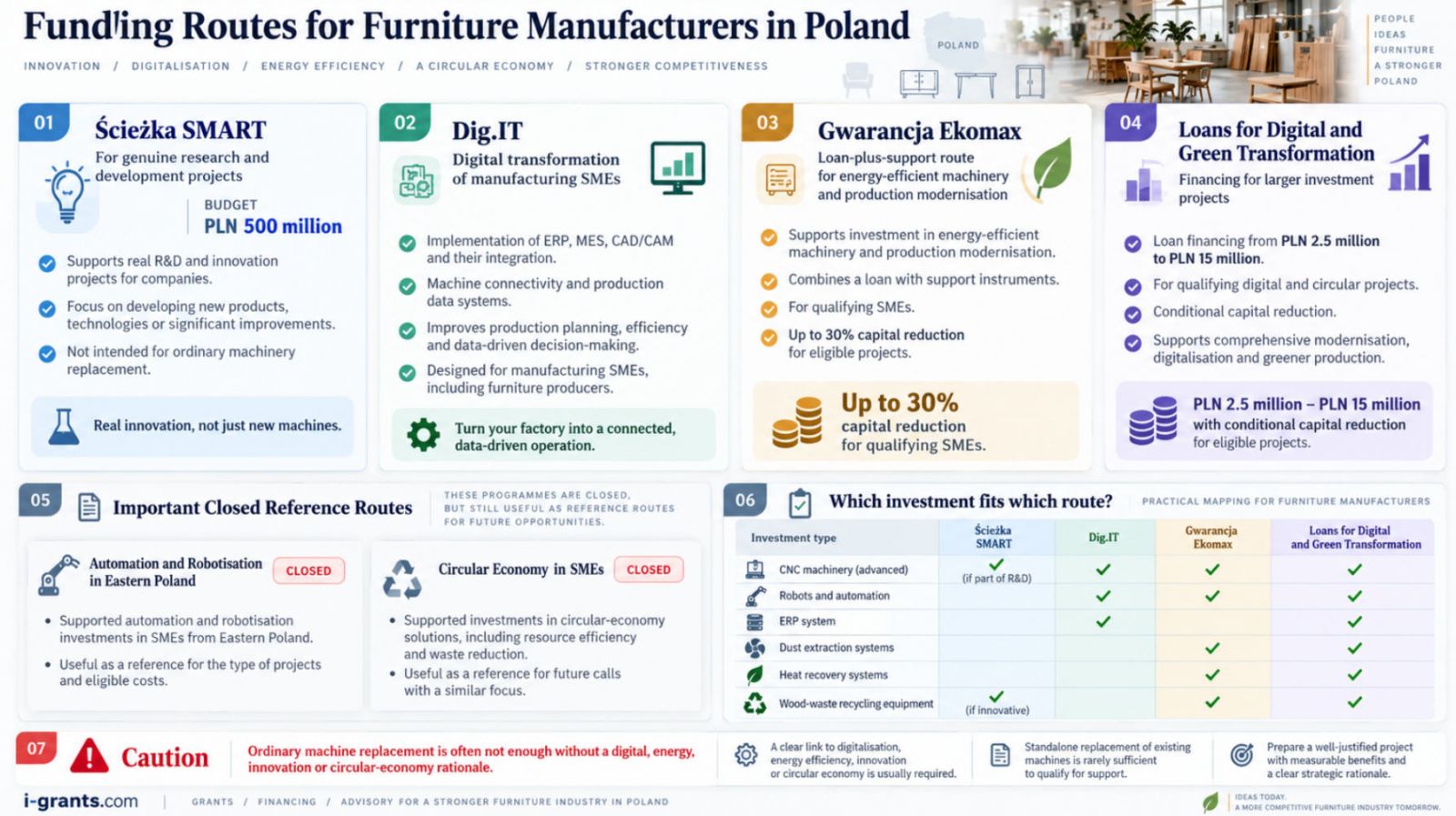
| Ścieżka SMART | Direct grant for eligible research and development | New products and production technologies | High for genuine R&D, low for ordinary machinery replacement |
| Dig.IT | Direct digitalisation grant | Digital transformation of SMEs | High for ERP, MES, CAD/CAM integration, automation and data-driven production |
| Gwarancja Ekomax | Bank financing with guarantee and capital subsidy | Energy efficiency and environmental investment | Very high for energy-saving production lines and machinery |
| Loans for Digital and Green Transformation | Preferential loan with conditional repayment support | Digital and circular transformation | High for large automation, robotics and circular-economy projects |
| Automation and Robotisation in SMEs, Eastern Poland | Grant and conditional grant | Industry 4.0 transformation | Historically very relevant, but the most recent call is closed |
| Circular Economy in SMEs | Direct grant | Circular production and resource efficiency | Relevant to wood waste, material recovery and closed-loop manufacturing |
| Kredyt ekologiczny | Bank loan with ecological premium | Energy-efficiency investment | Important recent instrument, though the latest call is closed |
The strongest strategy is not to search for a single “best” programme. Instead, the company should classify the investment first.
If the goal is research and development of a new production technology, Ścieżka SMART may be the right route. If the goal is digitalisation, Dig.IT or the digital transformation loan may be more appropriate. If the objective is energy savings, Ekomax can be significantly stronger. If the project focuses on material recovery, recycling or circular use of wood waste, a circular-economy instrument may be the better fit.
Ścieżka SMART: powerful, but only for real research and development
Ścieżka SMART is one of Poland’s best-known support programmes for innovative companies, but furniture manufacturers should be careful not to misunderstand it.
A new call has been announced with a budget of PLN 500 million. Applications are scheduled from late October to late December, with individual project support potentially reaching PLN 50 million. That headline is attractive, but the programme is not intended to finance routine replacement of machinery.
The current structure requires a genuine research and development component.
For industrial research, the base aid intensity can reach 50 percent, while experimental development can receive up to 25 percent. Under specific conditions, those rates can increase significantly, reaching up to 80 percent for industrial research and up to 60 percent for experimental development.
For a furniture manufacturer, a strong project might involve the development of a new material, a new production method, an innovative surface-treatment technology, a new modular furniture system, a highly automated mass-customisation process or a production technology that materially reduces waste while creating a novel product or process.
Buying a standard CNC machining centre because the existing machine is old is not enough.
The same applies to software. Implementing a standard ERP system or adding another CAD workstation does not automatically create a research and development project.
There is also an important accounting issue when research equipment is involved. If machinery will continue to be used after the R&D project ends, the full purchase price will generally not automatically become an eligible research cost. In many cases, only the proportionate depreciation attributable to the project period and use can be recognised.
This makes Ścieżka SMART highly valuable for innovative furniture companies, but unsuitable as a general machinery grant.
For companies planning for 2027, it may still be worth building an R&D pipeline now. Research projects often require technical preparation, defined research questions, prototype plans, intellectual-property analysis and financial documentation long before the application itself is submitted. A manufacturer that starts this work early can be in a stronger position when future calls are announced.
Dig.IT: potentially one of the best direct grants for digital furniture production
For an ordinary furniture manufacturer seeking real digital transformation rather than research, Dig.IT may be more relevant.
The programme is designed for micro, small and medium-sized manufacturing companies and production-service businesses. Its purpose is to accelerate digitalisation, modernise production management and improve the technological capabilities of Polish SMEs.
The pilot call offered grants from PLN 150,000 to PLN 850,000 and covered up to 50 percent of eligible costs. Support was provided under de minimis rules.
The main condition was that the project had to include the purchase and implementation of digital technology or the development of software needed for digital transformation. Training, certain equipment and other supporting costs could be added, but the digital component had to remain the core of the project.
For furniture manufacturing, this is a very strong match.
A factory could potentially build a project around ERP and MES integration, CAD/CAM integration, automatic generation of machining data, real-time machine monitoring, production scheduling, barcode or RFID tracking, automated quality control, predictive analytics or integration of CNC equipment with wider production-management systems.
The pilot programme also showed strong demand for automation and analytical tools.
Importantly, the pilot did not work as an advance-payment scheme. The grant was reimbursed after expenditure. This means the company needed sufficient liquidity to implement the project before recovering the grant.
The first call received 146 applications. More than 50 projects were ultimately recommended for support, with over PLN 21 million in grant funding. The allocation was increased so that all positively assessed projects could be financed.
Further Dig.IT calls are planned, with a combined allocation of around PLN 80 million announced for future rounds. Final rules, however, may differ from the pilot, so manufacturers preparing a 2027 digitalisation project should not assume that the previous PLN 150,000 to PLN 850,000 range, the 50 percent rate or every cost category will remain unchanged.
Still, the programme is strategically important because it addresses exactly the type of transformation many Polish furniture producers need.
What a realistic Dig.IT project could look like
Consider a medium-sized furniture producer that already owns several CNC machines but still transfers production data manually between design, planning and manufacturing.
The company could develop a project integrating its ERP system with CAD/CAM, automated production scheduling and CNC machine data. It could add machine monitoring, digital work orders and automatic generation of machining instructions.
The value of the project would not come from buying computers. It would come from reducing programming time, eliminating manual re-entry of data, improving machine utilisation, reducing mistakes and creating a digital production flow from customer order to finished product.
This is a much stronger funding narrative than “we want newer software”.
A similar logic applies to robotic sanding, automated painting or palletising. The equipment itself may be important, but the grant case becomes stronger when it is part of a measurable transformation of the production process.
Ekomax: one of the strongest current routes for energy-efficient machinery
For a furniture company whose main objective is energy efficiency rather than digitalisation, Gwarancja Ekomax deserves particular attention.
The scheme combines a commercial investment loan with a free BGK guarantee covering up to 80 percent of the loan principal. For qualifying SMEs, the structure can also include a capital subsidy that reduces the outstanding debt.
From July 2026, that capital subsidy was increased from 20 percent to 30 percent of the disbursed loan principal.
This is not the same as receiving a 30 percent grant before purchasing machinery.
The furniture company first receives financing through a participating bank. The project must satisfy Ekomax requirements, including the necessary energy-efficiency criteria. After implementation and verification, the capital subsidy can reduce part of the loan.
The programme can support the modernisation of production lines, machines and equipment when the investment reduces primary energy consumption. It can also support renewable energy, energy storage, heating and cooling improvements, circular-economy measures, waste recovery and some other environmentally beneficial investments.
For manufacturing projects, an energy audit plays a central role.
The investment should normally demonstrate at least 30 percent primary-energy savings in the activity covered by the project.
That requirement changes the way the company should design the investment.
A furniture producer cannot simply say that a new CNC machine “uses less electricity”. The audit needs to quantify the expected energy effect of the project.
The strongest Ekomax case may therefore combine several measures: replacement of inefficient production equipment, more efficient dust extraction, better process ventilation, heat recovery, improved motors, modern compressors, energy management and potentially renewable generation.
The result must be documented, not assumed.
How the Ekomax capital subsidy can work in practice
Suppose a furniture manufacturer finances an eligible energy-efficiency project with PLN 1 million of qualifying Ekomax-backed loan principal.
If all relevant conditions are met and the 30 percent capital subsidy applies, the reduction could reach PLN 300,000.
With PLN 2 million of qualifying loan principal, the corresponding amount could reach PLN 600,000.
This example should not be interpreted as a universal 30 percent machinery grant. The company must first satisfy the programme conditions, complete the energy audit, secure the loan, implement the approved project and demonstrate the required result.
The subsidy is linked to the disbursed loan principal, not simply to whatever amount appears in a supplier quotation.
For many furniture companies, however, this structure may be more commercially useful than a traditional grant because it also solves the financing problem.
A company may need to pay a machine supplier long before any subsidy is credited. The loan provides the capital required for implementation, while the capital subsidy later reduces the debt.
That combination can be especially attractive for six-figure or seven-figure investments.
What Ekomax could finance in a furniture factory
Furniture production includes many energy-intensive systems beyond the main CNC machines.
Dust extraction can run for long periods and move large volumes of air. Compressed-air systems are often inefficient when leaks, oversized compressors or poor control are present. Sanding, painting and drying can require significant electricity or thermal energy. Ventilation and air handling can consume large amounts of power, while motors, pumps and production lines may remain in operation for multiple shifts.
Heat recovery can also be relevant, particularly where warm process air is currently exhausted without reuse.
If the audit confirms the required energy savings, an investment programme could potentially include more efficient production machinery, extraction, ventilation, heating, cooling or renewable-energy measures.
The exact eligibility always depends on the approved project structure. A manufacturer should therefore obtain an energy audit before making final equipment decisions rather than after the machines have already been selected and ordered.
The new digital and green transformation loan
Another major financing route is the new loan programme for digital and green transformation.
The planned loan range is unusually large: from PLN 2.5 million to PLN 15 million. The interest rate is set at 0.5 percent annually, with repayment periods of up to 15 years and a grace period that can reach 24 months.
This is clearly not a grant.
However, the instrument includes a conditional capital reduction after successful implementation.
For circular-economy investments, the reduction can reach 10 percent, or up to 15 percent in certain medium-sized cities and marginalised areas. For qualifying digital projects in designated locations, a 5 percent reduction can apply. For mixed projects, the total conditional reduction cannot exceed 15 percent.
For a furniture manufacturer, the digital part of the programme could include ERP, MES, SCADA, IoT, artificial intelligence, cloud systems, predictive analytics, CAD/CAM/CAE, digital twins, robotics, automated production centres and automated guided vehicles.
The green component can support circular-economy investments such as recycling equipment, material recovery, closed production loops, water recovery, eco-design and digital tools for life-cycle management.
One important limitation is that the green component is not intended for projects whose only objective is energy efficiency.
If a furniture factory simply wants to replace old equipment with lower-energy machines, Ekomax may be the more logical instrument. If the company wants to redesign the factory around digital manufacturing, recycling and circular material flows, the transformation loan may be much more appropriate.
The application window is designed to remain open well beyond the current year, with the programme expected to operate into 2029. That makes it particularly relevant for companies preparing larger investment plans for 2027 and later.
Automation and robotisation: real results from Eastern Poland
The previous Automation and Robotisation in SMEs programme for Eastern Poland provides some of the strongest evidence that furniture and woodworking companies can receive substantial public support for Industry 4.0 investments.
The most recent call is closed, so it should not be presented as a current application opportunity.
Nevertheless, it is extremely useful because it shows what kinds of projects were actually funded.
The scheme targeted SMEs in Eastern Poland and supported robotics, automated machinery, software, installation, intangible assets, consulting and training. The maximum support per project reached PLN 3 million.
For certain cost categories, support intensity could reach 85 percent. Investment costs, however, were financed under a conditional grant structure rather than being treated identically to advisory and training costs.
Applicants also needed a technological audit and an Industry 4.0 transformation roadmap before implementing the project.
This requirement is important because it reflects the wider direction of Polish industrial funding. Public support increasingly rewards planned transformation, not isolated machine purchases.
Real Polish furniture and woodworking funding cases
The strongest evidence for this article comes from companies that have already implemented publicly supported projects.
Table 3. Real Polish Furniture and Woodworking Funding Cases
| Company | Project value | Public support | Main investment |
|---|---|---|---|
| SEGPOL | PLN 4,138,575 | PLN 2,021,865.85 | Automated furniture-front line, palletising robot, ERP, 3D design automation and automatic CNC code generation |
| Zakład Stolarski Roman Wielgosz | PLN 1,899,436.04 | PLN 1,077,585 | Automation and digitalisation of solid-wood and wood-based production |
| Inwest-Profil | PLN 6,720,720 | PLN 2,999,959.96 | Painting robot, drying, machining centre, sanding, conveyors and automated quality control |
| DREWDOM | PLN 3,960,600 | €415,812.52 | Automated raw-material preparation, wood-waste recycling and 50 kW photovoltaic system |
SEGPOL
SEGPOL is particularly relevant because it manufactures furniture fronts.
Its Industry 4.0 project had a total value of more than PLN 4.1 million and received more than PLN 2 million in public support.
The company implemented an automated furniture-front production line with a palletising robot, ERP integration, automated 3D design and automatic generation of CNC machining data.
This is precisely the kind of project that demonstrates the difference between buying a machine and transforming a production process.
The public support was not awarded simply because SEGPOL needed new equipment. The investment linked automation, software and machine integration to a broader Industry 4.0 transformation.
Zakład Stolarski Roman Wielgosz
This furniture producer works with solid wood and wood-based materials.
Its project was worth approximately PLN 1.9 million and received more than PLN 1.07 million in support.
The investment focused on automated and digital production processes, covering work with solid wood, MDF, plywood and particleboard. The expected result was improved repeatability, productivity and product quality.
For a smaller furniture company, this case may be more relatable than the largest industrial projects because it shows that substantial funding can also reach specialised woodworking SMEs.
Inwest-Profil
Inwest-Profil is a woodworking manufacturer rather than a furniture producer, so it should be described accurately.
Its project is still highly relevant because the technologies are similar to those used in furniture manufacturing.
The investment reached PLN 6.72 million, with almost PLN 3 million in public support. The project included a painting robot, drying equipment, a multifunction machining centre, impregnation systems, sanding equipment, conveyors, automated quality control and internal transport.
It demonstrates that automation funding can cover an integrated process rather than a single robot.
DREWDOM
DREWDOM provides an especially useful circular-economy example.
Its investment of approximately PLN 3.96 million received a grant of €415,812.52 under an earlier programme.
Before the project, production waste represented roughly 30 percent of processed wood mass. The investment introduced a new raw-material preparation line, recycling of wood waste, process improvements and a 50 kW photovoltaic installation.
The company planned to process all production waste into wood chips, representing approximately 1,725 tonnes annually, while the project was also expected to reduce CO2 emissions by around 36.31 tonnes.
This is an important case for furniture manufacturers because wood waste is not only an environmental issue. It directly affects material yield, purchasing costs, waste-disposal costs and the economics of production.
Circular economy funding: relevant even when the call is closed
Poland has also used EU funding to support circular-economy transformation among SMEs.
The recent Stage II call for Circular Economy in SMEs offered non-repayable support of up to PLN 3.5 million to eligible companies in Eastern Poland.
The call is now closed, so companies cannot treat it as a current application opportunity.
However, the scale of demand is noteworthy. More than 270 applications requested over PLN 580 million in support.
For furniture companies, circular-economy funding is particularly logical because the sector uses large volumes of timber, MDF, particleboard, plywood, veneers, foams, fabrics, packaging and finishing materials.
A strong project can focus on reducing cutting waste, recovering wood offcuts, recycling production residues, reusing packaging, reducing material consumption per product or designing furniture for easier repair, refurbishment or recycling.
The strategic value goes beyond the individual call. Circular manufacturing remains a major EU policy priority, which means furniture companies planning investment for 2027 should continue to monitor new Polish and regional programmes in this area.
The ecological credit: important precedent, but not an open call
Kredyt ekologiczny is another programme that should be understood correctly.
The most recent call has already closed, so it should not be presented as available now.
Nevertheless, it demonstrates the scale of demand for industrial energy-efficiency funding in Poland.
The latest call received 678 applications for energy-efficiency projects. The original allocation was PLN 350 million, but after evaluation the budget was increased to approximately PLN 581.8 million because eligible projects exceeded the original funding pool.
The programme also illustrates how energy projects are increasingly assessed.
One important ranking measure compared expected primary-energy savings with eligible project expenditure. In other words, a company was not rewarded simply for spending more money. It had to demonstrate how much energy saving the investment generated relative to its cost.
That principle is highly relevant to furniture manufacturers preparing future projects.
A new sanding line, compressor or CNC machine should therefore be supported by energy-consumption data wherever possible. The company should know the baseline consumption of existing equipment and the expected consumption of the new system.
That information can become essential even before a formal funding call is announced.
Which investment fits which funding route?
For furniture manufacturers, the easiest way to understand the funding system is to start with the investment itself.
Table 4. Which Furniture Factory Investment Fits Which Programme?
| Planned investment | Most logical funding route | Main limitation |
|---|---|---|
| Palletising or handling robot | Dig.IT or digital transformation loan | Robot should form part of genuine digital transformation |
| CNC machining centre | Depends on project purpose | Ordinary replacement alone is rarely enough |
| ERP or MES system | Dig.IT or digital transformation loan | Must create measurable digital transformation |
| CAD/CAM integration | Dig.IT | Particularly strong furniture-manufacturing use case |
| Automatic CNC code generation | Dig.IT | Already demonstrated in a real Polish furniture project |
| Robotic sanding or painting | Digital or automation route | Energy-efficiency funding requires energy-saving evidence |
| AGV or automated internal transport | Digital transformation loan | Should be integrated with production processes |
| Energy-efficient production line | Ekomax | Energy audit and required primary-energy reduction |
| Dust extraction and process ventilation | Ekomax where supported by audit | Not every ventilation project qualifies automatically |
| Heat recovery | Ekomax | Must form part of an eligible energy project |
| Photovoltaics or energy storage | Ekomax in qualifying cases | Must meet programme rules and business-use conditions |
| Wood-waste recycling equipment | Circular-economy funding or green transformation loan | Must have a genuine resource-efficiency purpose |
| Material-yield optimisation | Digital or circular-economy route | Savings should be measurable |
| New innovative furniture product or production technology | Ścieżka SMART | Genuine R&D activity is compulsory |
| Simple replacement of an old standard machine | Often no direct grant | Needs a digital, energy, innovation or circular-economy justification |
This table illustrates one of the most important lessons for applicants.
The same CNC machine can have completely different funding prospects depending on the project.
If it is simply replacing an old machine with a new standard model, grant eligibility may be weak.
If it forms part of a digital production system with CAD/CAM integration and automated data flow, Dig.IT may be relevant.
If it reduces primary energy use enough to satisfy an energy audit, Ekomax may become relevant.
If it is being used to develop a genuinely new production process, some of its eligible research-related costs might fit Ścieżka SMART.
The machine has not changed. The project logic has.
Do not start the project too early
Project-start rules are one of the most dangerous areas in public funding.
Different programmes define the beginning of an investment differently, so a furniture manufacturer should not assume that placing an order before the grant decision is always safe.
Under some schemes, expenditure is only eligible after the application has been submitted. Under others, the company must wait for a formal funding decision. Some programmes allow certain preparatory or advisory costs earlier, while binding machinery orders may create a problem.
Ekomax, for example, applies specific rules on when eligible expenditure can be incurred. Certain audit costs may be treated differently from the machinery investment itself.
Dig.IT pilot rules allowed implementation to start from the day after application submission, but the company did so at its own risk before receiving the final decision. Future Dig.IT calls should be checked again because procedural rules can change.
This creates a practical rule that applies across almost every programme: obtain quotations before committing to the investment, but confirm the project-start rules before placing a binding order, paying a deposit or beginning installation.
For a PLN 2 million production line, that procedural detail can be worth hundreds of thousands of zloty.
Financing matters because many grants are paid after expenditure
A public subsidy does not necessarily solve the company’s short-term cash-flow problem.
Reimbursement-based programmes require the company to pay suppliers first and recover eligible support later. Even a manufacturer approved for PLN 600,000 of support may need enough cash or credit to finance the full investment during implementation.
This is one reason financing instruments such as Ekomax can be strategically useful.
A loan-backed structure provides the capital needed to purchase and install the equipment, while the subsidy or repayment reduction improves the project economics later.
Companies should therefore evaluate not only the grant percentage but also the payment schedule.
A smaller subsidy with reliable financing may be more useful than a larger reimbursement grant that creates an unmanageable liquidity gap.
A realistic digitalisation example
Consider a furniture manufacturer with annual sales of PLN 12 million.
The company uses three CNC centres, but production planning is managed through spreadsheets and machine data is transferred manually from the design office.
The company wants to implement MES, connect the CNC machines, integrate CAD/CAM with production scheduling, add automatic machine-data collection and introduce barcode tracking.
Assume the eligible digitalisation project costs PLN 1 million.
Under a programme offering support at 50 percent, the theoretical grant could reach PLN 500,000, assuming all programme limits and eligibility conditions are satisfied.
The remaining PLN 500,000 would still need to be financed by the company.
The benefit, however, should not be described only as “new software”.
A strong application would quantify reduced programming time, fewer production errors, shorter lead times, higher machine utilisation, lower rework, improved traceability and better capacity planning.
Those operational outcomes are what turn an IT purchase into a digital transformation project.
A realistic energy-efficiency example
Now consider another furniture manufacturer planning a PLN 2 million modernisation of production.
The project includes more efficient machinery, upgraded dust extraction, modern compressors and heat recovery.
An energy audit confirms that the package reduces primary-energy consumption by more than the required threshold.
If the qualifying project is financed through Ekomax and the full PLN 2 million becomes relevant disbursed loan principal, a 30 percent capital subsidy could mathematically correspond to PLN 600,000.
The company would still need to service the remaining financing and meet all programme conditions.
If the audit showed only a 15 percent primary-energy saving, however, the same machinery package might fail the Ekomax threshold.
That demonstrates why the energy audit should not be treated as paperwork completed after the investment is designed. It should help shape the project from the beginning.
Material efficiency can be as important as energy efficiency
Furniture factories often focus on electricity because energy bills are highly visible.
Material losses can be equally important.
If a factory buys thousands of cubic metres of wood, MDF or particleboard each year, even a small improvement in cutting yield can have a large financial effect.
Software that optimises nesting, better cutting strategies, improved production planning and recovery of usable offcuts can reduce raw-material consumption per finished product.
This can also strengthen the environmental case for funding.
Circular-economy projects are increasingly concerned not only with recycling waste after it is created, but also with preventing waste from being generated in the first place.
For a furniture manufacturer, that may mean redesigning components to improve board utilisation, introducing digital cutting optimisation, separating wood residues by quality, reusing offcuts, recovering sawdust or developing a secondary product stream from production waste.
These investments can reduce both procurement and disposal costs.
Energy-saving claims should be based on real measurements
It is tempting to use generic statements such as “a new CNC machine saves 25 percent electricity” or “robotisation reduces energy consumption by 30 percent”.
Those figures can be misleading.
Actual savings depend on the old machine, new machine, utilisation rate, spindle power, idle time, extraction requirements, compressed air, production volume and operating shifts.
The same applies to dust extraction and ventilation.
A variable-speed extraction system may create significant savings in one factory and much smaller savings in another, depending on the original system and how production is organised.
Furniture manufacturers preparing a funding project should therefore collect real baseline data.
Electricity bills alone are useful but often insufficient. Machine-level meters, compressor data, extraction-system operating hours and production-volume data can make the investment case much stronger.
A funding programme that requires an audit effectively forces the company to answer the question that management should already be asking: how much energy will this investment actually save?
What should a furniture manufacturer prepare before applying?
A strong application usually requires more preparation than a supplier quotation.
The company should be able to explain its current production process, the bottleneck or inefficiency, the proposed technology, the expected operational improvement and the financial logic of the investment.
For a digitalisation project, that may require an architecture showing how ERP, MES, CAD/CAM, machines and production data will be connected.
For an energy project, it means a credible energy baseline and audit.
For a research project, it means a real research problem, development methodology and measurable technological uncertainty.
For a circular-economy project, the company should understand its material flows: how much wood, board, packaging or other material enters the factory, how much becomes product and how much becomes waste.
This preparation is useful even if the company eventually decides not to apply for a grant.
It creates a clearer investment case for banks, owners and management.
How to plan for 2027
Furniture manufacturers planning major capital expenditure for the next year should avoid waiting until a call opens before preparing the project.
Several current funding routes have application or implementation periods extending beyond the present year, while new Dig.IT and other EU-supported calls may continue to appear.
The digital and green transformation loan is particularly relevant for longer-term planning because it is designed to operate for several years. Ekomax also remains important for companies building an energy-efficiency investment pipeline.
Ścieżka SMART requires more preparation than ordinary capital expenditure, so companies expecting to develop new products or production processes should start documenting research needs early.
Digitalisation projects should also be prepared in advance.
A furniture factory considering ERP, MES, CAD/CAM integration, machine connectivity or robotics can begin with a digital maturity assessment, map its current data flows and calculate where manual processes generate delays and errors.
Likewise, companies planning energy projects can install metering now and collect several months of baseline data before requesting an audit.
That preparation can materially improve the quality of a future application.
The practical funding roadmap
A Polish furniture manufacturer can usually narrow the funding search by asking what the project is designed to achieve.
If the company is developing a genuinely new product or manufacturing technology, Ścieżka SMART should be investigated.
If the primary goal is digital production, Dig.IT and the digital transformation loan are more logical.
If the central objective is lower primary-energy consumption, Ekomax may provide one of the strongest current financing structures.
If the investment focuses on recycling, raw-material recovery and closed production loops, circular-economy programmes and the green component of the transformation loan become more relevant.
A project involving automation can potentially fit several of these categories, but the company should not try to force the same machinery into whichever programme advertises the highest percentage. The best funding route is normally the one whose objectives most closely match the actual business case.
The bottom line
Polish furniture manufacturers have access to a broad range of public funding, but the system rewards transformation rather than simple equipment replacement.
Ścieżka SMART can provide very large grants, but only where genuine research and development exists. Dig.IT is potentially much better suited to practical digitalisation such as ERP, MES, CAD/CAM integration, machine connectivity and production automation. Ekomax creates a particularly attractive route for energy-efficiency investment because qualifying SMEs can combine bank financing, an BGK guarantee and a capital subsidy of up to 30 percent of disbursed loan principal.
The new digital and green transformation loan opens another path for larger investments, with financing from PLN 2.5 million to PLN 15 million and conditional capital reductions for qualifying digital and circular-economy projects.
Historical programmes in Eastern Poland have already demonstrated that furniture and woodworking SMEs can receive more than PLN 1 million or PLN 2 million in support for automation. SEGPOL received more than PLN 2 million for an Industry 4.0 project involving a furniture-front production line, robotics, ERP and automated CNC data generation. Zakład Stolarski Roman Wielgosz received more than PLN 1 million for digital and automated woodworking production. DREWDOM demonstrated how public support can also finance wood-waste recovery and more circular production.
The most important lesson is that the machine itself is rarely the grant project.
The grant project is the transformation created by that machine.
A CNC centre can be part of a digital manufacturing system, an energy-efficiency programme, an R&D project or simply an ordinary replacement investment. Each of those situations has a different funding outcome.
For a furniture manufacturer preparing investments for 2027, the strongest strategy is therefore to define the business objective first, measure the current process, build the technical case and identify the correct funding route before signing machinery contracts.
That approach gives the company a far better chance of finding support that genuinely improves both the investment economics and the long-term competitiveness of the factory.