

 Français
  Deutsch
  Українська
Hiring a freelance grant writer is not the same as buying a standard writing service. A grant proposal is part research document, part strategy memo, part budget argument, part compliance file, and part funder-facing story. That is why freelance grant writing fees can look confusing at first: one writer may quote 500 USD for a basic foundation proposal, another may quote 5,000 USD for a government application, and a senior consultant may charge 150 USD or more per hour for complex institutional funding work.
The real question is not only “How much does a grant writer cost?” The better question is: what kind of grant work are you actually buying?
A simple proposal review, a full application package, a multi-partner EU project, a federal grant application, a research funding proposal, and a long-term grant strategy retainer are different services. They require different levels of research, technical writing, budget design, coordination, risk control, and revision work.
Current freelance market data confirms that many grant writers on Upwork charge around 35 to 60 USD per hour, with a median hourly rate of 50 USD. Advanced specialists may charge more, especially when the project involves technical, government, research, or multi-stakeholder funding applications. The wider writing profession also shows why professional grant writing cannot be treated as a low-value clerical task: the U.S. Bureau of Labor Statistics reported a median annual wage of 72,270 USD for writers and authors in May 2024.
For applicants, this means one thing: the cheapest grant writer is not always the lowest-risk option, and the most expensive grant writer is not always the best fit. The right price depends on scope, funder type, deadline pressure, applicant readiness, and the pricing model used.
A grant writer is not paid for “words on a page”. A strong freelance grant writer is paid for turning a funder’s rules, an applicant’s project, and a budget logic into a credible application.
Why Freelance Grant Writing Fees Vary So Much
Freelance grant writing fees vary because grant applications vary. A small local foundation application may require a short narrative, a simple budget, and basic organizational documents. A government or EU grant may require eligibility interpretation, work packages, outcome indicators, procurement assumptions, partner letters, budget categories, risk management, sustainability logic, and strict portal submission rules.
The main cost drivers are:
-
Grant complexity - simple foundation grants usually cost less than federal, EU, research, infrastructure, or multi-partner grants.
-
Funder requirements - some donors require detailed logic models, monitoring plans, budget justifications, compliance documents, and partner evidence.
-
Applicant readiness - if the organization already has a clear project, budget, data, and documents, writing is faster. If not, the writer must also act as a strategist.
-
Deadline pressure - urgent applications cost more because the grant writer must compress research, drafting, review, and coordination into fewer days.
-
Level of expertise - a beginner, an intermediate freelancer, and a senior grant consultant do not price the same way.
-
Scope of service - grant research, eligibility review, application writing, budget development, editing, submission support, and post-award support are separate workstreams.
A client may think: “I only need someone to write the application.” In reality, the freelancer may need to ask: Is the grant still open? Is the applicant eligible? Is the project fundable under this call? Are the budget categories allowed? Are match funding rules clear? Are documents ready? Are partners confirmed? Are outcome indicators measurable?
Every unanswered question adds time.
The Main Pricing Models for Freelance Grant Writers
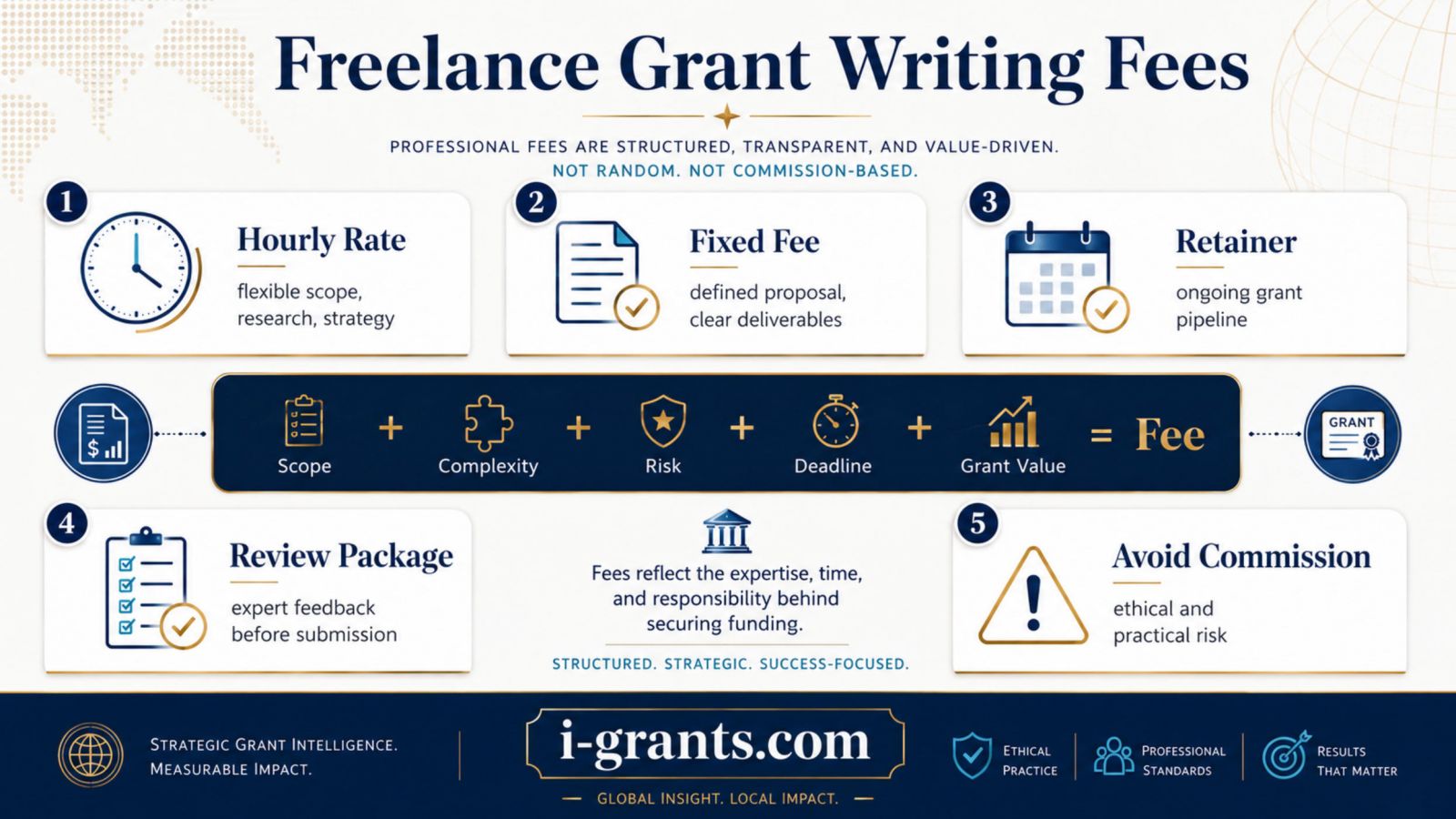
Most freelance grant writing rates fall into four common pricing structures: hourly rates, fixed project fees, monthly retainers, and limited-scope review packages. Some applicants also ask about success fees or commission, but this model is ethically problematic in the grant profession.
The Grant Professionals Association states that members should work for salary, wage, or fee, and that they should not accept finder’s fees, commission, or percentage compensation based on grants. The Association of Fundraising Professionals also states that proposal writers must not receive compensation calculated as a percentage of funds sought or raised.
That is why serious grant writers usually prefer transparent hourly fees, fixed project fees, or retainers.
| Pricing model | Typical use case | Strength | Risk for applicant |
|---|---|---|---|
| Hourly rate | Unclear scope, research, editing, strategy, complex applications | Flexible and fair when scope may change | Final cost can grow if hours are not capped |
| Fixed project fee | Defined proposal with clear deadline and deliverables | Predictable budget | Scope creep can create disputes |
| Monthly retainer | Ongoing grant research, pipeline building, multiple applications | Builds long-term grant capacity | Not ideal for one small application |
| Review package | Applicant writes internally, freelancer reviews and improves | Lower cost, useful for small teams | Does not replace full proposal development |
| Success fee or commission | Payment based on award result | Attractive to cash-poor applicants | Often unethical, risky, and misaligned with funder expectations |
Hourly Freelance Grant Writing Rates
Hourly pricing is common when the work is uncertain, strategic, or likely to change. For example, a nonprofit may ask a freelancer to review several grant opportunities, determine eligibility, estimate competitiveness, and then decide which application to pursue. In that situation, fixed pricing may be difficult because the grant writer does not yet know the full scope.
A practical market range often looks like this:
| Experience level | Typical hourly rate | Best for |
|---|---|---|
| Beginner or early-career freelancer | 25 to 50 USD per hour | Basic research, simple drafts, document formatting |
| Intermediate grant writer | 50 to 100 USD per hour | Foundation grants, nonprofit proposals, small business grants |
| Experienced consultant | 100 to 150 USD per hour | Government grants, complex budgets, strategic applications |
| Senior specialist | 150 to 250 USD per hour or more | EU grants, federal grants, research funding, technical programs |
These ranges should not be treated as universal prices. They are working benchmarks. The official Upwork grant writer cost page places typical grant writer rates at 35 to 60 USD per hour, while other professional and consulting sources report wider ranges for specialized work.
Hourly pricing is often the best model when:
-
the applicant is not sure which grant to apply for;
-
the project still needs strategy;
-
the funder’s rules are complex;
-
the applicant needs research before writing;
-
the proposal requires multiple revision rounds;
-
the organization wants advisory support, not only writing.
The weakness of hourly pricing is uncertainty. A client may approve 20 hours and then discover that the project actually requires 45 hours. To control this risk, applicants should ask for a written estimate with a soft cap, such as: “Initial eligibility review and proposal outline: up to 8 hours. Full draft after approval: estimated 25 to 35 hours.”
Fixed Grant Writing Fees
Fixed fees are attractive because they give the applicant a predictable budget. The freelancer quotes one price for a defined scope: for example, a foundation proposal, a government grant narrative, or a complete application package.
A fixed fee may cover:
-
discovery call and project briefing;
-
grant guidelines review;
-
proposal outline;
-
narrative drafting;
-
budget narrative support;
-
document checklist;
-
one or two revision rounds;
-
final formatting or submission support.
Fixed freelance grant writing fees are useful when the grant opportunity is already selected and the deliverables are clear. A small foundation proposal may cost a few hundred to a few thousand USD. A more complex application may cost several thousand USD. Large government, EU, research, or multi-partner grants can cost significantly more because the writer may need to manage strategy, technical content, partner input, compliance logic, and budget coordination.
The danger with fixed fees is scope creep. A client may ask for “one grant application”, but the application may expand into project design, stakeholder interviews, impact framework development, budget reconstruction, evidence gathering, and portal troubleshooting.
A good fixed-fee contract should define:
-
the exact grant opportunity;
-
the number of pages or sections;
-
what the applicant must provide;
-
what the writer will produce;
-
how many revisions are included;
-
whether budget development is included;
-
whether submission support is included;
-
what happens if the funder changes the rules or the applicant changes the project.
Without these boundaries, a fixed fee can become unfair for the writer and frustrating for the client.
Monthly Retainers for Grant Writers
A monthly retainer is not just “paying a writer every month”. It is a model for organizations that need a grant pipeline, not a single proposal.
Retainers are common for nonprofits, universities, social enterprises, cultural institutions, and growing organizations that apply for multiple funding opportunities each year. Under a retainer, a grant writer may provide a package of services such as funder research, calendar planning, eligibility screening, proposal drafting, reporting support, and strategic advisory.
A retainer can be especially useful when the applicant wants to move from reactive grant searching to systematic funding development. Instead of starting from zero before every deadline, the organization builds reusable assets: organizational profile, needs statement, theory of change, budget templates, outcome data, partner language, and funder-specific narratives.
Retainers may range from a modest monthly advisory package to several thousand USD per month for active proposal development. The price depends on the number of hours, applications, funding targets, and strategic responsibility included.
Retainers make sense when:
-
the organization applies to several grants per year;
-
the applicant needs continuous donor research;
-
the organization lacks internal grant capacity;
-
there are repeated reporting and renewal cycles;
-
the applicant wants to build a long-term funding pipeline.
Retainers do not make sense when the applicant has only one small grant opportunity and no plan to pursue future funding.
Proposal Review Fees
Not every applicant needs a full freelance grant writing package. Sometimes the organization can write the application internally but needs expert review before submission. This is where proposal review packages are useful.
A review package may include:
-
eligibility risk check;
-
narrative clarity review;
-
funder fit assessment;
-
budget consistency check;
-
scoring criteria alignment;
-
missing document checklist;
-
final improvement recommendations.
This can be one of the most cost-effective forms of grant writer support. It is especially useful for small nonprofits, early-stage startups, local community organizations, and universities where internal staff already understand the project but need an external grant professional to identify weaknesses.
A review package usually costs less than full proposal writing because the writer is not building the application from the beginning. However, it is only effective when the applicant has a real draft, a clear project, and enough time to make changes.
Why Success Fees Are a Problem
Many applicants ask: “Can we pay the grant writer only if we win?” The question is understandable, especially for small organizations with limited budgets. But in professional grant writing, success-based compensation creates serious problems.
The grant writer does not control the final funding decision. Funders consider many factors beyond proposal quality: eligibility, geography, organizational track record, funder priorities, competition, budget fit, timing, previous relationships, available funds, political priorities, technical scoring, and compliance history.
A great proposal can lose. A weaker proposal can win if the funder’s priorities, region, or applicant profile fit better.
That is why commission-based compensation is discouraged by major professional ethics frameworks. The Grant Professionals Association prohibits finder’s fees, commissions, and percentage compensation based on grants, and the Association of Fundraising Professionals applies similar restrictions to proposal writers.
Grant writing is professional work, not a lottery ticket. Paying only after an award shifts all risk to the writer and can distort the applicant’s judgment about which grants are worth pursuing.
There is also a practical budget issue. Many funders do not allow applicants to include pre-award grant writing costs in the grant budget unless the rules explicitly permit it. The GPA Code of Ethics notes that compensation should not be written into grants unless allowed by the funder.
A safer model is to pay a fair fee for defined work and, where appropriate, offer a non-percentage performance bonus that follows ethical and funder rules. Even then, applicants should be careful and transparent.
The Grant Writing Fee Logic Map
To understand freelance grant writing fees, it helps to break the work into cost components. A proposal fee is not one number. It is a bundle of tasks.
Grant Writing Fee = Research + Eligibility Review + Strategy + Narrative + Budget Logic + Evidence + Compliance + Revisions + Submission Support
Here is how that logic works in practice:
| Work component | What it includes | Why it affects price |
|---|---|---|
| Research | Finding and checking grant opportunities | Poor grant fit wastes the entire application |
| Eligibility review | Applicant type, geography, sector, legal status, match funding | Ineligible applications are usually rejected early |
| Strategy | Project design, funder fit, outcomes, theory of change | Strong strategy improves competitiveness |
| Narrative | Writing the proposal sections | More technical grants need deeper writing |
| Budget logic | Budget table, justification, eligible costs | Budget errors can damage credibility |
| Evidence | Data, letters, documents, partner input | Missing evidence weakens the application |
| Compliance | Rules, attachments, portal requirements, formatting | Noncompliance can lead to rejection |
| Revisions | Feedback cycles with applicant and partners | More stakeholders mean more coordination |
| Submission support | Portal upload, final checklist, deadline management | Technical submission work carries deadline risk |
This map explains why two grants with the same word count can have different prices. A short but technical government application may require more expertise than a longer but simpler foundation narrative.
What Clients Actually Pay For
Clients often believe they are paying for “writing”. In reality, they are paying for risk reduction.
A freelance grant writer reduces the risk that the applicant will:
-
apply for the wrong grant;
-
miss an eligibility condition;
-
submit a weak project logic;
-
understate measurable outcomes;
-
build an unrealistic budget;
-
forget a required attachment;
-
use generic language instead of funder-specific language;
-
submit late or incompletely;
-
waste staff time on a low-probability opportunity.
This is where i-grants.com’s marketplace logic becomes relevant. The platform’s value is not only in helping applicants find grant writers. It is in helping applicants understand which funding opportunities are worth professional effort, what type of grant writer is needed, and whether the expected grant value justifies the preparation cost.
For a 5,000 USD microgrant, a 4,000 USD writing package may be irrational unless the proposal can be reused or the grant has strategic value. For a 500,000 USD institutional grant, a 6,000 USD proposal budget may be reasonable if the application is complex, competitive, and strategically important.
The fee must be judged against grant value, complexity, probability, and organizational capacity.
How Applicants Can Choose the Right Fee Model
The best pricing model depends on the applicant’s situation.
| Applicant situation | Best fee model | Reason |
|---|---|---|
| “We do not know which grant to apply for.” | Hourly or short research package | The scope is not clear yet |
| “We selected one foundation grant and have documents ready.” | Fixed fee | Deliverables are defined |
| “We apply to grants every month.” | Monthly retainer | Continuous pipeline work is needed |
| “Our team wrote a draft but wants expert feedback.” | Review package | Lower cost than full writing |
| “The grant is complex and the deadline is close.” | Hourly with cap or premium fixed fee | Risk and urgency are higher |
| “We can only pay if we win.” | Avoid this model | Commission-based pricing creates ethical and practical problems |
The applicant should not begin with the question: “What is your cheapest price?” A better first question is: “What work must be done before this application is submission-ready?”
Questions to Ask Before Hiring a Freelance Grant Writer
Before agreeing to freelance grant writing fees, applicants should ask direct questions:
-
Have you worked with this type of funder before?
-
Do you charge hourly, fixed fee, retainer, or review package?
-
What is included in the fee and what is excluded?
-
How many revisions are included?
-
Do you help with budgets or only the narrative?
-
Do you review eligibility before writing?
-
What documents do you need from us?
-
Will you support portal submission?
-
How do you handle urgent deadlines?
-
Do you avoid percentage-based compensation?
These questions protect both sides. A professional grant writer should be able to explain their pricing logic clearly. A serious applicant should be ready to provide documents, project details, financial information, and decision-makers on time.

Red Flags in Freelance Grant Writing Rates
Low fees are not always bad. A newer grant writer may offer competitive pricing while building a portfolio. A simple application may not require a senior consultant. But some pricing signals should make applicants cautious.
Be careful when a grant writer:
-
guarantees funding;
-
offers to work only for a percentage of the award;
-
does not ask about eligibility;
-
gives a quote without reading the grant guidelines;
-
promises a full complex application in an unrealistically short time;
-
does not clarify who prepares the budget;
-
avoids written scope;
-
uses generic templates without funder-specific adaptation;
-
has no process for revisions or document collection.
The biggest red flag is a guaranteed win. Ethical grant writers can improve application quality, competitiveness, clarity, and compliance. They cannot control the funder’s final decision.
A Practical Budgeting Example
Imagine a small business applies for a 100,000 USD innovation grant. The grant requires a project narrative, budget justification, market need section, implementation plan, risk analysis, sustainability plan, and supporting documents.
A beginner may quote 800 USD. A mid-level freelancer may quote 2,500 USD. A senior consultant may quote 6,000 USD or more.
Which price is “correct”? It depends on what is included.
If the 800 USD quote only covers basic writing, the applicant may still need to handle eligibility, budget, evidence, and submission alone. If the 2,500 USD quote includes narrative, budget narrative, and two revision rounds, it may be reasonable. If the 6,000 USD quote includes strategy, technical positioning, partner coordination, budget logic, compliance review, and submission support, it may be the safest option for a high-value, competitive grant.
The right decision is not based on price alone. It is based on scope, risk, and expected value.
Pay for the Work Behind the Application
Freelance grant writing fees make sense when applicants understand what the fee actually covers. Hourly rates are useful for flexible or uncertain work. Fixed fees are useful for defined applications. Retainers are useful for long-term grant pipelines. Review packages are useful when the applicant already has a draft. Commission-based pricing should usually be avoided because it creates ethical and practical risks.
For applicants, the smartest approach is to match the fee model to the grant opportunity. A small, simple grant does not need an expensive full-service consultant. A complex government, EU, research, or multi-partner grant should not be treated as a cheap writing task.
For freelance grant writers, transparent pricing protects professional value. For applicants, transparent pricing protects the funding strategy.
And for platforms like i-grants.com, this is exactly where the marketplace can create value: helping organizations move from vague cost questions to structured decisions. Find the grant. Check eligibility. Understand complexity. Estimate preparation effort. Then choose the right grant writer for the actual work required.