

 Français
  Deutsch
  Українська
France offers two closely related but fundamentally different tax incentives for companies developing technologies and new products: the Crédit d’impôt recherche, known as CIR, and the Crédit d’impôt innovation, known as CII.
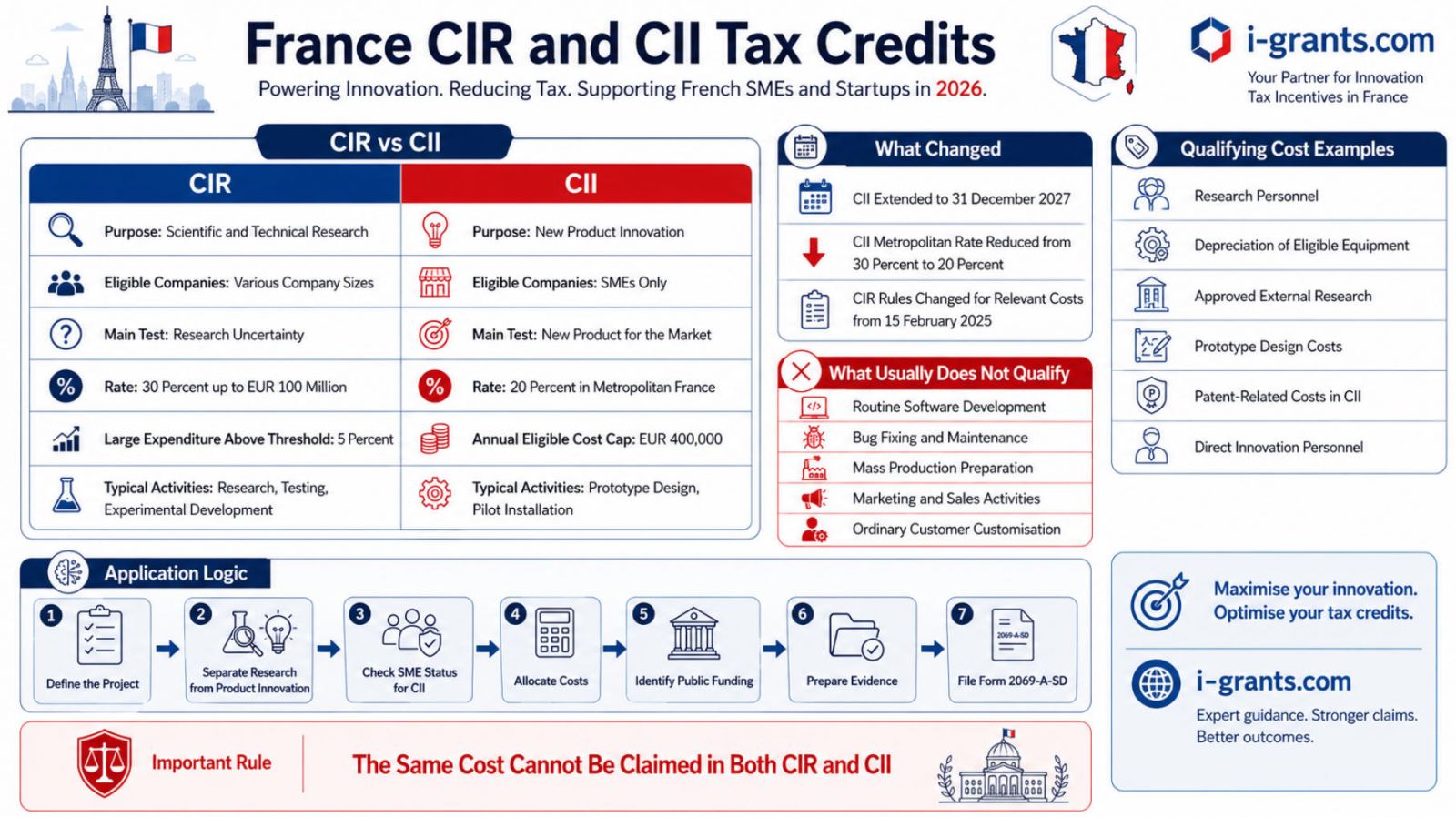
CIR supports qualifying scientific and technical research. CII supports certain activities involved in designing prototypes or pilot installations for new products. CIR is available to companies of different sizes, while CII is reserved for micro, small and medium-sized enterprises.
The distinction is not based on whether a project appears innovative, uses advanced technology or has commercial potential. It depends on the exact nature of the work.
The central question is:
Is the company creating new scientific or technical knowledge, or is it designing a new market product using knowledge that is already available?
Work undertaken to overcome a genuine scientific or technical uncertainty may qualify for CIR. Work undertaken by an SME to create a prototype of a product that is new to the relevant market and performs better than existing products may qualify for CII. Routine software development, ordinary engineering, commercial customisation, maintenance and preparation for mass production may qualify for neither.
This distinction is particularly important for startups and SMEs whose projects move through research, prototype development, industrialisation and market launch. A single commercial project can contain CIR activities, CII activities and non-qualifying work, but the same operation or expense cannot be included in both tax credits.
What CIR and CII actually finance
CIR is intended to encourage companies to carry out scientific and technical research. Its scope is based largely on the internationally recognised research concepts set out in the OECD Frascati Manual.
CII is an extension of the French research tax credit system for innovation activities outside qualifying research. It applies to the design of prototypes and pilot installations for new products by companies that satisfy the European definition of a micro, small or medium-sized enterprise.
CII has been extended to expenditure incurred through 31 December 2027. Its standard rate in metropolitan France was reduced from 30 percent to 20 percent from 1 January 2025. CIR remains available without a general statutory closing date under the current tax code.
Table 1. Main differences between CIR and CII
| Feature | CIR | CII |
|---|---|---|
| Official name | Crédit d’impôt recherche | Crédit d’impôt innovation |
| Main purpose | Scientific and technical research | Design of prototypes or pilot installations for new products |
| Eligible companies | Qualifying industrial, commercial and agricultural companies | Micro, small and medium-sized enterprises only |
| Core eligibility test | Creation of new knowledge by overcoming scientific or technical uncertainty | Product not yet available on the relevant market and offering superior performance |
| Standard metropolitan France rate | 30 percent up to EUR 100 million of qualifying research expenditure | 20 percent |
| Expenditure above EUR 100 million | CIR rate falls to 5 percent | Not applicable |
| Annual expenditure ceiling | No general ceiling, although the rate changes above EUR 100 million | EUR 400,000 |
| Maximum annual credit in metropolitan France | Depends on qualifying expenditure | EUR 80,000 |
| Current end date | No general end date | 31 December 2027 |
| Main technical authority | Tax administration, with possible scientific assessment by MESR | Tax and economic authorities |
| Typical beneficiary | From a research startup to a major industrial group | Innovative SME developing a new product |
The names of the incentives can be misleading. CIR does not automatically cover every activity performed by a research department. CII does not automatically cover every product described as innovative. Each operation must satisfy its own legal and technical conditions.
What changed in 2025 and what applies in 2026
The 2025 Finance Act introduced several important changes to CIR and CII.
For CII, the most visible changes were its extension through the end of 2027 and the reduction of the standard rate in metropolitan France from 30 percent to 20 percent.
For CIR, several reforms apply to expenditure incurred from 15 February 2025. The flat-rate operating cost percentage attached to eligible personnel expenditure was reduced from 43 percent to 40 percent. The 75 percent amount applied to eligible depreciation was retained.
The special treatment previously available for certain expenses connected with newly recruited doctorate holders was removed for expenditure incurred from 15 February 2025. Patent filing and maintenance costs, plant variety certificate costs and technological monitoring expenditure were also removed from the CIR base for expenditure incurred from that date.
These changes require particular care when calculating CIR for 2025 because expenses incurred before and after 15 February may be subject to different rules. For 2026 expenditure, the revised rules apply throughout the calendar year. The latest official CIR guide available as of 26 July 2026 is the 2025 guide published by the French Ministry of Higher Education and Research on 29 October 2025.
Table 2. Important CIR and CII changes affecting 2026 claims
| Provision | Previous position | Position relevant to 2026 |
|---|---|---|
| Standard CII rate in metropolitan France | 30 percent | 20 percent |
| CII closing date | 31 December 2024 before extension | Extended to 31 December 2027 |
| CIR operating cost allowance on personnel | 43 percent | 40 percent |
| CIR operating cost allowance on qualifying depreciation | 75 percent | 75 percent |
| Special young doctorate holder treatment | Enhanced treatment where conditions were met | Removed for expenditure from 15 February 2025 |
| Patent filing and maintenance costs under CIR | Certain costs could qualify | Excluded for expenditure from 15 February 2025 |
| Technological monitoring under CIR | Qualifying subject to conditions and a ceiling | Excluded for expenditure from 15 February 2025 |
| Patent-related expenses under CII | Certain expenses may qualify | Retained where directly connected with an eligible new product |
The removal of certain patent expenses from CIR should not be applied automatically to CII. The current tax code continues to include certain patent, plant variety certificate, design registration and defence expenses within the CII categories when they relate directly to an eligible prototype or pilot installation.
Which companies can claim CIR?
CIR is available to industrial, commercial and agricultural companies taxed in France under an actual-profit regime, as well as certain companies benefiting from specified tax exemptions.
It is not limited to SMEs, newly established companies, French-owned businesses or particular technology sectors. A manufacturing group, software company, biotechnology startup, engineering business or agricultural enterprise may qualify if it performs eligible research and satisfies the tax conditions.
A company does not qualify merely because it employs researchers, holds patents or operates in a high-technology sector. Eligibility is assessed at the level of the research operation.
A qualifying CIR operation should satisfy five connected research criteria:
-
Novelty: the work seeks to create knowledge that is not readily available within the relevant scientific or technical field.
-
Creativity: it involves original concepts, hypotheses or approaches rather than a routine application of established methods.
-
Uncertainty: the result, method or technical pathway cannot be determined in advance by a competent professional using available knowledge.
-
Systematic work: the research is planned, budgeted, documented and carried out according to an organised method.
-
Transferability or reproducibility: the knowledge and results can be recorded, communicated, reproduced or used in subsequent research.
The most important distinction is between scientific or technical novelty and commercial novelty. A product may be new to the company or even new to the market without producing new knowledge. Such a project does not automatically qualify for CIR.
Research eligible for CIR may include basic research, applied research and experimental development. In business claims, experimental development creates the greatest classification difficulty because it often takes place alongside ordinary product development.
A prototype may belong to CIR when it is built to test a research hypothesis or overcome a defined scientific or technical uncertainty. Once that uncertainty has been resolved, later work on product appearance, user convenience, standard integration, commercial functions or industrial preparation may fall outside CIR.
The official CIR guide emphasises that companies must identify the scientific or technical obstacle, describe the available state of knowledge and explain why a competent professional could not solve the problem through routine engineering alone.
Which companies can claim CII?
CII is available only to enterprises that satisfy the European definition of a micro, small or medium-sized enterprise.
This normally means fewer than 250 employees and either annual turnover not exceeding EUR 50 million or an annual balance sheet total not exceeding EUR 43 million. The company must also consider relevant partner and linked enterprises.
A French company with 40 employees may therefore fail the SME test if it belongs to a large corporate group. Conversely, an independent growing company may retain SME status until the applicable rules on exceeding the thresholds remove that status. Official guidance notes that a company exceeding the SME thresholds generally loses CII eligibility from the second consecutive year in which the thresholds are exceeded.
CII applies to the design of a prototype or pilot installation for a new product. Under the tax code, that product may be tangible or intangible, but it must satisfy two cumulative conditions:
-
it is not yet available on the relevant market;
-
it differs from existing or previous products through superior technical performance, environmental design, ergonomics or functionality.
The relevant market should be defined realistically. It may be a specialised business market rather than the entire French or global economy, but the company must identify the competing or comparable products already available.
A product is not new merely because it is absent from the applicant’s own catalogue. A redesigned product, a customised version for one customer or a combination of known functions may fail the test if comparable market products already offer the same performance.
Digital products can qualify. Software, an application or a digital platform may be an intangible new product. However, a new service, internal process, business method or organisational change does not automatically constitute a product for CII.
The prototype or pilot installation must be used as a model for creating the new product and must not itself be intended for ordinary sale. Expenses relating to the commercial production phase of the new product are excluded.
CIR, CII or ordinary development?
The best way to classify a project is not to ask whether the overall business is innovative. The company should separate the project into individual operations and examine the purpose of each operation.
Table 3. Practical classification of common development activities
| Activity | Likely treatment | Reason |
|---|---|---|
| Developing a new algorithm where existing methods cannot achieve the required result | CIR may apply | A technical uncertainty is investigated through hypotheses and testing |
| Studying a material whose behaviour under required conditions is unknown | CIR may apply | The work seeks new scientific or technical knowledge |
| Building an experimental prototype to test a research hypothesis | CIR may apply | The prototype forms part of the research method |
| Designing a market prototype after the research obstacle has been resolved | CII may apply for an SME | The work concerns a new product rather than new knowledge |
| Developing a digital product with demonstrably superior functions | CII may apply for an SME | An intangible product can satisfy the CII product test |
| Adding standard functions to existing software | Usually neither | Established solutions are applied without qualifying research or sufficient product novelty |
| Correcting defects and maintaining a system | Neither | Routine maintenance does not create new knowledge or a new product |
| Moving existing software to another hosting environment | Usually neither | Standard technical adaptation |
| Customising a product for one client | Depends on the underlying work | Commercial adaptation alone is insufficient |
| Designing tools for mass production | Usually neither | Industrial preparation normally occurs after prototype creation |
| Conducting market research or advertising tests | Neither | Commercial activity rather than research or prototype design |
A company may move from CIR to CII within the same broader product programme.
For example, the company might first investigate an unresolved technical problem under CIR. After resolving it, an SME may design a prototype of a new market product under CII. Later industrial engineering, certification, marketing and production launch may fall outside both credits.
The company must avoid applying CIR and CII to the same salary, depreciation amount, subcontractor invoice or technical operation. Official CII guidance expressly prohibits the same expenditure from being included in both calculations.
Which expenses can be included in CIR?
The CIR base begins with expenses directly connected with eligible scientific and technical research operations.
Table 4. Main CIR expense categories under the 2026 rules
| Expense category | Indicative treatment | Main condition |
|---|---|---|
| Depreciation of new research assets | Potentially eligible | Asset directly assigned to qualifying research operations |
| Researcher salaries and social charges | Potentially eligible | Employee directly and effectively participates in qualifying research |
| Research technician costs | Potentially eligible | Technical contribution and time must be documented |
| Administrative and support staff | Not separately eligible | Indirect support is reflected through the flat-rate operating allowance |
| Flat-rate operating expenditure | Eligible through statutory formula | 40 percent of qualifying personnel costs plus 75 percent of qualifying depreciation |
| Outsourced research | Potentially eligible | Provider must have the required approval and perform genuine research |
| Official standardisation work | Partly eligible | Only specified expenses connected with official standardisation meetings |
| Patent costs incurred after 15 February 2025 | Excluded from CIR | Reform removed these categories from the research base |
| Technological monitoring after 15 February 2025 | Excluded from CIR | Previous category no longer applies |
| Marketing, commercial design and sales work | Not eligible | Not scientific or technical research |
Research personnel costs require more than employment contracts and job titles. The company should be able to show which employees participated in each operation, what they did and how much time they spent on eligible work.
Employees do not need to spend all of their time on research. A reasonable proportion may be included when supported by reliable records. The company should avoid automatically treating the entire salary of every engineer, developer or technical manager as research expenditure.
The statutory operating expense formula for 2026 is:
40 percent of eligible personnel expenditure plus 75 percent of eligible depreciation
This formula is intended to represent indirect operating costs. It does not allow the company to add the actual salaries of administrative, financial, maintenance or general support employees as separate CIR expenses.
Which expenses can be included in CII?
CII has its own cost categories and should not be calculated by copying the CIR methodology.
Table 5. Main CII expense categories
| Expense category | Indicative treatment | Main condition |
|---|---|---|
| Depreciation of newly created or acquired assets | Potentially eligible | Asset directly assigned to an eligible prototype or pilot installation |
| Direct personnel expenses | Potentially eligible | Personnel directly and exclusively assigned to eligible design operations |
| Depreciation of patents and similar rights | Potentially eligible | Directly connected with the eligible new product |
| Patent filing and maintenance costs | Potentially eligible | Must relate to the eligible CII operation |
| Design registration costs | Potentially eligible | Connected with the prototype or pilot installation |
| Defence of patents and designs | Potentially eligible | Direct relationship with the eligible product |
| External design or engineering work | Potentially eligible | Provider must hold the appropriate approval |
| General flat-rate operating allowance | Not provided under the current CII category | CIR’s 40 percent and 75 percent formula should not be applied automatically |
| Mass production | Not eligible | CII applies before ordinary production |
| Advertising, sales and market launch | Not eligible | Commercial expenditure rather than prototype design |
CII personnel must be directly and exclusively involved in the eligible design operations. This wording requires the company to separate prototype work from sales support, routine customer projects, maintenance, certification administration and production preparation.
The current tax code contains no general flat-rate operating expense category within CII. The former provision has been repealed. Companies should therefore not add the CIR operating allowance to the CII base without a separate legal basis.
Rates and maximum amounts in 2026
Table 6. CIR and CII rates applicable in 2026
| Instrument and location | Rate | Expenditure ceiling |
|---|---|---|
| CIR in metropolitan France | 30 percent up to EUR 100 million | No general overall ceiling |
| CIR on expenditure above EUR 100 million | 5 percent | No general overall ceiling |
| CIR in an overseas department | 50 percent up to EUR 100 million | 5 percent above EUR 100 million |
| CII in metropolitan France | 20 percent | EUR 400,000 per year |
| CII in an overseas department | 60 percent | EUR 400,000 per year |
| CII for a small enterprise in Corsica | 40 percent | EUR 400,000 per year |
| CII for a medium-sized enterprise in Corsica | 35 percent | EUR 400,000 per year |
These rates are set out in the version of Article 244 quater B in force from 1 January 2026.
The maximum theoretical annual CII credit is therefore EUR 80,000 in metropolitan France, EUR 240,000 in an overseas department, EUR 160,000 for a small enterprise in Corsica and EUR 140,000 for a medium-sized enterprise in Corsica.
CIR calculation example
Consider a company with the following qualifying expenditure during 2026:
| Expense | Amount |
|---|---|
| Research personnel | EUR 300,000 |
| Eligible depreciation | EUR 20,000 |
| Approved external research | EUR 100,000 |
The flat-rate operating expenditure is:
EUR 300,000 × 40 percent + EUR 20,000 × 75 percent = EUR 135,000
The preliminary CIR base is:
EUR 300,000 + EUR 20,000 + EUR 100,000 + EUR 135,000 = EUR 555,000
The preliminary CIR is:
EUR 555,000 × 30 percent = EUR 166,500
This figure is not automatically the final claim. The company must still verify the research eligibility of each operation, personnel allocation, subcontracting rules, public subsidies and supporting documentation.
CII calculation example
An SME in metropolitan France incurs EUR 500,000 of otherwise eligible CII expenditure during 2026.
Because the annual base is capped at EUR 400,000, the calculation is:
EUR 400,000 × 20 percent = EUR 80,000
The additional EUR 100,000 does not create a CII credit and is not transferred to the following year merely because the annual ceiling was exceeded.
Public grants and double funding
A company can combine CIR or CII with grants, repayable advances and other public funding, but public support covering the same operations must be reflected in the tax credit calculation.
Public grants and repayable advances allocated to eligible research or innovation operations must generally be deducted from the relevant tax credit base. The deduction should correspond to the part of the public support that finances expenditure also included in CIR or CII.
If a public grant supports a broader project containing research, industrialisation, equipment and commercial activities, the company should allocate the grant across those work packages using a documented method. Only the portion corresponding to expenses in the tax credit base should normally reduce that base.
A repayable advance is deducted even though it may later need to be returned. If the company repays the advance to the funding authority, the repaid amount may generally be added back to the tax credit base for the year of repayment under the applicable rules.
Table 7. Example of funding allocation within one technology project
| Project component | Potential instrument |
|---|---|
| Scientific research and experimental work | CIR |
| Prototype of a new market product developed by an SME | CII |
| Collaborative research with an approved research organisation | CICo may apply |
| Industrial demonstration supported by a public call | France 2030 or another grant |
| Production machinery and factory investment | Industrial investment programme, loan or tax incentive |
| Marketing and customer acquisition | Company resources, equity or commercial finance |
A company should maintain a funding matrix showing every work package, cost category, public support source and tax credit treatment. This is particularly important when the same project receives a Bpifrance grant, France 2030 support, a regional subsidy and a tax credit.
.jpg)
Outsourced work and provider approval
CIR outsourcing rules are often misunderstood.
A company conducting its own internal research does not need a CIR provider approval simply to claim CIR on its own researchers and equipment. The approval is principally relevant to an external provider whose client wants to include the provider’s research invoice in the client’s CIR base.
For CIR, qualifying outsourced operations must generally be carried out by approved organisations or approved scientific and technical experts. The amount included is limited to three times the claimant’s other qualifying research expenditure before the separate outsourcing limits are applied.
The general annual limit is EUR 2 million. It rises to EUR 10 million where there is no dependency relationship between the claimant and the external provider. The provider is generally required to perform the outsourced operation directly, although limited further outsourcing to another approved organisation may be permitted for necessary work.
For CII, eligible external prototype or pilot installation work must be assigned to approved companies or approved design and engineering offices.
The client should retain more than the provider’s invoice. The supporting file should contain the contract, statement of work, description of the provider’s contribution, technical reports, deliverables, results and evidence that the work was genuinely connected with the eligible research or innovation operation. The Ministry of Higher Education and Research specifically expects the contribution of each research subcontractor to be described and supported by contracts and deliverables where necessary.
Provider approval calendar
A first CIR provider approval request must be submitted between 1 January and 31 March of the year from which approval is requested. A renewal request must generally be submitted between 15 August and 30 November of the final year of the existing approval.
For example, a provider requesting its first approval from 2026 had to submit the application between 1 January and 31 March 2026.
An organisation applying for CIR approval may also request CII approval. The official CIR guide explains that when CIR approval is granted, CII approval may be awarded on request without requiring a separate complete technical application.
Filing, use and reimbursement of the credit
CIR and CII are declared using form 2069-A-SD, together with the company’s relevant tax return.
The tax credit is calculated by calendar year, even when the company’s accounting year does not follow the calendar year. A company closing its accounts in September must still identify the qualifying expenditure incurred from January to December for the tax credit year.
The credit is first offset against the company’s corporate income tax or qualifying income tax liability. Under the general rule, an unused tax credit claim may be carried forward for three years. Any remaining amount is then refundable.
Certain companies can request immediate reimbursement, subject to the applicable conditions. These include qualifying SMEs, young innovative enterprises and some newly established companies. A company established for less than two years may be required to provide supporting documents proving that the expenditure was actually incurred when requesting reimbursement.
Receiving a refund does not necessarily mean that the scientific or technical eligibility has been definitively approved. The administration may subsequently examine the claim and request technical, accounting and personnel evidence.
Using a rescrit to reduce uncertainty
A rescrit allows a company to request an advance formal opinion from the administration on the eligibility of a defined operation.
For CIR, each request should normally concern one research operation. It should present the state of scientific or technical knowledge, the identified uncertainty, the proposed research method, the people involved and the planned expenses.
The request must be made sufficiently early under the applicable procedural rules. The administration generally has three months to respond within the specific rescrit procedure. Where the statutory conditions are satisfied, the absence of a response may create a binding positive position.
A favourable scientific eligibility decision does not automatically confirm every amount claimed. The administration can still examine whether the work was carried out as described, whether the time records are reliable, whether personnel costs were calculated correctly and whether subsidies were properly deducted.
CII has its own rescrit procedure. The official form requires each request to cover only one project and asks the company to explain the market, competing products, superior performance, project schedule and precise CII operations.
A rescrit can be particularly valuable when:
| Situation | Why a rescrit may help |
|---|---|
| The project combines research and ordinary development | It can clarify the eligible research boundary |
| Software work uses complex but known technologies | It can test whether a genuine technical uncertainty exists |
| The company claims a new digital product under CII | It can clarify the relevant market and superior performance |
| A project continues over several years | It can secure the classification of a clearly defined operation |
| A large claim depends on one disputed technical issue | It can reduce exposure before the tax credit becomes substantial |
The company must disclose the project accurately. A rescrit based on incomplete or misleading information may not protect a materially different claim.
Documentation and audit preparation
A strong CIR or CII claim is built while the project is being carried out, not several months after the financial year has ended.
For CIR, the supporting file should normally include:
-
the scientific and technical state of knowledge before the work began;
-
the specific uncertainty or obstacle;
-
the hypotheses and research approach;
-
tests, unsuccessful approaches and results;
-
the contribution of each employee and external provider;
-
the connection between technical operations, recorded time and financial expenditure.
The scientific narrative should be prepared with direct involvement from the researchers, engineers or developers who carried out the work. A tax adviser or grant writer can structure the file, but a generic description written without the technical team will rarely provide enough evidence.
Time recording should be sufficiently detailed to connect employees to specific eligible operations. Records created during the project are normally stronger than reconstructed estimates prepared only after an audit request.
During CIR verification, the French tax administration may ask the Ministry of Higher Education and Research to assess the scientific character of the declared work. MESR’s role is limited to the research component. The Ministry of the Economy and the tax authorities are responsible for examining CII activities outside research.
The supporting file should also reconcile the technical description with payroll records, accounting data, depreciation schedules, invoices, subsidy agreements and tax declarations. A technically strong operation can still be adjusted if the financial evidence is unreliable.
Official CIR and CII statistics
The latest detailed official figures available as of July 2026 concern expenditure incurred in 2023. The data are provisional and were extracted in April 2025.
In 2023, approximately 29,700 companies declared close to EUR 27 billion of eligible expenditure across the research, innovation and new collection components of the system. The corresponding total tax credit claim was approximately EUR 7.85 billion.
Research expenditure produced a claim of EUR 7.318 billion. Innovation expenditure produced a CII claim of EUR 500 million. New collection expenditure in the textile, clothing and leather sector produced a claim of EUR 31 million.
Table 8. Official CIR and CII figures for 2023
| Component | Declaring companies | Beneficiaries | Declared expenditure | Tax credit claim |
|---|---|---|---|---|
| Research, CIR | 19,098 | 16,089 | EUR 25.153 billion | EUR 7.318 billion |
| Innovation, CII | 11,030 | 10,688 | EUR 1.659 billion | EUR 500 million |
| New collections | 750 | 726 | EUR 163 million | EUR 31 million |
| Total system | 29,720 | 23,526 | EUR 26.975 billion | EUR 7.850 billion |
The 2023 CII figures reflect the 30 percent rate that applied in metropolitan France during that year. They should not be treated as a direct forecast of the cost or value of CII after the rate fell to 20 percent in 2025.
Approximately 81 percent of the 16,089 research CIR beneficiaries were SMEs. However, SMEs received around 31 percent of the research credit amount. Medium-sized companies received EUR 2.099 billion, while large companies received EUR 2.979 billion.
Table 9. Distribution of the research CIR claim by company size in 2023
| Company category | Research CIR claim | Share of research CIR |
|---|---|---|
| SMEs | EUR 2.241 billion | 30.6 percent |
| Mid-cap companies | EUR 2.099 billion | 28.7 percent |
| Large companies | EUR 2.979 billion | 40.7 percent |
Manufacturing industries received approximately 56 percent of the research CIR, while service companies received around 41 percent. The largest service activity was computer consulting and assistance.
CII had a very different sector profile. Service companies received 82.6 percent of the innovation credit, and computer consulting and assistance alone represented just over half of the CII claim.
The large share of digital and service companies does not mean that ordinary software work is automatically eligible. Every digital project must still satisfy either the CIR research criteria or the CII new product test.
Claims, refunds and actual outcomes are different figures
A tax credit claim, known in French reporting as a créance, does not necessarily equal cash paid from the state budget in the same year.
The credit may be offset against tax, carried forward or reimbursed later. A company may also amend a declaration, be audited or have part of the claim rejected.
The number of declaring companies is not the same as the number of beneficiaries. In a tax-integrated group, individual subsidiaries may report expenditure while the parent company receives the tax credit claim.
An increase in CIR expenditure or tax credit amounts does not by itself prove an equivalent increase in additional private research. Assessing the actual economic effect requires separate evidence on additional R&D investment, employment, new knowledge, patents, productivity, new products and company growth.
Table 10. How to interpret CIR and CII performance figures
| Indicator | What it means |
|---|---|
| Declared expenditure | Costs companies included in their own tax declarations |
| Tax credit claim | Calculated entitlement before final use and possible later review |
| Beneficiary | Company or tax group entitled to use the credit |
| Cash reimbursement | Amount actually repaid by the tax administration |
| Research result | New knowledge or a verified scientific or technical result |
| Innovation result | New product actually completed or introduced to the market |
| Forecast | Expected future impact that has not yet been confirmed |
A company announcing that it has claimed CIR has not necessarily demonstrated that every operation was accepted during a scientific review. Likewise, an approved refund does not prove that the project created a commercially successful product.
The collaborative research tax credit
Companies working with public or approved research organisations should also examine the Crédit d’impôt en faveur de la recherche collaborative, known as CICo.
CICo is separate from CIR. It supports qualifying research collaboration contracts concluded with approved research and knowledge dissemination organisations.
Under the version of Article 244 quater B bis in force from 1 January 2026, qualifying collaboration contracts may be concluded through 31 December 2028. Eligible invoiced research expenditure is limited to EUR 6 million per year. The rate is 50 percent for SMEs and 40 percent for other eligible companies.
CICo is not intended for an ordinary customer and supplier relationship. The contract must define a shared research objective, divide the work, risks and results, and prevent all intellectual property results from being assigned entirely to the company. The research organisation’s invoiced expenditure may not exceed 90 percent of the total expenditure on the collaborative operations.
The same expenditure cannot be included in both CICo and another tax credit. A company should therefore compare CICo with CIR outsourcing before selecting the treatment for a research partnership.
A practical CIR and CII preparation process
A company should classify its work before calculating the tax credit.
A practical process is:
-
Divide the broader project into technically distinct operations.
-
Identify the initial state of scientific, technical and market knowledge.
-
Determine whether each operation addresses research uncertainty, new product design or routine development.
-
Assign personnel, equipment, providers and public funding to each operation.
-
Calculate CIR and CII separately without overlapping costs.
-
Prepare the technical and financial evidence before filing form 2069-A-SD.
The boundary should be reviewed whenever a project moves into a new phase. Research may end when the technical uncertainty is resolved. CII may end when the prototype or pilot installation has been completed and ordinary production preparation begins.
A professional grant writer or public funding adviser can help structure the project narrative, divide the work packages, prepare the evidence matrix and coordinate grants with tax credits. However, CIR and CII also require direct participation from technical staff, accountants and tax specialists.
The strongest file is not the one with the most complex terminology. It is the one in which the technical problem, work performed, people involved, costs incurred and results obtained can all be connected and verified.
Final assessment
CIR and CII are among the most important instruments supporting corporate research and innovation in France.
CIR can finance a meaningful portion of qualifying scientific and technical research, including personnel, depreciation, statutory operating expenses and approved external research. It is available to companies of different sizes, but it requires evidence of a genuine scientific or technical uncertainty and a systematic effort to create new knowledge.
CII provides a more limited but potentially valuable incentive for SMEs designing prototypes or pilot installations for new products. In metropolitan France, it covers 20 percent of up to EUR 400,000 of eligible annual expenditure, producing a maximum theoretical credit of EUR 80,000.
The most important compliance rule is not to describe every development activity as research or every product improvement as innovation.
Scientific or technical uncertainty points toward CIR. A new market product with superior performance may point toward CII. Routine development, customer adaptation, maintenance, industrial preparation and commercial launch may belong to neither.
Companies that classify their work correctly, record employee contributions, separate public funding and prepare contemporaneous technical evidence can use CIR and CII as part of a broader financing strategy. Companies that rely on generic innovation claims, reconstructed time records or overlapping costs face a much greater risk of adjustment during a later review.