

 Français
  Deutsch
  Українська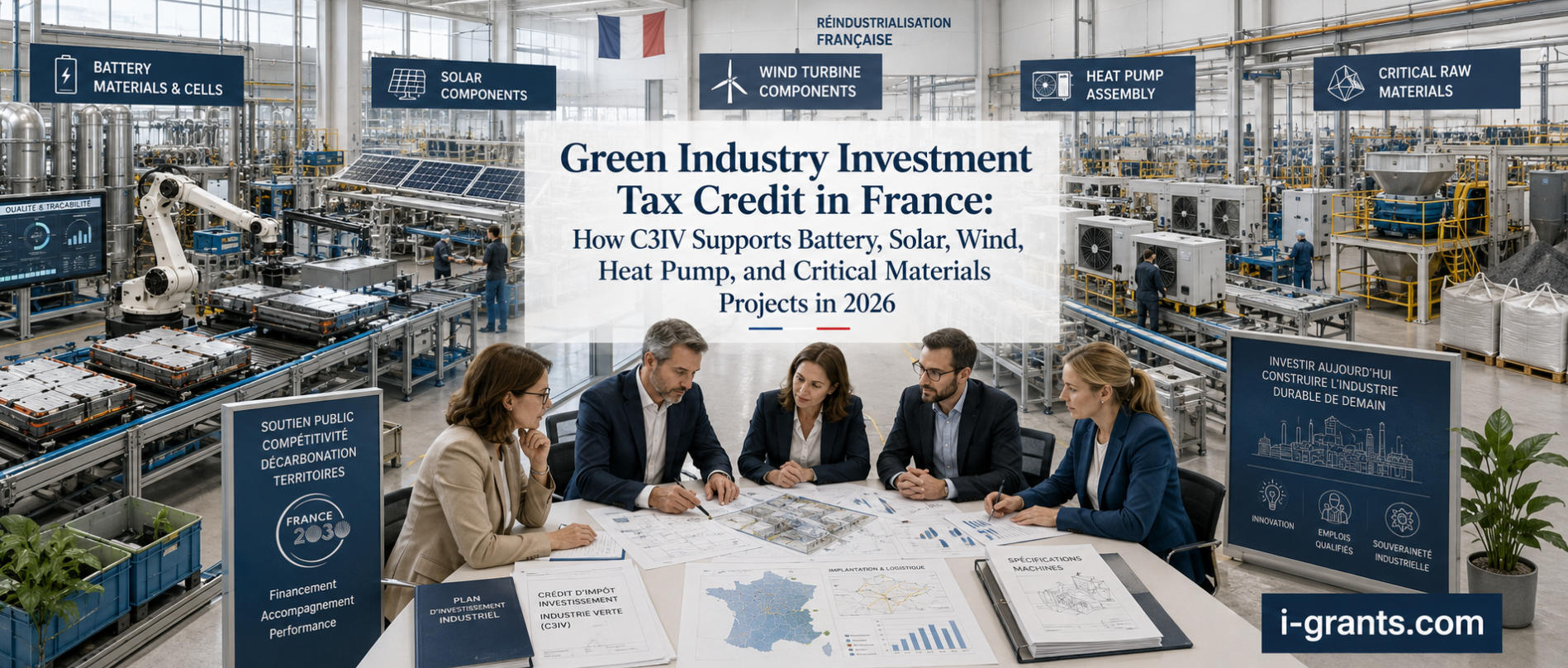
France’s Green Industry Investment Tax Credit, commonly known as C3IV, is one of the country’s most significant incentives for companies establishing or expanding manufacturing capacity in selected clean technology supply chains.
Unlike a conventional grant programme, C3IV is a refundable tax credit linked to eligible industrial investment. It can support production buildings, machinery, equipment, intellectual property and certain land-related costs associated with manufacturing batteries, solar panels, wind turbines, heat pumps and their essential inputs.
The central eligibility question is simple but frequently misunderstood:
Is the company manufacturing green technology, or merely using it?
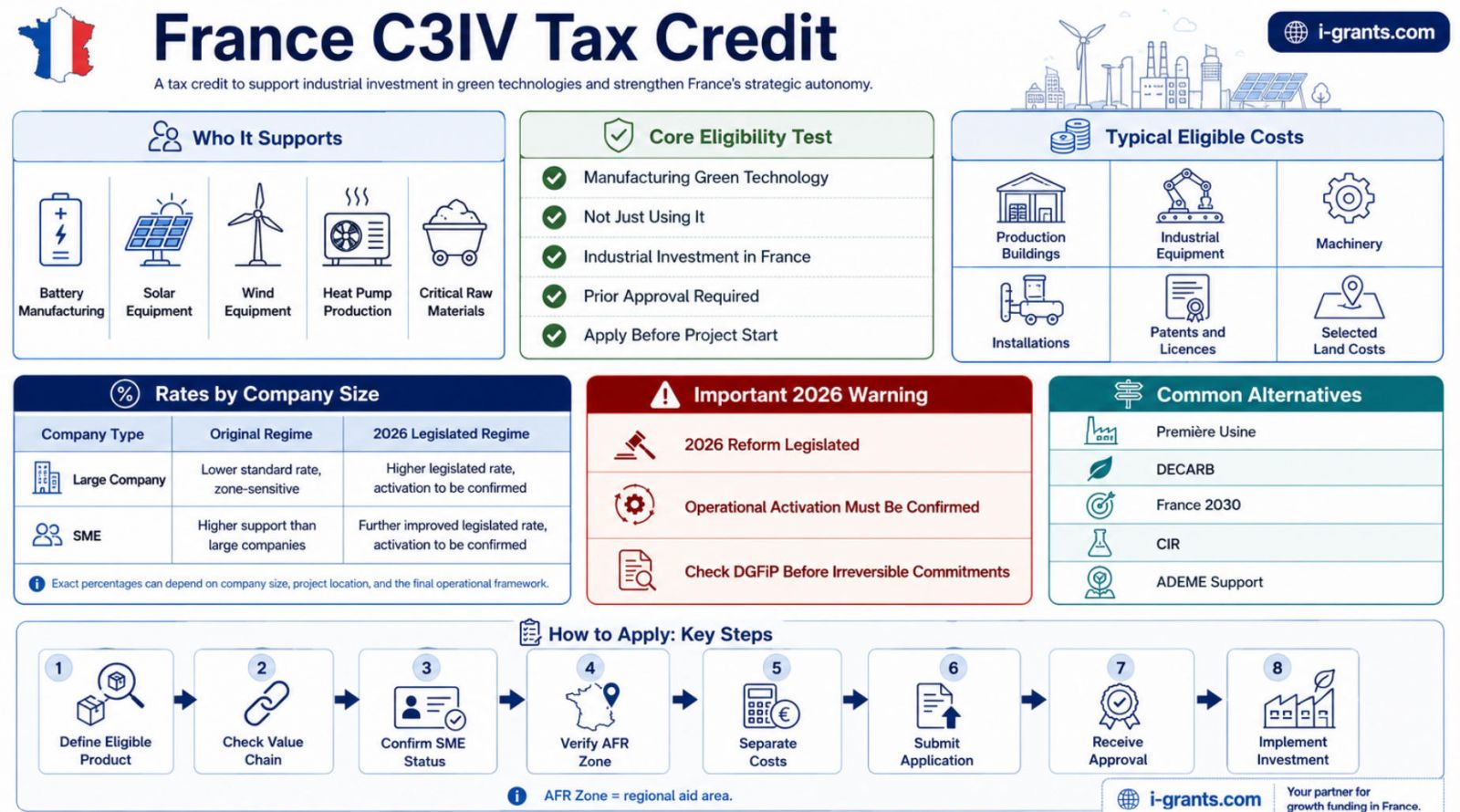
A factory producing heat pumps may qualify. A company purchasing a heat pump for its own premises normally does not. A manufacturer of photovoltaic cells or solar glass may qualify. A business installing solar panels on its roof is not undertaking a C3IV manufacturing project.
This distinction makes C3IV different from ADEME energy efficiency schemes, industrial decarbonisation programmes and renewable heat support. It is designed to build industrial capacity within strategic green technology value chains, not to subsidise every environmentally beneficial investment.
The programme is particularly relevant to manufacturers, industrial startups, SMEs, mid-cap companies and international groups planning a French production site. However, its 2026 legal status requires careful attention. France has legislated an extension and redesign of C3IV, but applicants must distinguish between the original rules and the new regime introduced by the 2026 Finance Act.
What is C3IV?
C3IV stands for Crédit d’impôt au titre des investissements dans l’industrie verte. It was created through the 2024 Finance Act as part of France’s Green Industry strategy and entered into operation in March 2024.
The tax credit supports investment connected with four strategic sectors:
-
batteries;
-
solar panels;
-
wind turbines;
-
heat pumps.
Support may extend beyond the final equipment manufacturer. Producers of specified essential components and companies extracting, processing, recovering or recycling certain critical raw materials may also qualify when their activities are sufficiently connected to an eligible value chain.
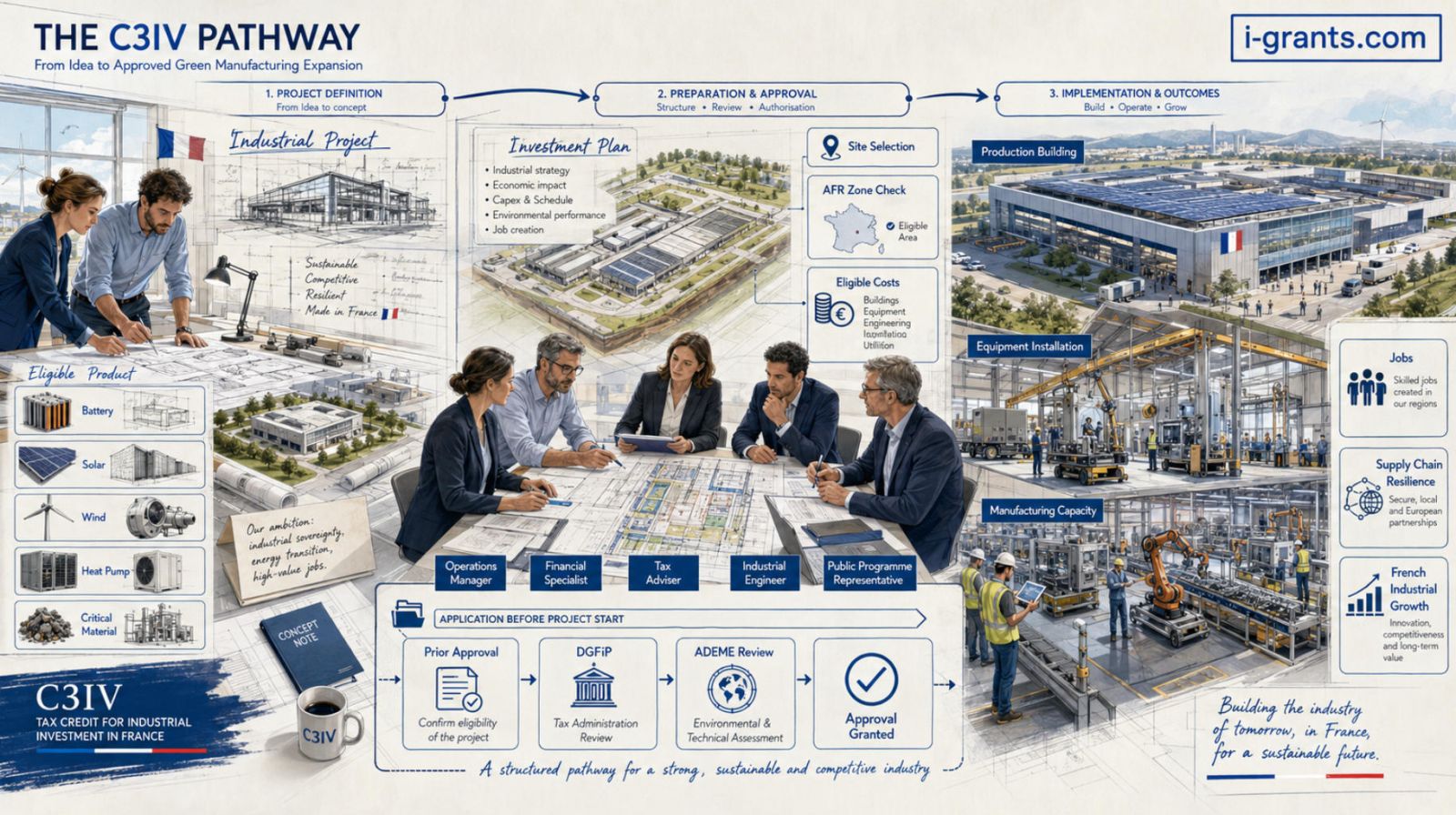
The company must obtain prior approval, known as an agrément, from the French tax administration. The investment plan is examined by the Direction générale des Finances publiques, with technical participation from ADEME and the Direction générale des Entreprises.
C3IV is not awarded through a competitive ranking in the same way as many France 2030 calls. A company does not wait for a fixed annual deadline or compete for a limited number of winner positions. Instead, the administration assesses whether the company, project, expenditure and financing structure satisfy the statutory conditions.
The tax credit is calculated on eligible investment costs as they are incurred. Before the 2026 reform becomes operational, the applicable legal framework, rate and cumulation method must be confirmed in the approval process.
The critical 2026 status: extended by law, but subject to operational activation
The 2026 Finance Act legislated a major extension and redesign of C3IV. It provides for approvals to continue until 31 December 2028, introduces new rates, modifies eligible activities and changes the rules for combining the tax credit with other public support.
However, Article 39 of the Finance Act states that these changes enter into force on a date established by decree after the French government receives confirmation that the scheme complies with EU State aid law. The law also sets a maximum period of three months after that confirmation for activation.
As of 29 July 2026, the consolidated version of Article 244 quater I displayed by Légifrance still contains the original C3IV rates, the original 50 percent customer test for component projects and the former State aid framework. The separate activation decree for the redesigned regime was not identified in the official sources reviewed for this article.
At the same time, a 2026 government guide already describes the redesigned programme, including rates beginning at 15 percent and project-level ceilings. This creates a transitional situation in which policy documents present the future framework while the consolidated tax code continues to display the original operational provisions.
Table 1. C3IV legal and operational timeline
| Date | Development | Practical meaning |
|---|---|---|
| 29 December 2023 | C3IV created through the 2024 Finance Act | The initial legal framework was established |
| 8 January 2024 | European Commission authorised the original French scheme | EU State aid approval was secured |
| 14 March 2024 | Initial C3IV scheme entered into force | Companies could receive approvals under the original framework |
| 31 December 2025 | Original approval period ended | The initial State aid framework could no longer support new approvals |
| 19 February 2026 | 2026 Finance Act adopted | C3IV was legislatively extended and redesigned |
| 2026 | New French scheme received EU State aid clearance | A major condition for continuation was fulfilled |
| 31 December 2028 | Planned final approval date under the redesigned regime | Approval must be issued by this date once the reform becomes operational |
The 2026 law includes transitional provisions for applications submitted from 1 October 2025 that had not received approval by 31 December 2025. The examination period for these files is intended to begin once the redesigned regime enters into force.
For applicants, the practical conclusion is not that C3IV has disappeared. The official DGE page continues to provide an application route and a dedicated DGFiP contact. The conclusion is that a company should not base a multimillion-euro investment decision solely on a summary webpage or an assumed rate. It should obtain written confirmation of the applicable legal basis, rate and timetable before signing binding contracts or opening a construction site.
Which companies can qualify?
C3IV is open to industrial and commercial companies taxed in France under an actual-profit regime, including certain companies benefiting from specified tax exemptions.
The mechanism is not reserved for large industrial groups. Small and medium-sized enterprises can qualify and may benefit from enhanced rates. Foreign-owned companies may also be eligible when the supported investment is carried out through an appropriate taxable establishment in France.
The main company-level conditions include:
-
The applicant must not be an undertaking in difficulty under the applicable EU State aid definition.
-
It must comply with its tax, social security and annual accounts filing obligations.
-
It must not have transferred an identical or similar activity from another EU or European Economic Area country during the relevant previous period.
-
It must not transfer the supported activity outside France during the required post-investment period.
-
It must keep eligible assets in operation in France for at least five years, reduced to three years for SMEs.
-
The supported activity must have the necessary environmental permits and operate in accordance with environmental law.
The French SME definition follows the European approach. A company must consider not only its own employees, turnover and balance sheet, but also relevant partner and linked enterprises. A French subsidiary belonging to a large international group cannot claim an SME rate merely because the subsidiary itself has fewer than 250 employees.
No general statutory minimum project cost is stated in the core C3IV rules. Nevertheless, the approval process requires detailed technical, financial, tax and industrial analysis. In practice, C3IV is better suited to substantial manufacturing investments than to the purchase of a small number of standard machines.
Which industrial activities are eligible?
C3IV is organised around four defined manufacturing value chains. Eligibility depends on the precise product being manufactured, not simply on whether the company describes itself as green, sustainable or involved in the energy transition.
Table 2. Main C3IV manufacturing routes
| Value chain | Potentially eligible activity | Important limitations |
|---|---|---|
| Batteries | Battery cells, qualifying modules, cathode and anode materials, electrolytes, separators, collectors, metal foils and certain critical materials | Module production may need to be associated with cell production of equivalent capacity under the redesigned rules |
| Solar panels | Photovoltaic or hybrid cells, qualifying modules, photovoltaic-grade polysilicon, silicon ingots and wafers, solar glass, trackers, support structures and inverters | Installing imported panels or operating a solar farm is not equivalent to manufacturing eligible solar equipment |
| Wind turbines | Onshore and offshore turbines, towers, blades, nacelles, foundations, substations, connection cables and other specified components | The component must have a direct and documented role in the eligible wind manufacturing chain |
| Heat pumps | Heat pumps of different technologies, compressors, heat exchangers, control systems, hydraulic components and refrigeration circuits | Purchasing or installing a heat pump for internal use does not create an eligible manufacturing project |
| Critical raw materials | Extraction, production, transformation, recovery and qualifying recycling of materials required by the four eligible chains | A general mining, metals or recycling project is not automatically eligible |
The statutory framework is supplemented by a ministerial list defining eligible equipment, essential components and raw materials. This makes product-level analysis essential.
A battery project, for example, may involve cells, cathode active material, anode material, electrolytes, separators or specific metal foils. A solar project may concern photovoltaic cells, silicon wafers, solar glass or inverters. A wind project may involve turbine blades, towers, nacelles, foundations or specialist cables.
A product used across many industrial sectors requires additional scrutiny. A general-purpose electronic controller, standard steel component or ordinary industrial cable is not automatically eligible merely because one customer manufactures heat pumps or wind turbines.
The 50 percent revenue test
Under the original rules displayed in the consolidated tax code, a component producer’s investment plan must show that at least 50 percent of the relevant project revenue will be generated with companies manufacturing eligible final equipment in the corresponding sector.
The 2026 reform changes this approach. Instead of relying only on a revenue threshold, the new law focuses more directly on whether the component or raw material meets the technical requirements of eligible equipment and supply chains.
However, the 2026 government reindustrialisation guide still refers to the 50 percent revenue condition for component producers. Until the redesigned regime and its implementing list are fully operational, companies should treat this as an issue requiring written clarification rather than assuming that the old test has already disappeared.
Manufacturing green technology is not the same as using it
The most common misunderstanding is to confuse C3IV with a general green investment incentive.
Table 3. Projects that may and may not fit C3IV
| Proposed investment | Likely C3IV position | More appropriate alternative where C3IV does not fit |
|---|---|---|
| New French factory producing heat pumps | Potentially eligible | C3IV, subject to approval |
| Expansion of a photovoltaic cell manufacturing line | Potentially eligible | C3IV |
| Production of an eligible battery component | Potentially eligible | C3IV, subject to supply-chain conditions |
| Refining lithium for battery production | Potentially eligible | C3IV and potentially separate France 2030 support for distinct costs |
| Solar panels installed on a warehouse roof | Not a C3IV manufacturing project | Regional energy support, tax or energy efficiency instruments |
| Heat pump installed to decarbonise an existing factory | Not a C3IV manufacturing project | ADEME, Fonds Chaleur or another decarbonisation scheme |
| Research into a new battery chemistry | R&D expenditure is not the main C3IV investment base | CIR, i-Nov, i-Démo or another R&D programme |
| First factory for an innovative medical device | Outside the four C3IV sectors | Première Usine or another industrialisation route |
| Replacement of old machinery without new green production capacity | Normally excluded as replacement expenditure | Industrial modernisation or regional investment support |
This distinction should be tested before the company spends significant resources on an application. The project title, marketing materials or environmental impact are less important than the exact production activity and the assets used to perform it.
Which costs can be eligible?
C3IV primarily supports capital investment. The eligible base may include tangible and intangible assets required for the approved manufacturing activity.
Table 4. Indicative treatment of C3IV project costs
| Cost category | Indicative treatment | Key condition |
|---|---|---|
| Production buildings | Potentially eligible | Necessary for the approved industrial activity |
| Industrial installations | Potentially eligible | Directly connected with eligible production |
| Machinery and equipment | Potentially eligible | Must generally represent new productive investment rather than ordinary replacement |
| Land beneath qualifying equipment | Potentially eligible | Limited to land necessary for the relevant equipment |
| Patents and licences | Potentially eligible | Recorded as assets, depreciable and acquired on market terms |
| Know-how and other intellectual property | Potentially eligible | Primarily used by the approved production facility |
| Certain rights to occupy public property | Potentially eligible | Must create an appropriate real right connected with the project |
| Employee salaries | Normally outside the investment base | Operating expenditure rather than an eligible capital asset |
| Training costs | Normally outside C3IV | May require a separate workforce programme |
| Research and development | Not automatically part of the C3IV base | May qualify under CIR or a separate France 2030 instrument |
| Working capital and inventory | Not eligible as production assets | Requires debt, equity or working-capital financing |
| Marketing and sales expenditure | Not eligible | Not part of the eligible manufacturing asset base |
| Assets purchased from a linked company | Normally excluded | Eligible assets should be acquired from an unrelated third party |
Eligible tangible assets include buildings, installations, equipment, machinery and the land required for the operation of that equipment. Eligible intangible assets can include patents, licences, know-how and other intellectual property rights.
The intangible asset must normally be recorded on the beneficiary’s balance sheet, depreciable, used primarily in the supported production facility and acquired on market terms from an unrelated party.
The eligible amount is generally based on acquisition or production cost, excluding taxes and general charges but including direct expenditure necessary to place the asset into operational condition.
Assets used partly for an eligible activity and partly for another activity require a defensible allocation method. A company should document floor space, machine hours, production volumes, technical capacity or another objective allocation key.
C3IV rates and maximum amounts
The rate depends on three variables:
-
company size;
-
location of the investment;
-
applicable C3IV legal regime.
Under the original scheme, the base rate is 20 percent. It increases to 25 percent or 40 percent in specified regional aid areas. Medium-sized enterprises receive an additional 10 percentage points, while small enterprises receive an additional 20 percentage points.
The 2026 Finance Act redesign reduces the starting rates by five percentage points. The future base rate is 15 percent, rising to 20 percent or 35 percent in the relevant regional aid areas. Medium and small enterprises continue to receive enhancements of 10 and 20 percentage points respectively.
Because the redesigned rules require an activation decree, the new rates should be described as the legislated 2026 framework, not automatically assumed to apply to every current application.
Table 5. Original C3IV rates and legislated 2026 rates
| Company size and location | Original regime | Legislated 2026 regime |
|---|---|---|
| Large company outside an AFR area | 20 percent | 15 percent |
| Large company in an AFR C area | 25 percent | 20 percent |
| Large company in an AFR A area | 40 percent | 35 percent |
| Medium-sized company outside an AFR area | 30 percent | 25 percent |
| Medium-sized company in an AFR C area | 35 percent | 30 percent |
| Medium-sized company in an AFR A area | 50 percent | 45 percent |
| Small company outside an AFR area | 40 percent | 35 percent |
| Small company in an AFR C area | 45 percent | 40 percent |
| Small company in an AFR A area | 60 percent | 55 percent |
The original ceilings are EUR 150 million, EUR 200 million and EUR 350 million depending on project location, assessed at company or linked-group level under the original framework.
The 2026 redesign changes the calculation to a project basis. The legislated ceilings remain EUR 150 million outside the relevant regional aid areas, EUR 200 million in AFR C areas and EUR 350 million in AFR A areas. Where a project covers several sites, the location representing the largest portion of eligible expenditure can determine the relevant rate and ceiling.
A 2026 government guide presents a practical range of 15 to 40 percent and refers to ceilings of EUR 150 million per project, or EUR 200 million in an AFR area. That simplified presentation may not reflect every higher-rate area or every statutory scenario, which is another reason to calculate the rate using the formal legal text and the precise location of the investment.
Illustrative calculation
Consider a small independent manufacturer planning EUR 12 million of approved eligible investment in an AFR C area.
Under the legislated 2026 rate table, the potential rate would be 40 percent:
EUR 12 million × 40 percent = EUR 4.8 million
This is only an initial theoretical amount. The final credit could be affected by:
-
excluded expenditure;
-
other public support allocated to the same costs;
-
the applicable aid ceiling;
-
changes to the investment plan;
-
the final approval decision;
-
the operative legal regime at the time of approval.
The company should therefore avoid treating the maximum theoretical tax credit as confirmed financing before receiving the agrément.
The start-of-work rule can determine the entire outcome
C3IV must be requested before the project begins.
This does not refer only to the physical start of production. It can include the first legally binding commitment that makes the investment irreversible.
Depending on the asset, the relevant event may include:
-
placing a binding equipment order;
-
beginning the in-house manufacture of an eligible asset;
-
opening a construction site;
-
signing a binding construction or supply contract;
-
entering into the relevant public-property occupation arrangement.
French tax guidance indicates that work may begin after the administration has received the approval application, even if the final decision has not yet been issued. However, the company proceeds at its own risk. If approval is refused or the project scope is narrowed, expenditure already incurred may remain unsupported.
The safest approach is to submit a complete application before any binding commitment and to identify the proposed start date explicitly in the project schedule.
Preliminary studies, non-binding market consultations and preparation of permit applications may not necessarily constitute the start of works, but every early contract should be reviewed. A letter of intent, equipment reservation, deposit or framework agreement can contain binding clauses even when the commercial team describes it as preliminary.
How the C3IV approval process works
The company submits its application to DGFiP using the designated C3IV route. The file is reviewed with technical input from ADEME and industrial-policy input from the Direction générale des Entreprises.
The usual preparation sequence is:
-
Define the exact equipment, component or raw material to be produced.
-
Match the product with the statutory and implementing lists.
-
Establish the legal SME or group status of the applicant.
-
Map the site against the applicable AFR classification.
-
Separate eligible capital investment from R&D, operating expenditure and working capital.
-
Submit the approval request before any binding start of works.
The investment plan should explain the production process, technical capacity, customers, supply chain, site, expenditure, financing, implementation schedule, permits and expected industrial impact.
Under the 2026 redesign, the Ministry of the Economy is expected to assess the project’s economic interest. The assessment can consider its consistency with the EU Net-Zero Industry Act, the needs of the eligible sectors and its impact on supply-chain resilience.
This means that formal product eligibility may not be sufficient. A technically eligible project with weak financing, uncertain demand, excessive dependence on one supplier or little strategic value may face difficulties during assessment.
What should the application file demonstrate?
A robust application should allow the administration to understand the project without reconstructing it from disconnected engineering, tax and financial documents.
The file should normally demonstrate:
-
A precise eligible product and its position in the relevant value chain.
-
A technically credible industrial process with defined production capacity.
-
A cost schedule identifying each asset, supplier, delivery date and accounting treatment.
-
A financing plan covering equity, debt, public support and working capital.
-
A realistic implementation schedule that protects the start-of-work rule.
-
Evidence of customers, market demand, supply security, environmental permits and long-term operation in France.
For component manufacturers, customer evidence may be particularly important. Letters of intent, long-term supply agreements, technical specifications and sales forecasts can help demonstrate that the product is genuinely intended for an eligible value chain.
For a critical raw material project, the applicant should show how the material will serve eligible battery, solar, wind or heat pump production. Merely producing a material included on a broad European critical materials list may not be enough.
A professional grant writer can help coordinate the industrial narrative, work plan, budget logic, evidence matrix and interaction between C3IV and other public funding. However, the final file also requires specialist tax, legal, accounting and engineering validation. C3IV should not be treated as a standard grant-writing exercise alone.
Can C3IV be combined with France 2030 or other support?
C3IV may be combined with other public support, but the same cost cannot be financed twice without respecting State aid limits.
Under the original regime, public aid received for expenditure included in the C3IV base is deducted from that base. Cumulated support must remain within the applicable aid rate, ceiling and total eligible cost.
The legislated 2026 regime introduces a revised cumulation approach. Support for different identifiable costs may be combined. Where several measures cover the same eligible costs, total support must remain within the highest applicable aid intensity or amount. The total public support for the investment may not exceed 75 percent of eligible costs.
Table 6. How C3IV can fit into a wider financing structure
| Project component | Potential funding route |
|---|---|
| Fundamental or industrial research | CIR, collaborative research credit or a France 2030 R&D call |
| Prototype and experimental development | i-Nov, i-Démo or another innovation programme |
| First industrial demonstration | France 2030 or an ADEME-managed programme |
| Production building and manufacturing line in an eligible C3IV sector | C3IV |
| Decarbonisation of auxiliary factory processes | DECARB, Fonds Chaleur or another ADEME instrument |
| Employee recruitment and training | Regional, employment or professional training support |
| Working capital and customer-order financing | Bank finance or Bpifrance instruments |
| Non-eligible commercial expansion | Equity, debt or company resources |
A company developing a new battery component could therefore use an R&D tax credit for laboratory research, France 2030 support for a pilot demonstration and C3IV for the later production line.
The budgets must be separated. The company should maintain an asset-level register showing which costs are included in each support request. Shared expenditure should have a documented allocation method.
When should a company choose C3IV instead of another programme?
C3IV is most appropriate when the central challenge is financing new manufacturing assets in one of the four eligible green technology chains.
Première Usine may be more appropriate when an innovative startup or SME is building its first factory but the product falls outside C3IV. DECARB FLASH or DECARB IND may be more appropriate when an existing factory is reducing emissions from its own industrial process. CIR, CII, i-Nov and i-Démo are more relevant when the main expenditure concerns research, prototypes or experimental development.
Table 7. Choosing between C3IV and other French funding routes
| Main project objective | Most relevant route |
|---|---|
| Manufacture batteries, solar equipment, wind equipment or heat pumps | C3IV |
| Manufacture a qualifying essential component or critical raw material | C3IV, subject to detailed value-chain analysis |
| Build the first factory for another innovative product | Première Usine |
| Conduct industrial R&D or develop a demonstrator | CIR, i-Nov, i-Démo or another France 2030 programme |
| Reduce emissions from an existing factory | DECARB FLASH, DECARB IND, AO GPID or Fonds Chaleur |
| Modernise production without an eligible green technology output | Regionalised France 2030, regional aid or another industrial investment instrument |
| Finance working capital or equipment outside the eligible base | Bpifrance or commercial financing |
The choice should be made at cost-line level rather than only at project-title level. One large industrial programme may contain several distinct financing routes.
What has C3IV achieved so far?
The most detailed official results available for the initial scheme cover the period to 3 October 2025.
By that date, the tax administration had received 109 applications. It had issued 72 decisions, of which 34 resulted in approvals. The approved projects represented almost EUR 1.8 billion in maximum tax credits. All submitted applications together represented more than EUR 27 billion in potential investment, but that figure should not be described as completed or confirmed investment.
Table 8. Confirmed C3IV approvals by sector as of 3 October 2025
| Sector | Number of approvals | Maximum approved tax credit |
|---|---|---|
| Batteries | 12 | Approximately EUR 1.1 billion |
| Solar technologies | 3 | EUR 389 million |
| Wind energy | 7 | EUR 239 million |
| Heat pumps | 12 | EUR 57 million |
| Total | 34 | Almost EUR 1.8 billion |
Battery projects accounted for approximately one-third of approvals but more than 60 percent of the approved tax credit amount. Heat pump projects matched batteries in number of approvals, although their average support amount was much lower.
The applications were concentrated in major industrial regions, including Hauts-de-France, Grand Est, Normandy and Auvergne-Rhône-Alpes. Nearly half of the applications still under review came from SMEs and mid-cap companies, indicating that C3IV is not limited to multinational manufacturers.
A separate DGE webpage states that C3IV has supported more than 70 projects. That broader figure should not be presented as equivalent to the 34 confirmed approvals reported as of 3 October 2025. The difference may reflect a later reporting date or a wider definition of supported projects, but the public webpage does not provide the same sector-by-sector approval breakdown.
Examples of supported industrial projects
Official reporting identifies several projects associated with C3IV.
The Siemens Gamesa project in Le Havre concerns the modernisation of an offshore wind turbine blade factory. The official evaluation associates the investment with 700 direct and indirect jobs.
Carester’s CAREMAG project in Lacq concerns the separation of heavy rare earths and the recycling of permanent magnets. Official materials describe planned annual production of more than 500 tonnes of dysprosium, 100 tonnes of terbium and 800 tonnes of light rare earths. The project is associated with 92 jobs in Lacq and 13 in Vénissieux.
The Carester project illustrates how several instruments can support different parts of one industrial strategy. French public support involves France Relance, France 2030 and C3IV, alongside substantial Japanese investment. The combined support does not mean that the same invoice is funded several times. It reflects a structured financing package covering distinct activities and cost categories.
Groupe Atlantic has also been cited in relation to a heat pump production site associated with 300 jobs. These employment figures should be treated as project-linked commitments or expected effects unless later evidence confirms the number of positions actually created and maintained.
Approved support is not the same as completed investment
C3IV reporting contains several types of figures that should not be confused.
An application means a company requested approval. It does not mean support was granted.
An approval confirms that a defined investment plan can qualify for a maximum tax credit, subject to implementation and compliance. It does not prove that the full amount has already been claimed or paid.
An investment announcement represents a company’s plan. It may later be reduced, delayed, restructured or cancelled.
A forecast production capacity describes expected future output. It is not current production.
A job commitment or project estimate does not necessarily equal the final number of permanent employees.
When C3IV was introduced, the French government estimated that it could generate EUR 23 billion in investment and 40,000 direct jobs by 2030. These figures remain policy expectations, not completed results. The 2024 DGE activity report itself uses prospective language when presenting them.
Common C3IV application risks
The most serious risks usually arise before the formal tax calculation.
A company may select a product that is environmentally useful but not included in an eligible manufacturing chain. It may assume that every component sold to a battery or heat pump company qualifies. It may use an incorrect SME classification by ignoring its shareholders or linked enterprises.
Other risks include signing an equipment contract before submitting the application, including ordinary replacement expenditure, purchasing assets from a related company, using weak customer evidence or combining several support schemes without separating their costs.
Location errors can also be expensive. A project may use the wrong AFR classification or assume that a regional incentive automatically produces a higher C3IV rate. The classification must be checked for the precise municipality and against the legally relevant version of the regional aid map.
Finally, an applicant may confuse a technically possible maximum with an approved amount. The tax credit rate is only one part of the calculation. The eligible cost base, State aid cumulation, project ceiling and approval conditions are equally important.
A practical preparation strategy
A company considering C3IV should begin with a short eligibility memorandum before commissioning a full application.
The memorandum should identify the applicant, ownership structure, manufacturing product, customer chain, proposed site, planned assets, total investment, other public support and earliest binding commitment date.
If the initial analysis is positive, the company can build an integrated application model containing:
-
a technical production plan;
-
an eligible asset register;
-
a customer and supply-chain evidence file;
-
a financing and State aid matrix;
-
a permit schedule;
-
a start-of-work control procedure.
The finance team should prevent procurement staff from placing binding orders before the application is submitted. The engineering team should connect each asset to a production stage. The legal team should review contracts, environmental permits, group relationships and relocation conditions.
The grant writer or public funding adviser should ensure that the industrial narrative, cost model and evidence are consistent across the application. C3IV files become vulnerable when the engineering description, financial spreadsheet and commercial forecast present different versions of the same project.
Final assessment
C3IV can be one of the most valuable French incentives available to a qualifying green technology manufacturer. For an SME establishing a battery component, solar, wind or heat pump production facility, the potential support may represent a substantial share of eligible capital investment.
Its value is matched by its complexity.
The company must be manufacturing an eligible product, not merely purchasing green technology. It must define the relevant value chain, establish its true enterprise size, identify the correct regional rate, separate eligible assets from R&D and operating expenditure, submit before the start of works and manage State aid cumulation.
For a well-prepared manufacturer, C3IV can anchor the capital expenditure portion of a wider financing structure. Research support, France 2030 funding, regional assistance, private investment and debt can then be added around it, provided each instrument covers clearly identified costs and the combined support remains within State aid limits.
The strongest applications will not simply claim that a project is green. They will demonstrate that it creates credible, financeable and strategically important manufacturing capacity within France’s clean technology supply chains.