

 Français
  Deutsch
  Українська
Food manufacturers in Wallonia can access several layers of public investment support, but there is no single grant that applies to every bakery, dairy processor, beverage producer, frozen-food company or industrial food plant. The amount of aid can change dramatically depending on what the company manufactures, where its production site is located, whether the investment expands productive capacity, whether new jobs are created, and whether the project reduces energy use or environmental impact.
This distinction matters because the strongest funding route is not always the most obvious one. A programme specifically referring to agricultural-product processing may appear to be the natural choice for a food company, yet some finished products fall outside its agricultural-product rules, and the dedicated SME budget can be extremely limited. Conversely, a general Walloon investment premium may support a much broader manufacturing project, while GREEN aid can be particularly valuable for industrial refrigeration, process energy efficiency and environmental investment.
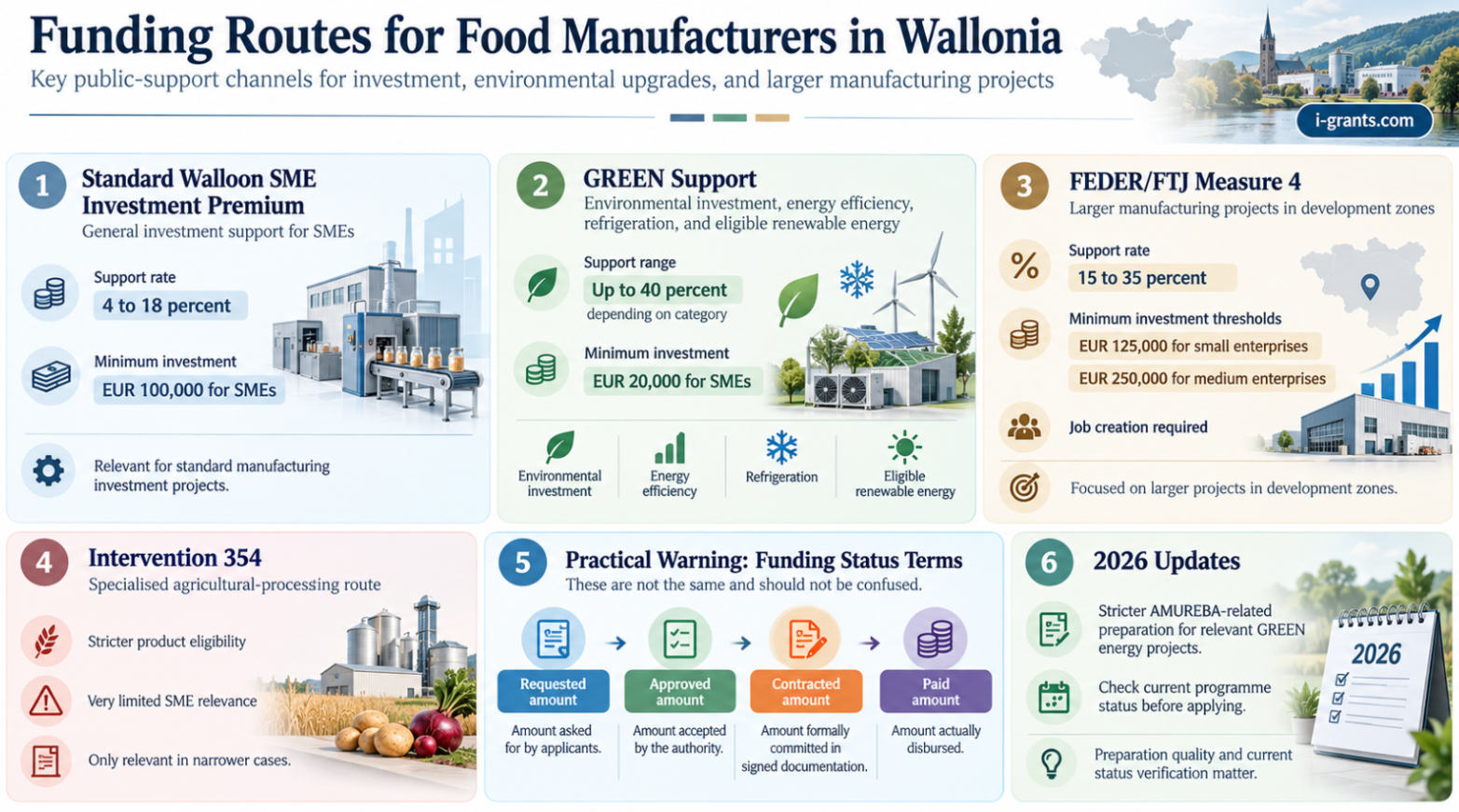
As of 24 September 2026, the most important funding routes for a food manufacturing SME in Wallonia are the standard regional investment premium, GREEN investment aid, FEDER/FTJ co-financed investment support and, for a narrower group of agricultural processors, CAP Intervention 354. Two additional 2026 initiatives are also relevant: a major industrial decarbonisation call for companies participating in the Conventions Carbone and the new Boost4Circularity call for circular industrial projects.
The Walloon food sector is large enough for these programmes to matter economically. Official 2023 figures published by AWEX put sector turnover at approximately EUR 11.6 billion, with 25,906 jobs and around EUR 2.1 billion in exports. Le Forem separately recorded 1,622 food-processing establishments and 25,981 salaried jobs in Wallonia at the end of 2023. About three quarters of the establishments had fewer than ten workers, showing why investment rules designed for smaller companies are particularly relevant to this industry.
The funding landscape for a Walloon food manufacturer
The first mistake a business should avoid is starting with the name of a grant. The better starting point is the investment itself.
A EUR 150,000 filling line that expands production capacity belongs to a different funding category from a EUR 150,000 refrigeration upgrade designed primarily to reduce energy consumption. A EUR 2 million factory expansion creating six jobs may qualify for a European co-financed investment route that would not be available to a smaller replacement project. A dairy processor producing an agricultural product can also face a different legal framework from a chocolate, biscuit or beer manufacturer.
Table 1. Main funding routes for food manufacturers in Wallonia
| Funding route | Status as of 24 September 2026 | Indicative aid level | Main financial threshold | Best suited to |
|---|---|---|---|---|
| Standard Walloon SME Investment Premium | Available | 4 to 18 percent | EUR 100,000 minimum SME investment | New production capacity, expansion, productive machinery, substantial modernisation |
| GREEN Environmental Aid | Available | 15 to 40 percent of the relevant additional cost | EUR 20,000 minimum for SMEs | Environmental performance, resource efficiency, pollution reduction |
| GREEN Energy Efficiency | Available | 20 to 40 percent of the relevant additional cost | EUR 20,000 minimum for SMEs | Lower-energy production processes and industrial systems |
| GREEN Renewable Energy | Available | 4 to 40 percent | EUR 20,000 minimum for SMEs | Eligible renewable-energy technologies |
| GREEN Refrigeration Support | Available | 15 to 40 percent of the relevant additional cost | EUR 20,000 minimum for SMEs | Replacement or upgrading of eligible industrial refrigeration systems |
| FEDER/FTJ Measure 4 | Available for qualifying projects | 15 to 35 percent | EUR 125,000 for small enterprises, EUR 250,000 for medium enterprises | Larger manufacturing investment in development zones |
| CAP Intervention 354 | Legally exists, but SME funding availability is highly constrained | Base aid can start at 10 percent, subject to specific CAP rules | Sector-specific rules | Transformation or marketing of qualifying agricultural products |
| 2026 Industrial Decarbonisation Call | Open until 25 September 2026 | Grants and subsidised loans | Environmental performance thresholds apply | Major decarbonisation investments by Convention Carbone participants |
| Boost4Circularity | Open until 12 October 2026 at 13:00 | No direct grant | No standard investment minimum | Structuring circular industrial projects and connecting them to public support tools |
These instruments should not be treated as interchangeable. A company may technically be a food manufacturer and still be excluded from one route while fitting another very well.
The standard Walloon SME Investment Premium is the main starting point
For many food manufacturers planning substantial productive investment, the standard Walloon SME Investment Premium is the most important programme to examine first.
The scheme supports companies with an establishment in Wallonia that are creating, expanding or significantly developing productive activity. For SMEs, the eligible investment programme must generally reach at least EUR 100,000. The aid rate depends primarily on company size, project quality and whether the investment site is located inside a recognised development zone.
The programme does not work as a simple reimbursement of a fixed percentage for every machine purchased. Wallonia uses a scoring system designed to favour projects that contribute to economic development, employment and industrial eco-performance. A company must reach at least 30 points to qualify and must satisfy conditions across the relevant assessment structure.
Economic criteria can reward innovation, strategic relevance and certain company-development situations. Employment criteria reward the preservation and especially the creation of jobs. Industrial eco-performance can contribute up to 30 points, including points for decarbonisation and circular-economy performance.
For a food manufacturer, this creates an important project-design opportunity. A production-line project that simultaneously introduces a new process, increases capacity, creates employment and materially reduces energy consumption can be substantially stronger than a proposal presented merely as replacement of ageing equipment.
Table 2. Standard Walloon SME Investment Premium rates
| Enterprise size and score | Outside a development zone | Inside a development zone |
|---|---|---|
| Small enterprise, 30 to 49 points | 6 percent | 11 percent |
| Small enterprise, 50 to 59 points | 10 percent | 15 percent |
| Small enterprise, 60 to 100 points | 13 percent | 18 percent |
| Medium enterprise, 30 to 49 points | 4 percent | 9 percent |
| Medium enterprise, 50 to 59 points | 8 percent | 13 percent |
| Medium enterprise, 60 to 100 points | 10 percent | 15 percent |
The standard investment premium is normally capped at EUR 7.5 million, except for certain projects treated separately as strategically important to Wallonia.
The rate table also demonstrates why location is not a secondary detail. The same small enterprise scoring 60 points can theoretically move from a 13 percent rate outside a development zone to 18 percent in a development zone. On a EUR 1 million eligible investment programme, that difference would represent EUR 50,000 in potential public support.
However, those rates are not promises. They apply only after the administration confirms the eligible investment base, company category, location, scoring criteria and compliance with the applicable state-aid framework.
Replacement is not the same as eligible modernisation
This is one of the most important practical rules for an established food factory.
An ordinary like-for-like replacement of worn, obsolete or damaged equipment is generally not the strongest basis for a standard investment premium. Regional investment support is intended to encourage economic development rather than finance normal depreciation.
Consider a food producer replacing an old EUR 120,000 packaging machine with a newer machine that performs essentially the same function at the same capacity. The expenditure may be commercially sensible, but simply describing it as "modernisation" does not automatically make it grant eligible.
The funding logic becomes stronger if the new system increases capacity, changes the production process, enables a new product range, introduces measurable automation, materially improves resource efficiency or forms part of a wider expansion programme.
This distinction should be made before suppliers are asked to finalise the project specification. Grant strategy is therefore not just an administrative exercise performed after the investment plan has been designed. It can affect how the investment itself is structured.
Other commonly problematic expenditure can include goodwill, shares, ordinary stocks, many second-hand assets, spare parts, certain vehicles and assets primarily intended for rental. Fossil-fuel heating investments are also increasingly incompatible with the direction of Walloon investment policy.
Do not order machinery before the application sequence is protected
Timing is one of the easiest ways to lose access to investment aid.
For the standard investment premium, the company must submit a request for authorisation to begin an investment programme before entering into a binding commitment connected with the investment. A signed purchase order, binding supplier agreement or comparable legal commitment can therefore create a problem if it predates the relevant application step.
The date on which the start-authorisation request is submitted is crucial because it establishes the point from which the investment programme may begin under the scheme. This does not mean that the grant has already been approved. A company that proceeds immediately after the permitted start date may still be investing at its own risk until the aid decision is issued.
A valid Passeport Entreprise is also central to the application system. It determines the official company-size category used by the administration. The complete investment-aid application normally follows the initial start-authorisation procedure.
For a food factory ordering specialist machinery with long manufacturing lead times, this timing rule should be built directly into procurement planning. Waiting until a supplier demands a deposit before considering the grant is often too late.
GREEN aid can be more valuable for energy-intensive food production
Food manufacturing can be unusually energy intensive. Refrigeration, freezing, heating, drying, compressed air, steam generation, mixing, cooking, cooling and continuous processing can create significant energy demand.
For this reason, Wallonia's GREEN investment aid deserves separate analysis rather than being treated as a minor addition to the general SME premium.
The minimum eligible investment programme for an SME is EUR 20,000, significantly below the EUR 100,000 threshold for the standard SME investment premium.
GREEN contains four major categories relevant to industrial companies.
Environmental protection support can cover eligible investments designed to go beyond ordinary regulatory compliance or common market practice. Aid generally ranges from 15 to 40 percent of the relevant additional investment cost.
Energy-efficiency support for production processes generally ranges from 20 to 40 percent of the relevant additional cost.
Eligible renewable-energy investment can receive support ranging from 4 to 40 percent, depending on the technology and conditions.
A separate category supports the replacement or upgrading of refrigeration systems, generally at rates from 15 to 40 percent of the relevant additional cost.
The refrigeration category is especially important for dairies, meat processors, frozen-food manufacturers, cold-chain operations, beverage facilities and other businesses where industrial cooling represents a major part of electricity consumption.
A 40 percent GREEN rate does not always mean 40 percent of the invoice
Businesses need to understand the concept of the eligible additional cost.
For several GREEN categories, the aid percentage is not necessarily applied to the entire purchase price. Instead, the administration may calculate the part of the expenditure representing the additional cost of achieving a higher environmental or energy standard compared with an appropriate reference investment.
Suppose a standard industrial system would cost EUR 200,000 and the qualifying high-performance solution costs EUR 260,000. Depending on the relevant GREEN rules and technical baseline, the support calculation may be linked to the incremental EUR 60,000 rather than automatically to the full EUR 260,000.
This makes supplier specifications, technical comparisons and audit methodology highly important. The headline percentage can look generous while the actual aid base is substantially narrower.
A funding model should therefore distinguish at least four numbers: total project cost, theoretically eligible expenditure, approved eligible expenditure and final paid aid.
The AMUREBA requirement became much more important in 2026
One of the most important changes affecting GREEN applications is the progressive tightening of technical preparation requirements.
For sustainable-use-of-energy projects, companies need an AMUREBA audit or an eligible feasibility study performed according to the required methodology by a qualified auditor. The project must also provide for appropriate energy metering and energy accounting so that the actual impact of the investment can later be measured.
During 2025, the audit requirement applied above specified investment thresholds. For process energy-efficiency investments, the threshold was EUR 25,000, while eligible renewable-energy projects were subject to a EUR 100,000 threshold.
From 2026, these thresholds disappear for the relevant categories. The AMUREBA audit or feasibility-study requirement therefore applies to all covered investment programmes, regardless of their value.
For process energy-efficiency investments, the discounted payback period calculated using the AMUREBA methodology must also exceed three years.
This changes the practical order of work. A manufacturer considering a new energy-efficient freezer, oven, industrial dryer, compressor or process system should not first sign the machinery contract and ask whether an audit is needed later. The technical analysis should be integrated into investment preparation before the binding commitment.
GREEN investment programmes must reach at least EUR 20,000 for an SME. They must also start within the applicable period after authorisation and are generally expected to be completed within four years.
Some investments that look green are currently excluded
The word "GREEN" can create misleading expectations.
The current Walloon investment-aid information specifically warns that several common investments do not presently qualify under the GREEN investment scheme, including photovoltaic panels, electricity-storage batteries, electric-vehicle charging points, standard insulation works for roofs, floors and walls, and window frames.
A company should therefore never assume that an investment is eligible simply because it lowers electricity consumption or carbon emissions.
For a food factory, the better questions are whether the equipment belongs to a recognised GREEN category, whether it exceeds the required regulatory or market baseline, whether the technical savings can be documented, and whether the appropriate AMUREBA evidence exists.
This is particularly important when planning a broader factory decarbonisation package. A single project may contain eligible refrigeration or process-efficiency investments alongside non-eligible solar, battery or building-envelope expenditure. Those costs may need to be separated.
FEDER/FTJ can reach 35 percent for larger manufacturing projects
Food manufacturers planning more substantial expansions should examine Measure 4 of the Wallonia 2021-2027 FEDER/FTJ investment framework.
This route is more restrictive than the standard regional premium but can provide materially higher rates.
The project must involve an SME carrying out eligible manufacturing activity and must be located in a recognised development zone. The programme must also satisfy strategic criteria connected with areas such as Wallonia's smart-specialisation priorities, product innovation, digital transformation of production, circular economy or reduction of the carbon and environmental footprint of manufacturing.
Employment creation is compulsory.
A small enterprise must create at least four jobs and present an eligible investment programme of at least EUR 125,000.
A medium enterprise must create at least six jobs and present an eligible investment programme of at least EUR 250,000.
The aid is also limited to EUR 100,000 per job created.
Table 3. FEDER/FTJ Measure 4 for qualifying manufacturing SMEs
| Criterion | Small enterprise | Medium enterprise |
|---|---|---|
| Minimum eligible investment | EUR 125,000 | EUR 250,000 |
| Minimum new jobs | 4 | 6 |
| Base aid level | 20 percent | 15 percent |
| Potential higher rate depending on development-zone category and enhanced criteria | Up to 35 percent | Up to 30 percent |
| Maximum aid linked to employment | EUR 100,000 per job created | EUR 100,000 per job created |
| Final deadline for completing and paying eligible investments | 31 December 2029 | 31 December 2029 |
The project must also respect the Do No Significant Harm principle and the additional accounting, procurement, information and publicity obligations attached to European co-financing.
This is not a realistic route for every small food company. A micro-producer investing EUR 80,000 in one production machine does not meet the investment threshold. A EUR 500,000 expansion that does not create four jobs may also fail a central eligibility test even if the technology itself is excellent.
However, the programme can be highly significant for a growing food manufacturer establishing a new line, expanding a factory or combining automation with circularity, digital production or decarbonisation.
FEDER/FTJ payment is still tied to realised investment
A high co-financing percentage should not be confused with cash available before construction starts.
For qualifying projects below EUR 1 million, the premium can generally be liquidated in two stages. A first tranche representing 40 percent of the awarded premium can be requested after at least 40 percent of the approved investment programme has been realised and paid. The balance follows completion and payment of the programme.
For approved programmes of EUR 1 million or more, the structure can include three stages. The first 40 percent of the premium follows proof that at least 40 percent of the programme has been realised and paid. A further 30 percent of the premium can follow once at least 70 percent of the investment programme has been realised and paid. The remaining balance follows full completion.
The practical consequence is clear: even a company expecting a major public contribution needs sufficient liquidity, bank financing or other capital to carry the investment through the reimbursement milestones.
CAP Intervention 354 needs much more caution than its headline suggests
CAP Intervention 354 supports investment connected with the transformation or marketing of agricultural products and certain diversification activities. Agro-food SMEs are legally included among the potential beneficiaries.
At first sight, that sounds like a dedicated food-manufacturing grant. In practice, eligibility is significantly narrower.
The nature of the input and final product matters. The agricultural-processing route is built around products covered by the agricultural framework, including Annex I classification.
A farmer processing milk into butter or yoghurt is a straightforward example of the intended agricultural transformation logic. Similar issues can arise for meat, fruit, vegetables, cereals and other agricultural commodities.
By contrast, official Walloon guidance identifies finished products such as beer, chocolate, pizza, ice cream and pastries or biscuits as examples of non-agricultural finished products for this specific classification purpose.
A chocolate factory is still a food manufacturer. It simply should not assume that the agricultural-processing route is its correct grant route.
In many cases, standard regional investment aid, GREEN aid or FEDER/FTJ support will be more relevant.
The EUR 500,000 figure can easily be misunderstood
For qualifying companies, Intervention 354 can involve a base level of support and additional intensity linked to specific characteristics such as organic or differentiated-quality production. The overall public-aid framework can permit significant support, and the intervention includes a regulatory ceiling of up to EUR 500,000 per qualifying company over the relevant 2023-2027 programming period.
That does not mean EUR 500,000 is sitting in an open budget for every Walloon food SME.
Current Walloon budget documents tell a much more important story.
The revised budget for Intervention 354 is approximately EUR 10.4 million across its different beneficiary components. Only around EUR 0.2 million is allocated to the SME component over the overall period shown in the current selection-budget document, and the dedicated SME allocation shown for 2026 is zero.
Official AII statistics dated 26 January 2026 also show how limited the SME uptake has been. In the 2023 SME agricultural category, two applications were recorded and neither received a favourable opinion.
For an applicant, the practical lesson is that a legal beneficiary ceiling is not the same as available programme budget.
The figures must be separated carefully:
requested amount is what an applicant asks for;
approved amount is what the authority agrees to award;
contracted or formally committed amount is what becomes legally attached to the project under the applicable procedure;
paid amount is what is actually transferred after the required conditions and expenditure have been verified.
The same distinction should be applied whenever grant statistics are used.
2026 brought additional changes to agricultural investment rules
Wallonia introduced further changes to its agricultural investment framework for the 2026 campaign.
Among them, certain real-estate investments calculated using standardised cost-per-square-metre methodologies are now subject to a limit linked to the first 1,000 square metres of the relevant investment area. Aid also cannot exceed the amount actually invested.
There are also communication obligations associated with sufficiently large FEADER-supported projects. When cumulative public support co-financed by FEADER exceeds the relevant threshold, beneficiaries can be required to display appropriate information or signage.
These requirements may appear minor compared with the grant amount, but they form part of the beneficiary's compliance obligations and can matter during controls.
A very current 2026 decarbonisation opportunity
Wallonia also launched a major industrial decarbonisation call in 2026 with a total financing envelope of slightly more than EUR 39 million.
Approximately EUR 14.4 million is available as grants and up to EUR 25 million as subsidised loans. The 2026 application deadline is 25 September 2026, meaning this opportunity is extremely time-sensitive and should be treated as a current call rather than a permanent programme.
It is also not open to all manufacturers.
The call targets companies participating in Wallonia's Conventions Carbone whose action plans have been validated by the Region. Eligible projects must form part of those plans, be technically mature and demonstrate substantial environmental impact.
The required annual improvement must include at least 500 tonnes of CO2 equivalent savings or at least 1 GWh of final-energy savings.
Projects are assessed partly according to environmental efficiency, including the relationship between the public support requested and the expected environmental or energy gain.
For larger dairies, beverage producers, frozen-food plants or other energy-intensive food manufacturers already participating in a Convention Carbone, this type of call can be much more financially important than a general SME premium.
Wallonia reports that the Conventions Carbone framework covers more than 200 companies and approximately 250 industrial sites representing around 80 percent of industrial energy consumption in the Region. Audits have identified more than 6,000 possible improvement measures through 2031.
Companies outside that framework should not interpret the 2026 call as a general EUR 39 million grant programme for the food sector.
Boost4Circularity is relevant, but it is not a grant
A second edition of Boost4Circularity opened in September 2026, with applications due by 12 October 2026 at 13:00.
One of its four priority value chains is explicitly "Agri-food / bio-based / water", making it highly relevant to food manufacturers working on circular industrial models.
Projects can address issues such as valorisation of food and agricultural by-products, reduction of losses and waste, material loops, treated-water reuse, energy and nutrient recovery, new bio-based ingredients, shared processing or storage infrastructure, and digitalisation of value chains.
An individual company can apply, or a consortium can be led by a company. The project leader must have an operating establishment in Wallonia.
However, Boost4Circularity must not be described as a grant.
The programme provides strategic support, project structuring, a dedicated point of contact, coordination with relevant public actors and assistance in mobilising existing tools for innovation, finance, skills, regulation and internationalisation. It does not itself provide direct investment funding.
The distinction is valuable for a food manufacturer with a complex circular project. Being selected may help the company assemble a financing structure using other instruments, but it does not create a direct cash award from Boost4Circularity.
Which route fits different food manufacturing projects?
The best programme depends more on the economic purpose of the investment than on the fact that the company happens to produce food.
Table 4. Practical funding route by type of food manufacturing project
| Project | First funding route to investigate | Critical eligibility issue |
|---|---|---|
| New production line increasing capacity | Standard SME Investment Premium | EUR 100,000 threshold, scoring and location |
| Expansion in a development zone with significant job creation | FEDER/FTJ Measure 4 | Minimum investment, 4 or 6 new jobs, strategic criteria |
| High-efficiency industrial refrigeration | GREEN | Technical eligibility, incremental cost and AMUREBA requirements where applicable |
| Production-process energy reduction | GREEN Energy Efficiency | Audit, feasibility evidence, metering and documented savings |
| Ordinary like-for-like replacement of worn machinery | Do not assume standard grant eligibility | Simple replacement can be excluded |
| Agricultural processor producing qualifying Annex I output | Standard aid plus examination of Intervention 354 | Product classification and actual available SME budget |
| Chocolate, beer, biscuit, pastry or similar finished-food manufacturer | Standard aid, GREEN and possibly FEDER/FTJ | Do not assume Intervention 354 applies |
| Major decarbonisation by a Convention Carbone participant | 2026 decarbonisation call or successor instruments | Validated action plan and minimum environmental impact |
| Multi-partner circular food-industry project | Boost4Circularity | Strategic support only, not direct grant funding |
Documentation should be built before procurement
The exact document set changes between programmes, but a serious food-manufacturing application should normally be prepared around evidence rather than narrative alone.
Typical preparation can include:
-
a valid Passeport Entreprise confirming the relevant SME category;
-
the establishment and NACE activity information for the site receiving the investment;
-
a detailed investment plan and financing plan;
-
supplier quotations and technical specifications prepared without creating a premature binding commitment;
-
employment data and job-creation projections when employment criteria are used;
-
environmental, energy or circularity evidence where those criteria affect eligibility or scoring;
-
an AMUREBA audit or qualifying feasibility study for relevant GREEN energy projects;
-
invoices, proof of payment and technical evidence required later for reimbursement or liquidation.
A company should also confirm its tax, social-security and environmental compliance before relying on an investment-aid calculation.
One technical detail deserves attention in 2026: Walloon investment-aid files are still being analysed using NACE-BEL 2008 while the broader business-registration environment transitions toward NACE-BEL 2025. An applicant should therefore verify how the activity directly connected with the proposed investment is treated by the Walloon administration instead of relying only on the newest code shown elsewhere.
Cash flow can become the hidden eligibility problem
A food manufacturer can have a highly fundable project and still fail financially if the reimbursement mechanics are ignored.
Most of these instruments should not be treated as advance financing. The business normally has to incur, document and pay eligible expenditure before obtaining the relevant liquidation or reimbursement tranche.
For a EUR 1 million investment with a potential 18 percent regional premium, the theoretical EUR 180,000 subsidy does not remove the need to finance machinery deposits, installation, commissioning, VAT where applicable, working-capital pressure and non-eligible project costs.
GREEN support creates a similar issue. Even if a qualifying investment generates a high percentage of aid, the company must still finance the investment and satisfy the technical verification requirements.
FEDER/FTJ can provide staged liquidation for larger projects, but even there the first payment follows a substantial level of completed and paid investment.
A funding roadmap should therefore combine grant strategy with liquidity planning, bank finance and the timing of supplier payments.
Table 5. Key timing and payment issues
| Funding route | What must happen before a binding order | Can the company assume an advance? | Important payment feature |
|---|---|---|---|
| Standard SME Investment Premium | Start-authorisation request and correct application sequence | No | Partial liquidation may be possible for larger approved programmes after sufficient investment has been realised and paid |
| GREEN | Start-authorisation procedure and required technical preparation | No | Payment depends on eligible realised investment and evidence of environmental or energy performance |
| FEDER/FTJ Measure 4 | Application/start-authorisation procedure before binding commitment | No | Staged liquidation can begin after specified portions of the programme have been realised and paid |
| Intervention 354 | Applicable CAP application and selection requirements | No automatic advance should be assumed | Selection, budget availability and CAP payment rules apply |
| Boost4Circularity | Application before the call deadline | Not applicable | No direct grant is paid |
Real examples show why programme labels need careful interpretation
Historical beneficiary data can provide useful evidence that public investment aid reaches the food sector, but old cases should not be presented as proof of current entitlement.
One example is Chocolatier Galler in Chaudfontaine. Under a previous ERDF-supported investment framework, a recorded project had a total project cost of approximately EUR 537,697.61. The ERDF contribution was approximately EUR 53,769.76, with approximately EUR 53,769.77 from other public authorities.
The case demonstrates that food manufacturing has historically been supported through European regional investment mechanisms. It does not mean a chocolate producer applying in 2026 would receive the same rate or qualify under the current Measure 4.
Another useful example is BIONAT, a mustard and sauces producer in Namur that appears in current European-programme reporting as a company receiving business-development support through a wider BEP-supported project. Here the distinction between direct and indirect beneficiary is essential. The broader project budget cannot be presented as a cash grant paid directly to BIONAT.
A different type of benchmark is the new Leonidas factory in Nivelles. The approximately 30,000-square-metre facility represents an investment of roughly EUR 70 million and includes production and R&D capacity. It is an important example of current food-industry investment in Wallonia, but available official information describes own financing and bank financing rather than presenting Leonidas as a beneficiary of a specific grant for the project.
These distinctions matter because successful investment, subsidised support and direct grant receipt are three different things.
The sector is large, but dominated by smaller establishments
Official statistics help explain why investment support for SMEs is economically relevant.
Table 6. Key indicators for food manufacturing in Wallonia
| Indicator | Latest clearly identified figure used here | Reference period |
|---|---|---|
| Food-sector turnover | Approximately EUR 11.6 billion | 2023 |
| Employment reported by AWEX | 25,906 jobs | 2023 |
| Food-sector exports | Approximately EUR 2.1 billion | 2023 |
| Food-processing establishments reported by Le Forem | 1,622 | December 2023 |
| Salaried jobs reported by Le Forem | 25,981 | December 2023 |
| Self-employed workers | 2,478 | 2023 |
| Establishments with fewer than 10 workers | About 75.9 percent | 2023 |
The figures come from different official statistical systems and should not be combined as though they were one identical dataset. AWEX and Le Forem use different reporting frameworks, which explains small differences in employment totals.
Le Forem's establishment data also show strong geographical concentration. Hainaut accounted for roughly 32 percent of food-processing establishments and Liège for another approximately 33 percent in 2023. Together, those provinces contained almost two thirds of the sector's establishments.
The workforce is also growing. Walloon salaried employment in food processing increased from around 23,760 jobs in 2019 to 25,981 in 2023, an increase of roughly 8.5 percent.
At the same time, recruitment can be difficult. This matters for grant strategy because employment creation is not merely an economic side effect. It can directly affect the score of the standard investment premium and is a formal eligibility requirement under FEDER/FTJ Measure 4.
A practical funding strategy for a Walloon food manufacturer
A good application strategy should be designed in the same order as the investment decision.
-
Classify the product and the project separately. Determine the food activity, the output classification and the investment purpose. Do not assume that an agricultural input automatically places the company under Intervention 354.
-
Check the site before calculating the rate. Development-zone status can materially affect the standard investment premium and is essential for FEDER/FTJ Measure 4.
-
Separate productive investment from environmental investment. A production expansion, an efficient refrigeration system and a solar installation may belong to three different eligibility categories even if they are part of one factory project.
-
Protect the start date. Do not sign binding purchase orders or contracts before completing the required start-authorisation procedure.
-
Build the technical evidence early. GREEN projects may require AMUREBA work, metering, energy accounting and a clearly documented reference investment.
-
Model cash flow using the approved-aid logic, not the headline rate. Budget for the period between supplier payments and public reimbursement, and do not treat requested aid as approved or approved aid as already paid.
This approach also makes it easier for a professional grant writer to determine whether a project should be divided into different investment packages or kept together under one programme.
What a EUR 500,000 factory project could look like
Consider a small food manufacturer planning a EUR 500,000 modernisation.
EUR 300,000 is allocated to a new automated production line that increases capacity. EUR 120,000 goes to a high-efficiency refrigeration system. EUR 50,000 is planned for rooftop solar panels, and EUR 30,000 for digital quality-control equipment.
It would be a mistake to multiply the entire EUR 500,000 by the highest grant percentage found online.
The production line might be considered under the standard investment premium if it satisfies the economic-development and eligibility criteria.
The refrigeration system might be analysed separately under GREEN, potentially using an incremental-cost calculation and technical evidence.
The solar panels are currently among the investments specifically identified as not supported through the GREEN investment-aid route.
The digital quality-control equipment might strengthen the innovation or productive-transformation logic of the standard investment programme, depending on how it is integrated into the project.
If the same manufacturer is in a development zone, creates at least four new jobs and meets the strategic conditions for FEDER/FTJ, the company might instead compare the European co-financed route with the standard regional premium.
This is why a funding roadmap should be prepared before the company freezes the technical scope and procurement calendar.
The most important conclusion for food manufacturers
Wallonia offers meaningful investment support to food manufacturers, but the system rewards careful project classification more than broad sector labels.
For a typical SME, the standard Walloon Investment Premium is the logical first programme to test for productive expansion. Rates range from 4 to 18 percent, with a EUR 100,000 minimum SME investment and materially higher support possible for strong projects in development zones.
GREEN can be more attractive for energy and environmental projects because the SME threshold starts at EUR 20,000 and intervention rates can reach 40 percent for some categories. Industrial refrigeration is particularly relevant to food production, while the 2026 extension of AMUREBA requirements means that technical preparation must begin earlier than many companies expect.
FEDER/FTJ Measure 4 can offer between 15 and 35 percent for qualifying manufacturing projects, but it is geographically restricted, requires significant investment and obliges small and medium enterprises to create at least four or six jobs respectively.
Intervention 354 remains important for understanding agricultural-product processing, but its product restrictions and extremely limited dedicated SME budget mean it should not be presented as the default food-manufacturing grant. A EUR 500,000 beneficiary ceiling is not equivalent to EUR 500,000 of currently available funding.
Finally, current initiatives such as the 2026 industrial decarbonisation call and Boost4Circularity demonstrate that Walloon industrial policy is increasingly linking public support to energy performance, circularity and measurable transformation. However, the first is restricted to companies already participating in the Conventions Carbone, while the second provides strategic support rather than direct funding.
For a food manufacturer, the most effective strategy is therefore not to search for the largest advertised grant percentage. It is to match each part of the investment to the correct legal and financial instrument, protect the application date before placing orders, verify the site's territorial status, document the project's economic and environmental impact, and plan enough liquidity to finance expenditure before reimbursement.
In Wallonia, the difference between an unfunded machinery purchase and a strong investment-aid application can begin long before the application form itself.