

 Français
  Deutsch
  Українська
Poland has opened a substantial investment grant for small farm-based food processors that want to expand production, modernise equipment, improve storage, reduce energy use or digitalise their operations. Under intervention I.10.6.1, an eligible existing microenterprise can receive up to PLN 500,000, with public support covering up to 50 percent of accepted eligible expenditure.
At first glance, this looks like a broad grant for Polish food-processing SMEs. It is not. The largest funding route under the current call is considerably more targeted. The applicant must be a natural person operating an existing microenterprise, continue an eligible processing activity, own or properly lease an agricultural holding, and use agricultural products from that holding in the supported processing activity. By the time of the first payment claim, at least 50 percent of the agricultural raw materials used in that activity must come from the applicant's own holding, measured quantitatively.
That condition fundamentally changes who should consider the programme. A farmer who already turns apples from an owned orchard into juice can be a natural candidate. A small dairy processor using substantial quantities of milk from its own farm may also fit. A conventional urban food manufacturer that buys all of its ingredients from external suppliers is in a very different position, even if it is a microenterprise and its activity appears on the eligible list.
The current call runs from 1 October to 2 November 2026 and has a budget of more than PLN 86 million. Applications are submitted electronically through the Agency for Restructuring and Modernisation of Agriculture, ARiMR. The programme forms part of Poland's Strategic Plan for the Common Agricultural Policy 2023-2027 and is designed to help agricultural producers move further along the value chain instead of selling only primary agricultural products.
This policy objective is economically important. Poland is already one of Europe's major agri-food exporters. In the first half of 2026, the value of Polish agri-food exports reached roughly EUR 29 billion, while the trade surplus approached EUR 9.6 billion. Highly and partially processed products accounted for around EUR 20 billion of those exports. The commercial value therefore lies not only in producing agricultural commodities, but increasingly in processing, packaging, storing and selling higher-value food products.
For an eligible farm-based microenterprise, I.10.6.1 can finance exactly that transition. New processing machinery, cold rooms, packaging equipment, production buildings, photovoltaic systems, batteries, heat pumps, heat recovery, water-saving technology and digital systems can all potentially form part of a supported investment.
The key is understanding which funding route applies, what costs are genuinely eligible and how the project must be structured before money is spent.
The PLN 500,000 Grant Is Real, but It Is Not for Every Food SME
The first point to understand is that I.10.6.1 contains several different funding routes rather than one universal grant.
The programme can support farmers beginning small-scale processing, agricultural retail activity and certain forms of marginal, local and restricted food production. Those applicants can receive fixed amounts of support at lower ceilings.
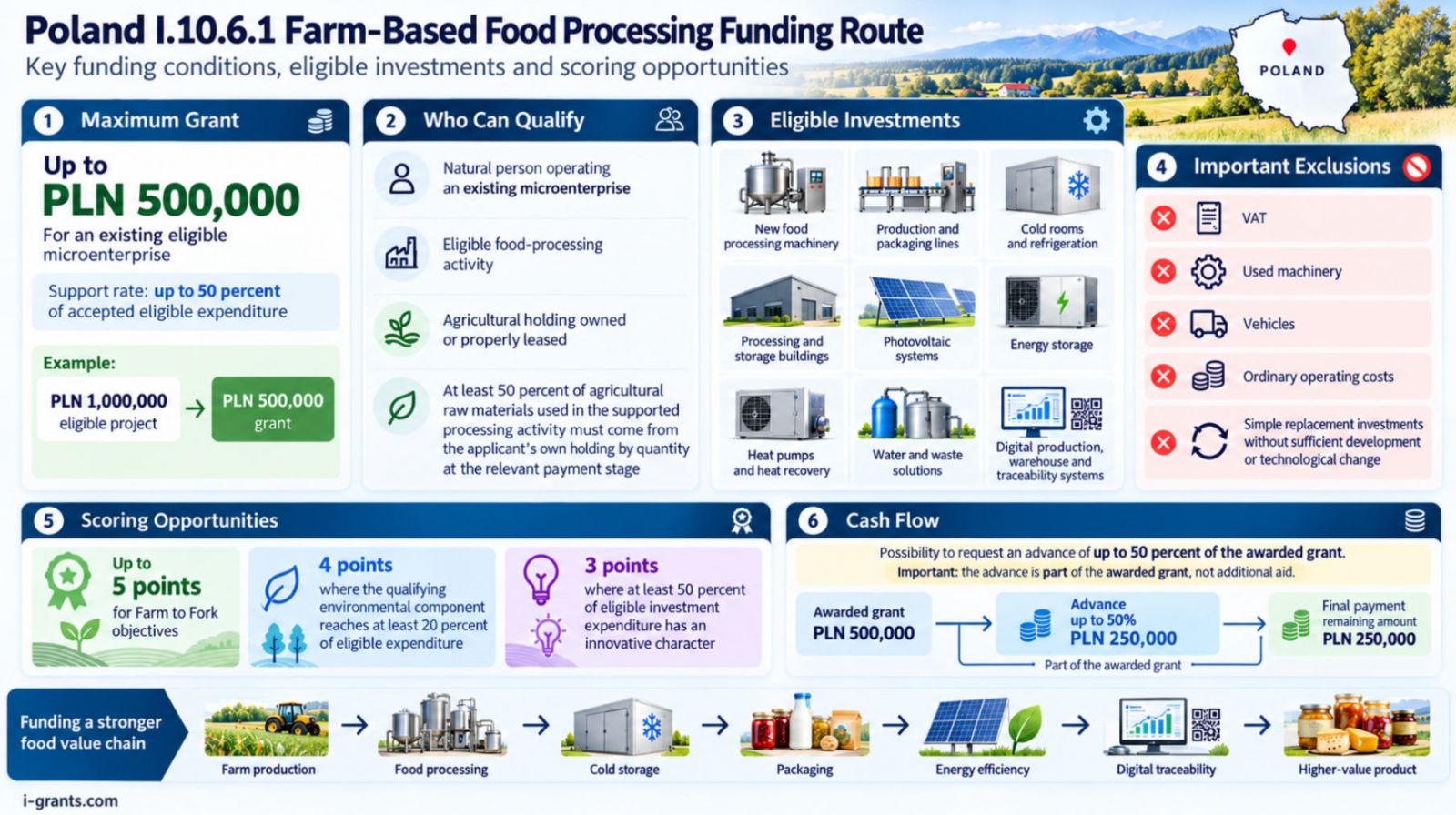
The largest route is designed for an existing microenterprise that is already carrying out an eligible processing activity and wants to continue and develop it. In this case, the support takes the form of reimbursement of up to 50 percent of eligible expenditure, with a maximum grant of PLN 500,000.
The PLN 500,000 figure is the maximum amount of aid. It is not the maximum size of the investment.
That distinction is extremely important. A project with PLN 1 million of fully accepted eligible expenditure could theoretically generate the full PLN 500,000 grant. If eligible expenditure reached PLN 1.2 million, 50 percent would equal PLN 600,000, but the grant would still be capped at PLN 500,000.
At the lower end, the minimum amount of aid under the reimbursement route is PLN 10,000. With a 50 percent support rate, that corresponds mathematically to at least PLN 20,000 of fully eligible costs.
Table 1. Three Main Funding Routes Under I.10.6.1
| Applicant and situation | Form of support | Support level |
|---|---|---|
| Farmer or spouse carrying out or developing agricultural retail activity | Fixed amount | PLN 30,000, PLN 60,000 or PLN 120,000 |
| Farmer, spouse or household member starting an eligible business or marginal, local and restricted activity | Fixed amount | PLN 30,000, PLN 60,000 or PLN 120,000 |
| Existing eligible microenterprise continuing food-processing activity | Reimbursement | Up to 50 percent of eligible costs, maximum PLN 500,000 |
The first two routes can cover up to 65 percent of eligible expenditure, subject to the fixed funding levels. The PLN 500,000 route is different. It is based on actual accepted costs and uses the lower 50 percent reimbursement rate.
This means that the largest grant is not necessarily the easiest grant to qualify for. It comes with a much more specific business profile.
Who Can Receive Up to PLN 500,000?
For the largest reimbursement route, the applicant must be a natural person. This is an important limitation. The current call should not be presented as a general programme for every Polish limited company operating in food processing.
The applicant must operate an existing microenterprise and continue an eligible economic activity. The relevant activity cannot simply be created after the application in order to access the PLN 500,000 route. It must already exist and cannot be suspended in the Central Register and Information on Economic Activity, CEIDG, in a way that conflicts with the programme conditions.
The applicant must also have an agricultural holding. Depending on the legal structure of the holding, this can be based on ownership or an acceptable form of lease or possession recognised by the programme.
The strongest additional condition concerns agricultural raw materials. The microenterprise is expected to use products originating from its own farm in the supported processing activity. By the first request for payment, at least 50 percent of the agricultural raw materials used for that processing activity must come from the applicant's own holding, measured by quantity.
This requirement is the reason the programme should be described as a farm-based food-processing grant rather than a general Polish food-manufacturing subsidy.
Consider two businesses producing apple juice. The first owns an orchard, processes its own apples and purchases additional fruit from nearby farms when necessary. The second is a small urban juice producer that owns no agricultural land and purchases all fruit from wholesalers. Both businesses may perform essentially the same industrial process, but only the first naturally fits the central logic of the PLN 500,000 farm-based route.
The same distinction can apply to meat processing, dairy, grain milling, bakery products and vegetable processing. The activity code may be eligible, but the business still has to satisfy the agricultural-holding and raw-material conditions.
New Food Businesses Have a Different Route
Farmers who want to begin processing can also receive support, but they should not confuse their route with the PLN 500,000 existing-microenterprise grant.
For certain applicants who are starting an eligible activity, the programme provides fixed grants of PLN 30,000, PLN 60,000 or PLN 120,000. These routes can support up to 65 percent of eligible expenditure.
A person using the startup route generally must not have operated the supported activity during the 12 months before applying. That requirement helps distinguish a genuine new processing business from an existing enterprise attempting to change funding categories.
Because the support is provided at fixed levels, the project has to be large enough to justify the chosen amount. At a maximum aid intensity of 65 percent, a PLN 120,000 grant corresponds to at least approximately PLN 184,615 of eligible expenditure. A PLN 60,000 grant corresponds to approximately PLN 92,308, while PLN 30,000 corresponds to approximately PLN 46,154.
Those figures are mathematical illustrations rather than automatic entitlements. The final structure of the project must still satisfy programme requirements.
The important point for an applicant is that Poland effectively offers a progression. A farmer can begin processing under one of the smaller fixed-support routes and, if the business develops into an existing eligible microenterprise meeting future programme conditions, larger investment mechanisms may become relevant later.
Which Food-Processing Activities Are Covered?
The programme covers a broad range of food-processing activities, but eligibility still depends on the exact Polish Classification of Activities code, PKD.
Meat processing is included, as are poultry products, fruit and vegetable processing, fruit and vegetable juices, dairy, grain milling, bakery products, preserved bakery goods, pasta, confectionery, spices, prepared meals, selected honey and egg processing, animal feed and certain wine and cider production activities.
Fish and aquaculture processing are excluded from this intervention and follow different funding structures.
Table 2. Examples of Food-Processing Activities Covered by I.10.6.1
| Activity | Examples of eligible processing |
|---|---|
| Meat processing | Slaughter-related processing, poultry processing, meat products |
| Fruit and vegetables | Juice production, fruit processing, vegetable processing, potato processing |
| Dairy | Milk processing and dairy products |
| Grain | Flour milling and selected starch-related activities |
| Bakery | Fresh bread and bakery products, preserved bakery products |
| Pasta | Pasta and similar cereal products |
| Confectionery | Cocoa, chocolate and confectionery |
| Prepared foods | Prepared meals and dishes |
| Specialist products | Selected herbal teas, spices, honey and egg processing |
| Feed | Feed for farm animals and pets |
| Alcoholic agricultural products | Grape wine, cider and selected fruit wines |
The list creates interesting possibilities for family farms seeking to capture more value from what they already produce. A cereal farmer can move further into milling or bakery production. A fruit grower can invest in juice or processed fruit products. A dairy farm can expand into cheese, yoghurt or another eligible dairy activity. A livestock holding can develop a qualifying meat-processing operation.
However, the existence of an eligible PKD code does not cancel the other conditions. A conventional bakery that buys all flour from external suppliers does not automatically become eligible for the PLN 500,000 route simply because bakery production appears in the eligible activity list.
What Can the Grant Actually Finance?
The eligible investment range is much broader than basic production equipment.
One of the clearest categories is new machinery and equipment used for processing, storage, preparation for sale or marketing of the supported products. Depending on the business, this could include production lines, processing machinery, filling equipment, packaging systems, sorting technology, storage installations or laboratory and quality-control equipment.
Buildings can also form part of the project. Construction, extension, reconstruction or renovation combined with modernisation can qualify when the building or structure is required for processing, storage, preparation for sale, marketing or laboratory control. Sanitary and technical rooms may also be included. Administrative space is more restricted and cannot simply dominate a production investment.
Cold storage is especially relevant. The programme recognises investment in refrigeration equipment, cold rooms, controlled-atmosphere systems and technologies designed to extend shelf life and reduce food losses. For fruit, vegetables, dairy, meat and many prepared foods, cold-chain investment can therefore be just as important as the processing line itself.
Packaging can also qualify when it is part of the supported processing and sales chain. This can include packaging machines, labelling systems and technologies designed to extend product life or reduce waste.
The programme also recognises digital investment. Software and information systems can be supported when they directly serve production, storage, management, traceability or sales. This creates room for production-management systems, warehouse management, traceability tools, digital sales systems and other technology connected to the supported activity.
For many farm-based processors, the strongest project will therefore not be a single-machine purchase. It will be a coordinated investment combining processing, storage, energy, packaging and digital control.
Solar, Batteries and Energy Equipment Can Be Included
Energy investment is one of the strongest features of the programme.
Photovoltaic systems can be eligible when they serve the supported processing, storage or sales activity. Energy storage can also qualify. The rules recognise heat pumps, heat-recovery systems, selected biogas solutions, solar thermal installations, wastewater-treatment systems and equipment related to waste management.
This means that a processor expanding production does not necessarily have to treat renewable energy as a separate project.
A fruit processor installing a larger juice line may also add photovoltaic generation to offset electricity consumption. A dairy operation could combine new processing equipment with heat recovery. A cold-storage project could include renewable generation and energy management. A business that produces large amounts of organic by-product may investigate whether a qualifying biogas component makes economic and technical sense.
Environmental investment can also improve the competitive strength of the application. If qualifying environmental expenditure represents at least 20 percent of total eligible costs, the project can receive additional assessment points.
This creates an important strategic opportunity. An environmental component can potentially do two things at once: reduce the business's future operating costs and strengthen the project's score.
The correct approach is not to add solar panels artificially simply to collect points. The energy equipment should make technical and economic sense for the supported processing operation. But where the business already faces high electricity, heating or refrigeration demand, integrating energy investment into the project can be very logical.
Cold Storage Can Be a Strategic Investment, Not Just a Supporting Cost
Cold storage deserves separate attention because it can transform the economics of agricultural processing.
Farmers often face pressure to sell raw products immediately after harvest because storage capacity is limited. This can weaken bargaining power and increase food losses. A properly designed cold-storage system allows the producer to hold products longer, process them gradually and choose the timing of sales more strategically.
For a berry grower, apple producer, vegetable farm, dairy operation or meat processor, refrigeration can therefore affect both product quality and business margins.
The programme's broader Farm to Fork logic recognises cold rooms, refrigeration systems, controlled atmosphere and technologies that extend shelf life or reduce waste. A cold-storage component may therefore strengthen a project that is already focused on processing.
For example, an apple-growing microenterprise may not only buy a juice line. It may also install refrigerated raw-material storage, new tanks, bottling equipment and a digital traceability system. Together, those investments can create a much more complete value chain than a standalone machine purchase.
Buildings Can Be Funded, but Ordinary Repairs Are Not Enough
Construction-related expenditure can qualify, but the programme is not designed to pay for ordinary maintenance.
A business may construct, extend or reconstruct a building needed for processing or storage. Renovation can also qualify when it forms part of genuine modernisation. Technical and sanitary rooms connected to production can be included.
Simple repair without modernisation is different. Repainting walls, replacing worn finishes or carrying out routine maintenance is not enough simply because the work takes place in a food-processing building.
The investment should improve or create productive capacity, technology, storage, hygiene, efficiency or another business function covered by the programme.
There is also a limitation on administrative space. Office areas cannot dominate the project and are restricted relative to the relevant production or processing premises.
Applicants planning construction should expect a higher documentation burden. Technical drawings, cost estimates, property documents, ownership or lease evidence, permissions and potentially water or environmental documentation may all become relevant depending on the project.
A Simple Replacement of an Old Machine May Be Too Weak
One of the less obvious rules concerns replacement investment.
The programme does not want to spend development money merely replacing old equipment with an equivalent new item without changing the business.
A project can be treated as replacement investment if a building, machine or piece of equipment is simply exchanged for a new equivalent without increasing production capacity by at least 25 percent and without creating a fundamental change in production or technology.
This rule deserves close attention.
Suppose a small processor owns a ten-year-old pasteuriser with a capacity of 1,000 litres per hour and wants to replace it with another machine of almost identical capacity and function. That may be difficult to justify as a development project if nothing else changes.
Now consider a new line that increases throughput by 35 percent, lowers energy use, adds automated cleaning, improves process control and allows production of a new product. This is much easier to present as a genuine development investment rather than simple replacement.
Applicants should therefore explain what changes because of the investment. Capacity, product range, technology, waste reduction, energy use, food safety, storage life, traceability or production control can all be important.
The strongest grant application usually answers not only "What are we buying?" but also "What will become possible after we buy it?"
Used Machinery, Vehicles and VAT Are Not Funded
The programme has a number of exclusions that should be built into the financial model from the beginning.
Value added tax is not an eligible cost. A company therefore needs to calculate its financing requirement separately from the grant calculation and consider the temporary cash-flow effect of VAT.
Used machinery and equipment are excluded. The project should be based on new assets.
Vehicles are also excluded from the eligible investment framework. A processor should not assume that a refrigerated van or delivery vehicle can be added simply because it is necessary for distribution.
Land and real-estate purchase costs are not eligible. Leasing costs, insurance, employee salaries and ordinary operating expenses are also excluded.
Routine expenses such as utilities, accounting, legal services, normal rent and refinancing existing debt should not be mixed with the investment budget.
This distinction is important because a food-processing expansion can create many costs that are economically necessary but not grant-eligible. The company should calculate both the grant budget and the total cash requirement.
How the PLN 500,000 Ceiling Works
The 50 percent support rate makes the grant straightforward to model once the eligible-cost base has been established.
Table 3. Indicative Grant Calculations for an Existing Microenterprise
| Accepted eligible expenditure | 50 percent calculation | Indicative grant |
|---|---|---|
| PLN 20,000 | PLN 10,000 | PLN 10,000 |
| PLN 100,000 | PLN 50,000 | PLN 50,000 |
| PLN 300,000 | PLN 150,000 | PLN 150,000 |
| PLN 500,000 | PLN 250,000 | PLN 250,000 |
| PLN 750,000 | PLN 375,000 | PLN 375,000 |
| PLN 1,000,000 | PLN 500,000 | PLN 500,000 |
| PLN 1,200,000 | PLN 600,000 | PLN 500,000 due to the programme ceiling |
The most important line is PLN 1 million. That is approximately the eligible-cost level at which an existing microenterprise reaches the maximum PLN 500,000 grant at a 50 percent rate.
The business can invest more than PLN 1 million, but the extra eligible expenditure no longer increases the grant once the PLN 500,000 ceiling is reached.
This can influence project design. A processor planning a PLN 1.3 million investment should not necessarily reduce the project to PLN 1 million simply because the grant stops increasing. The additional investment may still be commercially necessary. But the business needs to understand that every zloty above the ceiling has to be financed without additional support from this particular grant.
A Realistic PLN 980,000 Apple-Processing Project
Consider an existing Polish microenterprise operated by a fruit grower who owns an apple orchard and already produces juice commercially.
The company wants to increase output, extend storage life, improve energy efficiency and sell a larger share of production under its own brand.
It proposes a new juice-processing and bottling line costing PLN 300,000. Cold-storage and warehouse equipment add PLN 160,000. A packaging and labelling line costs PLN 100,000. A photovoltaic installation and heat-recovery system cost PLN 200,000. Modernisation of the production building costs PLN 150,000. A digital production, stock and traceability system costs PLN 30,000. Eligible technical preparation, business-plan and other qualifying general costs add another PLN 40,000.
The total project reaches PLN 980,000.
If all PLN 980,000 are ultimately accepted as eligible costs, the 50 percent support calculation gives a grant of PLN 490,000.
The business therefore needs to finance another PLN 490,000 of eligible expenditure itself, through its own resources or external financing. It must also cover VAT and any project costs that ARiMR later rejects or considers ineligible.
The environmental component is substantial because the project includes photovoltaic generation and heat recovery. The refrigeration, packaging and traceability elements may also support Farm to Fork objectives by reducing food losses, extending shelf life and improving production control.
The project is stronger than a simple request for a new juice machine because it changes the entire processing chain.
It increases production capability, improves storage, lowers energy exposure, strengthens packaging and improves traceability.
That is the type of integrated investment for which the programme is best suited.
Environmental Investment Can Improve the Project Score
I.10.6.1 is competitive rather than purely automatic. A project has to reach the minimum assessment threshold, and stronger applications can be better positioned when demand exceeds the available budget.
For an existing microenterprise, several scoring criteria are particularly relevant.
A project contributing to Farm to Fork objectives can receive up to 5 points. Environmental investment representing at least 20 percent of eligible expenditure can add 4 points. A project in which at least 50 percent of eligible investment costs are innovative can add 3 points. Location in a district with relatively high unemployment can add further points.
The minimum required score is only 2 points, but applicants should not design a project merely to cross that minimum. The programme budget is finite. A stronger score can matter if applications exceed available resources.
The Farm to Fork criterion is broader than simply installing solar panels. It can include energy recovery, renewable energy, biodegradable or reusable packaging, water treatment and reuse, intelligent management of energy or water consumption, cold-storage systems, controlled atmosphere, shelf-life extension and digital traceability.
A carefully designed processing project can therefore score through several mutually reinforcing improvements.
Innovation Does Not Necessarily Mean Laboratory Research
The innovation criterion may sound intimidating to a small food processor, but innovation does not necessarily mean developing patented technology or operating a research department.
The relevant question is whether a significant part of the investment introduces sufficiently new solutions in the context required by the programme. New processing technology, automation, digital control, modern packaging, improved traceability or production methods that substantially change the business can potentially contribute to the innovation assessment.
Applicants should avoid making exaggerated claims. Buying a standard machine that thousands of similar businesses already use is not automatically innovative simply because the applicant has never owned one before.
The business plan should explain precisely what is new, what process changes and what measurable benefit the investment creates.
Price Reasonableness Must Be Proven
ARiMR does not simply accept the price written in a supplier quotation. The applicant has to demonstrate that the proposed costs are reasonable.
For purchases of goods or services above PLN 20,000 net, where the expense is not construction, reconstruction or renovation with modernisation, the applicant will generally need at least two offers from different suppliers.
This requirement is designed to show that the budget reflects market conditions.
There can be exceptions when only one supplier objectively exists or proprietary compatibility requires a particular solution, but the applicant then needs to explain and document the reason.
For construction work, an investment cost estimate and relevant technical documentation are required instead.
This rule has a practical consequence: serious preparation starts before the grant application itself. A processor should identify potential suppliers, compare technical specifications and collect proper quotations early enough to build a defensible budget.
The cheapest offer is not automatically the best. A food-processing line must meet production, hygiene, service and quality requirements. But if the applicant chooses a substantially more expensive supplier, the business plan should be able to explain why.
When Can the Project Start?
The timing rule differs from some other European grant programmes.
As a general rule, eligible expenditure cannot be incurred before the application is submitted. Certain general preparation costs may be allowed from an earlier date under the specific programme rules, but machinery, construction and other core investment costs should not precede the filing date.
The programme definition of starting an operation can include beginning construction, purchasing machinery, taking another action that transfers ownership or possession, or entering into an agreement that leads to the use of project assets.
After the application has been submitted, the applicant may in principle begin incurring eligible costs under the programme framework. However, doing so before the grant is awarded means taking the financial risk that the application could later be rejected or the eligible-cost base reduced.
A cautious business can therefore choose between two strategies.
It can submit the application and begin quickly at its own risk, or it can wait until the funding decision is secured before making major irreversible commitments.
The second option is safer financially, while the first may be necessary when the investment is urgent.
An Advance Can Solve Part of the Cash-Flow Problem
One of the most useful features of the programme is the possibility of receiving an advance.
For the reimbursement route, an applicant can request an advance of up to 50 percent of the awarded grant. The request must be included in the application, and the beneficiary must provide the required security, including the applicable blank promissory-note arrangement.
If the company receives the maximum PLN 500,000 grant, the advance could therefore theoretically reach PLN 250,000.
This is not additional funding. It is an early payment of part of the already awarded grant.
For a small processor, however, the effect on cash flow can be substantial.
Imagine a PLN 1 million eligible project with a PLN 500,000 grant. Without an advance, the business may have to finance almost the entire investment before receiving reimbursement. With a PLN 250,000 advance, the initial financing pressure is reduced.
The company still needs substantial capital, but the gap is smaller.
A business considering the advance should include it in the financing model from the beginning rather than treating it as an afterthought.
Projects Can Be Implemented in One or Two Stages
An investment under the reimbursement route can generally be structured in one or two stages.
A one-stage project is implemented and then submitted for final payment.
A two-stage project allows an intermediate payment claim, with the first stage completed within the required timetable. The final payment claim is submitted after the complete operation is finished.
The overall project must be implemented within the maximum programme period and no later than 30 June 2029.
This flexibility can be particularly useful for larger projects combining building works, machinery and energy systems.
For example, a processor may first modernise the production building and install the main processing equipment, then complete cold storage, photovoltaic generation and digital systems in the second stage.
The structure should reflect genuine implementation logic rather than being created solely for payment convenience.
Another important condition is that eligible payments must leave a clear financial record. Non-cash payment methods are required for expenditure used to calculate reimbursement. Supplier payments should therefore be organised through transparent bank transactions.
Documentation Is a Major Part of the Project
The business plan is a central element of the application, not an optional attachment.
The applicant may also need a technological flow description, supplier quotations, construction cost estimates, site plans, documents proving rights to the property, owner or co-owner consent, evidence relating to quality schemes or organic production and documentation supporting the origin of agricultural raw materials.
For food production, sanitary, veterinary or other sector-specific requirements may also be relevant depending on the type of product.
Construction projects can require permits and additional technical or water-related documentation.
If bank financing forms part of the project, the applicant may need to provide a financing promise or credit agreement depending on the stage and requirements.
The documentation burden is therefore significant, but it also reflects the size of the possible support. A PLN 500,000 grant is not designed as a simple voucher for buying a machine.
The programme expects a credible investment project.
The Own-Raw-Material Rule Must Be Planned Operationally
The 50 percent own-raw-material condition is not something a processor should check only when the application is submitted.
It affects how the business will actually operate.
Suppose an apple processor owns an orchard capable of supplying 400 tonnes per year but plans to process 1,000 tonnes annually after expansion. The company's own production would represent only 40 percent of the agricultural raw material by quantity. If the programme requires at least 50 percent from the applicant's own holding at the relevant stage, the investment plan may not comply unless the production or sourcing structure changes.
The business therefore needs to model both investment capacity and agricultural supply.
A project should not create a processing plant much larger than the applicant's ability to provide the required share of farm-origin raw material.
This is another reason the programme is different from a conventional industrial grant. It is deliberately linking primary agricultural production with downstream processing.
What If the Business Is a Normal Food SME Without a Farm?
This is probably the most important question for readers who discover that they do not meet the I.10.6.1 farm-based conditions.
Poland also has a broader support route for food-processing companies under intervention I.10.7.1, Development of Cooperation Within the Value Chain Outside the Farm.
The 2026 round was much larger than I.10.6.1. Its budget exceeded PLN 624 million, and eligible micro, small and medium-sized processors could seek support for machinery, technological lines, processing and storage premises, renewable energy and specialised software. The maximum aid could reach PLN 10 million.
However, that call closed on 30 September 2026.
ARiMR reported 1,211 applications in the completed round, demonstrating strong demand.
A normal food-processing SME without an agricultural holding should therefore not be directed to the currently open PLN 500,000 farm-based grant simply because I.10.7.1 is closed.
That would be inaccurate.
Instead, the company should monitor future I.10.7.1 rounds or examine financing instruments that remain available.
FGR Plus and Agromax: Useful Financing, but Not an Equipment Grant
One of the alternatives is Fundusz Gwarancji Rolnych Plus, FGR Plus, which operates through the Agromax guarantee.
This is not a direct capital grant for machinery.
It is a financial instrument designed to improve access to bank credit for agricultural and agri-food investment. The guarantee can cover a substantial portion of an eligible loan and may also be combined with support toward interest costs under applicable conditions.
For agri-food processors, the mechanism can support investment in processing and storage buildings, machinery, equipment and quality-management systems.
This distinction needs to remain explicit.
I.10.6.1 is a grant.
I.10.7.1 is also a grant, but the current round is closed.
FGR Plus and Agromax provide loan guarantees and interest support. They improve financing conditions, but the underlying credit still has to be repaid.
Table 4. Which Funding Route Fits Different Polish Food Businesses?
| Business situation | Most relevant route | Current practical position |
|---|---|---|
| Existing farm-based food-processing microenterprise using substantial own agricultural raw material | I.10.6.1 reimbursement route | Current grant can provide up to PLN 500,000 |
| Farmer beginning agricultural retail processing | I.10.6.1 fixed-support route | PLN 30,000, PLN 60,000 or PLN 120,000 depending on project |
| Farmer, spouse or household member beginning eligible processing business | I.10.6.1 startup route | Fixed support rather than PLN 500,000 reimbursement |
| Ordinary food-processing microenterprise without a farm | I.10.7.1 would be more relevant | 2026 round closed |
| Small or medium food processor without farm-based eligibility | I.10.7.1 | Monitor future calls |
| Processor needing investment finance now | FGR Plus / Agromax | Loan guarantee and interest support, not an equipment grant |
| Fish or aquaculture processor | Other sector-specific support | Not covered by this I.10.6.1 food-processing route |
This funding map is crucial because the wrong programme can waste months of preparation.
A company should first identify what type of business it actually is, then search for funding.
Why Poland Wants Farmers to Move Further Along the Value Chain
The logic behind I.10.6.1 becomes clearer when viewed in the context of Poland's food economy.
Poland exports very large volumes of agricultural and food products, but processed goods generally create more value than unprocessed commodities. Processing also allows producers to differentiate products, build brands, extend shelf life and access retail or export markets.
A farmer selling raw apples competes largely on price and crop quality. A producer selling bottled juice, cider, dried fruit or branded processed products can capture value from processing, packaging and marketing.
The same principle applies to milk, meat, grain, vegetables and many other agricultural products.
The programme is therefore not simply paying farms to buy machinery. It is encouraging a structural change from commodity production toward integrated food businesses.
That objective explains the own-raw-material rule. The grant is intended to strengthen the link between agricultural production and processing rather than become a generic subsidy for independent food factories.
Polish Food Processing Is Already a Major Export Industry
The wider market context makes this transition particularly attractive.
In the first half of 2026, Polish agri-food exports reached roughly EUR 29 billion. The trade surplus increased to around EUR 9.6 billion. Approximately three quarters of exports went to other European Union countries.
Germany remained the largest market, followed by countries including France, the Netherlands, Italy and Czechia.
Most importantly for processors, highly and partially processed products accounted for roughly EUR 20 billion of export value during the six-month period, considerably more than the value of unprocessed and minimally processed agricultural products.
Polish food production also continued to expand domestically. Official industrial statistics showed strong growth in sold food-industry output in 2025.
For a small farm-based processor, this does not automatically guarantee commercial success. Export markets are highly competitive, retailers demand consistency and food production requires strict regulatory compliance.
But the data show why investment in processing capacity is economically significant.
Poland is not only an agricultural producer. It is already a major European food-processing and export economy.
There Are No Meaningful Beneficiary Cases From the Current Round Yet
The current I.10.6.1 call has only recently opened, so there is no mature portfolio of completed beneficiaries from this specific round.
Any article claiming that a named processor has already received and completed a PLN 500,000 project from the current October call would need very strong evidence.
At this stage, it is more responsible to use current programme rules and historical demand data rather than inventing success stories.
Earlier Polish programmes for small-scale processing show very strong demand. A previous KPO round for small processing attracted almost 4,300 applications requesting approximately PLN 1.55 billion.
The recently closed I.10.7.1 round received 1,211 applications.
Those figures do not prove the success rate of the new I.10.6.1 call. They do show that Polish farmers and processors have a substantial appetite for investment support.
The Strongest Project Connects Production, Processing, Storage and Energy
A weak application can look like a shopping list: one machine, one cold room, one solar installation and one computer system.
A strong project explains why those investments belong together.
Consider the apple processor again. The new line increases processing capacity. Cold storage allows apples to be processed over a longer period rather than immediately after harvest. The packaging line creates a retail-ready product. Photovoltaics reduce the electricity cost associated with processing and refrigeration. Heat recovery reduces wasted energy. Digital traceability improves production control and provides better documentation for customers and regulators.
Together, these elements create one coherent business model.
The same logic can be used in other sectors.
A dairy processor might combine cheese-processing equipment, cold storage, energy recovery and traceability. A grain producer could combine milling, packaging, storage and renewable energy. A farm-based bakery could connect grain production, flour processing, baking and packaging if the precise activity and raw-material conditions are satisfied.
The best grant project is usually the one in which every major investment solves an identifiable bottleneck.
A PLN 500,000 Grant Can Be Transformational, but Only for the Right Applicant
I.10.6.1 is one of the most interesting current investment opportunities for farm-based food processors in Poland.
An eligible existing microenterprise can receive up to 50 percent of accepted expenditure and as much as PLN 500,000 in total support. The grant can finance far more than a single production machine. Processing lines, buildings, cold rooms, packaging, renewable energy, batteries, heat pumps, heat recovery, wastewater solutions and digital systems can all potentially become part of a well-designed project.
An advance of up to 50 percent of the awarded support can reduce the financing burden, while a two-stage structure can make larger investments easier to implement.
At the same time, the programme is much more restrictive than a headline such as "PLN 500,000 for food SMEs" suggests.
The largest current grant is intended for an existing microenterprise operated by a natural person and connected directly to an agricultural holding. The business must use a substantial share of its own agricultural raw materials. It must carry out an eligible activity, avoid simple replacement investment, prove the reasonableness of costs and provide a credible business plan.
A conventional food manufacturer without a farm should not distort its business structure simply to fit this grant. Its more appropriate route may be a future I.10.7.1 call, bank financing supported by FGR Plus or another national, regional or European programme.
The right starting question is therefore not:
"How can my food company get PLN 500,000?"
It is:
"Does my business genuinely fit the farm-based processing model, and can this investment move more of my own agricultural production into higher-value processing?"
If the answer is yes, I.10.6.1 can provide a powerful combination of production, storage, energy and digital investment support.
For the right Polish microenterprise, the programme can do more than subsidise equipment. It can help transform a farm from a supplier of raw agricultural products into a more integrated food-processing business with greater control over production, margins, storage and market access.