

 Français
  Deutsch
  Українська
French SMEs planning to enter foreign markets can access one of Europe’s most developed export support systems. However, France does not offer a single universal export grant that automatically reimburses every company for exhibitions, international travel, foreign recruitment, or market research.
Instead, the French system combines several different mechanisms. These include repayable export-risk insurance, regional grants, subsidised advisory services, international staffing through the V.I.E. programme, bank financing backed by state guarantees, and credit insurance for larger export contracts.
Understanding the legal and financial nature of each instrument is essential. A regional subsidy is not the same as an insurance advance. A state guarantee does not provide cash directly to the exporter. V.I.E. is not a free employee. A maximum coverage rate is not necessarily the amount that a company will receive.
This article explains how the main French export support instruments work in 2026, which companies and costs may qualify, how repayments are calculated, and how SMEs can combine different forms of support without financing the same expense twice.
France Does Not Have One Universal Export Grant
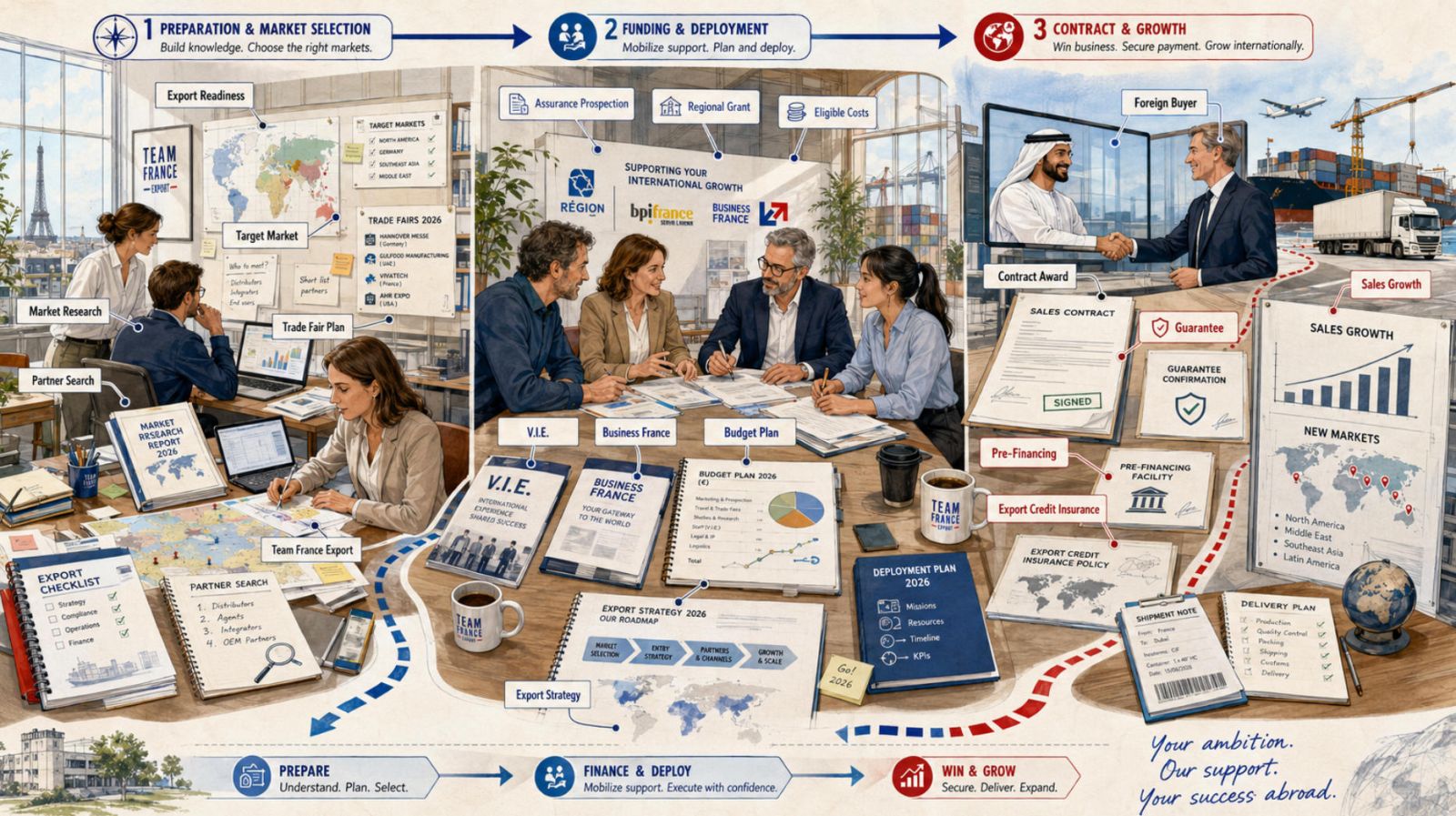
French export support is organised around three main stages of international expansion.
At the market-entry stage, companies may need help analysing demand, adapting their commercial offer, attending exhibitions, identifying distributors, or recruiting export staff. Assurance Prospection, regional grants and Team France Export services are particularly relevant at this stage.
Once a company begins developing a permanent presence abroad, it may use the V.I.E. programme, international advisory services, local representation, or regional assistance for commercial development.
When the company wins an international contract, its needs change. It may require bank financing to manufacture goods before payment, guarantees requested by the foreign buyer, or insurance against non-payment. These needs are addressed through Bpifrance Assurance Export and participating banks.
The same institution may therefore support very different transactions. This is why French export programmes should not all be described as grants.
Table 1. Main Forms of Export Support Available to French SMEs
| Instrument | What the company receives | Repayment obligation | Typical purpose |
|---|---|---|---|
| Assurance Prospection | An advance linked to insured international prospecting expenditure | At least part of the advance must normally be repaid | Market studies, exhibitions, travel, marketing, export staff and foreign representation |
| Regional export grant | Partial reimbursement of approved eligible expenditure | Normally non-repayable if all conditions are met | Trade fairs, commercial missions, V.I.E. assignments and market-entry services |
| Diagnostic Business International | A subsidised advisory service | No repayment, but the company pays part of the service cost | Market selection, commercial preparation and partner identification |
| V.I.E. | An administered international assignment for a young professional | The company pays the cost of the assignment | Foreign representation, sales development, technical support and partnerships |
| Assurance Préfinancement Export | Improved access to a bank loan protected by a state guarantee | The bank loan must be repaid in full | Production and working capital before an export contract is paid |
| Assurance Caution Export | Risk protection for a bank or guarantee provider | No direct cash grant to the exporter | Tender guarantees, advance-payment guarantees and performance guarantees |
| Export credit insurance | Protection for the lender against foreign buyer default | Depends on the financing structure | Large export contracts with deferred payment |
| France 2030 Export | Co-financing of selected international development activities | Depends on the individual measure | International expansion by eligible France 2030 beneficiaries |
How the French Export Support System Is Organised
The French system is based on cooperation between national institutions, regional authorities, chambers of commerce, banks and international advisers.
Team France Export acts as the main coordination network for companies seeking international support. It brings together the French regions, Business France, the chambers of commerce and industry, and Bpifrance. Its regional advisers assess a company’s export readiness, help select target markets and identify available support.
Business France is the national agency responsible for international business development and foreign investment. It organises trade missions, French pavilions at international exhibitions, market-entry services and the V.I.E. programme.
Bpifrance provides loans, guarantees and advisory support. Through Bpifrance Assurance Export, it also manages French state export guarantees on behalf of the government.
The regions play a decisive role because many direct subsidies for exhibitions, commercial missions and V.I.E. assignments are regional rather than national. Eligibility therefore depends on where the company is established, where the project is managed and whether the relevant regional budget is still available.
Since the creation of Team France Export, the network has supported more than 70,000 company export projects. In 2026, Business France and the national chamber network renewed their partnership, confirming the continuation of the coordinated regional and international support model.
Assurance Prospection Explained
Assurance Prospection is one of the most important French instruments for companies entering new international markets. Despite its name, it is not conventional private insurance and it is not a standard non-repayable grant.
The instrument is designed to share the financial risk of a prospecting campaign. A company defines a target market or geographical area, prepares an export-development budget and applies before carrying out the relevant activities.
If the application is approved, the company can receive an initial payment based on the insured budget. After the prospecting period, Bpifrance examines the expenditure actually incurred and the export revenue generated in the covered area. The final repayment is then calculated.
A company whose export campaign generates significant revenue may repay the full insurance payment. A company whose campaign is unsuccessful still normally repays a minimum portion. The instrument therefore limits part of the commercial risk but does not eliminate it.
Who Can Apply
Assurance Prospection is available to French companies with annual turnover below €500 million. This threshold means that the instrument is not limited to SMEs under the formal European definition, although SMEs are among its principal users.
The applicant must normally have completed at least one full 12-month financial year. The product or service concerned must already be commercially available. Assurance Prospection is generally not intended to finance the initial development of a product that has not yet reached the market.
The company must also be financially viable, up to date with its tax and social obligations, and able to demonstrate sufficient French economic content. A minimum French share of approximately 20% is generally required in the product or service connected with the export campaign.
Pure intermediaries, companies whose activities create little French added value, certain fossil-fuel-related operations, self-employed consultants and some commercial trading structures may be excluded.
Table 2. Main Assurance Prospection Parameters in 2026
| Parameter | 2026 condition |
|---|---|
| Maximum applicant turnover | Below €500 million |
| Minimum operating history | At least one completed 12-month financial year |
| Commercial status | The relevant product or service must already be marketed |
| Minimum French content | Generally at least 20% |
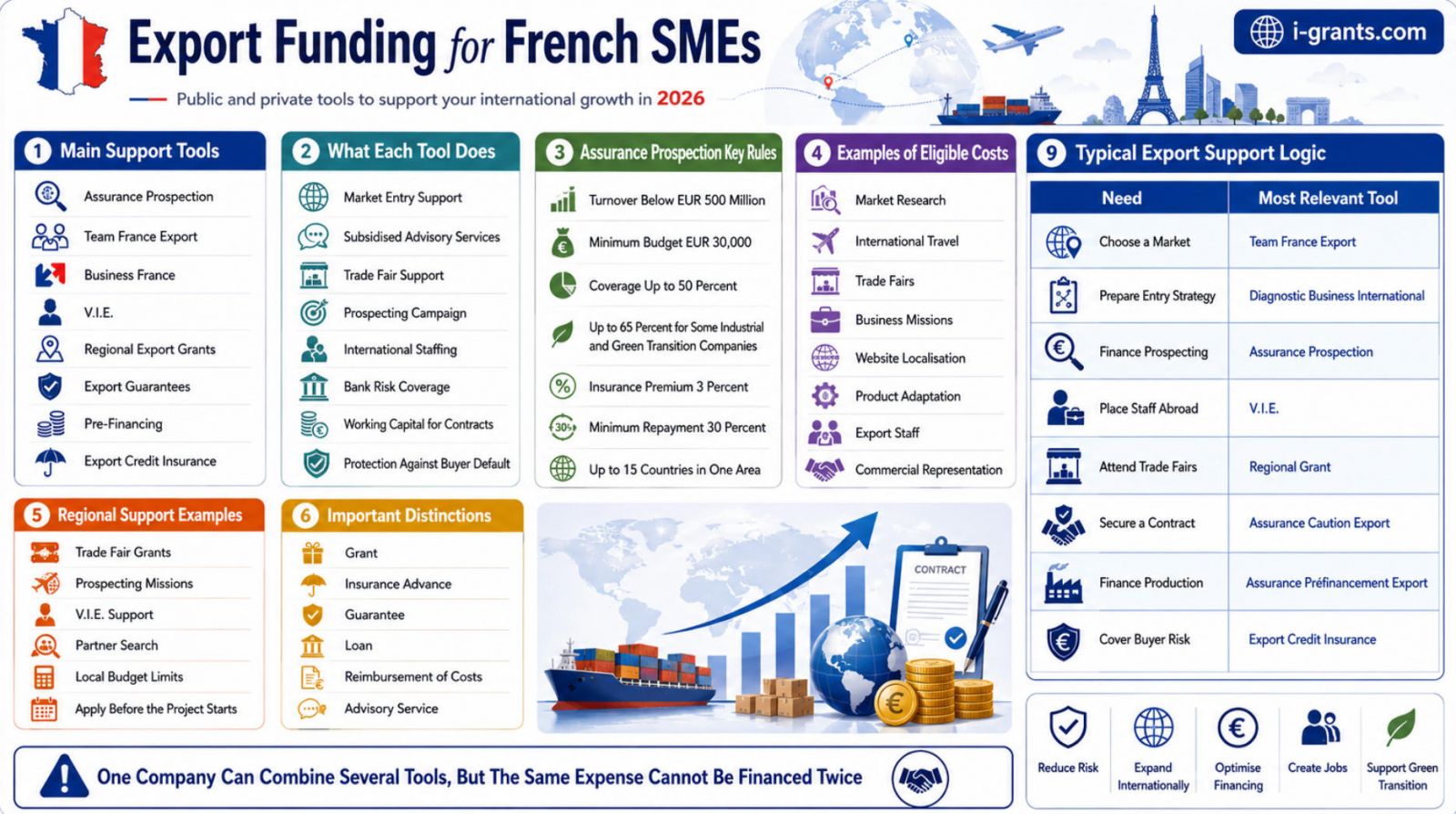
| Minimum proposed budget | €30,000 excluding VAT |
| Standard coverage rate | Up to 50% of eligible expenditure |
| Higher coverage rate | Up to 65% for eligible industrial or environmental-transition companies |
| Geographical scope | Up to 15 countries in one insured area |
| Insurance premium | 3% of the insured budget |
| Initial payment | 50% of the estimated indemnity, minus the premium |
| Minimum repayment | Normally 30% of the insurance indemnity received |
| Maximum repayment | Up to 100% of the insurance indemnity received |
| Possible total duration | Seven or nine years, depending on the prospecting period |
The 50% or 65% rate represents the maximum insured share of accepted expenditure. It is not a guaranteed grant rate. The approved amount may be limited by the company’s financial capacity, available equity, the quality of the project, the accepted budget and the final expenditure report.
How the Advance Is Calculated
An official example illustrates the difference between the insured budget and the amount initially paid.
Suppose a company receives approval for an insured prospecting budget of €200,000 and qualifies for a 65% coverage rate. The maximum calculated indemnity is €130,000.
The initial advance is based on 50% of that amount, which equals €65,000. The insurance premium is 3% of the €200,000 insured budget, or €6,000. After deducting the premium, the initial payment is €59,000.
The company does not automatically retain this amount. The final amount repayable depends on the accepted expenditure and the export turnover generated in the covered countries.
Prospecting and Repayment Periods
A typical contract includes a prospecting period, a waiting period and a repayment period.
For a two-year prospecting campaign, the total contractual cycle may last seven years. This can include two years of expenditure, two years without repayment and three years during which repayment is calculated.
For a three-year prospecting campaign, the total cycle may extend to nine years, including a four-year repayment period.
Although up to 15 countries may be included in one geographical area, companies are usually advised to concentrate their resources on a small number of priority markets. Including too many countries without a credible commercial strategy can weaken an application.
Eligible Costs Under Assurance Prospection
Eligible expenditure may include market research, commercial travel, accommodation, international exhibitions, prospecting missions, legal advice, local business development services, advertising, website localisation, translation, product adaptation, intellectual property protection and the preparation of samples or demonstration materials.
The programme may also cover the creation of an export department, the recruitment and training of export staff, employer social contributions, foreign commercial agents, and the rental of temporary commercial premises.
The connection between each expense and the approved export campaign must be documented. Where an employee works only partly on the international project, only the relevant share of salary costs may be accepted.
Expenditure must normally be new, paid during the contractual period, recorded in the company’s accounts and supported by invoices, payroll records or equivalent evidence. Costs incurred before the eligible starting date may be rejected.
The company must also declare any public support received for the same expenditure. A regional grant for a trade fair, a subsidy for a V.I.E. assignment or support for recruiting an export manager must be deducted before the same cost is submitted under Assurance Prospection.
Team France Export Services for Market Entry
Team France Export is often the first point of contact for an SME that has not yet selected a market or developed a complete international strategy.
The regional adviser can assess export readiness, identify internal weaknesses, compare target markets and refer the company to Business France specialists abroad. The network also helps companies understand whether a regional subsidy, Bpifrance product or European programme is relevant.
This advisory role is important because many SMEs apply for international support too early. A company may have a strong domestic product but lack the necessary pricing strategy, distribution model, regulatory documentation, multilingual sales material or export staff.
Team France Export services can help separate commercial preparation from financial support. Not every company that receives advice will qualify for a grant, and not every subsidised service provides cash directly to the applicant.
Diagnostic Business International
Diagnostic Business International is a structured Business France and Bpifrance service for companies preparing to enter one foreign market.
The service covers market targeting, preparation of the company’s commercial approach and contact with prospective buyers or partners. The operational support generally lasts around four months within a six-month contractual framework.
In 2026, the service was available across 51 markets. The subsidised price for an SME was approximately €4,000 excluding VAT. For a mid-cap company, the price was approximately €7,650 excluding VAT.
The programme generally targeted companies with turnover of at least €1.5 million. Pure trading companies and businesses seeking only procurement opportunities could be excluded.
The company therefore receives a service at a reduced price, not a grant equal to the full market value of the service.
V.I.E. as an International Staffing Instrument
The Volontariat International en Entreprise programme allows a French company to assign a young professional to a foreign country for a commercial, technical, scientific or administrative mission.
Business France manages the legal and administrative framework, including the participant’s status, monthly allowance, social protection and contractual administration.
Eligible participants are generally aged between 18 and 28 when registering and must be citizens of France or another country in the European Economic Area. A mission can last from six to 24 months and may be renewed once within the maximum duration.
The programme can be used by startups, SMEs, mid-cap companies and large groups. Typical assignments include finding distributors, developing sales, supporting a foreign client, monitoring a local industrial project, establishing partnerships or preparing the opening of a subsidiary.
However, V.I.E. is not a free staffing programme. The company pays the participant’s allowance, management costs, social protection, travel and other mission-related expenses. Housing and local costs may also be significant in some destinations.
Regional support can reduce the cost, but the subsidy rate, eligible period and maximum amount vary substantially.
At the end of 2025, approximately 11,458 V.I.E. participants were working in 121 countries. Business France also maintained a candidate database containing tens of thousands of profiles.
Regional Grants for Trade Fairs, Prospecting and V.I.E.
Regional assistance is the area in which French companies are most likely to find a conventional non-repayable export subsidy.
The support may cover participation in an approved international exhibition, the cost of an equipped stand, travel and accommodation for a commercial mission, meetings with potential partners, a V.I.E. assignment, or a structured Business France market-entry service.
There is no uniform national rate. Some regions reimburse 50% of eligible costs, while others use fixed vouchers, capped contributions or programme-specific packages.
Table 3. Selected Examples of Regional Export Support in 2026
| Region and programme | Maximum support | Eligible activities | Important conditions |
|---|---|---|---|
| Auvergne-Rhône-Alpes, international commercial action | 50% of eligible costs, up to €6,000 | Structured commercial prospecting through Team France Export | Primarily for regional industrial SMEs and industrial service providers |
| Auvergne-Rhône-Alpes, V.I.E. support | 50% of eligible costs, up to €20,000 | Allowance, administration and social protection for an initial assignment of at least 12 months | Regional conditions apply; support is not automatic |
| Grand Est, trade fairs and international prospecting | 50% of approved costs, up to €6,000 | International exhibitions, non-European prospecting missions and buyer meetings | The project must align with regional priorities |
| Grand Est, exhibition support | Within the programme ceiling | Equipped exhibition stand, generally within a defined surface limit | The event must be eligible under the regional scheme |
| Grand Est, partner-search mission | Within the programme ceiling | Mission organisation, travel and accommodation | The application must be submitted before the mission begins |
In July 2026, Auvergne-Rhône-Alpes increased the maximum regional V.I.E. contribution from €15,000 to €20,000 while maintaining a 50% intervention rate. The region also removed a previous restriction that limited support to companies using V.I.E. for the first time or returning after a long interruption.
This change demonstrates why regional availability must be checked immediately before an application. A rate published in an older guide may no longer be valid, and a programme may close once its annual budget is exhausted.
A company should also verify whether the aid is restricted by sector, destination, company size, previous export experience or membership in a regional development programme.
State Guarantees for Export Contracts
When an SME moves from prospecting to contract execution, it may face a new financing problem. The foreign customer may request bank guarantees, while the exporter must purchase materials, manufacture equipment and pay employees before receiving the final payment.
Bpifrance Assurance Export manages several state-backed instruments designed for this stage.
Assurance Caution Export
International buyers often require guarantees covering tender participation, repayment of an advance, proper performance or the release of a retention amount.
The exporter asks a bank or financial institution to issue the guarantee. The institution may hesitate if the amount is large compared with the company’s balance sheet.
Assurance Caution Export protects part of the institution’s risk. For companies with turnover below €300 million, the state-backed coverage may reach 80%.
This does not mean that the exporter receives 80% of the contract value. The guarantee protects the bank against part of its potential loss and can make it easier for the company to obtain the required bond.
Assurance Préfinancement Export
A company that has signed an export contract may require working capital before receiving payment from the foreign buyer.
A participating bank can provide a pre-financing loan for production, materials, salaries and other contract costs. The state-backed guarantee may cover up to 80% of the bank’s risk for a company with turnover below €300 million.
The minimum loan amount is generally above €50,000. The relevant contract must usually include at least 20% French content, and the loan period cannot normally exceed the contract execution period.
The exporter must repay the bank loan in full. The support improves access to credit but does not convert the loan into a subsidy.
Export Credit Insurance
For larger contracts, a French supplier may allow the foreign buyer to pay over several years. The financing may be structured as a buyer credit granted by a bank.
State export credit insurance can protect the lender against commercial default, political instability, transfer restrictions, catastrophic events and other covered risks.
Depending on the contract and the company, coverage may reach 95% or, in specific structures, 100% of the lender’s insured risk. Again, this is not a grant rate. It is the maximum proportion of a defined credit risk that can be insured.
Table 4. Recent Export Support and French Export Indicators
| Indicator | Period | Reported result |
|---|---|---|
| Assurance Prospection activity | 2023 | €212 million involving 1,244 companies |
| Assurance Prospection activity | 2024 | €246 million involving 1,039 companies |
| Export bond and pre-financing guarantees | 2024 | €1.407 billion involving 401 companies |
| Export credit insurance | 2024 | €18.956 billion involving 119 companies |
| Bpifrance and Business France international services | 2024 | 4,244 companies supported |
| Companies supported by Business France and Team France Export | 2025 | Approximately 11,120 SMEs and mid-cap companies under one official reporting scope |
| Additional turnover attributed to supported companies | 2025 | €2.55 billion |
| Jobs created or planned | 2025 | 25,386 |
| Active V.I.E. participants | December 2025 | 11,458 in 121 countries |
| France-based goods exporters | 2025 | Approximately 124,200 |
| Total goods exporters including non-residents | 2025 | Approximately 154,300 |
| French goods exports under customs methodology | 2025 | €604.8 billion |
| SME and microenterprise share of exporters | 2025 | Approximately 95% to 96% |
| SME and microenterprise share of export value | 2025 | Approximately 11% |
The official figures show that Assurance Prospection activity increased from €212 million in 2023 to €246 million in 2024, while the number of participating companies decreased. This suggests a higher average operation size, although the available data do not establish the reason for the change.
Export bond and pre-financing guarantees increased to approximately €1.407 billion in 2024. This illustrates the importance of liquidity and contract-financing support once a company has moved beyond the initial prospecting stage.
French customs data also reveal a structural imbalance. SMEs and microenterprises represent almost all exporting businesses by number, but they account for only around 11% of the total value of goods exports.
In 2025, the number of SMEs and microenterprises involved in exporting increased, while the value of their exports remained broadly stable or declined slightly. This helps explain the continued public focus on export scale, market diversification and long-term international presence.
Official Business France publications contain slightly different totals for the number of companies supported in 2025, including approximately 11,120 and 11,310 businesses. These figures should not be added together because they appear to use different service scopes or reporting methodologies.
France 2030 Export
France 2030 Export is a specialised international development programme for companies already selected under France 2030.
It should not be presented as a universal programme open to every French SME.
By April 2026, approximately 875 companies had received support, against a target of 1,000 companies by the end of the year. Eligible international development activities could receive support covering up to 50% of selected expenditure, with a possible maximum of €50,000 per company.
Around 120 V.I.E. assignments had also been launched through the initiative.
The maximum €50,000 figure is not an automatic award. The actual amount depends on the company’s France 2030 status, the proposed export activities, the eligible budget and the remaining programme resources.
Budget Allocations Are Not Grant Budgets
The French state budget for 2026 included approximately €68.6 million in appropriations connected with expected deficits under state export insurance mechanisms.
This included approximately €61.6 million for Assurance Prospection, €6 million for export bonds and pre-financing guarantees, and €1 million for foreign-exchange insurance.
These figures should not be interpreted as grant budgets that companies can apply for directly. They are public accounting appropriations used to balance insurance schemes where premiums, repayments and other revenues may not cover expected claims and expenditure.
The distinction is important because government budget documents often report the fiscal cost of a guarantee system rather than the total financing made available to exporters.
Combining Export Support Instruments
A well-prepared SME may use several instruments at different stages of the same international strategy.
For example, a company can use Diagnostic Business International to validate a market, receive regional support for a trade fair, deploy a V.I.E. professional to develop local contacts, include other prospecting costs under Assurance Prospection and later obtain a guaranteed bank loan to fulfil its first major contract.
The combination is possible only if the company respects public-aid and double-financing rules.
The same invoice cannot normally be reimbursed twice. Regional support received for a trade fair, V.I.E. assignment or external consultant must be declared when calculating eligible Assurance Prospection expenditure.
Some regional support may be granted under the European de minimis framework. Under the general rule applying in 2026, a single undertaking can receive up to €300,000 in de minimis aid over a rolling three-year period. Not every export instrument is classified as de minimis aid, so the legal basis of each measure must be checked separately.
A Practical Application Strategy for French SMEs
Before applying, a company should follow six steps:
-
Define a small number of priority countries and explain why the product is commercially relevant in each market.
-
Separate market-entry costs from production, working-capital and contract-guarantee needs.
-
Contact the regional Team France Export adviser before signing contracts or paying for exhibitions and missions.
-
Check whether the region offers a grant for the same costs planned under Assurance Prospection.
-
Prepare evidence of French economic content, previous commercial activity, financial capacity and internal export resources.
-
Build a cost-tracking system that clearly identifies each invoice, employee cost and source of public financing.
The strongest application is not necessarily the one with the largest budget. Evaluators will examine whether the company has a realistic target market, sufficient management capacity, a credible distribution strategy and enough financial resources to continue after public support ends.
Final Assessment
France offers French SMEs a broad and sophisticated export support system, but the available instruments serve different purposes.
Assurance Prospection helps companies share the risk of developing new markets, although part of the advance must be repaid. Team France Export and Business France provide diagnostics, commercial services, foreign contacts and international programme delivery. V.I.E. offers an administratively structured way to place a young professional abroad, but the company remains responsible for the mission’s cost.
Regional governments provide some of the most direct non-repayable assistance, particularly for exhibitions, prospecting missions and V.I.E. assignments. However, support varies by region and is subject to local priorities and annual budgets.
State guarantees become especially important after an exporter wins a contract. They can help the company obtain bank guarantees, production financing and protection against foreign buyer default.
For a French SME, the most effective strategy is therefore not to search for one export grant. It is to construct a financing pathway in which advisory support, regional aid, insurance, international staffing and bank guarantees are used at the correct stage and for clearly separated costs.