

 Français
  Deutsch
  Українська
Corporate funding in Europe is often grouped under one convenient label: grants. Yet three well-known retailers, Decathlon, Kaufland, and Carrefour, show why that label can be misleading.
In 2026, the Decathlon Foundation supports long-term social projects built around sport, but it does not operate like a conventional open grant competition with a single annual deadline and a published maximum award. Kaufland, working with Nadace Via in the Czech Republic, offers genuinely open local grant calls that can finance informal community groups as well as established organisations. Fundación Solidaridad Carrefour in Spain operates the most formalised competition of the three, offering six awards of exactly €30,000 for specialised equipment benefiting vulnerable children and young people.
The practical consequences are substantial. A Decathlon applicant needs an actively involved Decathlon employee before the project can realistically progress. A Kaufland applicant may begin with only a local group of three people and does not necessarily need co-financing. A Carrefour applicant can be rejected for requesting €29,999 instead of €30,000 or for failing to attach the required supplier quotations.
For NGOs, community organisations, sports initiatives, schools, associations, and grant professionals, these programmes therefore require three very different strategies.
Three companies, three different funding systems
As of September 2026, the current opportunities are at different stages.
Kaufland has two active Milion pro... calls in the Czech Republic, including Lovosice with an initial deadline of September 30 and Dačice with an initial deadline of October 25. Carrefour's 2026 Spanish call has closed, with results expected in the first quarter of 2027. Decathlon continues to invite eligible organisations to develop projects through its Foundation structure without publishing a standard 2026 annual deadline.
Table 1. Decathlon, Kaufland, and Carrefour Community Funding at a Glance in 2026
| Programme | Geography | September 2026 status | Funding model | Main funding |
|---|---|---|---|---|
| Decathlon Foundation | Countries where Decathlon operates | Project development route remains available | Long-term Foundation partnership involving a Decathlon employee | No single public maximum award published |
| Kaufland Milion pro Lovosice | Defined area around Lovosice, Czech Republic | Open | Local community grant | 20,000 to 100,000 Kč per project |
| Kaufland Milion pro Dačice | Defined area around Dačice, Czech Republic | Open | Local community grant | 20,000 to 100,000 Kč per project |
| Kaufland Už to roste, už to klíčí | Czech Republic | 2026 round closed | National community garden grant programme | Up to 100,000 Kč per project in the 2026 cycle |
| Carrefour Convocatoria de Ayudas 2026 | Spain | Closed | Formal NGO competition with employee voting | Six awards of exactly €30,000 |
| Carrefour annual programme budget | Spain | 2026 competition completed for applicants | Corporate social funding | €180,000 |
The comparison immediately reveals why applicants should not treat these opportunities as interchangeable.
Decathlon is relationship-based and employee-led. Kaufland is community-led and relatively accessible. Carrefour is documentation-heavy and equipment-specific.
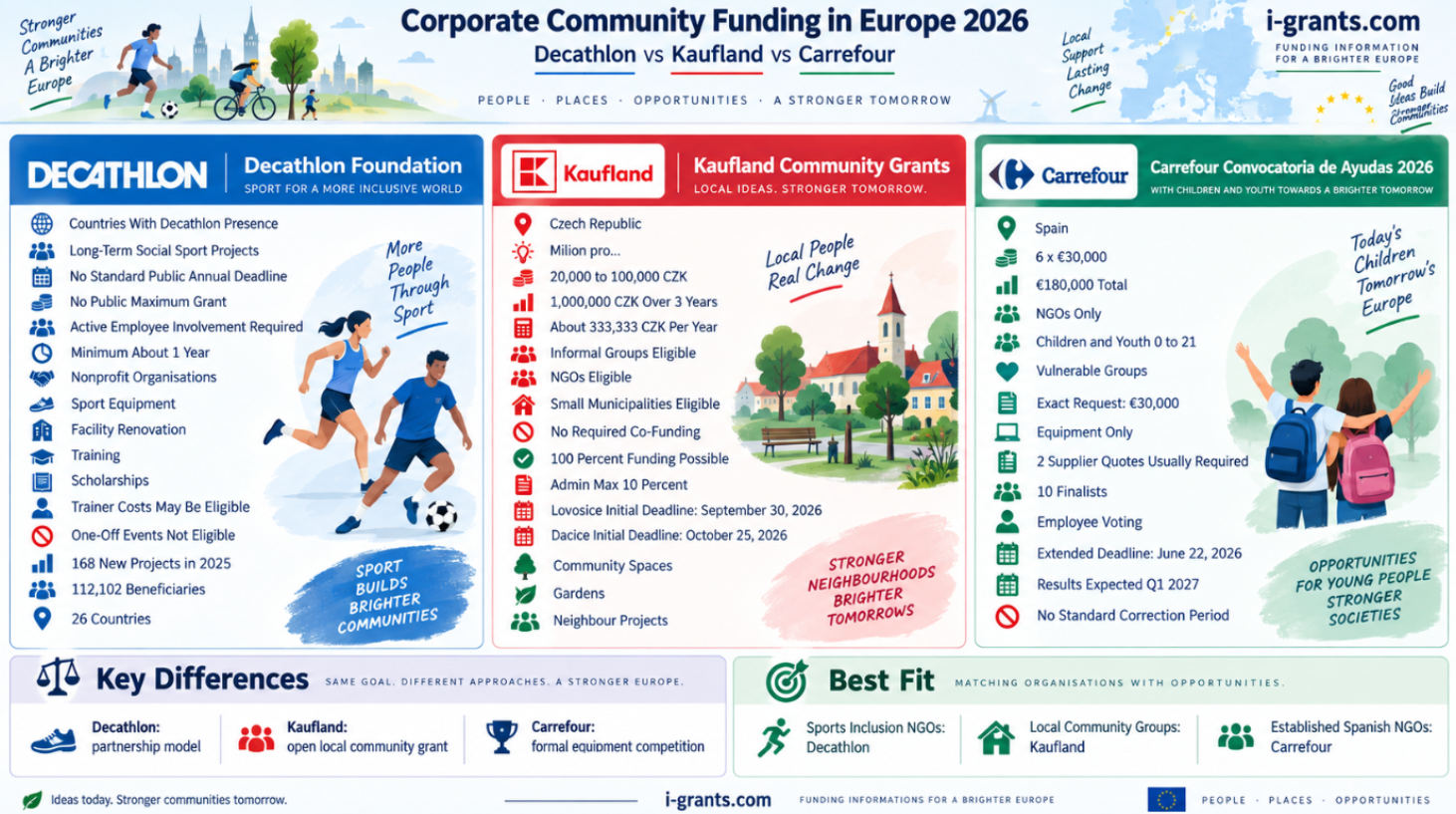
Decathlon Foundation: funding begins with a relationship, not an application portal
The Decathlon Foundation was created in 2005 to make the benefits of sport more accessible to people in vulnerable situations. Its current priorities include young people at risk, girls and women facing vulnerability, and people affected by physical, mental, or psychological health conditions or disabilities. The Foundation states that it has supported about 900,000 beneficiaries through roughly 1,000 completed projects across 53 countries, with around 10,000 Decathlon employees involved.
The first important distinction is that an organisation cannot approach the Foundation in the same way it would approach a conventional annual grant scheme.
There is no widely advertised 2026 application deadline, no standard maximum grant amount, and no simple national competition where every eligible NGO submits through the same portal.
Instead, the organisation develops the project together with Decathlon.
The Foundation's current process requires the applicant to meet the programme criteria, connect with a Foundation project manager, identify one or more Decathlon employees from a nearby store or site, prepare a detailed project dossier together, and ultimately present the project before the Foundation's Board of Directors. The Board decides whether support will be provided.
This makes access itself part of the funding process.
The employee requirement is not symbolic
The most important hidden rule of the Decathlon Foundation is the requirement for genuine employee involvement.
A Decathlon employee cannot simply provide a recommendation letter or allow their name to appear on a proposal. The Foundation says employees must be "humanly involved" in the supported project. This may involve participating in sports activities with beneficiaries, helping with professional integration, contributing to workshops, or otherwise being actively involved over time.
This requirement also explains the geographic limitation. The Foundation supports projects only in countries where Decathlon is present because local employees are expected to participate.
For an NGO, this changes the order of preparation.
The first question is not only "Is our project eligible?" It is also "Can we identify a Decathlon team member who understands the project and is prepared to participate in it?"
Without that internal human connection, an otherwise strong sports project may never reach the formal decision stage.
What Decathlon Foundation can finance
The funding scope is broader than many corporate sports programmes.
Sport must remain at the heart of the project and serve as a tool for social change, but the Foundation may support sports equipment, construction or renovation of sports facilities, beneficiary training, scholarships, certain operating costs, including salaries of trainers or educators directly involved in the project, communication linked to the supported initiative, and environmental awareness activities.
One-off events such as charity races, sponsorship events, or raffles do not meet the Foundation's current criteria. Projects must be long-term, with the Foundation stating that supported initiatives should last at least one year.
Table 2. Decathlon Foundation Eligibility and Funding Rules
| Requirement | Current position |
|---|---|
| Applicant type | Non-profit organisations |
| Geography | Countries where Decathlon operates |
| Beneficiaries | People facing social, economic, physical, or related vulnerability |
| Role of sport | Must be central to the project as a tool for social change |
| Minimum duration | At least one year |
| Decathlon employee involvement | Mandatory and active |
| Sports equipment | Can be financed |
| Construction or renovation of sports facilities | Can be financed |
| Beneficiary training | Can be financed |
| Scholarships | Can be financed |
| Trainer or educator salaries | May be financed as part of the broader project budget |
| Communication costs | May be supported where proportionate and linked to the project |
| Environmental awareness | May be included |
| One-off charity races or similar events | Not supported |
| Standard published maximum award | Not publicly specified |
| Standard annual 2026 deadline | Not publicly specified |
The treatment of staff costs is particularly notable.
Many corporate foundations exclude salaries entirely. Decathlon takes a more flexible approach where trainers or educators are integral to the project's delivery. This can make the Foundation particularly relevant to organisations whose impact depends on sustained human support rather than only equipment purchases.
At the same time, the Foundation makes clear that these supporting costs must remain proportionate to the overall project.
Decathlon's latest impact figures show the scale of the model
Decathlon's 2025 Group results, published in 2026, show that the Foundation supported 168 new projects in 26 countries during 2025, benefiting 112,102 people.
These annual figures are useful because they demonstrate that the Foundation remains operational at substantial scale rather than functioning only as a legacy corporate philanthropy programme.
Table 3. Decathlon Foundation Scale and Selected Outcomes
| Indicator | Reported figure or example |
|---|---|
| New projects supported in 2025 | 168 |
| Countries with new projects in 2025 | 26 |
| Beneficiaries of 2025-supported projects | 112,102 |
| Approximate completed projects since 2005 | 1,000 |
| Approximate beneficiaries since 2005 | 900,000 |
| Decathlon employees involved since 2005 | 10,000 |
| Countries represented in cumulative Foundation figures | 53 |
The figures also help explain why Decathlon's process is based on relationships rather than mass applications. Employee participation is embedded in the Foundation's operating model rather than added as a publicity feature after selection.
Decathlon cases show what "sport for social change" means in practice
The Foundation's European portfolio gives applicants a clearer picture of what it considers meaningful impact.
In Poland, United by the Mountains works with Fundacja Ładne Historie to make mountain experiences accessible to people with physical and intellectual disabilities and their families. Decathlon's twentieth-anniversary materials refer to around 400 volunteers and nearly 500 people with disabilities who have been able to experience mountain activities through the initiative.
In Portugal, Sai Prà Rua works with APERCIM and Decathlon Sintra to create inclusive sports opportunities for people with disabilities. The Foundation describes facilities intended for 1,100 beneficiaries and reports that by 2024 around 300 participants were taking part in weekly activities. The initiative also incorporates internships and opportunities for professional integration.
In France, Bouge ta coloc supports shared homes operated by Lazare, where young workers and formerly homeless people live together. Foundation support has provided bicycles, yoga equipment, weights, and team-sport materials, while Decathlon employees organise recurring sporting and social activities with residents. The initiative began in two homes and is intended to contribute to a broader network model.
These examples demonstrate an important selection principle. Decathlon is not primarily looking for organisations that simply need sports equipment. It is looking for programmes where sport creates measurable inclusion, health, confidence, social connection, or professional opportunity.
Kaufland Milion pro...: a genuinely open community grant
Kaufland's Czech programme provides the clearest conventional open grant opportunity in this comparison.
Milion pro... is operated with Nadace Via and is connected to communities where Kaufland opens a new store. Kaufland describes the programme as an investment of 1,000,000 Kč into local community projects in the relevant area.
The headline, however, needs explanation.
The detailed rules for the Dačice cycle state that the one million Czech crowns are distributed over three years, with up to approximately 333,333 Kč available each year. Individual projects can receive grants from 20,000 to 100,000 Kč.
The difference matters. A local organisation should not assume that the entire one million is available in one annual competition.
Two Milion pro... rounds are still actionable in 2026
As of September 2026, Lovosice and Dačice are the most relevant active calls.
The Lovosice round opened on August 3, 2026, and accepts initial questionnaires until September 30. Applicants that progress receive the full application form and must submit it by October 11. The committee meets on November 3.
Dačice accepts initial questionnaires until October 25. Full applications are then due by November 8, with the committee meeting on November 26.
Table 4. Kaufland Milion pro 2026 Active Grant Timelines
| Stage | Lovosice | Dačice |
|---|---|---|
| Call opens | August 3, 2026 | August 26, 2026 |
| Initial questionnaire deadline | September 30, 2026 | October 25, 2026 |
| Full application deadline | October 11, 2026 | November 8, 2026 |
| Selection committee | November 3, 2026 | November 26, 2026 |
| Project implementation begins | November 4, 2026 | November 27, 2026 |
| Project implementation ends | October 31, 2027 | October 31, 2027 |
| Final report and financial settlement | November 14, 2027 | November 14, 2027 |
The distinction between the initial questionnaire and the full application is important.
The public deadline advertised most visibly is not necessarily the date by which a complete final grant proposal must be submitted. Applicants first send a short introductory questionnaire. Nadace Via staff then contact them, discuss the idea, and provide the full application form.
This creates a form of pre-application consultation that can substantially improve accessibility for small local groups.
Kaufland allows informal groups to apply
One of the most unusual features of Milion pro... is its applicant eligibility.
A formal registered NGO is not always required.
The programme can accept groups of friends who want to improve their community, local non-profit organisations largely based on volunteer work, certain public institutions undertaking activities beyond their standard responsibilities, and municipalities with populations of up to 2,000.
For an informal group, the programme materials envisage at least three individuals acting together. A responsible individual can act as the formal recipient of the grant, including providing a bank account in that person's name where required by the process.
This dramatically lowers the legal entry barrier compared with most corporate funds.
At the same time, the project itself must remain local, non-commercial, and community-oriented.
Community participation matters more than professional grant language
Kaufland and Nadace Via place unusual emphasis on the quality of the local idea rather than the sophistication of the proposal text.
The evaluation framework states that a poorly written application should not automatically be rejected if the underlying project deserves support.
This does not mean the application can be careless. Budget realism, public benefit, sustainability, local participation, and feasibility still matter. But the programme explicitly recognises that good community organisers are not always professional grant writers.
That is a meaningful difference from many competitive corporate programmes.
The same philosophy applies to physical infrastructure. A gazebo, playground element, community garden, or piece of equipment should not be the final objective by itself. The asset should enable community activity, neighbour-to-neighbour interaction, volunteering, or long-term use of shared space.
Kaufland financing is flexible, but not unrestricted
Kaufland can support a relatively broad range of expenses, including materials, services, food connected with community events, lecturer or performer fees, and certain personnel costs.
Co-financing is not mandatory. A project may request support for the entire eligible budget.
However, administrative and coordination costs are limited to 10 percent of the requested amount. Team travel is not supported, and the programme excludes expenditure such as alcohol, cigarettes, and investments primarily increasing the value of private property.
Projects involving land or buildings also require careful attention to ownership and public access. In certain cases involving private land, written owner consent can be required, together with a commitment that the supported site remain available to the public for at least five years.
Table 5. What Kaufland Milion pro Can and Cannot Normally Fund
| Expense or feature | Treatment |
|---|---|
| Community materials and equipment | Potentially eligible |
| Local cultural or community events | Potentially eligible |
| Food connected with community events | Potentially eligible |
| Lecturer or performer fees | Potentially eligible |
| Certain personnel costs | Potentially eligible |
| Public-space improvements | Potentially eligible |
| Community gardens | Potentially eligible |
| Project coordination and administration | Limited to 10 percent of requested grant |
| Mandatory co-financing | Not required |
| Funding 100 percent of eligible project budget | Possible |
| Team travel | Not supported |
| Alcohol and cigarettes | Not supported |
| Private-property value enhancement | Not supported |
| Pure construction with no community activity | Weak fit |
| Public-access commitment on certain private sites | May be required for at least five years |
Another less visible condition appears after selection. Successful applicants are expected to participate in networking and educational activities organised by Nadace Via. The grant therefore includes a community-development component rather than functioning only as a cash transfer.
Kaufland's previous results show that small grants can create visible local outcomes
Milion pro... has already supported a wide variety of projects across Czech communities.
In Lovosice, the first two rounds financed 12 projects with more than 680,000 Kč in total support. Other completed multi-year locations have produced between roughly 14 and 19 supported projects per area.
Examples show that awards can be relatively modest while still creating tangible outcomes.
A Lovosice project called Den lovosických sborů received 52,650 Kč and brought together eight local choirs and ensembles. More than 140 children and adults also participated in an accompanying art competition, while local NGOs were invited to present their activities.
Another supported project in Želevice received 22,698 Kč to restore a nature trail beside the Ohře River, combining volunteer work, environmental education, information signs, and activities for local schools and families.
Elsewhere, funding has supported community meeting places, sports and creative equipment, neighbourhood events, ecological clean-ups, Czech-Ukrainian community activities, cultural festivals, and new spaces for regular social interaction.
Table 6. Examples of Kaufland-Supported Community Projects
| Project | Funding | Main community outcome |
|---|---|---|
| Den lovosických sborů, Lovosice | 52,650 Kč | Intergenerational cultural event, eight choirs, local NGO participation |
| Cesta řeky a stromů, Želevice | 22,698 Kč | Restored nature trail, volunteering, environmental education |
| Board-game club in Slivenec area | 85,000 Kč | Regular local social activity for adults |
| Community activities in Velká Chuchle | 31,000 Kč | Local family and community engagement |
| Folklore festival near Mejstříkův pond | 71,126 Kč | Local traditions, families, children, seniors, neighbourhood participation |
| Community facilities and activities in Mažice | 30,950 Kč | Sport, creative workshops, intergenerational community use |
| Multifunctional community firepit in Horusice | 50,000 Kč | Shared outdoor space and volunteer involvement |
These cases reinforce the programme's central principle: funding is intended to create relationships and shared activity, not simply to purchase physical assets.
Kaufland's national community garden programme adds another route
Milion pro... is not Kaufland's only relevant Czech funding mechanism.
The 2026 round of Už to roste, už to klíčí supported community gardens across the country. The round has already closed, but the results provide useful evidence of Kaufland's broader funding priorities.
In 2026, 16 projects received a combined 1,090,780 Kč. Across five years, the programme has supported 79 community gardens and distributed almost 4.8 million Kč. The next call is expected at the beginning of 2027.
An interesting detail is that the actual 2026 amount awarded exceeded the round-number funding level initially associated with the programme.
The supported gardens are not simply urban agriculture schemes. They frequently combine food growing with composting, rainwater collection, biodiversity, environmental education, intergenerational activities, and regular neighbourhood events.
For grant seekers preparing for 2027, this is a useful signal that Kaufland's community strategy extends beyond the areas surrounding newly opened stores.
Carrefour 2026: €180,000, six winners, and one of the strictest applications
Fundación Solidaridad Carrefour's Convocatoria de Ayudas is the most legally and administratively structured programme in this comparison.
The 2026 edition has a total budget of €180,000 and is designed to support six Spanish non-profit organisations with €30,000 each.
The Foundation states that this funding route has operated for more than 20 years and has distributed more than €4.1 million to 138 social organisations.
The target group is very specific.
Applicants must be legally established non-governmental non-profit organisations with their registered and tax address in Spain. Their projects must benefit children or young people aged from birth to 21 who live in Spain and are in situations of social vulnerability. Organisations must demonstrate at least two years of relevant experience.
Table 7. Carrefour Convocatoria de Ayudas 2026 Core Requirements
| Requirement | 2026 rule |
|---|---|
| Geography | Spain |
| Applicant | Legally registered non-governmental non-profit organisation |
| Registered and tax address | Must be in Spain |
| Beneficiaries | Vulnerable children and young people aged 0 to 21 living in Spain |
| Minimum relevant experience | Two years |
| Total programme budget | €180,000 |
| Number of winners | Six |
| Award per winner | Exactly €30,000 |
| Main funded purpose | Technical or technological equipment for direct beneficiary use |
| Initial official deadline | June 15, 2026 at 14:00 |
| Extended deadline | June 22, 2026 at 14:00 |
| Finalists | 10 |
| Final decision | Employee vote selects six winners |
| Results | Expected in first quarter of 2027 |
| Equipment operational deadline | Before December 31, 2027 |
| Final financial and activity report | First quarter of 2028 |
Carrefour's original rules gave June 15 at 14:00 as the deadline, but the technical secretariat, Fundación Lealtad, later officially extended the deadline to June 22 at 14:00. The call is now closed.
This is a useful reminder that applicants should monitor the technical operator as well as the corporate foundation. Deadline changes may appear there first.
Carrefour does not finance a general social project budget
The €30,000 award is much more restricted than the headline amount may suggest.
Carrefour funding is intended exclusively for materials or technical and technological equipment used directly by beneficiaries.
The rules mention examples such as adapted vehicles, therapy equipment, information technology, new technologies, mobile applications, multisensory stimulation rooms, and physiotherapy equipment.
Ordinary organisational expenditure is excluded. Salaries, rent, telephone bills, electricity, water, general construction work, conferences, seminars, one-off events, and publications are not the purpose of the fund.
This changes how a project should be designed.
An NGO cannot build a €30,000 request around six months of therapy staff salaries. It can, however, apply for specialised therapy or rehabilitation equipment that those professionals will use with eligible beneficiaries.
The distinction between project activity and project equipment is central to the entire Carrefour competition.
The requested amount must be exactly €30,000
This is perhaps the programme's most easily overlooked technical rule.
Each successful organisation receives €30,000, but applicants are also required to request exactly that amount.
A request for less than €30,000 or more than €30,000 is considered invalid under the rules.
The total equipment package may cost more than €30,000, but the organisation must then explain and document how the remaining cost will be financed.
That makes budgeting unusually unforgiving.
An organisation that needs only €27,000 of eligible equipment cannot simply ask Carrefour for €27,000. Nor can an organisation request €35,000 and hope that the Foundation reduces the award.
The grant request itself must be constructed to match €30,000.
Two supplier quotations are normally required
Carrefour also requires at least two quotations or pro forma invoices for the requested equipment, together with an explanation of which supplier has been selected and why.
Only highly specialised equipment with effectively one available supplier can justify a single quotation, and that exception must be explained.
This rule makes market testing part of application eligibility rather than merely a procurement recommendation.
For an application containing several equipment categories, preparing credible supplier evidence can become a substantial administrative task.
It is therefore risky to wait until the final days of the call before beginning procurement research.
Carrefour does not provide a normal correction period for incomplete applications
The 2026 rules state that incomplete applications can be discarded and that there is no standard correction period to repair documentation submitted incorrectly.
This is one of the most important administrative risks in the programme.
A strong project can therefore fail before any substantive assessment takes place.
Previous Carrefour guidance has identified common causes of rejection such as incomplete annual accounts, applying outside the deadline, requesting an amount above or below €30,000, failing to provide the required supplier quotations, omitting a detailed project budget, targeting an ineligible beneficiary group, or lacking the minimum two years of experience.
In other words, compliance is not separate from competitiveness. It is the gateway to being evaluated at all.
Carrefour performs substantial institutional due diligence
Organisations may also be asked for additional documentation within 10 calendar days during the assessment process.
This can include evidence that the governing body approved the application, an updated list of board members or trustees, tax identification documents, constitutive documents and statutes, certificates confirming compliance with tax and social-security obligations, and evidence of other financing.
The rules also contain a particularly unusual provision concerning politically exposed persons.
Where relevant members of the organisation have held significant public roles or have certain connections to public officeholders, Carrefour may request information to assess independence, local political relationships, and possible links between the project and Carrefour Group expansion activity.
For a corporate grant of €30,000, this represents a comparatively serious level of compliance review.
Selected organisations must later provide bank-account ownership documentation and information about anti-corruption measures and, where applicable, their data-protection officer before the funding agreement is completed.
Carrefour's selection process combines expert review with mass employee voting
The competition has two formal selection stages.
Fundación Solidaridad Carrefour first identifies 10 finalists from eligible applications. Carrefour employees then vote to determine the six organisations that receive funding.
The employee vote is substantial rather than symbolic.
For the 2025 edition, Carrefour reports that more than 41,800 employees participated in selecting the six successful organisations. A separate Carrefour programme page gives the more precise figure of more than 41,850 employees and reports that 207 NGOs applied in that edition.
The 2025 winners included Fundación CRIS de Investigación para Vencer al Cáncer, Asociación Murciana de Fibrosis Quística, FEDACE, Autismo Ávila, Autismo Córdoba, and AVAPACE.
These results offer rare competition data.
With 207 NGO applications and 10 finalists in 2025, only about 4.8 percent of submitted organisations reached the employee-voting stage. Six ultimately received funding, equivalent to roughly 2.9 percent of submitted applications.
These figures should not be treated as a guaranteed 2026 success rate, because application volume and eligibility quality can change from year to year. But they illustrate the level of competition much more clearly than most corporate funding programmes do.
What Carrefour evaluates
The assessment framework looks at both the organisation and the proposed equipment.
The legal rules emphasise organisational strength and sustainability, experience, collaborative work, the need and appropriateness of the requested equipment, technical feasibility, budget quality, expected use, beneficiary numbers, and impact.
The Foundation also values geographic diversity, different beneficiary profiles, and a spread of activity types among selected organisations. External audits, public-benefit status where applicable, and Fundación Lealtad accreditation can strengthen an organisation's position.
This means that simply demonstrating need for an expensive piece of equipment is not enough.
The applicant needs to demonstrate that it is institutionally capable of using the asset effectively and sustainably.
Reporting continues long after the award
Carrefour's obligations continue well beyond the announcement of the winners.
The equipment must be acquired after the funding is provided and must be operational before December 31, 2027. Changes to the approved equipment must be communicated and justified to the Foundation.
Recipients must submit a final economic and activity report during the first quarter of 2028. Carrefour also reserves the right to request information about how the funded equipment is being used.
If the organisation cannot adequately demonstrate that the full award was used for the approved equipment, the Foundation reserves the right to take appropriate legal action.
This makes document retention essential. Supplier invoices, payment records, evidence of installation, equipment records, and beneficiary-use information should be treated as part of grant management from the moment funding is received.
Previous winners can temporarily become ineligible
Carrefour also restricts repeat participation.
Organisations selected in the two previous editions cannot apply in the current round. Organisations with unresolved reporting obligations from other Fundación Solidaridad Carrefour-supported projects are also ineligible until those obligations are completed.
One organisation can submit a maximum of two applications in the same call.
These provisions prevent repeated concentration of funding among the same recipients and increase the importance of maintaining clean post-award reporting.
Hidden rules that can decide the outcome
The headline figures are not necessarily the most important part of any of these programmes.
Table 8. Hidden Rules Applicants Should Know Before Applying
| Programme | Less visible requirement | Practical consequence |
|---|---|---|
| Decathlon Foundation | Active Decathlon employee involvement is mandatory | Finding an internal partner is part of eligibility |
| Decathlon Foundation | Projects must last at least one year | One-off sports events are a poor fit |
| Decathlon Foundation | No standard published maximum award | Applicants should not assume a universal funding ceiling |
| Decathlon Foundation | Trainer and educator salaries may be eligible | Human delivery costs can be part of the funding model |
| Kaufland Milion pro... | The headline 1,000,000 Kč is spread over three years | Annual local availability is much lower than the headline may suggest |
| Kaufland Milion pro... | First deadline is for an introductory questionnaire | Full proposal comes after consultation |
| Kaufland Milion pro... | Informal groups can apply | Legal incorporation is not always necessary |
| Kaufland Milion pro... | Co-financing is not compulsory | Up to the full eligible budget may be requested |
| Kaufland Milion pro... | Administration is capped at 10 percent | Budgets with high coordination costs need restructuring |
| Carrefour | Request must equal exactly €30,000 | Even a slightly different request can be invalid |
| Carrefour | Normally two supplier quotations are required | Procurement preparation must start before submission |
| Carrefour | No ordinary correction period for incomplete documents | Administrative mistakes can end the application immediately |
| Carrefour | Previous two-edition winners are excluded | Repeat applicants need to check historical eligibility |
| Carrefour | Politically exposed person checks may be requested | Governance and compliance can affect assessment |
| Carrefour | 10 finalists move to employee voting, but only six win | Public-facing project clarity matters after technical assessment |
The table captures the central lesson of this comparison: eligibility can depend on factors that are barely visible in the headline campaign message.
Which programme is the best fit?
For a European NGO using sport as a long-term tool for inclusion, Decathlon can be exceptionally valuable, particularly when the organisation needs infrastructure, equipment, trainers, or sustained employee engagement rather than a one-time contribution. The key difficulty is gaining a committed internal Decathlon partner.
For a small Czech community initiative, Kaufland offers the lowest institutional barrier of the three. An informal group can potentially apply, co-financing is not mandatory, and Nadace Via's consultation process can help turn a local idea into a workable proposal. The programme is especially well suited to projects that create repeated community interaction rather than simply purchasing equipment.
For a Spanish NGO working with vulnerable children or young people, Carrefour offers the largest fixed individual award in this comparison, but also the narrowest spending purpose and the most demanding administrative process. It is particularly suitable where an established organisation needs specialised technical or technological equipment and can demonstrate strong governance, experience, procurement evidence, and long-term use.
The three programmes reward different kinds of readiness
Decathlon rewards relationship readiness.
An NGO needs a credible social-sport concept, but it also needs a Decathlon employee willing to invest time and participate directly.
Kaufland rewards community readiness.
The organisation or informal group needs evidence that neighbours actually want to take part, that the project improves local life, and that the result will continue beyond the grant-funded purchase or event.
Carrefour rewards institutional and procurement readiness.
A competitive organisation must already know what equipment it needs, why it needs it, how much it costs, which suppliers can provide it, how any amount above €30,000 will be financed, and how the organisation will maintain and use the equipment.
These are three fundamentally different meanings of the phrase "grant ready."
Final assessment
Decathlon, Kaufland, and Carrefour all provide meaningful corporate support in Europe in 2026, but they should not be described as three versions of the same grant.
The Decathlon Foundation is a long-term social partnership model built around sport and direct employee involvement. Its flexibility can be valuable for substantial social-sport initiatives, but access depends heavily on internal collaboration.
Kaufland's Czech programmes are closest to grassroots community grants. They combine relatively small awards with unusually broad applicant eligibility, consultation, community participation, and practical local outcomes. Their accessibility makes them particularly relevant to small associations, volunteer groups, neighbourhood initiatives, and municipalities.
Carrefour's Spanish Convocatoria de Ayudas is a highly structured competitive funding programme. Its €30,000 awards are substantial, but applicants face exact budgeting, supplier quotation requirements, extensive eligibility checks, no ordinary correction period for incomplete documentation, formal reporting obligations, and a second-stage employee vote.
For applicants, the most important question is therefore not simply which company offers the largest award.
The better question is which funding model matches the organisation's real stage of development.
A project with a strong Decathlon employee champion may be ready for Foundation partnership even without a conventional public deadline. A small Czech group with committed neighbours may have a realistic Kaufland opportunity without forming a large NGO. An established Spanish organisation may be competitive for Carrefour only when its governance, procurement documentation, beneficiary evidence, and €30,000 equipment plan are already complete.
Understanding those differences before applying can save weeks of work and, more importantly, can reveal which corporate funding opportunity an organisation is actually ready to win.