

 Français
  Deutsch
  Українська
Corporate grants occupy an unusual part of the funding landscape. They are neither government subsidies nor conventional venture capital, and they are often much more targeted than grants from large philanthropic foundations. A company may offer funding because it wants to strengthen communities where it operates, accelerate innovation in its industry, build a technology ecosystem, support environmental action, or help entrepreneurs who already participate in its marketplace.
That distinction matters. Searching for "companies that give grants" can produce hundreds of results, but only a fraction are genuine open funding opportunities. Some corporate programs are invitation-only. Some are available only to nonprofits. Others require applicants to be existing sellers, women-led businesses, scientific institutions, environmental organizations, or innovators working in a specific industry.
In 2026, major brands and brand-linked foundations including Google, Amazon Web Services, Cartier, H&M Foundation, eBay, Walmart and Patagonia illustrate how diverse corporate grantmaking has become.
The wider funding environment is substantial. According to Giving USA, charitable giving in the United States reached an estimated $617.20 billion in 2025. Corporate giving accounted for $43.67 billion. More importantly, corporate giving increased by approximately 60% over the previous five years, considerably faster than the 29% growth in total charitable giving over the same period.
However, corporate giving should not be confused with money that any organization can apply for. A corporation may donate billions through product donations, employee matching, strategic partnerships and invitation-only philanthropy while offering only a relatively small portion through competitive open grants.
For applicants, the practical question is therefore not simply, "Which companies give money?" It is: "Which corporate funding programs accept organizations like mine, for projects like mine, in my country, at my current stage of development?"
This guide examines seven major corporate or brand-linked grant ecosystems in 2026 and explains their funding amounts, eligibility requirements, deadlines, selection logic and strategic fit.
Information and application status in this article were reviewed as of August 31, 2026. Corporate grant programs can change between cycles, so applicants should always verify the current rules before submitting.
How Corporate Grants Differ from Government and Foundation Funding
Corporate grantmakers usually have a stronger strategic connection between the funder's business, mission or ecosystem and the projects they support.
Google.org increasingly funds organizations applying artificial intelligence to major scientific or public-sector problems. AWS focuses on nonprofit technology transformation and cloud infrastructure. Cartier supports women impact entrepreneurs whose businesses already demonstrate commercial traction. H&M Foundation's Global Change Award targets systemic innovation in textiles. eBay supports entrepreneurs within its own commerce ecosystem. Walmart focuses on organizations serving communities around its facilities. Patagonia funds environmental organizations whose methods closely match its philosophy of grassroots activism.
This creates an important rule for applicants: a corporate grant proposal cannot be judged only by whether the project is socially useful.
It must also explain why this particular company or corporate foundation is an appropriate funder.
A technically excellent proposal can still be a poor corporate grant application if the connection with the funder's strategic priorities is weak.
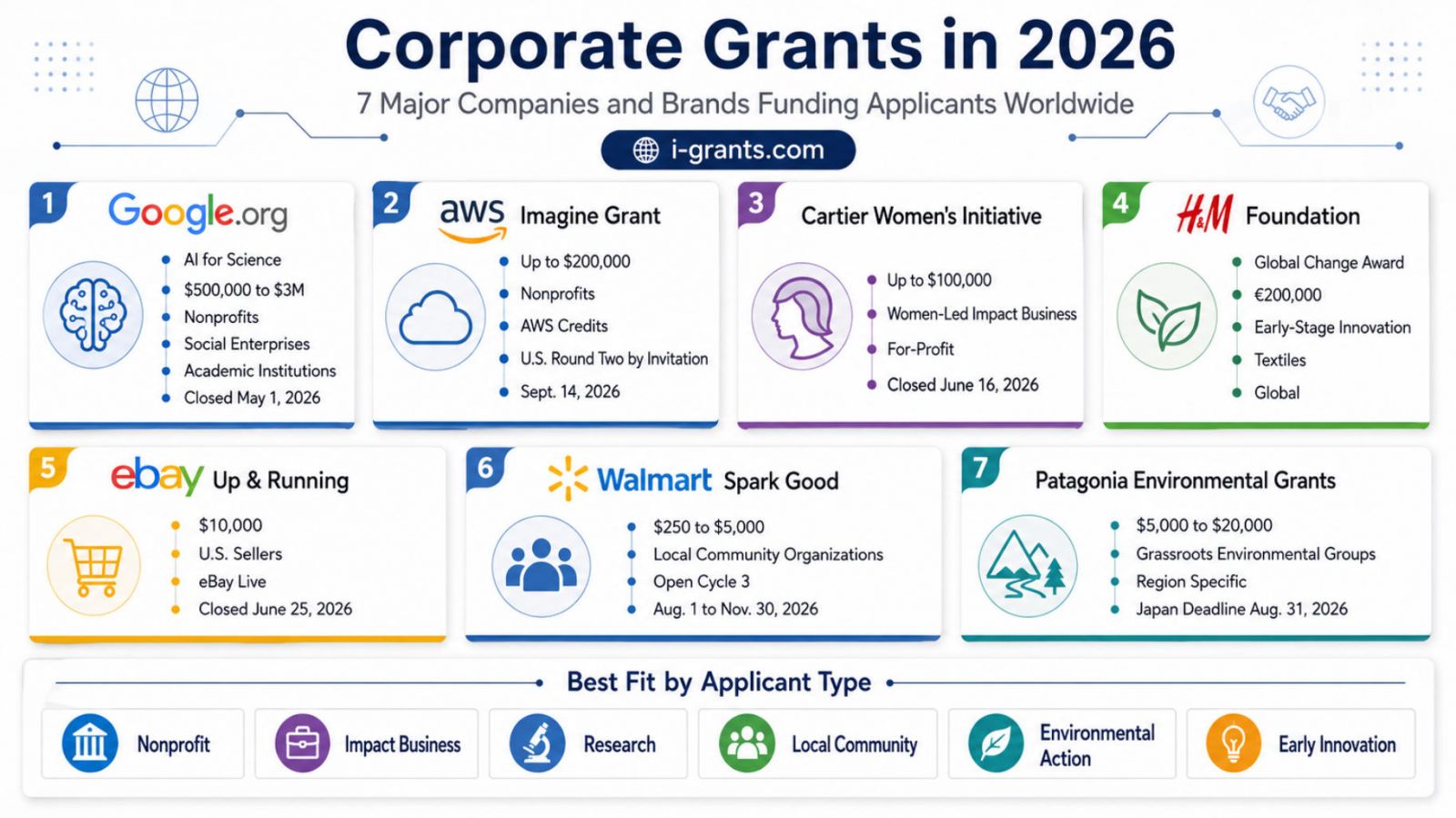
Table 1. Major Corporate and Brand-Linked Grant Opportunities in 2026
| Company or Brand | Program | Funding | Main Eligible Applicants | Geography | 2026 Application Status |
|---|---|---|---|---|---|
| Google / Google.org | Google.org Impact Challenge: AI for Science | $500,000 to $3 million per selected organization; $30 million total initiative | Nonprofits, social enterprises and academic institutions | Global | Applications closed May 1, 2026 |
| Amazon Web Services | AWS Imagine Grant | U.S. awards include up to $50,000, $150,000 or $200,000 in unrestricted funding, depending on category, plus AWS credits and support | Registered nonprofits | U.S.; versions also available in the UK, Canada, Australia and New Zealand | Closed to new U.S. applicants after June 5; invited Round Two applicants have until September 14, 2026 |
| Cartier | Cartier Women's Initiative Regional Awards | $100,000 for first place, $60,000 for second and $30,000 for third | Women-owned and women-led for-profit impact businesses | Global | Applications for the 2027 edition closed June 16, 2026 |
| H&M Foundation | Global Change Award | €200,000 per winner; 10 winners annually | Early-stage textile and fashion innovators, including individuals, teams and organizations | Global | 2026 winners announced; next nomination cycle should be monitored |
| eBay | eBay Live x Up & Running Grants | 10 grants of $10,000 | U.S. sellers interested in building or expanding eBay Live businesses | United States | Applications closed June 25, 2026 |
| Walmart | Spark Good Local Grants | $250 to $5,000 | Eligible public charities, government entities, schools and qualifying faith-based organizations | United States | FY27 Cycle 3 open August 1 to November 30, 2026 |
| Patagonia | Environmental Grants | Amount varies by program; Japan 2026 grants range from $5,000 to $20,000 | Grassroots environmental organizations | Selected countries and regions | Japan application deadline August 31, 2026 for organizations that completed registration; North American grants currently invitation-only |
1. Google.org Impact Challenge: AI for Science
Google.org is a particularly important corporate grantmaker for organizations working at the intersection of technology and social impact.
Its 2026 Google.org Impact Challenge: AI for Science is a $30 million global initiative designed to accelerate scientific breakthroughs through artificial intelligence. Selected organizations can receive between $500,000 and $3 million.
The financial award is only one component. Selected organizations may also participate in a Google.org Accelerator, receive up to six months of dedicated pro bono technical assistance from Google experts and access Google Cloud credits.
The program accepts nonprofits, social enterprises and academic institutions. It is not a conventional startup grant for any company developing an AI product.
Google.org identifies two principal scientific areas: Health & Life Sciences and Climate Resilience & Environmental Science. Exceptional proposals outside these areas can still be considered, but they must demonstrate strong alignment with the program's broader scientific objectives.
The most important eligibility principle is that AI must be central to the proposed solution.
Using generative AI to write reports, summarize documents or improve routine administrative work would not normally constitute the type of scientific innovation this challenge is designed to fund. Successful proposals are expected to use AI to unlock scientific discoveries, create foundational datasets or models, accelerate research, or solve major scientific problems that would otherwise be difficult to address.
Applicants are expected to demonstrate evidence-based scientific ambition, quantifiable outcomes, a credible project plan, realistic budget and timeline, sufficient technical and domain expertise, and the potential for impact beyond the immediate project.
Google.org also emphasizes responsible AI. The program states that AI should be developed in accordance with Google's Responsible AI Principles and that relevant solutions should be shared through open-source licensing for public benefit, or create infrastructure such as an open foundational dataset that can enable future AI use cases.
Applications for the 2026 AI for Science challenge closed on May 1, 2026.
The program is part of a much larger funding system. Google.org reports that 46 Google.org Impact Challenges have provided approximately $310 million and 100,000 hours of pro bono technical expertise, supporting more than 550 organizations worldwide.
Google.org also launched a separate $30 million AI for Government Innovation challenge in 2026. That competition offered selected organizations between $1 million and $3 million for projects using AI to improve public services in partnership with governments. Applications closed April 3, 2026.
For grant seekers, this demonstrates a broader strategic pattern: Google.org is increasingly using large grants to support organizations capable of applying advanced AI to systemic public-interest problems.
Who is a strong candidate for Google.org funding?
The strongest applicant is unlikely to be an organization merely exploring whether AI could be useful. It is more likely to be a nonprofit, social enterprise, university or research institution that already understands the problem, possesses relevant scientific and technical capability, has access to appropriate data and can explain exactly how AI changes what is scientifically possible.
A project seeking $1 million or more should also be able to show organizational capacity proportionate to the requested funding. A transformative concept without a credible implementation team is unlikely to compete effectively at this level.
2. AWS Imagine Grant: Funding Nonprofit Technology Transformation
The AWS Imagine Grant follows a different model. Rather than focusing on one scientific problem, it finances nonprofit organizations that treat technology as part of their mission-critical infrastructure.
For U.S.-based organizations, AWS currently offers three main award categories.
The Momentum to Modernize award provides up to $50,000 in unrestricted financial support and up to $20,000 in AWS Promotional Credit. It is intended for foundational technology projects such as application modernization, cloud migration, database centralization and infrastructure expansion.
The Go Further, Faster award provides up to $150,000 in unrestricted funding and up to $100,000 in AWS Promotional Credit. It targets more ambitious projects capable of using advanced cloud services such as artificial intelligence, machine learning, high-performance computing and the Internet of Things.
The Pathfinder Award provides up to $200,000 in unrestricted funding and up to $100,000 in AWS Promotional Credit. It is intended for mission-critical projects at the frontier of artificial intelligence, including generative AI, agentic AI and autonomous systems. Selected projects can also receive implementation support from the AWS Generative AI Innovation Center.
U.S. applicants must generally be registered 501(c) nonprofits. Organizations of any annual budget size can apply, but educational institutions are currently excluded from the main U.S. Imagine Grant. The program is also available in the United Kingdom, Canada, Australia and New Zealand, although award categories and eligibility conditions vary by country.
An organization does not need to be an existing AWS customer to apply. This is an important detail. However, the project should logically benefit from AWS technology because cloud credits, specialist support and AWS services form an integral part of the award.
AWS evaluates the innovative nature of the project, impact on mission-critical objectives, clarity of outcomes and milestones, relevance of AWS services, sustainability and completeness of the proposal.
For the U.S. 2026 to 2027 grant cycle, Round One opened March 19 and closed June 5. Applicants selected for Round Two were notified July 14. The invitation-only second round runs from August 10 to September 14, 2026, with final results expected in mid-November and public announcement of winners scheduled for December 1.
The scale of the program has increased significantly. AWS reported in 2025 that the Imagine Grant had distributed more than $14 million in unrestricted funding, AWS credits and technical expertise to more than 130 nonprofit organizations since its 2018 launch. In the 2025 application cohort, 87% of applicants were exploring AI use cases.
The lesson for applicants is clear: AWS Imagine is not an ordinary operating grant. A nonprofit may have an excellent mission, but if the proposed project does not require meaningful technology modernization, it is probably not the right funding route.
3. Cartier Women's Initiative: Grants for Established Women-Led Impact Businesses
The Cartier Women's Initiative is fundamentally different from many corporate grant programs because its Regional Awards are designed specifically for for-profit businesses.
It targets the "missing middle" of impact entrepreneurship: businesses that have moved beyond the idea stage and demonstrated both commercial and impact potential, but may still struggle to access sufficient capital to scale.
The Regional Awards cover nine geographic regions. Three fellows are selected from each region.
First-place awardees receive a $100,000 grant, second-place awardees receive $60,000 and third-place awardees receive $30,000. In addition to financial support, fellows receive leadership and media training, an INSEAD Women's Impact Entrepreneurship Program, individual business training, executive leadership coaching, mentorship, international visibility and lifelong access to the Cartier Women's Initiative community.
Eligibility is substantially more demanding than in many startup competitions.
The business must be for-profit and demonstrate a positive social or environmental impact connected to at least one United Nations Sustainable Development Goal. It does not need to be profitable when applying, but for the Regional Awards it must have generated annual revenue between $50,000 and $5 million in its last closed financial year.
It must also have between 5 and 250 team members and must not have raised more than $2 million in dilutive or potentially dilutive financing, including equity and instruments such as SAFEs or convertible notes.
The applicant must be a woman who is part of the founding team and occupies a principal leadership role such as CEO, COO, CTO, General Manager or Managing Director. Cartier also requires a woman to own a share in the company that is greater than or equal to the share held by each individual co-founder.
This makes Cartier inappropriate for a project that is still only an idea. It is also not designed for nonprofits.
Applications for the 2027 edition opened in 2026 and closed at 2 p.m. CEST on June 16, 2026.
The program now has a considerable track record. Since its establishment in 2006, the Cartier Women's Initiative reports 360 fellows from 67 countries and approximately $16 million in financial support. Its broader community includes more than 500 active members.
For an impact entrepreneur, the program's eligibility thresholds reveal what Cartier means by "early stage." It does not mean pre-revenue. It means a business that has enough evidence, revenue and staffing to begin scaling but has not yet become heavily financed by institutional capital.
4. H&M Foundation Global Change Award: €200,000 for Early Textile Innovation
The Global Change Award demonstrates almost the opposite funding philosophy.
Run by the H&M Foundation, the GCA is designed for very early-stage ideas that could help decarbonize and transform the textile and fashion industry.
There is an important distinction here. The H&M Foundation is a philanthropic foundation funded by the Persson family. It should therefore be described as a brand-linked foundation rather than simply as a corporate grant program run by the commercial H&M Group.
Each year, ten winners receive €200,000 and participate in a year-long Changemaker Programme. The program combines systems thinking, personal development, textile-industry knowledge, expert support and industry connections.
Unlike Cartier, GCA does not require a functioning company, revenue or customers.
An applicant can be an individual, small team or organization. The idea can be technological, social, policy-driven or focused on broader system change. H&M Foundation explicitly states that early-stage applicants may still be conducting research, working in a laboratory or developing a concept and may not yet have received funding, achieved validation or commercialized their solution. There are no geographic restrictions.
The application process is nomination-based. However, innovators who do not have access to one of the program's established nominators can submit an idea to official nominator The Mills Fabrica for consideration.
For the 2025 to 2026 cycle, nominations ran from September 1 to October 6, 2025, nominee applications remained open until November 17, screening continued through March 2026 and winners were announced in June 2026.
The 2026 winners illustrate the breadth of ideas H&M Foundation is seeking. They include technologies turning agricultural waste into regenerated fibres, bio-based materials inspired by spider silk, digital systems that improve repair and recycling, AI-based production optimization and technologies for recovering or recycling textile materials.
Since 2015, the Global Change Award has supported 66 innovations with a combined €12 million in grants.
This is one of the most important programs in this comparison for applicants who are too early for conventional investors. A founder with no revenue may be ineligible for Cartier but potentially well positioned for GCA if the innovation can create system-level change in textiles.
5. eBay Up & Running Grants: A Corporate Grant That Follows Platform Strategy
eBay's Up & Running Grants show how quickly a corporate funding program can evolve.
In 2026, the company repositioned the program around eBay Live, its live-commerce format.
The 2026 eBay Live x Up & Running Grants program committed $100,000 in total funding. Ten U.S. sellers are to receive $10,000 each, together with expert eBay Live mentorship and professional live-selling equipment.
Grant funds can support expenses including inventory, equipment, marketing and hiring. Applications were accepted from May 28 through June 25, 2026.
The opportunity was open to U.S. sellers already using eBay Live as well as sellers interested in joining the format.
That detail is strategically important.
A small business does not qualify simply because it needs $10,000. The grant is intended to develop entrepreneurs whose growth also supports one of eBay's strategically important commerce formats.
This is a common feature of corporate grantmaking: the funder's commercial ecosystem can influence the grant's design.
The program nevertheless has a meaningful history of direct small-business funding. eBay reports that it has distributed more than $3 million through Up & Running Grants since 2020.
For a seller, the strongest application would therefore connect the requested spending directly to a credible plan for developing a scalable live-commerce operation. A proposal focused on unrelated business expenses would have a weaker strategic fit even if those expenses were legitimate business needs.
6. Walmart Spark Good Local Grants: Small Awards at Community Scale
Not all significant corporate grant programs involve six-figure awards.
Walmart's Spark Good Local Grants range from $250 to $5,000. The individual awards are relatively small, but the system is distributed through Walmart U.S. stores, Sam's Clubs and distribution centers, making it highly relevant to local organizations across the United States.
For FY27, Walmart established three application cycles. Cycle 1 ran from February 1 to April 15, Cycle 2 from May 1 to July 15 and Cycle 3 runs from August 1 through November 30, 2026. As of August 31, the third cycle is open.
Eligible entities include qualifying 501(c)(3) public charities, recognized government entities, schools and faith-based organizations when the proposed project benefits the community at large.
Applicants must maintain a Walmart Spark Good account and be verified through Deed. Most importantly, the organization must serve the same service area as the Walmart, Sam's Club or other participating facility from which it requests funding.
This local connection is not a minor administrative condition. It is central to the funding model.
Facility managers consider factors including demonstrated community need, organizational track record, trust, legal compliance, the proposed use of funds and expected community outcomes. Walmart's guidelines also explicitly consider whether the need falls within an area where Walmart or Sam's Club is well positioned to contribute.
Organizations can have no more than 25 applications in pending or approved status at one time. Once an organization receives funding from a particular facility, it cannot reapply to the same facility within the same fiscal year.
The broader Walmart giving ecosystem is much larger than the Spark Good Local Grants program alone. Walmart and the Walmart Foundation reported $1.97 billion in cash and in-kind donations globally in FY2026, while the Spark Good platform connected approximately 71,700 U.S. organizations with giving and volunteer opportunities.
Applicants should not interpret those billions as an open grant budget. Instead, the statistic illustrates the scale of Walmart's community-giving infrastructure, within which Spark Good Local Grants provide one accessible application route.
7. Patagonia Environmental Grants: Funding Activism, Not Generic Sustainability
Patagonia is one of the best-known examples of corporate environmental grantmaking, but its grant structure requires careful reading.
There is no single worldwide Patagonia application with one grant amount and one annual deadline.
The company's International Grants Program supports grassroots activist organizations using direct-action strategies and multipronged campaigns to protect the environment. Patagonia states that it is particularly interested in organizations addressing the root causes of environmental problems, pursuing long-term change and proposing projects with measurable objectives, action plans and methods for evaluating success.
International funding can support environmental work in countries including Argentina, Australia, Austria, Belgium, Chile, Czechia, Denmark, France, Germany, Ireland, Italy, Japan, Luxembourg, the Netherlands, Norway, South Korea, Spain, Sweden, Switzerland and the United Kingdom. Regional processes and deadlines differ.
The Japan program provides an unusually detailed example of how the system works in 2026.
Organization registration ran from July 2 through July 15. Applications opened July 23, with an application deadline of August 31, 2026. Awards range from $5,000 to $20,000. Organizations are normally limited to one application per year. Funding decisions are expected approximately 60 days after the deadline and payments approximately 120 days after the deadline. The funded project period generally lasts one year.
Because the organization-registration period had already closed before the August 31 application deadline, the deadline is relevant primarily to organizations that completed registration in time.
The Japanese guidelines show how specific Patagonia's expectations can be. Applicants may need to provide evidence of nonprofit status, governance information, organizational goals for the next three to five years, strategy, measurable one-year outcomes, quantitative indicators, project budgets and previous financial reports.
Patagonia does not want generic environmental awareness projects simply because they are environmentally positive. The Japan guidelines exclude, among other activities, projects focused only on environmental education, land purchases, endowments, political campaigns supporting particular candidates and scientific research unless that research directly supports action addressing an environmental problem.
The international program also excludes capital expenditures such as purchasing buildings, land, vehicles or boats.
Geography matters significantly. Patagonia confirms that its North American grants program is currently operating on an invitation-only basis. Organizations cannot simply request an invitation. Patagonia's grant team and advisors identify potential organizations according to the company's funding strategy.
Patagonia's latest published impact data illustrates the scale of the broader funding activity. Its 2025 Work in Progress Report states that it provided $14.7 million in grants and in-kind support to 824 nonprofits through the 1% for the Planet program in FY25, and reports approximately $240 million in total environmental grants since the company's founding.
The key lesson is that Patagonia funds environmental activism according to a very specific theory of change. An organization can be environmentally responsible and still be a poor fit if it focuses primarily on conferences, awareness, general education or activities without a direct-action strategy.
Table 2. What Applicants Actually Need to Qualify
| Program | Critical Eligibility Requirement | What a Competitive Applicant Should Demonstrate | Common Mismatch |
|---|---|---|---|
| Google.org AI for Science | Nonprofit, social enterprise or academic institution with an eligible scientific project | AI at the core of the research, measurable scientific outcomes, technical capacity, responsible AI, scalability | Adding AI superficially to a conventional project |
| AWS Imagine Grant | Qualifying nonprofit; U.S. applicants generally require 501(c) status | Technology-driven mission impact, defined milestones, cloud architecture, measurable outcomes, sustainability | Requesting general operating support without a meaningful technology project |
| Cartier Women's Initiative | Women-led and women-owned for-profit impact business; $50,000 to $5 million annual revenue; 5 to 250 team members; no more than $2 million dilutive funding | Commercial traction, measurable impact, scalable model, leadership capacity | Pre-revenue idea, nonprofit model or company already beyond funding thresholds |
| H&M Foundation GCA | Early-stage innovation capable of helping transform or decarbonize textiles | System-level potential, originality, industry relevance, credible changemaker | Mature conventional fashion business without transformative innovation |
| eBay Up & Running | U.S. seller aligned with the eBay Live opportunity | Clear use of the $10,000 to create or scale a live-commerce business | Business need unrelated to eBay Live |
| Walmart Spark Good | Eligible local organization, Deed verified, serving the facility's community | Demonstrated local need, credible track record, clear use of funds and community outcome | Applying to facilities outside the organization's service area |
| Patagonia Environmental Grants | Eligible grassroots environmental organization under the relevant regional program | Direct action, work on root causes, measurable environmental results, community support | Generic awareness, education-only activity or prohibited capital spending |

Which Corporate Grant Fits Your Organization?
The seven programs should not be treated as alternatives for the same applicant. They operate at different stages and fund different legal structures.
A practical first screening can be made by matching the organization to the funder's basic model:
-
A research institution, nonprofit or social enterprise using advanced AI for scientific discovery should examine Google.org.
-
A nonprofit building serious cloud, data or AI infrastructure should examine AWS Imagine Grant.
-
A women-led for-profit impact business with meaningful revenue and a team of at least five people may fit the Cartier Women's Initiative.
-
An early-stage textile innovator without revenue or even a registered company may be better suited to the H&M Foundation Global Change Award.
-
A U.S. online seller building a live-commerce model may fit eBay's current Up & Running strategy.
-
A U.S. nonprofit, school or community organization seeking a few hundred or a few thousand dollars for a local project may fit Walmart Spark Good.
-
A grassroots environmental organization using direct action and tackling the root causes of environmental problems may fit Patagonia.
This screening should take place before substantial time is spent writing a proposal.
A common mistake is to start from the amount available. A founder sees "$100,000 grant" and immediately begins preparing an application. Professional grant selection works in the opposite direction: first establish legal, geographic, thematic and stage eligibility, then evaluate the funding amount.
Table 3. Track Record and Scale Behind the Seven Funding Ecosystems
| Funder | Evidence of Scale or Recent Achievement |
|---|---|
| Google.org | 46 Impact Challenges have provided approximately $310 million and 100,000 pro bono technical hours to more than 550 organizations worldwide. |
| AWS | More than $14 million in unrestricted funding, AWS credits and technical expertise had been awarded to more than 130 nonprofits since 2018; 87% of 2025 applicants explored AI use cases. |
| Cartier Women's Initiative | 360 fellows from 67 countries and approximately $16 million in financial support since 2006. |
| H&M Foundation Global Change Award | 66 innovations supported with a combined €12 million since 2015; ten 2026 winners receive €200,000 each. |
| eBay Up & Running Grants | More than $3 million in grants awarded since 2020; the 2026 program redirected funding toward eBay Live entrepreneurship. |
| Walmart | $1.97 billion in global cash and in-kind donations in FY2026; approximately 71,700 U.S. organizations connected through Spark Good. These figures cover Walmart's wider giving ecosystem, not only Local Grants. |
| Patagonia | $14.7 million in FY25 grants and in-kind support to 824 nonprofits through 1% for the Planet, with approximately $240 million in total environmental grants reported since the company's founding. |
Why Strong Projects Still Lose Corporate Grants
Corporate grant selection frequently exposes a weakness that is less visible in government funding: mission alignment is not enough.
A nonprofit may address a serious social problem but fail an AWS application because its technology plan is weak. A profitable women-led startup may fail Cartier eligibility because it lacks a measurable social or environmental impact model. A sustainability organization may be unsuitable for Patagonia because it works primarily through education rather than direct environmental action.
Five recurring problems deserve particular attention:
-
Applying to the brand instead of the program. The fact that a company supports entrepreneurship, sustainability or communities does not mean every related project fits its current grant.
-
Ignoring the applicant type. Google.org accepts several institutional forms, Cartier requires a for-profit impact business, AWS primarily targets registered nonprofits, and Walmart's local grants exclude ordinary commercial businesses.
-
Treating geography as a formality. Walmart requires local service-area alignment. Patagonia uses region-specific processes. eBay's 2026 Up & Running competition is U.S.-focused. International organizations should not assume a global brand automatically operates a global open grant.
-
Using generic impact language. "Helping communities", "using AI" or "supporting sustainability" is rarely enough. Competitive applications define who benefits, what changes, how that change will be measured and why the proposed method can achieve it.
-
Assuming last year's program will return unchanged. eBay's shift toward eBay Live in 2026 is a useful example. Corporate programs can change faster than government schemes because they respond directly to business strategy, technology and corporate priorities.
How to Prepare for the Next Corporate Grant Cycle
Several major programs in this article are already closed for new 2026 applications. That does not make them irrelevant.
Annual corporate grants often reward organizations that prepare before the next application portal opens.
A serious preparation process should include:
-
Create a funder eligibility matrix. Record legal status, eligible countries, revenue thresholds, team-size thresholds, prohibited activities, funding limits and whether an invitation or nomination is required.
-
Study the funder's strategic logic. Identify why the company funds the program. For AWS, the answer involves cloud technology and mission transformation. For eBay, it currently involves live commerce. For Patagonia, it involves grassroots environmental action. The proposal should reflect that logic without becoming promotional.
-
Analyse recent winners. The latest H&M Foundation winners, for example, show a preference for innovations that address concrete pressure points across materials, manufacturing, recycling and product life. Recent recipients often reveal more about a program's real selection standard than generic marketing language.
-
Build evidence before the deadline. Corporate funders repeatedly ask for measurable outcomes. Applicants should establish baseline data, beneficiary numbers, revenue or traction data where relevant, project milestones and realistic budgets before the application period begins.
-
Separate eligibility from competitiveness. Meeting the minimum requirements only means an application can be considered. A company with exactly $50,000 in eligible Cartier revenue still needs a compelling impact model. A verified Walmart nonprofit still needs a locally relevant project. An eligible Google.org institution still needs a scientifically ambitious AI proposal.
-
Monitor program changes. Deadlines, countries, award categories and funding amounts can change from one cycle to the next. Organizations targeting corporate funding should maintain a calendar and review official program pages before relying on information from previous years.
Open, Closed and Invitation-Only Are Different Funding States
One of the most misleading features of online grant databases is the tendency to label a program simply "available" because its website still exists.
For applicants, at least three different statuses must be distinguished.
An open call means eligible applicants can currently submit a new application. Walmart Spark Good Cycle 3 is an example as of August 31, 2026.
A closed annual program means applications are not currently being accepted, but the program has an established recurring structure and may reopen in a future cycle. Cartier, eBay, Google.org AI for Science and the 2026 Global Change Award currently fall into this broader category, although future program details may change.
An invitation-only program is fundamentally different. It may distribute substantial grants but does not provide a normal application route to every eligible organization. Patagonia's current North American grantmaking is an example. AWS Round Two is also invitation-only, but only after applicants first competed through Round One.
This distinction should determine how an organization allocates grant-writing resources. Spending days preparing for a program that is invitation-only or geographically inaccessible is not grant strategy.
The Bigger Trend: Corporate Grants Are Becoming More Strategic
The seven programs reveal several broader trends in corporate grantmaking in 2026.
First, technology is becoming more central. Google.org is funding AI-enabled scientific research at the million-dollar level. AWS has created a dedicated Pathfinder category for frontier AI projects, and the overwhelming majority of its 2025 Imagine Grant applicants were already exploring AI.
Second, grants are increasingly connected to industry transformation rather than generic entrepreneurship. H&M Foundation is looking for innovations capable of contributing to textile decarbonization. eBay's program is now linked directly to live commerce.
Third, financial support is increasingly bundled with non-financial resources. Google offers technical expertise and cloud credits. AWS combines cash with technology credits and implementation guidance. Cartier adds INSEAD education, coaching and global networks. H&M Foundation combines €200,000 with a year-long Changemaker Programme. eBay adds mentorship and equipment.
For applicants, this changes how the value of a grant should be assessed.
A $50,000 award with specialist infrastructure, technical experts, network access and market credibility can sometimes create more long-term value than a larger grant with no accompanying ecosystem.
Fourth, corporate grantmaking spans very different stages of organizational maturity. There is no universal profile of a "grant-ready company." H&M Foundation explicitly accepts ideas that may have no revenue, no customers and no registered company, while Cartier's Regional Awards require revenue, staffing and evidence of traction.
Finally, the growth of corporate giving does not mean grants are becoming easier to win. As corporate philanthropy becomes more strategic, alignment becomes more important.
Final Assessment
Large companies and global brands do provide meaningful grant funding, but the market looks very different from the simplified lists often found online.
Google.org can provide up to $3 million for AI-driven scientific projects. AWS can combine up to $200,000 in unrestricted U.S. funding with cloud resources and technical assistance. Cartier provides grants of up to $100,000 to women-led impact businesses that already have revenue and teams. H&M Foundation gives ten early-stage innovators €200,000 each to develop ideas capable of transforming the textile industry. eBay uses $10,000 grants to accelerate entrepreneurs in its live-commerce ecosystem. Walmart distributes smaller local grants of $250 to $5,000 across U.S. communities. Patagonia supports grassroots environmental action through a geographically fragmented system of regional and invitation-based programs.
These are not seven versions of the same opportunity.
They represent seven different funding models.
For a grant seeker, the most important task is therefore not to identify the company offering the largest amount. It is to identify the funder whose applicant profile, geography, strategic objective, project stage and definition of impact most closely match the organization.
That is where corporate grant research becomes more than searching for deadlines.
It becomes funding strategy.
And for organizations prepared to monitor programs before they open, document their results, understand the funder's strategic logic and select opportunities carefully, corporate grants can become a significant complement to government grants, foundation funding, investment and other forms of non-dilutive finance.