

 Français
  Deutsch
  Українська
Opening an independent coffee shop in England can require far more capital than the business model initially suggests. A commercial espresso machine, grinders, refrigeration, furniture, point-of-sale equipment, signage, electrical work, extraction, counters, plumbing, deposits, professional fees and initial working capital can quickly turn a small neighbourhood café into a significant investment. Even where the premises already has hospitality use, the owner may still need to spend heavily before serving the first customer.
For an established café, the financial challenge changes but does not disappear. The business may need to replace ageing equipment, introduce digital ordering, improve energy efficiency, refurbish the shopfront, expand seating, develop a new concept or make the premises more productive. Rising labour, ingredient and occupancy costs make it increasingly important for owners to distinguish between investments that create long-term value and ordinary operating expenses that must be financed from cash flow.
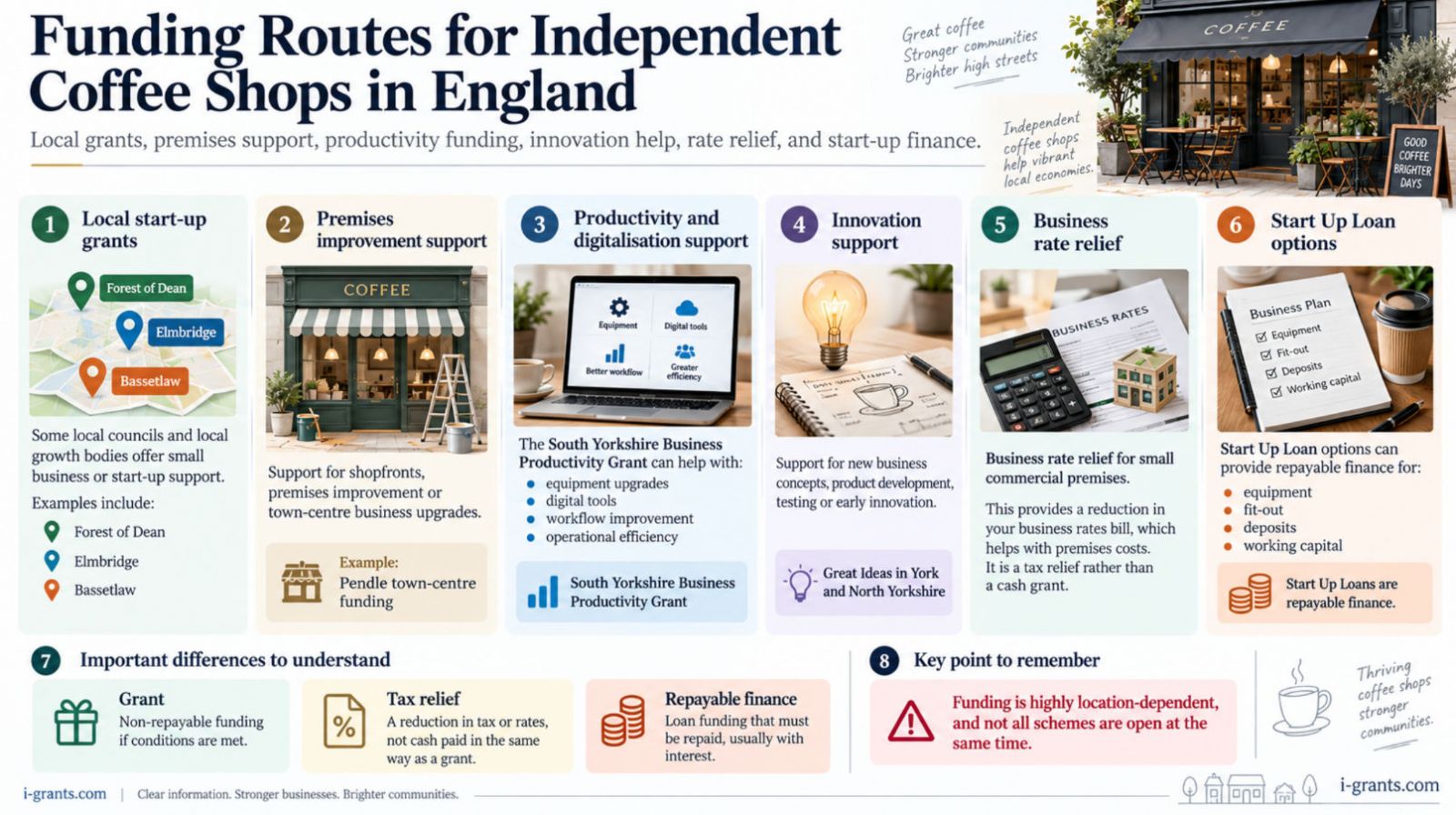
England does not currently have one universal national grant that gives every coffee shop the same amount of money. Instead, café funding is fragmented across local authorities, combined authorities, town-centre programmes, innovation funds, productivity grants, business-rate relief and government-backed finance. A café in one district may find a £1,000 start-up grant, while a similar business a few miles away may have access to a premises improvement scheme, a productivity programme or no direct grant at all.
This makes geography one of the most important eligibility tests. Two entrepreneurs can open almost identical coffee shops, buy similar equipment and employ the same number of people, yet face completely different public-support options because their premises sit under different councils or regional authorities.
The national policy environment has also become more interesting. A new £10 million hospitality support scheme explicitly refers to independent cafés, restaurants and pubs, but that headline needs careful interpretation. The first funding round is not a conventional direct grant allowing an individual café owner to request money for an espresso machine, tables or refurbishment. The most practical direct support for an individual coffee shop still tends to come from local and regional programmes.
A strong funding strategy therefore starts by separating the project into components. Equipment, premises work, digital systems, innovation, energy improvements, training, working capital and business rates may each have a different funding route. Trying to force the entire opening budget into one grant usually leads to poor programme matching.
This roadmap explains how that funding landscape works, where independent cafés can realistically search for grants, how much different schemes can provide, which expenses may qualify, why business-rate relief sometimes matters more than a small grant, and when repayable finance becomes necessary.
Why Coffee Shops Are an Important Small-Business Funding Market
The United Kingdom has one of Europe's largest and most developed coffee-shop markets. The independent segment alone contains more than 13,000 outlets and generates annual sales of more than £5 billion. The branded coffee-shop market is also enormous, with more than 12,000 outlets and annual market value measured in billions of pounds.
Independent coffee shops therefore operate in a sector with strong consumer demand, but also with intense competition. A new café is not competing only with multinational chains. It may also face established independent operators, bakeries, restaurants, convenience stores, specialty coffee roasters and hybrid concepts combining coffee with retail, coworking, books, children's activities or food production.
The economics can be demanding. A coffee shop has to generate enough gross margin from drinks and food to cover rent, labour, utilities, merchant fees, ingredients, insurance, waste, maintenance, cleaning, business rates and other expenses. Equipment failure can also create sudden capital requirements, while inflation in labour and input costs can reduce the margin available for reinvestment.
Official business surveys have repeatedly shown that accommodation and food service businesses face significant cost pressures. Labour costs, material costs and wider economic uncertainty have all been reported as major concerns. Insolvency statistics also show that accommodation and food service activities have experienced a comparatively high rate of business failure.
That does not mean that cafés are poor businesses. It means that the financial structure matters. A grant that reduces the cost of essential equipment, a rate relief that cuts a recurring property charge or a productivity investment that reduces labour pressure can materially affect the economics of a small operation.
Table 1. Key Indicators for the UK Coffee Shop and Hospitality Market
| Indicator | Recent Figure | Why It Matters |
|---|---|---|
| Independent coffee shop outlets | About 13,211 | Shows the scale of the independent café market |
| Independent coffee shop annual sales | About £5.1 billion | Demonstrates substantial consumer demand |
| Independent outlet growth | About 3.3 percent | Indicates continued expansion of the independent segment |
| Branded coffee shop outlets | About 12,313 | Shows the scale of chain competition |
| Branded coffee shop market value | About £6.8 billion | Confirms the strength of the wider coffee market |
| Hospitality businesses reporting turnover-related challenges | About 78 percent in a recent survey period | Shows significant pressure on trading conditions |
| Hospitality businesses reporting material-cost pressure | About 50 percent | Relevant to food, packaging and café input costs |
| Hospitality businesses reporting labour-cost pressure | About 50 percent | Important for a labour-intensive business model |
| Accommodation and food service insolvency rate | 268 per 10,000 businesses in 2025 | Demonstrates pressure across the wider hospitality sector |
The insolvency rate in the table refers to the broader accommodation and food service sector rather than coffee shops alone. It should not be interpreted as a café-specific failure rate. Its value is contextual: hospitality businesses operate in a demanding environment, which makes the structure of capital investment and recurring costs particularly important.
Why a Coffee Shop Can Need More Capital Than Expected
Entrepreneurs sometimes underestimate the difference between buying domestic or prosumer equipment and fitting out a commercial café. A busy coffee shop may need equipment designed for continuous use, suitable electrical capacity, reliable refrigeration, water filtration, adequate drainage, food-storage systems and a service arrangement capable of dealing with breakdowns quickly.
The premises itself can create additional costs. A unit that previously operated as a shop may need more adaptation than a former café. Electrical capacity may need upgrading, plumbing routes may need changing, counters may have to be built, flooring may need replacement and the front of the unit may require work before the business can open.
The owner must also preserve enough money for the period between signing the lease and reaching stable monthly sales. A café can spend heavily before opening and then face several months of uneven trading while the local customer base develops. A grant that pays part of a machine purchase does not eliminate this wider working-capital requirement.
This is why a coffee-shop funding plan should distinguish between capital expenditure and operating cash. Public grants often favour one-off investment because it creates a visible asset or measurable improvement. Rent, wages and stock are much harder to finance with grants and often need to come from owner funds or repayable finance.
The £10 Million Hospitality Scheme Is Not a Direct £10 Million Café Grant
The new £10 million Hospitality Grant Scheme attracted attention because the government explicitly referred to independent pubs, family-run restaurants and neighbourhood cafés when announcing the initiative.
The scheme is designed to support the hospitality sector over a multi-year period. Its objectives include helping new hospitality ventures, bringing vacant premises back into use, developing the workforce, improving productivity and strengthening the sector. More than £3 million of the overall allocation is associated with Pub is The Hub, while the remainder supports broader hospitality initiatives.
The important point for an independent café owner is that the national headline should not be confused with a direct grant programme for individual cafés.
The first round of the Hospitality Support Fund operates through larger projects. Typical project sizes start at a much higher level than the capital needs of a single small café, and applicants or delivery partners can include organisations capable of supporting groups of businesses or delivering sector-wide interventions. Funding is also expected to cover only part of project costs.
An individual café may eventually benefit from services, projects, training or initiatives financed through this fund, but a café owner should not assume that the business can submit a simple application requesting a share of the national £10 million budget.
This distinction is crucial. Government programmes can support a sector without providing direct cash grants to every business in that sector.
For practical purposes, a café owner looking for money to buy equipment, improve a shopfront or introduce a new digital system should continue to focus primarily on local and regional schemes.
The Real Grants Are Often Local
Direct café grants in England are frequently linked to place rather than industry. A district council may want to encourage new businesses into vacant units. A combined authority may want to improve productivity. A town-centre programme may focus on façades and shopfronts. An innovation programme may support new technologies or business processes.
Each programme therefore has its own logic.
A council that wants to revive a high street may be willing to fund visible premises improvements but reject the purchase of coffee beans or general stock. A productivity programme may support software, digital ordering or systems integration but reject ordinary furniture. An innovation programme may offer a much larger award but require the business to demonstrate something genuinely new.
The correct question is therefore not simply, “Are there coffee-shop grants?” A more useful question is, “Which programmes are available in the exact location of this café, and which parts of the project match their objectives?”
Table 2. Selected Funding Options for Independent Cafés in England
| Programme | Geography | Current Position | Maximum Support | Applicant Contribution | Best Fit |
|---|---|---|---|---|---|
| Hospitality Support Fund | Wider UK hospitality sector | First round focused on larger delivery projects | Part of a £10 million multi-year fund | Normally only part of project cost covered | Sector-wide support rather than a standard direct café grant |
| Forest of Dean Business Start Up Grant | Forest of Dean | Regular application rounds | £1,000 | Programme-specific | New hospitality businesses, equipment and launch costs |
| Elmbridge Start-up Boost | Elmbridge, Surrey | Available subject to programme rules | £1,000 | Applicant generally funds at least 50 percent | Equipment, one-off marketing and start-up expenditure |
| Bassetlaw Enterprise Grant | Bassetlaw | Available subject to local funding | £2,000, with possible discretionary support | Up to 50 percent of project cost | Start-ups and young businesses, equipment and marketing |
| Pendle Town Centre Premises Improvement Grant | Selected Pendle town centres | Current local scheme | £3,000 | Up to 50 percent | Shopfronts, premises improvements and vacant-unit activation |
| South Yorkshire Business Productivity Grant | South Yorkshire | Current regional support | £12,499 | Up to 50 percent | Digital systems, technology and productivity improvements |
| Great Ideas | York and North Yorkshire | Current innovation programme | Up to £60,000 | Depends on project | Genuine innovation, technology and specialist development |
| Small Business Rate Relief | England | Current tax relief | Potentially full relief | Not a grant | Reducing business rates for qualifying small premises |
| Start Up Loan | United Kingdom | Current | £25,000 per applicant | Repayable finance | Equipment, fit-out, deposits and working capital |
This table shows why there is no meaningful single figure for “the coffee-shop grant in England.” Depending on location and project type, an eligible business may find support of £1,000, £3,000, more than £12,000 or potentially much more under an innovation programme. Another café may find no direct grant at all.
Forest of Dean: A Straightforward Start-Up Grant
The Forest of Dean Business Start Up Grant is one of the clearest examples of a local programme that can directly support a new hospitality business.
Eligible applicants must be based in the Forest of Dean and meet the programme's start-up conditions. Hospitality and catering are specifically included among the sectors that can qualify, which removes some of the uncertainty that arises when a programme uses only broad wording such as “small businesses.”
The maximum grant is £1,000. Eligible expenditure can include premises-related costs, equipment, the launch of a new product or service, training and certain energy-efficient or renewable-energy installations.
For a coffee shop, the £1,000 ceiling is modest compared with the total cost of opening, but it can still be useful. The owner might use it toward a smaller item of commercial equipment, display refrigeration, signage, digital tools or part of an energy-related investment.
One of the strengths of this scheme is that application rounds are planned in advance. That creates an opportunity for entrepreneurs to prepare business plans, quotes and cash contributions rather than rushing to submit before a single one-off deadline.
The limitation is equally important: the support is local. A café outside the Forest of Dean cannot access the programme simply because its business model is identical.
Elmbridge: Up to £1,000, but the Applicant Must Pay Part of the Project
The Elmbridge Start-up Boost is aimed at businesses preparing to start trading in Elmbridge or those that have only recently begun.
The grant can provide up to £1,000 but normally covers no more than 50 percent of eligible project expenditure. That means a café seeking the full £1,000 should generally expect to have at least £2,000 of qualifying project costs and finance the remaining portion itself.
For a new café, relevant expenditure may include equipment and certain one-off marketing or launch costs. This programme is particularly useful as an example of the practical requirements behind a small grant because the applicant needs more than enthusiasm and a list of purchases.
Comparable quotations may be required, along with a business plan, financial forecasts and information demonstrating the sustainability of the enterprise. Retrospective expenditure is generally not the purpose of the programme, which means an applicant should avoid purchasing the proposed equipment before grant approval.
This creates a common timing problem. A café owner may find a discounted piece of equipment and want to buy immediately, but doing so before the programme allows expenditure can make the item ineligible.
The scheme also shows that the definition of a start-up matters. Buying an existing café does not automatically make the new owner a start-up for grant purposes.
Bassetlaw: Up to £2,000 for Start-Ups and Young Businesses
The Bassetlaw Enterprise Grant provides a somewhat larger example of local start-up support. It can provide up to £2,000 to eligible pre-start businesses and businesses that have been trading for a limited period, with smaller discretionary awards potentially available in certain cases.
Support can cover up to 50 percent of eligible project costs and may include expenditure on equipment and marketing. Hospitality businesses can qualify.
A new café could potentially use this type of grant for a defined equipment or launch package while financing larger costs, such as construction, deposits and working capital, separately.
The programme also requires the applicant to demonstrate commercial credibility. A business plan and financial projections are therefore not just paperwork added at the end of the process. They are part of the case for why public money should be used to support the business.
For a café, this means demonstrating more than the popularity of coffee. The application should show realistic customer numbers, pricing, opening hours, labour costs, rent, supplier assumptions and the expected route to sustainable trading.
Pendle: Funding the Premises Rather Than the Coffee Machine
The Town Centre Premises Improvement Grant in Pendle has a different objective. It is not primarily a start-up equipment scheme. Instead, it focuses on improving commercial premises in selected town centres.
Eligible projects can receive up to £3,000, generally covering no more than 50 percent of qualifying project costs.
For a new café, this can be useful when a vacant or tired retail unit needs visible improvements before it can operate effectively. Shopfronts, windows, frames and doors can be more expensive than expected, particularly when the owner is simultaneously paying for internal fit-out and equipment.
A premises grant can therefore remove part of the opening cost that an equipment grant would not touch.
This type of programme also illustrates why a café budget should be divided into categories. A shopfront project and an espresso-machine purchase may belong to completely different funding schemes even though both are necessary for the same opening.
Routine business costs, such as rent, electricity, milk or staff wages, should not be assumed to qualify.
Town-Centre Regeneration Can Create Indirect Opportunities
Local authorities increasingly use business grants as part of broader attempts to reduce vacancy and increase activity in town centres. Independent cafés can fit naturally into this policy objective because they can increase daytime footfall, encourage longer visits and occupy units that might otherwise remain empty.
This can create opportunities even when a programme is not marketed as a “coffee shop grant.”
A council may prioritise new occupiers in vacant premises, visible façade improvements, accessibility works or projects that diversify a town-centre offer. A café that matches those objectives can therefore have a stronger case than one applying solely on the basis of needing equipment.
The important lesson is that the applicant should understand the public objective behind the programme. A grant application should explain how the café contributes to that objective rather than treating the programme as a general source of free money.
South Yorkshire: Up to £12,499 for Productivity
An established café may have very different investment needs from a business that is opening for the first time. Once the basic equipment and premises are in place, the owner may focus on improving productivity, reducing queues, integrating online ordering, managing stock more accurately or obtaining better sales data.
The South Yorkshire Business Productivity Grant is relevant to this kind of project.
Eligible businesses in Barnsley, Doncaster, Rotherham and Sheffield can potentially receive between £2,500 and £12,499, with grant support reaching up to 50 percent of total eligible project costs.
Hospitality businesses can qualify, but the core purpose is productivity. This distinction matters because the programme is not an unrestricted equipment budget.
Potentially relevant expenditure can include software development, computers, tablets, applications, electronic commerce, systems integration, consultancy and certain equipment.
For a café, a strong project might involve a connected ordering and payment system, integration of point-of-sale data with stock management, digital pre-ordering or technology that reduces administrative work. A simple request to replace an ordinary coffee machine with a similar one may not fit the productivity objective nearly as well.
The programme therefore illustrates a broader funding principle: the same item can be eligible under one programme and irrelevant under another because eligibility depends on the purpose of the project, not merely the type of business.
Digital Systems Can Be More Grant-Friendly Than Routine Equipment
Digital investment is often easier to connect to productivity than ordinary replacement expenditure.
A café with a fragmented payment, ordering and stock system may be able to demonstrate that new technology reduces manual input, improves reporting, shortens queues or gives management better information about product performance.
This creates a clearer public-policy justification than replacing chairs or purchasing standard kitchen items.
For an existing café, a digital grant or productivity grant can therefore be worth investigating even when there is no local programme specifically labelled for hospitality.
The project still needs a measurable business case. The applicant should be able to explain what the current system does poorly, how the proposed investment changes the process and what result the business expects.
Great Ideas: Innovation Funding Can Reach £60,000
The Great Ideas programme in York and North Yorkshire demonstrates that a coffee-sector company can potentially access much larger awards when the project is genuinely innovative.
The programme supports innovation in products, services, processes and technology. Businesses considered sufficiently ready for investment can seek grants of up to £60,000.
However, this is not simply a larger version of a café start-up grant.
The applicant needs to demonstrate genuine innovation and may need to go through an innovation assessment process before reaching the grant stage. Eligible activity can include specialist external expertise, development work, access to facilities and resources, new technology and other costs connected with commercialising an innovation.
A traditional café seeking a new espresso machine is unlikely to have the same case as a coffee company developing a new roasting technology, a novel supply system, a new production process or a technically differentiated product.
The potential award is much larger because the programme is solving a different economic problem.
kWh Coffee Shows That Coffee Businesses Can Win Innovation Funding
York-based kWh Coffee has been identified as one of the businesses supported through the Great Ideas programme.
The company operates in the specialty coffee sector and uses an electric roasting approach as part of its model. Its inclusion in the programme is valuable because it demonstrates that coffee-sector businesses can move beyond very small start-up grants when their project contains genuine innovation.
There is an important reporting issue with the award figure. One official programme source lists a grant of £13,500, while an earlier formal decision records £10,500.
Without documentation clearly showing why the figure changed, those numbers should not be presented as if there were no discrepancy. The safest conclusion is that kWh Coffee is a documented grant recipient under the programme, while the exact public award figure differs between official sources.
This case also illustrates the difference between an initial award decision, a later published programme figure and the final amount actually paid. Those figures may be related without being identical.
Real Café-Related Grant Recipients Already Exist
Independent cafés and café-related concepts have already received local public support.
Maqha Café was included among businesses supported through a Business Start Up Grant programme in Hyndburn. Seven businesses in the relevant funding wave collectively received £15,000 and were associated with substantial additional private investment and employment creation.
The individual amount awarded to Maqha Café was not publicly identified. It would therefore be incorrect to divide the total funding by the number of recipients and present the result as the café's grant.
Another example is Small & Mighty Play Hub in Godalming, which combines a children's activity concept with a family café. The project had a total value of more than £106,000 and received a £50,000 Rural England Prosperity Fund grant. The funding supported capital items, including play equipment and flooring, while the project also created employment.
This is not a conventional standalone coffee shop, and it should not be presented as one. Its value as a case study lies in showing how a café component can form part of a larger locally significant business project capable of attracting substantial capital support.
Table 3. Documented Café and Coffee Business Funding Examples
| Recipient | Location | Programme | Publicly Reported Award | Important Note |
|---|---|---|---|---|
| Maqha Café | Hyndburn | Business Start Up Grant | Individual amount not published | Café documented among funded start-up businesses |
| kWh Coffee | York | Great Ideas | £10,500 in one official decision and £13,500 on a later programme page | Coffee-sector innovation recipient; public figures differ |
| Small & Mighty Play Hub | Godalming | Rural England Prosperity Fund | £50,000 | Hybrid children's activity and family café project; total project above £106,000 |
These examples are useful because they show both the availability and the limits of café funding. Grants exist, but the business often needs to fit a broader economic-development objective such as start-up support, innovation, town-centre regeneration or job creation.
What Can a Coffee Shop Actually Fund?
A coffee-shop opening budget can contain dozens of line items, but those items do not have equal grant potential.
Commercial equipment, digital systems, shopfront work and certain one-off investments are much more likely to appear in grant programmes than recurring operating costs.
The exact treatment depends on programme rules.
Table 4. What an Independent Café May Be Able to Fund
| Cost | Most Relevant Funding Route | Likely Position | Main Limitation |
|---|---|---|---|
| Espresso machine and grinders | Local start-up grant or Start Up Loan | Potentially eligible | Depends heavily on local programme rules |
| Refrigeration | Local capital, productivity or energy programme | Potentially eligible | Treatment depends on purpose |
| Tables, chairs and basic furniture | Certain local start-up grants | Potentially eligible | Usually limited by grant ceiling |
| Shopfront and entrance improvements | High-street or premises grant | Strong potential fit | Geographically restricted |
| Point-of-sale system | Productivity or digital grant | Potentially strong fit | Should demonstrate business benefit |
| Online ordering | Productivity or digital grant | Potentially strong fit | May need measurable productivity gain |
| Innovative roasting technology | Innovation programme | Potentially eligible | Genuine innovation required |
| Staff training | Certain start-up or sector programmes | Potentially eligible | Must fit programme objectives |
| Energy-efficient equipment | Local environmental or energy programme | Potentially eligible | No universal national café energy grant |
| Rent and ordinary utility bills | Most capital grants | Usually ineligible | Routine operating expenditure |
| Coffee beans, milk and normal stock | Most capital grants | Usually ineligible | Working-capital cost |
| Ordinary wages | Most capital programmes | Usually ineligible | Specialised exceptions may exist |
| Business rates | Small Business Rate Relief | Not a grant | Reduces tax rather than paying cash |
| Working capital | Start Up Loan or other finance | Finance rather than grant | Repayment required |
A café owner should therefore organise the project budget before searching for funding. The more clearly the business separates equipment, premises work, technology, energy and working capital, the easier it becomes to identify appropriate programmes.
Espresso Machines Are Not Automatically Eligible
The espresso machine is often the most obvious café investment, but that does not mean every grant will fund it.
A local start-up grant that explicitly allows equipment may accept a commercial espresso machine. A productivity scheme may require the owner to show how the machine materially improves output or efficiency. An innovation programme is unlikely to treat a standard replacement machine as innovative simply because it is expensive.
The same principle applies to grinders, refrigeration, ovens and dishwashers.
Applicants should avoid assuming that an item is eligible just because the business needs it. Eligibility is defined by programme purpose.
This distinction also affects the quality of the application. Instead of writing, “We need a £12,000 espresso machine,” the business should explain what problem the machine solves. It may increase capacity during peak periods, reduce downtime, support a larger beverage menu or replace unreliable equipment that limits trading.
The stronger the connection between expenditure and measurable business improvement, the more coherent the grant case becomes.
Shopfront Funding Can Be Separate From Internal Fit-Out
A café occupying a high-street unit may need both internal and external investment.
Internally, the business may require counters, plumbing, flooring, furniture and equipment. Externally, the façade may need windows, doors, signage or accessibility improvements.
Local premises-improvement programmes often distinguish between these categories.
A council focused on town-centre appearance may be willing to support the external work while excluding internal decoration or equipment. Another programme may support business equipment but not structural work.
A café that treats all fit-out expenditure as one undifferentiated budget can therefore miss potential funding routes.
Separating the project also makes cost control easier. The owner can identify which work is essential before opening, which improvements can wait and which items may qualify for public support.
Energy Efficiency Matters Because Cafés Use Power All Day
Coffee shops can be energy-intensive for their size. Espresso machines remain hot for long periods, refrigeration operates continuously, dishwashers cycle repeatedly, hot-water systems consume energy and lighting may run throughout trading hours.
An older café can therefore have a meaningful opportunity to reduce operating costs through energy-efficient replacement equipment or building improvements.
Local authorities and regional programmes periodically offer grants for energy efficiency, decarbonisation or net-zero investments. These schemes may support eligible equipment or technical measures, but availability varies significantly by place and funding cycle.
There is no permanent national café-specific energy grant guaranteeing that every business can receive support for a more efficient espresso machine or refrigerator.
A café considering a major equipment replacement should therefore search separately for local energy programmes. If such funding exists, it may be more suitable than a general start-up or productivity grant.
The application may need to demonstrate energy savings rather than simply the commercial benefit of the purchase.
Refrigeration Can Sit Between Equipment and Energy Funding
Refrigeration is a good example of why programme matching matters.
A start-up grant may view a refrigerator as basic business equipment. A productivity programme might support it only where there is a clear capacity improvement. An energy programme may support a high-efficiency replacement if measurable energy savings can be demonstrated.
The same physical asset can therefore fit different schemes for different reasons.
For a café, this creates an opportunity to compare programmes before purchasing. If one grant offers only £1,000 toward general equipment but another programme covers a larger share of qualifying energy-efficiency expenditure, the second may be a better fit.
Again, the business should not claim the same cost under multiple programmes unless the rules explicitly permit a lawful financing structure without double funding.
Business Rates Relief Can Be Worth More Than a Small Grant
A café can receive meaningful financial support without winning a cash grant.
In England, Small Business Rate Relief can substantially reduce the business rates payable on a qualifying small commercial property.
A business using one property with a rateable value of £12,000 or less can potentially receive full relief, reducing the business rates bill to zero. For properties with rateable values between £12,001 and £15,000, the relief gradually decreases.
For a small café, the annual saving can exceed the value of some one-off local start-up grants.
This matters because business rates are recurring. A £1,000 equipment grant reduces one capital cost once. A qualifying rate relief can reduce annual premises costs and therefore improve cash flow for as long as the eligibility conditions continue to be met.
England has also introduced lower permanent multipliers for qualifying retail, hospitality and leisure properties. Smaller cafés may therefore benefit from the new structure even where full Small Business Rate Relief does not apply.
Neither mechanism should be described as a grant. They reduce tax liabilities rather than providing cash awards.
The Premises Can Change the Entire Funding Picture
Choosing a café location is usually driven by commercial factors such as customer traffic, competition, rent, visibility, transport and local demographics. Public funding should not override those fundamentals.
However, the premises can affect several elements of the financial model simultaneously.
The postcode determines the local authority and therefore many of the available grants. The rateable value determines potential access to business-rate relief. The condition of the unit determines fit-out costs. The previous use of the premises can influence how much adaptation is required. The landlord's terms can affect how much of the improvement cost the tenant must carry.
A café comparing two otherwise similar units may therefore find that one location offers a materially better financial environment.
One property may qualify for a town-centre improvement grant and full Small Business Rate Relief, while another may have higher occupancy costs and no equivalent local grant.
This does not automatically make the first property better, but it can affect the investment calculation.
A Café Can Save Money Without Winning a Grant
Grant searches sometimes become too narrow.
An entrepreneur may spend weeks trying to win £1,000 while ignoring thousands of pounds of possible savings elsewhere in the business.
Rate relief, better lease terms, energy savings, supplier negotiation and careful equipment purchasing can all improve the financial position without being grants.
For a coffee shop, this broader approach is particularly important because the business has many recurring costs.
The purpose of public funding should therefore be to strengthen an economically viable business, not to compensate for an unsustainable cost structure.
A grant can improve the economics of a good project. It rarely fixes a poor site, unrealistic rent, weak customer demand or an undercapitalised business.
Start Up Loans Can Finance What Grants Often Reject
The Start Up Loan programme is an important part of the funding landscape precisely because direct grants are often small.
Eligible applicants can borrow between £500 and £25,000. The support is government-backed but remains repayable finance. It is structured as an unsecured personal loan used for business purposes rather than as a cash grant.
The loan can be useful for expenses that local grants may not fully cover, including equipment, fit-out, deposits and working capital, subject to the programme's lending rules.
The fixed annual interest rate is 7.5 percent, and repayment periods generally range from one to five years. Applicants must pass a credit assessment and demonstrate that the proposed business is viable.
Business-plan support and mentoring can also form part of the programme.
A café owner should therefore evaluate the loan based on repayment capacity. The relevant question is not only whether the business can obtain £25,000, but whether projected operating cash flow can support the repayments after rent, wages, stock, tax and other expenses.
A Realistic £60,000 Café Funding Example
Consider a hypothetical independent café requiring £60,000 before opening.
Suppose £15,000 is allocated to the espresso machine, grinders and refrigeration; £10,000 to furniture and internal fixtures; £12,000 to building and shopfront works; £5,000 to point-of-sale systems, website and launch costs; and £18,000 to deposits, professional fees, opening stock and working capital.
It would be unrealistic to expect one local grant to pay the entire £60,000.
If the café is located in an area offering a £2,000 start-up grant, that support might contribute toward qualifying equipment. A separate premises grant could potentially support part of the façade or entrance works. The owner might use private savings for the required match and obtain a Start Up Loan for equipment or working capital that grants do not cover.
If the property also qualifies for Small Business Rate Relief, the café may benefit from lower recurring costs after opening.
The result is a funding structure rather than a single grant.
This is the most realistic way to think about café finance.
A Larger £120,000 Café Project Needs Even More Discipline
A more ambitious specialty coffee shop can easily exceed £100,000 if the business occupies a larger unit, includes food preparation, requires major building work or incorporates roasting.
Imagine a £120,000 project containing £30,000 of coffee and kitchen equipment, £30,000 of construction and fit-out, £15,000 of furniture, £10,000 of digital and technical systems, £5,000 of professional fees and £30,000 of deposits and working capital.
A £1,000 or £3,000 local grant will reduce only a small part of the total investment.
That does not make the grant irrelevant. It means the entrepreneur must understand the role of each funding instrument.
A premises grant may reduce fit-out expenditure. An innovation grant may be relevant to a genuinely new roasting or production process. A loan may finance equipment and working capital. Owner capital may cover the remainder.
The larger the project, the more dangerous it becomes to plan around an assumed grant before the award is confirmed.
Do Not Count an Unapproved Grant as Available Cash
A common planning mistake is including a hoped-for grant as if it were already secured.
If the business requires £60,000 to open and has £35,000 of confirmed capital plus a planned £25,000 grant application, the project does not yet have £60,000 of finance.
The application may fail, the award may be smaller, the eligible-cost calculation may change or the programme may run out of budget.
A cautious financial plan treats a grant as uncertain until formal approval is received.
This is particularly important when a lease has already been signed and rent is running.
The café should ideally be able to understand what happens if the grant is delayed or rejected. If the entire project collapses without one discretionary award, the financing structure may be too fragile.
Match Funding Is Not the Same as the Total Project Cost
Local grants frequently cover only part of a project.
If a programme offers up to 50 percent of eligible costs, the owner must usually finance the remainder.
A £3,000 grant at a maximum 50 percent intervention rate normally implies at least £6,000 of qualifying project expenditure.
But the business may need even more cash than the simple match calculation suggests.
The project may contain non-eligible costs, VAT treatment may matter depending on the applicant's circumstances, suppliers may require payment before reimbursement and the grant may be paid only after evidence of expenditure is submitted.
Applicants should therefore distinguish between the grant rate, the minimum required contribution and the actual cash needed to complete the project.
They are not always the same number.
Reimbursement Can Create a Temporary Funding Gap
Some grant programmes pay after the business has incurred eligible expenditure.
For a small café, this can create a meaningful cash-flow problem.
Imagine a £10,000 eligible equipment project supported at 50 percent. The final economic contribution from the grant may be £5,000, but the supplier may still require the café to pay the full £10,000 before the reimbursement claim is processed.
The owner therefore needs access to more than the final £5,000 contribution.
This is why grant applicants should examine payment mechanics as carefully as the headline award amount.
A £5,000 reimbursement grant can be difficult to use if the business does not have the temporary liquidity to pay the project cost first.
Buying Too Early Can Destroy Eligibility
One of the easiest mistakes to avoid is starting expenditure before the programme permits it.
A café owner may receive a time-limited equipment quote or find a discounted espresso machine and want to order immediately. If the grant rules prohibit retrospective expenditure, that purchase may become ineligible.
The same risk can apply to deposits, signed supplier contracts, building works and professional services.
Before committing money, the applicant should determine exactly when eligible expenditure can begin.
Some programmes permit spending only after a formal grant offer. Others may use a specific eligibility date. The applicant should never assume.
This timing rule is especially important when the business is under pressure to open quickly.
Quotes Are More Than an Administrative Detail
Local programmes may require multiple supplier quotations for significant purchases. This is intended to demonstrate value for money and can also protect the applicant from building the project around an unrealistic price.
For a coffee shop, comparable quotations should be genuinely comparable. A quote for a basic two-group espresso machine and another for a much more advanced system may not demonstrate meaningful price comparison if the specifications are fundamentally different.
The applicant should therefore define what the business actually needs before collecting quotations.
This also reduces the risk of buying equipment that is oversized for the expected sales volume.
A grant should not encourage unnecessary expenditure simply because part of the cost is subsidised.
A Business Plan Matters More Than the Café Concept Alone
Coffee is familiar, but a familiar product does not make a business automatically viable.
Councils and grant panels may want to understand who the customers are, how the business will attract them, what average transaction value is expected, how labour will be scheduled and how long the business can survive before reaching stable trading.
A useful café business plan should connect customer demand to capacity and cost.
If the owner expects 250 transactions per day, the equipment, staffing and seating assumptions should make sense for that volume. If the business is built around specialty coffee with higher prices, the plan should demonstrate why the local market can support that positioning.
Rent and labour assumptions should also be realistic.
A grant application becomes much stronger when the requested investment clearly supports this commercial model.
Productivity Claims Should Be Measurable
A productivity grant requires more than saying that new technology will “make the business more efficient.”
A café applying for support toward an ordering system can potentially measure current queue times, manual administrative hours, order errors or time spent reconciling different systems.
The proposed investment can then be linked to expected improvements.
A new system may reduce time spent entering data manually, allow customers to pre-order, increase throughput during peak periods or improve inventory control.
The grant panel can then see the connection between expenditure and productivity.
This is fundamentally different from purchasing technology because it looks modern.
Innovation Claims Also Need Substance
The same principle applies to innovation.
A coffee business should not describe a standard product or machine as innovative simply because it is new to that particular café.
Innovation funding generally expects something more substantial: a new product, process, service, technical approach or commercially meaningful development.
A coffee roaster developing an electric roasting process, new data-driven supply system or new production technology may have a credible innovation project.
A conventional neighbourhood café buying its first standard espresso machine usually does not.
Trying to reshape an ordinary project into an innovation narrative can weaken an application rather than strengthen it.
Food, Retail and Hybrid Café Concepts Can Open Different Funding Paths
Not every coffee business is a conventional café.
Some combine coffee with bakery production, books, coworking, children's activities, specialty food retail, roasting, events or community services.
These hybrid models can sometimes access programmes that a standard café cannot, because the project aligns with additional public objectives.
A café with its own production activity may fit certain manufacturing or innovation schemes. A community-focused café may fit a social-enterprise programme. A café occupying a long-vacant high-street property may align strongly with regeneration funding.
The business should still describe itself accurately. A café should not pretend to be a manufacturer or technology company solely to access a grant.
The funding strategy should follow the genuine business model.
Staffing and Training Can Be Part of the Investment Problem
Equipment is only one constraint on café growth.
An owner may invest in a larger espresso machine but still struggle to increase throughput if staff are not trained to use it efficiently. A new digital ordering system may not improve productivity if employees continue using old processes.
Some programmes allow training or professional support as part of a broader project.
Where training is eligible, the application should explain why it is necessary to obtain the intended benefit from the investment.
For example, barista training, food-safety training or technical instruction may be relevant in certain programmes if it directly supports the funded development.
Ordinary ongoing payroll costs are much less likely to be supported through capital grants.
Working Capital Remains One of the Hardest Costs to Fund
Many cafés need support most urgently for cash flow.
The business has to pay wages, buy milk and coffee, cover rent and replenish stock even during slow weeks. Unfortunately, these are precisely the costs that many grants do not finance.
Working capital therefore often needs to come from owner savings, commercial finance or a Start Up Loan.
This makes initial capital planning crucial.
An entrepreneur who spends almost every available pound on design and equipment may open an attractive café but have too little cash to survive the first few months.
Public funding should reduce investment cost, not encourage the owner to eliminate the working-capital reserve.
Business Rates Should Be Checked Before Signing the Lease
Because business-rate relief depends on the property, a café owner should investigate the rateable value before committing to a premises.
A unit with a rateable value of £12,000 or less may potentially qualify for full Small Business Rate Relief if the business meets the applicable conditions. A slightly more expensive or larger unit may have a higher rateable value and a very different annual cost.
This can materially change the occupancy calculation.
A location that is only modestly more expensive in rent may become much more expensive once business rates are included.
Conversely, a small premises qualifying for relief may have lower effective occupancy costs than expected.
This is a recurring financial effect, unlike a one-time grant.
A Grant Should Not Rescue a Bad Lease
An attractive grant can sometimes distract from the economics of the premises.
A £3,000 shopfront grant is not a good reason to accept a lease with unsustainable rent, poor footfall or restrictive terms.
The business should be viable without assuming repeated public support.
For most cafés, customer demand and occupancy costs will have a much larger effect on long-term profitability than a one-off small grant.
Grant support should improve a sensible project, not justify a weak one.
Documents a Café Applicant Should Prepare Early
Although requirements differ by programme, certain documents appear repeatedly across local and regional schemes. A serious applicant should normally be ready with a business plan, financial forecasts, project budget, supplier quotations, evidence of location, information about the business structure, proof of available matching funds and a clear explanation of how the proposed expenditure will improve the business.
Premises projects may require landlord consent or information about the lease. Innovation projects may require technical information. Start-up schemes may ask when the business began trading. Programmes supporting commercial property may require evidence that the applicant occupies or intends to occupy the eligible unit.
Applicants should also maintain clear records after approval. Invoices, proof of payment, supplier details and evidence that the funded items were purchased may all be needed before reimbursement or project closure.
Good documentation is therefore part of the funding strategy, not merely an administrative task after the award.
The Largest Headline Is Not Always the Best Opportunity
A £60,000 innovation grant or £10 million national hospitality announcement naturally attracts more attention than a £1,000 local start-up scheme.
For an ordinary independent café, however, the small local grant may be the only programme designed for the actual project.
Funding should therefore be compared using practical criteria: applicant eligibility, geographic eligibility, eligible expenditure, required contribution, payment mechanics and current application status.
A £1,000 grant that clearly funds an item the café needs can have more practical value than a £60,000 programme that requires a type of innovation the business does not have.
This is why grant research should begin with project fit rather than maximum award.
The Best Search Starts With the Postcode
For independent cafés in England, funding is often local before it is sector-specific.
The most efficient search therefore starts with the business postcode, local council, combined authority or county rather than the words “coffee shop grant” alone.
A café in Forest of Dean should search Forest of Dean business support. A business in Elmbridge should review Elmbridge schemes. A Sheffield café should investigate South Yorkshire programmes. An innovative coffee business in York should examine York and North Yorkshire support.
Useful search categories include start-up grants, town-centre grants, premises improvement, productivity, digitalisation, energy efficiency, decarbonisation and innovation.
This approach often reveals programmes whose titles never mention cafés but whose eligibility rules include hospitality businesses.

Check Whether the Programme Is Actually Open
Another major source of confusion is outdated funding information.
Council pages, old press releases and business-support articles can remain online after a grant has closed. A programme may also have existed in a previous funding round but not have a current allocation.
A prospective applicant should therefore confirm the current status before building a financial plan around a grant.
A useful programme from last year can still be mentioned as a funding route to monitor, but it should not be presented as if applications are currently being accepted.
This is particularly important with national programmes, where different phases or rounds can have very different objectives.
Requested, Approved and Paid Amounts Should Be Kept Separate
Grant case studies often publish the amount “awarded” to a business, but that figure may not be the same as the amount finally paid.
A company may request one amount, receive approval for another, sign a funding agreement and later receive reimbursement based on verified expenditure.
If a programme uses reimbursement, the final payment can depend on whether all planned costs were incurred and accepted.
For that reason, an announced award should not automatically be described as cash already received.
The kWh Coffee example shows another variation: different official sources can publish different figures at different stages.
Accurate grant reporting should preserve those distinctions instead of forcing them into one number.
Local Funding Can Change Quickly
One of the weaknesses of local funding is that availability can be temporary.
A council may open a scheme using a fixed allocation, award grants until the budget is committed and then close applications. Another area may launch a new programme several months later using a different funding source.
This means a coffee-shop article should teach readers how to search, not only give them a static list.
The most durable strategy is to understand the main categories of support and check the current local version when the business is ready to invest.
Start-up grants, premises grants, productivity programmes, innovation funds and energy schemes tend to reappear in different forms even when individual programme names change.
A Practical Funding Strategy for a New Independent Café
A prospective café owner should begin with the total project budget rather than with grant searches. The budget should separate equipment, fit-out, premises work, technology, deposits, professional fees, stock and working capital.
The next step is to identify the postcode and all relevant public bodies responsible for local business support. This includes the district or borough council, combined authority where applicable and other regional business-support organisations.
The owner can then match each investment category against available programmes. Equipment may fit a start-up grant. The façade may fit a town-centre scheme. Digital systems may fit productivity funding. A genuine technical development may fit innovation support.
The remaining costs should be financed through owner capital, appropriate loans or other sources.
Only after that structure is clear should the business decide which grants are worth applying for.
A Practical Funding Strategy for an Existing Café
An established café has a different starting point.
The owner should identify the operational problem before looking for money. The problem may be low throughput at peak times, high energy consumption, inefficient ordering, inadequate refrigeration, a poor shopfront or limited production capacity.
Once the problem is defined, the business can look for programmes aligned with that objective.
A digital productivity grant is more convincing when it solves a documented workflow issue. An energy grant is stronger when it reduces measurable consumption. An innovation grant needs a genuinely new process or product.
This problem-first approach reduces the risk of buying equipment simply because grant money is available.
Local Grants, Rate Relief and Finance Can Work Together
The most realistic funding model for many cafés is a combination rather than a single programme.
A local grant may reduce the cost of equipment. A premises grant may support a shopfront. Small Business Rate Relief may reduce recurring occupancy costs. A Start Up Loan may finance working capital or larger purchases. Owner funds may provide match funding.
These instruments solve different problems.
The café should document which source pays for which cost and avoid double funding.
A clear funding structure also makes the business plan more credible because it shows that the owner understands both the capital investment and the ongoing cash needs.
Coffee Shop Grants in England Are Local, Fragmented and Still Useful
England does not currently offer one simple national grant that gives every independent coffee shop the same amount for opening, refurbishment or expansion. The funding landscape is fragmented, but it is not empty.
Small start-up grants can contribute to equipment and launch costs. Town-centre programmes can help improve commercial premises. Productivity schemes can support digital systems and technology. Innovation programmes can provide much larger awards to businesses developing genuinely new processes or products. Energy programmes may support qualifying efficiency improvements when local rounds are available. Business-rate relief can reduce recurring property costs, while government-backed loans can finance expenses that direct grants do not cover.
The new £10 million hospitality support scheme adds another layer of national sector support, but it should not be confused with a direct £10 million grant pot open to ordinary applications from individual coffee shops.
For most café owners, the practical search begins locally. The postcode, council area, age of the business, premises and exact purpose of the investment can matter more than the fact that the company sells coffee.
A prospective applicant should therefore separate the project into equipment, premises, digital systems, energy, innovation, working capital and recurring costs before searching for support. Once those categories are clear, the business can match each cost to the most appropriate grant, relief or financing instrument.
The strongest café funding strategy does not ask, “Where can I get the biggest grant?” It asks which part of the project genuinely matches public funding, which costs require private capital, how much cash is needed before reimbursement and whether the business remains viable if the grant is smaller than expected.
For an independent café in England, grants can meaningfully reduce the cost of opening or improving a business, but they work best as one component of a realistic investment plan rather than as the entire financial foundation of the coffee shop.