

 Français
  Deutsch
  Українська
Corporate grants have become an important source of financing for nonprofit organisations working in education, employment, humanitarian assistance, environmental protection, and community development. International companies increasingly combine charitable giving with their business expertise, geographical presence, and long-term social commitments. However, identifying a company with a substantial philanthropic budget does not necessarily mean finding an accessible grant opportunity.
Some corporate foundations accept applications throughout the year. Others finance organisations selected by local business partners or distribute grants through competitions with strict geographical and thematic requirements. Even when two companies support similar social objectives, their application procedures, eligible expenditure, grant amounts, and reporting obligations may differ considerably.
Cisco, Starbucks, and Coca-Cola illustrate three different approaches to corporate funding.
Cisco supports nonprofit organisations developing technology-enabled solutions to significant social challenges. The Starbucks Foundation finances community initiatives across numerous international markets, including Europe, but its principal international programme operates through nominations from participating business partners. Coca-Cola's Thank You Fund provides direct grants through competitive funding rounds for eligible organisations in Ireland and Northern Ireland.
These programmes are relevant to organisations working in digital inclusion, youth development, employment, food security, and community resilience. They also demonstrate why grant seekers must distinguish between historical funding results, long-term financial commitments, and opportunities that are actually available for new applications.
This article examines the three companies' programmes using official information and published results reviewed as of September 16, 2026. It explains their financial scale, eligibility requirements, application procedures, selection criteria, documented beneficiaries, and important restrictions. Particular attention is given to European nonprofit organisations and the practical requirements they should consider before preparing funding proposals.
1. Corporate Grants in Europe: Understanding Three Different Funding Models
Corporate philanthropy encompasses several forms of support. Companies may provide cash grants, donate equipment, finance community partnerships, offer professional expertise, or invest in enterprises addressing social and environmental challenges. These instruments serve different purposes and create different obligations for recipients.
A charitable grant generally provides financial assistance for approved activities without requiring an ownership stake in the recipient organisation. Nevertheless, the funding may be conditional on delivering agreed results, maintaining financial records, submitting reports, and complying with restrictions on expenditure.
Technology donations and corporate partnerships operate differently. An organisation receiving equipment does not necessarily receive cash to cover operational expenses, while participation in a corporate partnership may involve volunteering, promotional activities, or other forms of cooperation.
Impact investments must also be distinguished from grants because they may involve equity, debt, or other financial arrangements through which the investor expects a return.
The programmes operated by Cisco, Starbucks, and Coca-Cola demonstrate why these distinctions matter.
Cisco offers an international application pathway for eligible nonprofit organisations. Its Global Impact Cash Grant Program accepts preliminary applications throughout the year, although organisations must pass an eligibility assessment and an initial review before they can submit a complete proposal.
The Starbucks Foundation's Global Community Impact Grants programme follows a nomination-based model. Participating international licensees identify and recommend local nonprofit organisations. Although grants have been awarded in numerous European countries, there is no confirmed universal public application portal available to every interested organisation.
Coca-Cola's Thank You Fund operates through announced competitions. Applicants must satisfy the conditions of a particular funding round and submit their proposals before the specified deadline. Its 2026 competition has already closed.
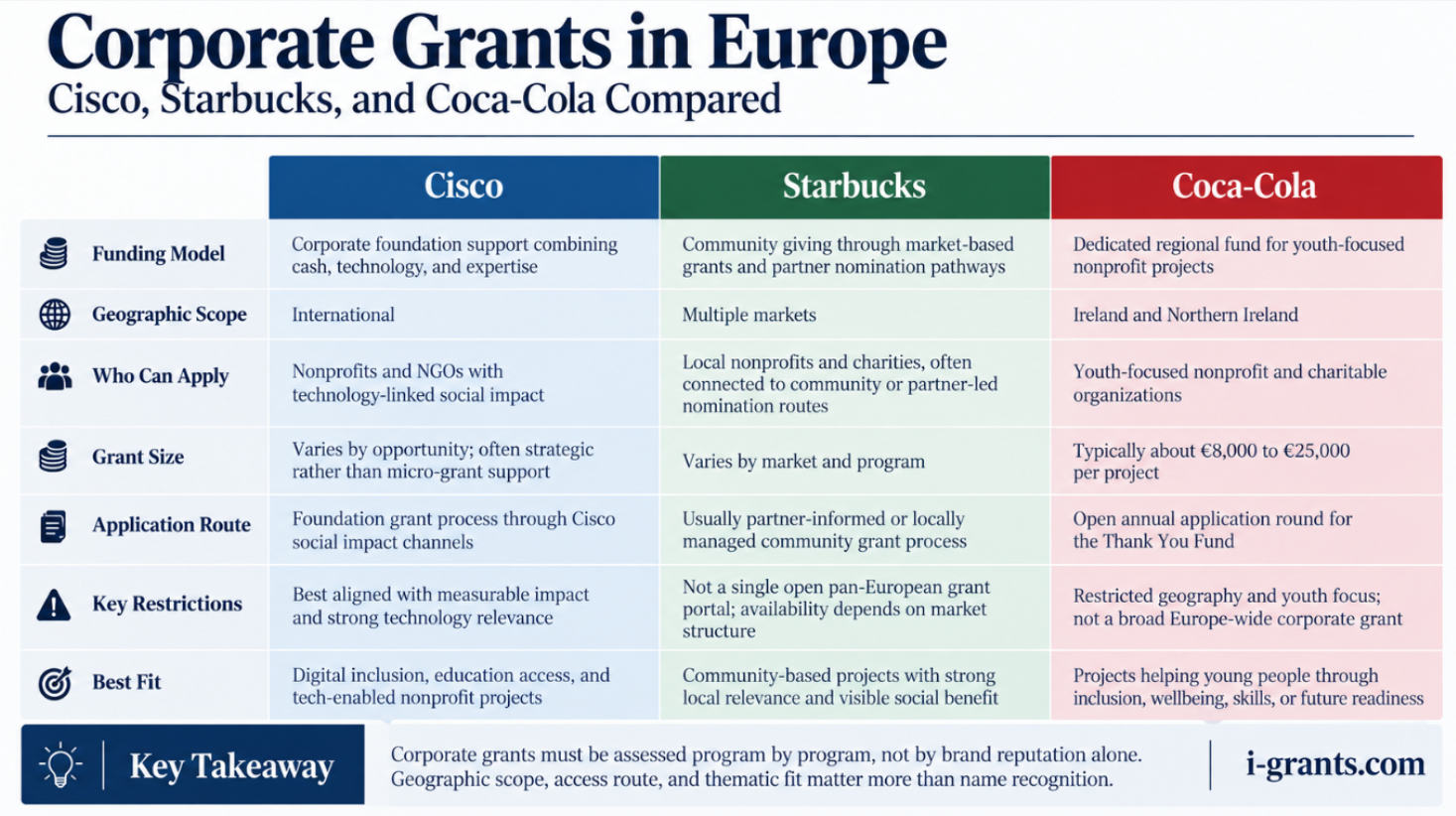
Table 1. Comparison of Cisco, Starbucks, and Coca-Cola Grant Programmes
| Parameter | Cisco | Starbucks | Coca-Cola |
|---|---|---|---|
| Programme | Global Impact Cash Grants | Global Community Impact Grants | Thank You Fund |
| Primary applicants | Eligible nonprofit and nongovernmental organisations | Nonprofits nominated by participating Starbucks partners | Registered nonprofit organisations |
| Geographical coverage | International, subject to eligibility requirements | Participating international markets, including Europe | Ireland and Northern Ireland |
| Grant amount | Up to US$100,000 for first-time recipients | No universal individual grant ceiling publicly confirmed | €5,000 to €15,000 in 2026 |
| Application procedure | Eligibility assessment, preliminary inquiry, full proposal by invitation | Nomination through participating licensees | Competitive application |
| Application status on September 16, 2026 | Initial applications accepted throughout the year | Partner nomination system | 2026 competition closed |
| Main priorities | Crisis response, education, economic empowerment, climate resilience | Community development and locally relevant social initiatives | Youth inclusion, wellbeing, education, and employment readiness |
The comparison reveals an important principle: corporate funding opportunities must be assessed at programme level rather than brand level.
A company may spend millions of dollars on charitable activities without offering an open application process. Similarly, the existence of previous grant recipients in a particular country does not establish that new organisations can currently apply.
Before developing a proposal, applicants should establish whether their organisation is eligible, whether an appropriate funding mechanism exists, and whether the proposed project matches the programme's requirements.
2. Cisco Foundation: International Grants for Technology-Enabled Social Impact
Cisco is a global technology company specialising in networking, telecommunications, and digital infrastructure. Its philanthropic activities include cash grants, technology donations, and investments supporting organisations that address major social and environmental challenges.
The Global Impact Cash Grant Program is one of its principal funding mechanisms for nonprofit organisations.
The programme focuses on innovative solutions that use technology to improve services, reach underserved populations, and generate measurable social benefits. Its priorities include crisis response, education, economic empowerment, and climate resilience.
For European NGOs, this creates potential opportunities in digital education, humanitarian coordination, employment services, environmental monitoring, and other fields where technology can improve the effectiveness of social interventions.
However, Cisco is not a general-purpose donor providing unrestricted funding to every organisation operating in these sectors. Its requirements emphasise technological innovation, organisational capacity, measurable outcomes, and the potential for solutions to expand beyond their initial implementation.
2.1. Grant Amounts and Financial Performance
Cisco's current Global Impact Cash Grant Program information establishes a maximum request of US$100,000 for first-time recipients.
This amount represents a funding ceiling rather than a standard award. Applicants should not assume that a successful proposal will automatically receive the maximum.
An additional consideration concerns differences between current and historical programme documentation. An older downloadable guide specifies a first-time funding limit of US$75,000, while the current programme webpage states US$100,000. Applicants should verify the amount permitted in the official application system before finalising their budgets.
Cisco Foundation's financial reporting provides a broader picture of its activities.
In fiscal year 2025, the foundation reported US$18 million in cash grants distributed to 103 nonprofit organisations. It also provided US$12 million in donated technology to nonprofit partners.
These figures represent different forms of assistance. Technology donations are not cash grants, and the US$18 million figure covers the foundation's broader grantmaking portfolio rather than the Global Impact Cash Grant Program alone.
Cisco also reported that its social investment activities positively impacted 154 million people during fiscal year 2025. The foundation attributed US$42 million in additional funding to its philanthropic support.
These results demonstrate the reported scale of Cisco's activities, but they cannot be used to calculate an individual applicant's probability of success.
Table 2. Cisco Foundation Financial Results and Climate Funding Commitments
| Indicator | Reported amount or result | Period |
|---|---|---|
| Cash grants distributed | US$18 million | Fiscal year 2025 |
| Nonprofit organisations receiving cash grants | 103 | Fiscal year 2025 |
| Technology donated to nonprofit partners | US$12 million | Fiscal year 2025 |
| People positively impacted across investment sectors | 154 million | Fiscal year 2025 |
| Additional funding attributed to Cisco support | US$42 million | Fiscal year 2025 |
| Cumulative climate resilience grants | US$24 million | Fiscal years 2021 to 2025 |
| Cumulative climate impact investments | US$25 million | Fiscal years 2021 to 2025 |
| Long-term climate funding commitment | US$100 million | Ten-year commitment announced in 2021 |
Cisco's reporting also indicates that 54 percent of funded solutions were replicated beyond their original country of operation, while 40 percent reached at least one million people annually.
These indicators represent three-year rolling averages for Global Grants. They are not outcomes achieved by every foundation recipient.
Nevertheless, they help explain Cisco's funding strategy. The foundation is particularly interested in solutions that can demonstrate results, improve their effectiveness, and potentially expand to additional locations.
Applicants should therefore explain not only what their project will accomplish during the initial funding period but also whether its approach can be sustained or replicated.
2.2. Eligibility Requirements for European NGOs
Cisco accepts applications from eligible nonprofit and nongovernmental organisations operating internationally.
US-based applicants must satisfy the relevant federal charitable status requirements, including recognition under Section 501(c)(3) and classification as a public charity.
Organisations registered outside the United States must provide documentation allowing Cisco to establish their equivalence to an American public charity.
This is particularly relevant for European applicants because nonprofit legal structures differ considerably between countries.
A charitable association in Germany, a foundation in France, and a nonprofit organisation in Poland may perform similar public-benefit activities while operating under different legal frameworks.
Domestic registration alone does not automatically establish eligibility for Cisco funding.
Applicants may need to provide registration documents, governing statutes, financial statements, and other evidence demonstrating their charitable purposes and organisational structure.
Cisco also emphasises the ability to deliver solutions with substantial impact. Its programme generally favours organisations with national or multinational operations and projects capable of producing benefits beyond their initial implementation.
A locally implemented project is not necessarily excluded, but applicants should demonstrate why the proposed approach could be relevant to a wider population or replicated elsewhere.
Another important eligibility requirement concerns the economic circumstances of beneficiaries.
More than 65 percent of the programme's target population must be economically underserved relative to the average economic standards of the relevant geographical area.
This requirement concerns the people served by the proposed project.
An NGO developing a digital employment platform for disadvantaged young adults would need to demonstrate that its intended beneficiaries satisfy the relevant economic criteria.
A general statement that the project operates in a disadvantaged region may not provide sufficient evidence.
Applicants should use reliable data, such as income statistics, unemployment figures, socioeconomic assessments, or other indicators appropriate to their target population.
Cisco also requires organisational overhead not to exceed 25 percent.
Exceptions may be considered individually when an organisation demonstrates exceptional alignment with the programme and provides an adequate explanation of its administrative expenses.
This requirement concerns organisational overhead. It should not be interpreted as automatic permission to allocate one-quarter of every grant budget to administration.
Cisco generally does not fund colleges and universities, although exceptions may be considered under specific circumstances. Additional institutional overhead charges are not supported when an exception is granted.
Consequently, research institutions should not assume that an innovative scientific project qualifies simply because it uses advanced technology.
2.3. Which Projects Does Cisco Support?
Cisco's Global Impact Cash Grant Program concentrates on four priority sectors.
Crisis response includes initiatives addressing urgent needs such as humanitarian assistance, food, housing, secure connectivity, and disaster relief.
Education covers projects improving access to learning, educational engagement, and the development of relevant skills.
Economic empowerment encompasses employment, entrepreneurship, workforce development, and access to financial services.
Climate resilience includes environmental education, conservation, regenerative agriculture, clean energy, and other activities contributing to environmental sustainability.
Although these sectors cover a wide range of social challenges, thematic relevance alone is insufficient.
The proposed intervention should use technology in a meaningful way.
Consider an organisation supporting unemployed young people.
A conventional training programme consisting entirely of classroom workshops may provide considerable social value. However, it does not necessarily demonstrate alignment with Cisco's technological priorities.
A different proposal could combine digital training, an accessible employment platform, progress monitoring, and an online system connecting participants with employers.
Such an intervention would still need to satisfy the programme's other conditions, but technology would play a clearer role in delivering the proposed results.
The same principle applies to environmental initiatives.
Purchasing computers for an NGO's administrative office does not automatically constitute technological innovation.
Developing a digital system that monitors environmental risks, coordinates conservation activities, or improves the efficiency of resource distribution represents a different type of intervention.
Cisco evaluates whether technology contributes directly to solving a significant problem and whether the proposed approach offers meaningful advantages over existing solutions.
Applicants should therefore establish a clear relationship between the social need, technological intervention, target population, and expected outcomes.
The foundation also considers leadership, organisational experience, implementation capacity, sustainability, and scalability.
A technically innovative concept without a credible operational plan may not provide sufficient evidence that the organisation can deliver its intended results.
2.4. Eligible Expenditure and Funding Restrictions
Cisco does not publish a universal budget schedule establishing that every type of expenditure is eligible across all projects.
The acceptability of costs depends on their relationship with the proposed activities and compliance with the foundation's grantmaking policies.
General operating expenditure unrelated to the funded programme is excluded.
Cisco also does not ordinarily support grants to individuals, conventional scholarships, certain research activities, fundraising events, athletic competitions, festivals, or standalone conferences and seminars.
Healthcare-focused programmes are generally excluded, although certain community-based direct-service activities associated with hospitals may be considered under specific conditions.
Equipment expenditure deserves particular attention.
Cisco generally does not finance purchases of computer hardware or software through its cash grant programme.
An exception may be considered when the equipment is essential to an innovative solution and the applicant demonstrates that suitable alternatives, including in-kind donations, are unavailable or less appropriate.
This distinction is particularly important for digital inclusion projects.
An organisation seeking funding to purchase standard computers for its office should not assume that its request qualifies simply because the equipment will be used for charitable purposes.
A project requiring specialised technology to deliver a measurable social intervention may present a different case, but the applicant must justify the expenditure.
Cisco's technology donation activities should also be distinguished from its cash grants.
Receiving donated equipment and receiving financial assistance through a grant agreement are different forms of support.
Applicants should identify the appropriate mechanism rather than treating a cash grant as a substitute for ordinary equipment procurement.
2.5. How the Cisco Application Process Works
Cisco accepts preliminary grant applications throughout the year, but its application process contains several stages.
An organisation begins by completing an eligibility assessment through the official grants management portal.
Applicants that satisfy the preliminary requirements can submit a Letter of Inquiry describing their organisation, proposed intervention, beneficiaries, technological approach, and expected results.
Cisco reviews the submission to determine whether the project aligns with its investment priorities.
The initial review may take up to one business quarter, approximately three months.
Organisations whose proposals demonstrate sufficient alignment may receive an invitation to prepare a complete application.
Following submission of the full proposal, the subsequent review may take another business quarter.
These periods should be considered when preparing a project schedule.
An organisation planning activities that depend entirely on Cisco funding should not assume that a decision will be available immediately after submitting its initial inquiry.
An invitation to complete a full proposal is also not a funding guarantee.
One important requirement concerns internal approval.
Cisco requires confirmation that the chairperson or at least one officer of the organisation's board of directors has reviewed the proposal and that the board supports its submission.
Organisations with formal governance procedures should arrange this approval before reaching the final application stage.
Successful recipients must enter into a donation agreement and participate in performance monitoring through Cisco's grant management system.
They are expected to establish indicators, report results, and demonstrate that funding has been used appropriately.
Cisco may also examine compliance with its requirements. Significant inaccuracies or violations can result in recovery of granted assets and loss of future funding eligibility.
Accurate financial information, appropriate internal approval, and reliable reporting arrangements are therefore essential throughout the process.
2.6. Case Study: LifeForce Ukraine and Digital Humanitarian Assistance
The LifeForce Ukraine initiative demonstrates how Cisco's technological and humanitarian priorities can be combined in a practical project.
Following Russia's full-scale invasion of Ukraine in 2022, humanitarian organisations faced substantial difficulties identifying urgent needs, coordinating available resources, and connecting displaced people with appropriate assistance.
AI4Good developed LifeForce Ukraine as a secure digital platform designed to improve humanitarian coordination.
The system incorporated identity verification through Ukraine's Diia infrastructure and connected government institutions, nonprofit organisations, and people requiring support.
The platform was intended to improve the operational process through which humanitarian needs could be identified and matched with available assistance.
Cisco Foundation supported the development of additional functionality, including tools for coordinating community tasks, verifying needs, and analysing humanitarian information.
According to Cisco's 2024 impact report, the platform had been deployed across five Ukrainian regions.
It recorded between 100,000 and 200,000 unique users per month, approximately 252,000 monthly matches between humanitarian needs and available assistance, and more than two million verified aid deliveries since its launch.
These figures describe results published in 2024. They should not be presented as independently verified operational statistics for September 2026.
The case illustrates several characteristics of Cisco's grantmaking approach.
Technology was central to the intervention rather than an incidental component. The platform responded to a substantial humanitarian challenge, supported vulnerable populations, and generated measurable operational results.
The initiative also demonstrated how digital infrastructure could improve coordination between different organisations and geographical locations.
This example does not establish that every humanitarian technology project will qualify for Cisco funding. However, it provides a concrete illustration of how the foundation's priorities can translate into a practical intervention.
2.7. Cisco's Climate Commitment: Grants Versus Investments
In 2021, Cisco Foundation announced a ten-year commitment of US$100 million to climate-related activities.
The original commitment divided this amount into US$50 million for nonprofit grants and US$50 million for impact investments.
These financial instruments should not be confused.
A charitable grant provides funding under an agreement that generally does not require repayment when contractual conditions are fulfilled.
An impact investment involves capital provided through an investment arrangement that may seek financial returns alongside environmental or social results.
Cisco's fiscal year 2025 reporting recorded cumulative climate resilience grants of US$24 million and cumulative climate impact investments of US$25 million since fiscal year 2021.
The original US$100 million commitment therefore cannot be described as a single grant fund available to nonprofit organisations.
Cisco also provides a separate inquiry pathway for commercial climate investment opportunities.
A for-profit startup using that pathway is not applying for the same financial instrument as an NGO seeking a Global Impact Cash Grant.
Applicants should identify the appropriate funding mechanism before evaluating eligibility, preparing financial projections, or accepting contractual obligations.
3. Starbucks Foundation: Community Grants and a US$30 Million Commitment
The Starbucks Foundation supports nonprofit organisations in communities connected to the company's international operations.
Its Global Community Impact Grants programme was launched in 2022 with a commitment to invest US$30 million by 2030.
The programme supports locally relevant initiatives across international markets, including numerous European countries.
Its activities address community development, food security, social inclusion, youth opportunities, refugee assistance, and other social needs.
For European NGOs, the foundation's geographical reach makes it relevant to corporate funding research. However, its application mechanism differs fundamentally from an ordinary open grant competition.
3.1. How Starbucks Selects Its Nonprofit Partners
The Starbucks Foundation invites international licensees to nominate local nonprofit organisations for Global Community Impact Grants.
Licensees operate Starbucks stores in their respective markets and may help identify organisations addressing important community needs.
The model allows the foundation to distribute funding through business partners with knowledge of local conditions and existing community relationships.
Participating partners may also provide additional financial contributions, volunteer support, or other resources.
However, the official programme description does not establish a universal public application portal through which any European NGO can submit a proposal independently.
This distinction is essential.
An organisation may operate in a country where Starbucks has previously awarded grants and still lack access to a current nomination process.
Similarly, the existence of Starbucks stores in a city does not prove that unsolicited grant applications are accepted locally.
Interested organisations should establish whether the relevant licensee participates in the programme and whether an appropriate nomination mechanism exists.
A general inquiry to a local coffeehouse should not be assumed to constitute an official application.
The partnership model creates opportunities for community organisations, but it also makes access to the nomination process a central consideration.
3.2. Financial Commitments and Reported Results
The Starbucks Foundation announced its US$30 million commitment in March 2022.
The objective was to finance locally relevant initiatives through Global Community Impact Grants by 2030.
This amount represents a multiyear commitment rather than an annual funding allocation.
In its September 2025 reporting, Starbucks indicated that more than US$14 million had been invested in communities through grants and associated support, reaching more than 200 nonprofit organisations across 62 markets.
For 2025, the foundation reported more than US$3.5 million in grants and market co-investment supporting over 100 nonprofit organisations across approximately 50 markets.
These results demonstrate the programme's international reach and financial scale.
However, the figures require careful interpretation.
The US$3.5 million amount includes grants and additional contributions from participating markets. It should not automatically be attributed entirely to direct foundation payments.
The US$30 million commitment also cannot be divided into equal annual allocations without information about the actual funding schedule.
Furthermore, the official programme description does not establish a universal maximum amount for individual grants.
Previous awards can provide examples of funding levels, but they do not establish the standard amount available to a new organisation.
Table 3. Starbucks Foundation Financial Commitments and Programme Results
| Indicator | Reported figure | Period |
|---|---|---|
| Long-term funding commitment | US$30 million | By 2030 |
| Cumulative community investment | More than US$14 million | Reported in 2025 |
| Organisations supported | More than 200 | Cumulative figure reported in 2025 |
| International markets reached | 62 | Cumulative figure reported in 2025 |
| Grants and market co-investment | More than US$3.5 million | 2025 |
| Organisations receiving support | More than 100 | 2025 |
| Markets receiving support | Approximately 50 | 2025 |
| Grants in the reported European and wider regional grouping | 43 | Reported in 2025 |
| Markets covered by that regional allocation | 20 | Reported in 2025 |
The regional reporting identified 43 grants across 20 markets in Europe and the wider regional grouping used by Starbucks.
Supported activities included social services, youth employment, hunger relief, and community inclusion.
These figures provide evidence of the programme's geographical reach, but the number of recipients cannot be used to calculate an application success rate without knowing how many eligible nominations were considered.
Dividing overall funding by the number of organisations would also produce only an approximate arithmetic average, not an official grant amount.
3.3. European Countries and Organisations Receiving Support
Starbucks has documented support for nonprofit organisations in numerous European countries.
Its published recipient information includes organisations in the United Kingdom, Ireland, Germany, France, Poland, Portugal, Slovakia, the Czech Republic, Romania, Spain, the Netherlands, Greece, Hungary, Bulgaria, Cyprus, Malta, and Serbia.
This geographical distribution demonstrates that funding has reached organisations beyond the largest Western European economies.
However, historical support does not establish future eligibility.
Participation depends on the arrangements for the relevant funding cycle and the involvement of local business partners.
An NGO in Slovakia, for example, can identify previous domestic recipients, but this does not prove that a new open competition is available to every Slovak organisation.
The foundation's recipient records nevertheless provide useful examples of the types of organisations supported.
Table 4. Selected European Starbucks Foundation Grant Recipients
| Organisation | Country | Confirmed recipient year |
|---|---|---|
| Hubbub | United Kingdom | 2025 |
| Karpatská nadácia | Slovakia | 2025 |
| Hope and Homes for Children Romania | Romania | 2025 |
| Lebenshilfe München e.V. | Germany | 2025 |
| Fundación World Vision | Spain | 2025 |
| Jigsaw | Ireland | 2025 |
| Scottish Refugee Council | United Kingdom | 2025 |
| Deutsche Kinder- und Jugendstiftung | Germany | 2024 |
| International Rescue Committee | Germany | 2024 |
| Associazione Banco Alimentare della Lombardia | Italy | 2024 |
These organisations represent different fields, including humanitarian assistance, social inclusion, youth development, and community services.
The published recipient lists do not consistently disclose individual award amounts or detailed project budgets.
Consequently, it would be misleading to assign estimated grant amounts to organisations whose actual funding has not been published.
The recipient lists demonstrate previous funding decisions, not guaranteed opportunities for future applicants.
3.4. Case Study: Starbucks and Hubbub in the United Kingdom
The partnership between Starbucks and the British environmental charity Hubbub provides an example of corporate cooperation extending beyond a single grant.
The organisations began working together in 2018 on environmental and community initiatives.
Their initial activities included reducing waste and improving recycling. The relationship subsequently expanded into food redistribution, community spaces, and other sustainability programmes.
By 2025, Starbucks reported that the wider partnership had helped recycle more than five million cups and collect approximately 2.5 million bottles and cans.
It also reported more than £6 million in distributed funding and support for the creation of more than 260 community spaces across the United Kingdom.
These achievements relate to the broader partnership developed over several years.
In 2025, Hubbub received a separate US$85,000 grant through the Starbucks Foundation's Global Community Impact Grants programme.
The funding was intended to strengthen community food hubs and improve their ability to support people experiencing food insecurity.
Community food hubs can help redistribute surplus food, connect residents with resources, and support local networks addressing poverty and social isolation.
Their effectiveness often depends on appropriate facilities, reliable partnerships, volunteers, and sustainable operational arrangements.
The Hubbub case illustrates how corporate funding can contribute to community infrastructure and longer-term cooperation.
However, the financial figures must be distinguished.
The US$85,000 award represents a specific foundation grant.
The more than £6 million reported by Starbucks concerns the wider partnership and associated programmes over several years.
These amounts should not be presented as though they were part of a single grant agreement.
The partnership also demonstrates how cooperation between a company and a nonprofit organisation can evolve over time.
Nevertheless, it does not establish a formal requirement that all new Starbucks grant recipients must have an existing multiyear relationship with the company.
For potential applicants, the essential question remains whether a legitimate nomination pathway is available.
3.5. What European NGOs Should Understand Before Seeking Starbucks Funding
The principal challenge associated with Global Community Impact Grants is access to the programme.
An organisation cannot assume that a conventional application exists simply because the foundation has announced a substantial financial commitment.
Before preparing a proposal, an NGO should establish whether the relevant local licensee participates in the initiative and whether it can access the nomination process.
The organisation should also distinguish between the programme's general charitable priorities and the specific arrangements operating in its country.
Another important consideration concerns Starbucks' other philanthropic initiatives.
Its Neighborhood Grants programme in North America operates under a different framework. Funding amounts and application procedures associated with that initiative should not automatically be applied to European organisations.
Global Community Impact Grants must be assessed according to their own conditions and the arrangements relevant to the applicant's geographical market.
The programme illustrates a broader characteristic of corporate philanthropy: some funding opportunities depend on institutional partnerships rather than public competitions.
Understanding how organisations are identified and nominated is therefore as important as understanding the causes the foundation supports.
4. Coca-Cola Thank You Fund: Direct Grants for Youth Organisations in Ireland
Coca-Cola's Thank You Fund provides a geographically focused example of corporate grantmaking.
Established in 2011, the initiative supports nonprofit organisations working with young people in the Republic of Ireland and Northern Ireland.
The programme is delivered by Coca-Cola Ireland and Coca-Cola HBC Ireland and Northern Ireland, with the Irish Youth Foundation managing the funding process and YouthAction Northern Ireland participating as a supporting partner.
Unlike Cisco's continuous preliminary application model or Starbucks' nomination-based programme, the Thank You Fund operates through announced competitive funding rounds.
Each competition establishes its own budget, application period, funding priorities, and grant limits.
This makes it particularly important to distinguish current conditions from previous awards.
4.1. The 2026 Competition: Budget and Priorities
For 2026, Coca-Cola announced a total funding allocation of €100,000.
Individual grants ranged from €5,000 to €15,000, with sterling equivalents specified for organisations in Northern Ireland.
The competition's theme was Inclusion and Wellbeing for Future Work Readiness.
Funding was intended to help young people develop the confidence, resilience, skills, and capabilities required to progress through education, training, and employment.
The programme focused on employability and skills development, educational access and progression, and wellbeing and personal development.
Applications opened on May 21, 2026, and closed on June 26, 2026.
As of September 16, 2026, the competition is closed.
The published rules anticipated an announcement of successful organisations by the end of August 2026. However, a verified official list of 2026 recipients was not established during the review underlying this article.
Consequently, no organisations are presented here as confirmed 2026 winners.
A new application deadline for 2027 has also not been confirmed in the reviewed information.
Although the fund has operated for many years, applicants should not assume that future deadlines, funding priorities, or grant amounts will remain unchanged.
4.2. Eligibility Requirements
The 2026 competition accepted applications from registered nonprofit, voluntary, and charitable organisations based in Ireland or Northern Ireland.
Applicants were required to have operated for at least 12 months before submitting their applications.
They also needed a bank account registered in the organisation's name.
The person submitting an application had to be at least 18 years old and authorised to act on behalf of the organisation.
Funded projects had to take place in Ireland or Northern Ireland and benefit young people meeting the programme's age requirements.
Organisations also needed appropriate safeguarding or child protection arrangements.
These conditions create several potential eligibility barriers.
An informal community group without the required organisational structure could not assume that it qualified simply because its project addressed youth development.
A recently established organisation might fail the minimum operating period requirement even if its proposed activities were valuable.
Similarly, an organisation registered elsewhere in Europe would not become eligible merely by proposing activities related to Irish communities.
The programme's geographical requirements applied to the applicant's organisational base and the location of funded activities.
Another issue concerns the definition of the target age group.
The general programme description refers to people aged 16 to 25, while a more specific provision in the terms describes eligible participants as older than 16 and younger than 25.
These formulations are not identical.
Organisations developing projects specifically for participants aged exactly 16 or 25 should request written clarification from the programme administrator.
Such inconsistencies illustrate why applicants need to examine detailed eligibility provisions rather than rely exclusively on introductory descriptions.
4.3. Eligible Activities and Expenditure
The Thank You Fund's 2026 priorities combined educational development, personal wellbeing, and preparation for employment.
Projects supporting employability could involve technical training and the development of transferable skills such as communication, teamwork, and resilience.
Educational initiatives could address barriers preventing disadvantaged young people from remaining in education or progressing into further learning.
Wellbeing projects could help participants develop confidence and personal capabilities needed to engage with education and employment.
However, thematic relevance did not automatically establish eligibility.
The proposed activities also had to comply with the programme's expenditure and delivery restrictions.
Eligible costs included materials, venue hire, facilitator fees, and staff time directly associated with project implementation.
Additional working hours for existing employees could be supported.
The programme did not permit funding for salaries associated with newly created positions.
Research expenditure was also excluded.
One particularly important restriction concerned schools.
Although educational access and progression were among the programme's priorities, the rules excluded projects benefiting schools or early education settings, as well as activities delivered in schools or in partnership with schools.
This distinction can affect organisations working on education.
A community-based initiative helping disadvantaged young adults prepare for further education may address the funding objectives.
An otherwise similar project delivered through a school could encounter the explicit exclusion.
Applicants should therefore examine both the purpose of their intervention and the setting in which it will be delivered.
4.4. How Funding Changed Between 2025 and 2026
The Thank You Fund's historical figures demonstrate why annual programme conditions must be checked separately.
In 2025, Coca-Cola distributed €200,000 among 14 nonprofit organisations.
Individual awards ranged from €8,000 to €25,000.
For 2026, the total announced allocation was €100,000, with individual grants ranging from €5,000 to €15,000.
The overall budget was therefore half the previous year's allocation, and the maximum individual grant was also lower.
An organisation that discovered a €25,000 award made in 2025 could not use it as evidence that the same amount remained available in 2026.
The company's historical reporting also indicated that the fund had distributed approximately €1.9 million to nearly 200 organisations since its establishment.
Its 2026 communications described the programme as reaching a cumulative funding milestone of more than €2 million.
This cumulative figure represents historical charitable expenditure rather than the annual budget available to new applicants.
Table 5. Coca-Cola Thank You Fund: Comparison of the 2025 and 2026 Funding Rounds
| Indicator | 2025 | 2026 |
|---|---|---|
| Total funding allocation | €200,000 | €100,000 |
| Individual grants | Actual awards of €8,000 to €25,000 | Announced range of €5,000 to €15,000 |
| Confirmed recipients | 14 organisations | Official list not verified during this review |
| Geographical coverage | Ireland and Northern Ireland | Ireland and Northern Ireland |
| Main priorities | Youth inclusion and development | Inclusion, wellbeing, and future work readiness |
| Application status on September 16, 2026 | Completed | Closed |
| Spending deadline | Subject to the relevant historical award conditions | August 31, 2027 |
The comparison demonstrates that an established programme can continue operating while its annual funding conditions change considerably.
Previous awards provide valuable information about a funder's history and priorities, but they cannot replace the rules of the latest competition.
4.5. Real Grant Recipients and Award Amounts
Coca-Cola's published results for 2025 identify 14 organisations that received grants.
The recipients included community development organisations, youth services, educational initiatives, and groups supporting young people experiencing disadvantage.
Table 6. Selected Coca-Cola Thank You Fund Recipients in 2025
| Organisation | Location | Grant awarded |
|---|---|---|
| South Dublin County Partnership | Republic of Ireland | €25,000 |
| Her Sport | Republic of Ireland | €18,678 |
| Generation: You Employed, Ireland | Republic of Ireland | €15,000 |
| South West Mayo Development Company | Republic of Ireland | €13,200 |
| YMCA Dublin | Republic of Ireland | €13,000 |
| AdaptNI | Northern Ireland | £21,000 |
| The McDonald Centre | Northern Ireland | £11,371 |
| Drumgor Detached Youth Work Project | Northern Ireland | £10,375 |
South Dublin County Partnership received €25,000 for its Aspire initiative, which helps young people explore educational and career opportunities.
The project connects participants with activities such as university visits, career discussions, workshops, and preparation for apprenticeship pathways.
Her Sport received €18,678 for educational and participation-related work supporting young women.
Generation: You Employed, Ireland received €15,000 for activities associated with employment readiness.
The recipient list demonstrates the programme's interest in projects helping young people overcome barriers and develop practical opportunities.
However, the number of successful organisations does not establish the programme's application success rate.
To calculate such a rate reliably, researchers would need information about the total number of applications, the number meeting eligibility requirements, and the methodology used to define successful applicants.
Without these figures, it would be misleading to describe the level of competition using an invented probability.
The 2025 award amounts should also not be treated as expected funding levels for future competitions.
4.6. Selection Criteria and Measurable Results
The Irish Youth Foundation assesses applications using a scoring framework based on the programme's published criteria.
Eligible applications are considered for shortlisting, after which Coca-Cola's selection committee makes funding decisions with participation from the programme's partners.
The assessment considers the proposed intervention's social impact, the number of young people expected to benefit, and the quality of its measurable outcomes.
Reviewers also examine whether the project can continue generating benefits beyond the funding period.
Another consideration concerns the ability to attract additional resources, including financial contributions or pro bono support.
This does not establish a universal co-funding requirement.
The programme's criteria concern the possibility of mobilising additional support rather than imposing a fixed contribution on every applicant.
A credible proposal should therefore explain both the activities and the results those activities are expected to produce.
For a youth employment project, relevant indicators might include training completion, progression into further education, acquisition of specific skills, or movement towards employment.
These are illustrative indicators rather than mandatory targets imposed uniformly on every applicant.
The measurement framework should reflect the actual intervention and the circumstances of its participants.
Applicants should avoid promising outcomes that cannot reasonably be achieved within the available budget and implementation period.
4.7. Reporting and Financial Obligations
Successful Coca-Cola applicants must comply with financial, operational, and reporting requirements.
Under the 2026 conditions, the full grant had to be spent on the approved project by August 31, 2027.
Any proposed change to the use of funding required prior written permission.
Recipients were expected to confirm acceptance of their award within one week of notification and complete the relevant funding agreement.
The programme also required financial documentation, including annual audited accounts or year-end accounts, and references when requested.
Coca-Cola could conduct background checks on successful organisations and relevant stakeholders before confirming awards.
Grant recipients had to submit a midpoint progress report and a final report.
They also needed to maintain evidence demonstrating that funding had been used for the approved purposes.
Failure to provide the required documentation could result in recovery of the grant.
Recipients were additionally expected to cooperate with publicity activities, which could include photographs, interviews, and public events.
Organisations working with young people should consider how these requirements interact with safeguarding, consent, and personal data protection.
The reporting obligations demonstrate that grant management begins during project preparation rather than after receiving an award.
A realistic implementation plan must account for the resources required to monitor activities, maintain financial records, obtain approvals, and prepare reports.
5. What These Programmes Reveal About Corporate Grantmaking
Cisco, Starbucks, and Coca-Cola support different types of social interventions and distribute funding through different institutional arrangements.
These distinctions directly affect which applicants can access financial assistance and how proposals should be prepared.
Cisco emphasises technology-enabled solutions capable of addressing significant social needs. Its LifeForce Ukraine case illustrates how digital infrastructure can improve humanitarian coordination and generate measurable operational results.
The Starbucks Foundation connects philanthropy with local business relationships. Its international recipient lists demonstrate substantial geographical reach, while the Hubbub partnership illustrates how corporate support can become part of longer-term cooperation involving environmental initiatives and community infrastructure.
Coca-Cola's Thank You Fund operates through defined competitions with annual budgets, published evaluation criteria, and specific geographical and thematic restrictions.
Table 7. Corporate Grant Programmes and Their Relevance to Different Project Types
| Project characteristic | Cisco | Starbucks | Coca-Cola Thank You Fund |
|---|---|---|---|
| Technology-enabled social innovation | Central to programme alignment | May be relevant through local nomination | Depends on current competition rules |
| Youth employment and skills development | Potentially relevant with appropriate technology | Relevant to some community priorities | Explicitly relevant to the 2026 theme |
| Food security and community assistance | Potentially relevant under crisis response | Demonstrated through previous partnerships | Must satisfy the youth-focused objectives |
| Environmental initiatives | Relevant under climate resilience | Relevant to some community partnerships | Not automatically aligned with the 2026 theme |
| Open application mechanism | Preliminary applications accepted year-round | No universal public application established | Available during announced competitions |
| Organisations outside Ireland and Northern Ireland | May qualify under international rules | Depends on nomination arrangements | Not eligible for the 2026 competition |
| Ordinary commercial businesses | Not eligible for nonprofit cash grants | Programme targets nonprofits | Not eligible as ordinary commercial applicants |
The comparison should be interpreted as an assessment of published programme requirements, not a prediction of funding outcomes.
An organisation may work on a topic that a company supports but still be ineligible because of its legal structure, location, target population, budget, or application method.
Similarly, a programme's historical funding record cannot establish the availability of a future competition.
Corporate grant research must consider these factors before an organisation begins preparing a full proposal.
6. Eligibility Restrictions That Applicants Often Overlook
One of the most persistent problems in corporate grant research is the tendency to focus on grant amounts while overlooking requirements that determine whether funding can actually be obtained.
The three programmes contain several important examples.
Cisco's requirement concerning economically underserved beneficiaries is particularly significant.
A project may have strong social objectives but still encounter an eligibility problem if its intended participants do not satisfy the relevant economic criteria.
The organisational overhead restriction creates another potential barrier.
Applicants should examine their actual financial statements rather than assume that a low administrative allocation within the proposed project budget establishes compliance.
Cisco's board approval requirement also deserves attention because it concerns organisational governance rather than the technical quality of the intervention.
For Starbucks, the main challenge is access to the nomination process.
An organisation may operate in a country where previous grants were awarded but still lack a legitimate route to consideration.
The distinction between Global Community Impact Grants and other Starbucks programmes is equally important. Award amounts and application procedures should not be transferred from one initiative to another without confirmation.
Coca-Cola's Thank You Fund demonstrates the importance of examining detailed competition rules.
An organisation may satisfy the programme's youth development objectives but fail because it operates outside the eligible geographical area.
A newly established organisation may have a promising proposal but lack the required operating history.
An educational project may address an approved thematic priority while being excluded because it is delivered through a school.
Budget restrictions create additional risks.
The possibility of financing additional working hours for existing employees does not automatically permit the creation of new salaried positions.
The discrepancy between the general and detailed age descriptions also illustrates why applicants should request clarification when official documentation contains inconsistent wording.
These restrictions define the boundaries of each programme. They can determine whether a proposal proceeds to substantive evaluation, regardless of the social value of the proposed activities.
7. Preparing a Corporate Grant Application
A credible corporate grant application begins with accurate programme research.
The applicant must establish that the relevant funding mechanism exists, that applications or nominations are available, and that the organisation meets the eligibility requirements.
Only then should substantial resources be invested in developing a complete proposal.
For Cisco, preparation should focus on the relationship between the social problem, technological solution, intended beneficiaries, and measurable results.
The applicant should demonstrate that technology is essential to the intervention rather than an incidental purchase.
It must also explain how the project will operate, which resources are required, what outcomes can be measured, and whether the solution can be sustained or replicated.
Evidence concerning the economic circumstances of beneficiaries is particularly important.
Financial documentation should be consistent with Cisco's organisational overhead requirements, and the necessary internal approvals should be obtained before submission.
For Starbucks, preparation follows a different sequence.
An organisation should first determine whether an appropriate nomination pathway exists.
It should understand the foundation's community priorities, identify relevant local corporate partners, and establish whether participation is possible through the programme's arrangements.
Preparing a complete grant proposal before confirming access to the nomination process may consume resources without creating an actual funding opportunity.
For Coca-Cola, preparation depends on the rules of the latest officially announced competition.
Applicants should examine the current funding priorities, geographical eligibility, organisational requirements, eligible costs, selection criteria, and implementation deadlines.
Historical awards can help organisations understand previous funding decisions, but current rules must determine the content and budget of a new proposal.
Across all three programmes, credible financial planning and measurable outcomes are essential.
The budget should explain how resources will be used, while the implementation plan should demonstrate that the organisation has the experience and operational capacity to deliver the proposed activities.
Applicants should also prepare for responsibilities after receiving funding, including financial documentation, monitoring, reporting, and compliance with grant agreements.
Professional grant writers can contribute by analysing donor requirements, checking eligibility, developing budgets, designing indicators, and preparing coherent applications.
Through i-grants.com, nonprofit organisations can connect with professional grant writers who provide specialised assistance with funding proposals.
However, professional support cannot override eligibility restrictions, create an application process that does not exist, or guarantee a positive funding decision.
8. Conclusion: Turning Corporate Philanthropy into Real Funding Opportunities
Cisco, Starbucks, and Coca-Cola demonstrate that international companies can provide substantial support for nonprofit organisations, but their funding opportunities differ considerably in purpose, geographical reach, financial scale, and accessibility.
Cisco offers an international application pathway for technology-enabled initiatives, with a current first-time grant ceiling of US$100,000. Its funding strategy emphasises significant social needs, organisational capacity, technological innovation, measurable outcomes, and the potential for long-term impact.
The Starbucks Foundation has committed US$30 million to Global Community Impact Grants by 2030. Its programme reaches nonprofit organisations across numerous international markets, including Europe, but its nomination-based structure means that funding access depends on participating partners rather than a universal open competition.
Coca-Cola's Thank You Fund provides a geographically focused competitive model. Its 2026 programme allocated €100,000 to eligible youth initiatives in Ireland and Northern Ireland, with individual grants ranging from €5,000 to €15,000. The application period has closed, and future competition conditions require separate confirmation.
These differences demonstrate why corporate funding should be assessed through specific, documented programmes rather than the reputation or financial resources of the sponsoring company.
A company's overall charitable expenditure does not reveal the amount available to a new applicant. A multiyear commitment does not necessarily establish an annual application budget. Previous grant recipients provide evidence of historical decisions but do not guarantee future eligibility or funding.
Similarly, grants, technology donations, corporate partnerships, and impact investments should not be presented as identical forms of financial assistance.
For nonprofit organisations planning projects for 2027 and beyond, reliable grant research should combine accurate programme information with realistic budgets, credible implementation plans, and a clear understanding of contractual responsibilities.
Corporate grants become practical funding opportunities when an organisation's legal status, project objectives, financial needs, and access to the application mechanism align with the programme's actual requirements.