

 Français
  Deutsch
  Українська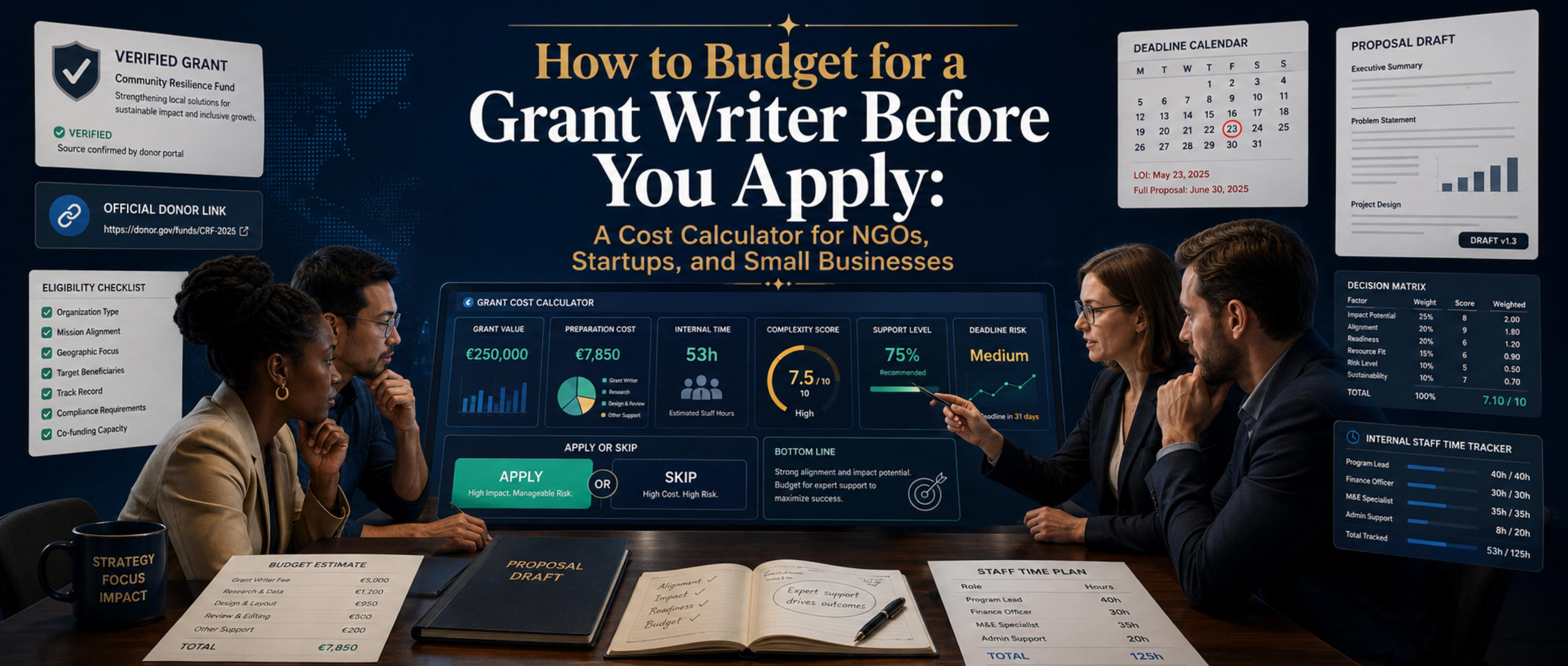
Many applicants begin the grant process with a funding question: “How much money can we get?” But before they hire a grant writer, they need a second question that is just as important: “How much will it cost us to prepare a serious application?”
This is where many NGOs, startups, small businesses, universities, cultural organizations, and community groups make a costly mistake. They treat grant writing as an expense that can be estimated after the grant is found. In reality, the cost of professional grant preparation should be part of the decision to apply.
A grant can look attractive on the surface. The award amount may be large. The topic may seem relevant. The deadline may still be open. But if the applicant is not ready, the internal documents are missing, the budget is weak, the eligibility rules are uncertain, and the funder requires a complex application, the real cost of applying can be much higher than expected.
This article provides a practical way to budget for a grant writer before you apply. It is not a promise of exact prices. It is a decision framework that helps applicants estimate the professional work required, compare preparation cost with grant value, and decide whether to hire a grant writer, request a review, or prepare the application internally.
For i-grants.com, this is exactly where grant intelligence becomes useful. A platform should not only show applicants current funding opportunities. It should help them understand whether each opportunity is worth the effort, what professional support may be needed, and how to match the grant with the right grant writer.
Why You Need a Grant Writer Budget Before You Start
Applicants often think of grant writer cost as a later procurement issue. First they find a grant. Then they ask someone to write it. Then they negotiate the price. That sequence can work for simple grants, but it often fails for complex funding opportunities.
A serious grant application requires time, documents, project logic, budget clarity, eligibility checks, and internal decision-making. If the applicant waits too long to estimate the cost of preparation, three problems appear.
First, the applicant may discover that the grant is not financially rational. Paying 3,000 USD to apply for a 5,000 USD grant may not make sense unless the work creates reusable material or strategic value.
Second, the applicant may hire too cheaply for a complex grant. A low-cost writer may be able to draft text, but not manage budget logic, compliance risk, partner coordination, or technical positioning.
Third, the applicant may underestimate internal effort. Even with a professional grant writer, the organization must provide data, documents, financial information, project decisions, signatures, partner letters, and approvals.
A grant writer budget is not only about the writer’s fee. It is about the total cost of becoming application-ready.
The Grant Writer Budget Formula
A practical grant writer budget can be estimated with a simple formula:
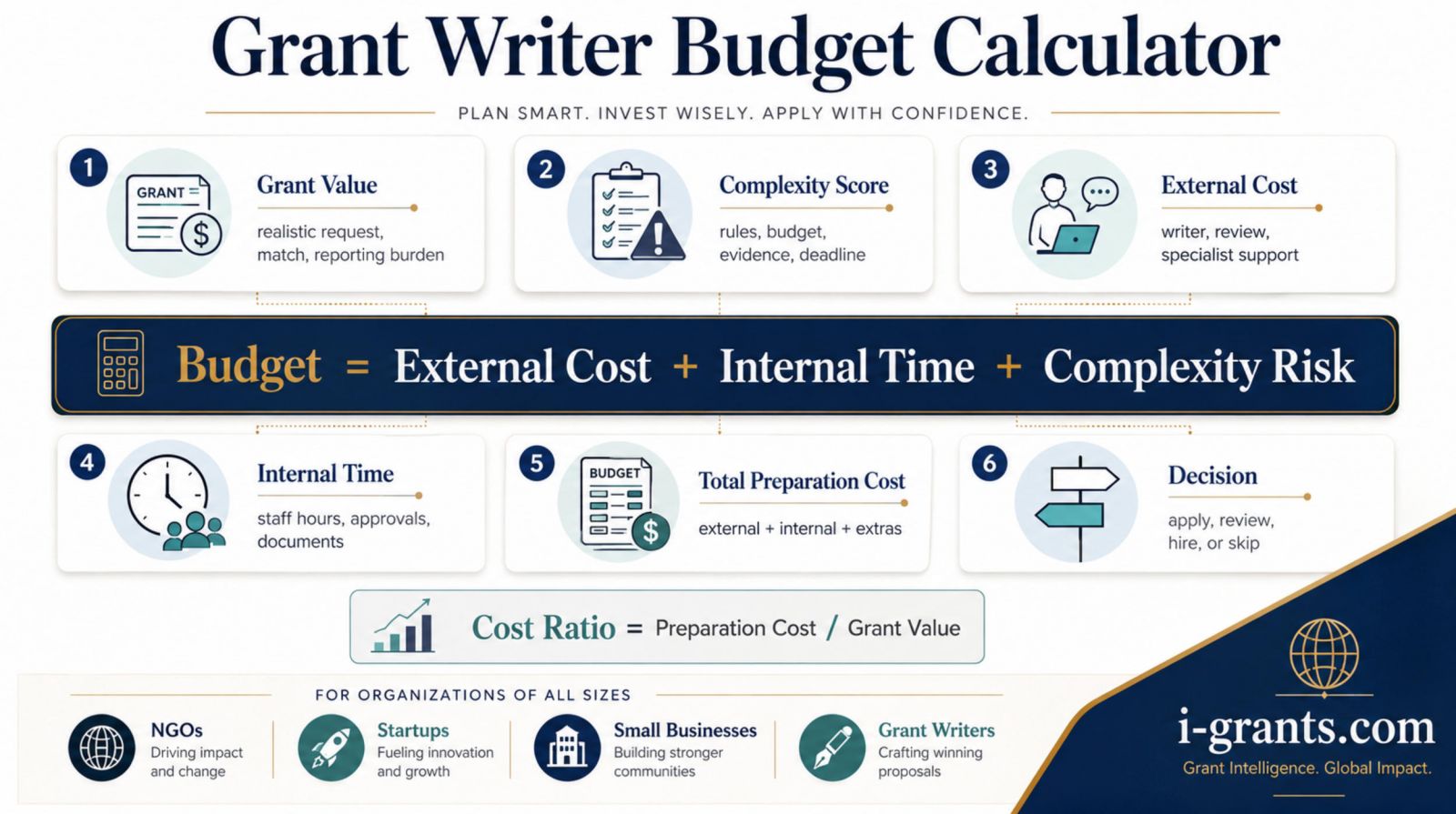
Grant Writer Budget = Grant Fit Review + Application Strategy + Narrative Writing + Budget Support + Evidence Collection + Compliance Check + Revision Time + Submission Support
Each part of this formula may be small or large depending on the grant.
| Budget component | What it means | When it becomes expensive |
|---|---|---|
| Grant fit review | Checking eligibility, funder priorities, deadlines, and applicant match | When rules are unclear or applicant status is uncertain |
| Application strategy | Shaping the project into a fundable concept | When the project is still vague |
| Narrative writing | Drafting the main proposal text | When the funder requires detailed sections |
| Budget support | Helping with budget logic and budget justification | When costs, match funding, or categories are complex |
| Evidence collection | Organizing data, letters, proof, and attachments | When documents are missing or partners are involved |
| Compliance check | Reviewing forms, rules, formatting, and required files | When the funder has strict instructions |
| Revision time | Handling feedback from staff, board, partners, and finance team | When many people must approve the proposal |
| Submission support | Assisting with portal upload and final checks | When the submission system is formal or technical |
This formula helps applicants understand why two grants with the same award amount can require very different preparation budgets. A 50,000 USD local foundation grant may be simpler than a 50,000 USD government grant with formal forms and compliance rules. A 100,000 USD startup innovation grant may require more technical strategy than a 100,000 USD community programme grant.
Start With the Expected Grant Value
The first number in the budgeting process is not the grant writer’s fee. It is the expected grant value.
Applicants should ask:
-
What is the maximum award amount?
-
What amount are we realistically eligible to request?
-
Is this a one-time grant or multi-year funding?
-
Does the grant provide cash, reimbursement, vouchers, equipment, services, or blended support?
-
Are indirect costs allowed?
-
Are pre-award costs allowed?
-
Is match funding required?
-
Is the reporting burden high?
The grant value is not always the same as the headline amount. A programme may advertise awards “up to 100,000 USD”, but the applicant may only be competitive for 25,000 USD. A grant may offer 200,000 USD but require 50,000 USD in match funding. A funder may reimburse costs after spending, which creates cash-flow pressure. A small grant may be valuable if it opens a relationship with a major donor.
The applicant should estimate the realistic value, not the dream value.
A simple way to think about this:
Realistic Grant Value = Likely Request Amount - Required Match - Unfunded Preparation Costs - Administrative Burden
This does not mean applicants should avoid grants with match funding or reporting obligations. It means they should budget honestly.
Estimate the Complexity Level
After estimating value, applicants should classify the grant’s complexity. This is where many budget decisions become clearer.
| Complexity level | Typical grant type | Suggested preparation approach |
|---|---|---|
| Low complexity | Small local foundation grant, simple community grant | Internal draft plus expert review or modest fixed fee |
| Medium complexity | Larger foundation grant, local government grant, small business grant | Fixed fee or staged hourly support |
| High complexity | Federal grant, EU grant, research grant, technical startup grant | Experienced grant writer, budget support, compliance review |
| Very high complexity | Multi-partner EU grant, large government programme, major research proposal | Specialist team, staged budget, partner coordination |
Low-complexity grants may not justify a large professional budget. A review package may be enough if the applicant has writing capacity.
Medium-complexity grants often justify a fixed-fee writing package, especially if the scope is clear.
High-complexity grants require more careful budgeting. The applicant may need a grant writer with sector expertise, budget support, and compliance review.
Very high-complexity grants should be treated like a project development process, not a writing assignment.
Use a Preparation Cost Ratio
A useful budgeting tool is the preparation cost ratio. This compares the cost of preparing the application with the realistic grant value.
Preparation Cost Ratio = Estimated Application Preparation Cost / Realistic Grant Value
For example:
| Realistic grant value | Estimated preparation cost | Preparation cost ratio | What it suggests |
|---|---|---|---|
| 5,000 USD | 1,500 USD | 30 percent | Usually too high unless reusable value is strong |
| 25,000 USD | 2,500 USD | 10 percent | May be reasonable if grant is strategic |
| 100,000 USD | 4,000 USD | 4 percent | Often reasonable for a competitive application |
| 500,000 USD | 10,000 USD | 2 percent | May be reasonable if complexity is high |
| 1,500,000 USD | 25,000 USD | 1.7 percent | May be justified for major institutional funding |
This ratio is not a universal rule. A low ratio does not guarantee that the application is worth pursuing. A high ratio does not automatically mean the application is irrational. But the ratio helps applicants see whether the preparation budget is proportional.
For small grants, the preparation cost ratio can become high very quickly. That is why small applicants should consider internal writing plus expert review, rather than full external proposal development.
For large grants, the ratio may look low even when the writer’s fee is high. A 15,000 USD proposal budget may seem expensive, but it may be proportionate for a 750,000 USD government or research grant if the opportunity is strategically important.
Add Internal Staff Time to the Budget
A professional grant writer does not remove all internal work. The applicant still needs to participate.
Internal staff time may include:
-
project clarification;
-
budget meetings;
-
document collection;
-
financial data preparation;
-
partner communication;
-
board or leadership approval;
-
reviewing drafts;
-
signing forms;
-
portal registration;
-
post-award planning.
This time has real cost, even if no invoice is issued. An executive director, founder, finance manager, programme officer, researcher, or operations lead may spend many hours supporting the application.
A practical internal cost estimate can be built like this:
Internal Cost = Staff Hours x Internal Hourly Value
For example, if a nonprofit team spends 30 internal hours and the blended internal value is 45 USD per hour, the internal cost is 1,350 USD. If a startup founder spends 25 hours on technical and market input, that time may represent a significant opportunity cost.
Applicants should not ignore internal time. A grant application that looks cheap externally can still be expensive internally.
Choose the Right Support Level
The grant writer budget should match the level of support needed. Not every grant needs full-service proposal development.
| Support level | What it includes | Best for |
|---|---|---|
| Grant-fit review | Eligibility check, funder fit, risk memo | Applicants unsure whether to apply |
| Proposal review | Expert feedback on an existing draft | Applicants with internal writing capacity |
| Basic writing package | Narrative drafting and limited revisions | Simple or medium grants with clear scope |
| Full application package | Strategy, narrative, budget narrative, documents, revisions | Larger or more competitive grants |
| Specialist proposal development | Technical content, compliance, partner coordination, budget logic | EU, federal, research, or startup innovation grants |
| Retainer | Ongoing grant pipeline and repeated applications | Organizations pursuing many grants per year |
The applicant should not buy more support than necessary. But they should also not buy less support than the grant requires.
A common mistake is hiring a basic writer for a specialist grant. Another common mistake is hiring an expensive full-service consultant for a small grant that only needs a final review.
The best budget is not the lowest budget. It is the budget that matches the risk.
A Cost Calculator for Applicants
Applicants can use the following practical calculator before hiring a grant writer.
Step 1: Identify the grant
-
Grant name:
-
Official source link:
-
Donor:
-
Deadline:
-
Maximum award:
-
Realistic request amount:
-
Required match:
-
Eligible costs:
-
Reporting burden:
Step 2: Score application complexity
Give each factor a score from 1 to 5.
| Factor | Score |
|---|---|
| Eligibility clarity | 1 to 5 |
| Funder rules complexity | 1 to 5 |
| Budget complexity | 1 to 5 |
| Technical content | 1 to 5 |
| Partner coordination | 1 to 5 |
| Evidence requirements | 1 to 5 |
| Deadline pressure | 1 to 5 |
| Internal readiness | 1 to 5 |
A low total score suggests that a review package or modest fixed fee may be enough. A high total score suggests that the applicant should budget for experienced professional support.
Step 3: Estimate external grant writer cost
Use a realistic range:
| Support type | Possible budget range |
|---|---|
| Short grant-fit review | 300 to 1,000 USD |
| Proposal review package | 500 to 3,000 USD |
| Simple grant writing package | 1,000 to 3,500 USD |
| Medium grant application | 2,500 to 7,500 USD |
| Complex government, EU, research, or startup grant | 7,500 to 25,000 USD or more |
| Monthly retainer | 1,500 to 8,000 USD or more per month |
These are planning ranges, not fixed market prices. Upwork lists typical grant writer hourly rates at 35 to 60 USD per hour, with a median of 50 USD, while advanced specialists can charge more. The actual budget depends on experience, geography, grant type, urgency, and scope.
Step 4: Add internal cost
Estimate internal hours:
| Internal role | Estimated hours | Internal hourly value | Cost |
|---|---|---|---|
| Executive director or founder | |||
| Finance person | |||
| Programme or technical lead | |||
| Partner coordinator | |||
| Administrative support |
Then calculate:
Total Internal Cost = Sum of all internal role costs
Step 5: Calculate total preparation cost
Total Preparation Cost = External Grant Writer Cost + Internal Cost + Additional Costs
Additional costs may include:
-
translation;
-
design or diagrams;
-
financial documents;
-
legal review;
-
partner documentation;
-
registration fees;
-
data collection;
-
evaluation planning;
-
letters of support;
-
technical attachments.
Step 6: Compare preparation cost with realistic grant value
Preparation Cost Ratio = Total Preparation Cost / Realistic Grant Value
If the ratio is high, consider a lighter support model. If the ratio is low and the opportunity is strategic, professional preparation may be justified.
Budgeting Examples
Example 1: Small NGO applying for a 10,000 USD local grant
The NGO has a clear project and basic documents. The application is short. The realistic grant value is 10,000 USD.
A full proposal package for 3,000 USD may be too expensive. A better option may be an internal draft plus a 700 to 1,200 USD expert review. If the organization can reuse the improved project language for future grants, the investment becomes more valuable.
Example 2: Small business applying for a 75,000 USD equipment grant
The business needs to provide project purpose, business information, eligible cost details, quotes, and local economic impact. The grant is not extremely technical, but the budget and documents must be accurate.
A fixed-fee package of 2,500 to 5,000 USD may be reasonable if the applicant has documents ready. If the business lacks a budget, implementation plan, or evidence, the first phase should be hourly strategy and readiness work.
Example 3: Startup applying for a 250,000 USD innovation grant
The startup must explain technical feasibility, milestones, market potential, use of funds, and commercialization path. A generic writer may not be enough.
The applicant may need a specialist grant writer, founder input, technical review, and budget support. A preparation budget of 7,500 to 15,000 USD may be reasonable if the grant is strategically important and the startup can provide technical content.
Example 4: University team applying for a major research grant
The research team has a strong scientific idea but needs proposal structure, budget justification, biosketch coordination, institutional letters, and review alignment.
A full professional preparation budget can be significant. But for a large research grant, the preparation cost ratio may still be acceptable. The applicant should budget for a proposal development specialist, not only a writer.
Example 5: NGO considering a multi-partner EU grant
The grant requires international partners, work packages, deliverables, impact logic, budget allocation, and consortium coordination.
This is not a simple writing task. The applicant should budget for proposal architecture, coordination, budget support, and final consistency review. A staged budget is safest: first evaluate eligibility and consortium readiness, then proceed to full proposal development only if the opportunity is strong.
When the Budget Says “Do Not Apply”
A grant writer budget can also protect applicants from bad decisions.
Sometimes the correct decision is not to apply.
The applicant should reconsider if:
-
the organization is not clearly eligible;
-
the deadline is too close;
-
the grant amount is too small relative to preparation cost;
-
required documents are missing;
-
match funding is unavailable;
-
leadership cannot review drafts on time;
-
partners are not confirmed;
-
the project does not fit the donor’s priorities;
-
reporting obligations would exceed organizational capacity;
-
the grant distracts from better opportunities.
Not applying can be a strategic decision. Every application consumes time, attention, and organizational credibility. A weak application to the wrong donor is not only a missed opportunity. It can also signal poor fit.
A professional grant writer should be willing to say when an applicant should not apply. That honesty is part of the value.
Ethical Budgeting: Do Not Plan Around Commission
Some applicants try to solve the budgeting problem by offering a percentage of the grant if the application succeeds. This may seem practical, but it creates ethical and operational problems.
Professional standards in the grant and fundraising fields discourage percentage-based compensation tied to grant awards. The Grant Professionals Association states that members should not accept finder’s fees, commissions, or percentage compensation based on grants. The Association of Fundraising Professionals also restricts percentage-based compensation for fundraising work.
The reason is simple: the grant writer does not control the funder’s decision, and grant funds may not be available to pay pre-award writing costs unless the funder explicitly allows it.
Applicants should budget for grant writing as a professional service, not as a success commission. If cash is limited, they can reduce scope, request a review package, apply to smaller grants internally, or build reusable proposal materials over time.
How i-grants.com Can Turn the Calculator Into a Marketplace Workflow
The cost calculator is not only useful for a blog article. It can become part of the i-grants.com workflow.
A strong grant marketplace can help applicants move through the following sequence:
-
Find an active grant opportunity.
-
Verify the official source.
-
Classify the donor, geography, sector, deadline, amount, and applicant type.
-
Check eligibility.
-
Estimate application complexity.
-
Calculate preparation cost.
-
Compare cost with realistic grant value.
-
Decide whether to apply.
-
Choose the right support model.
-
Match with a suitable freelance grant writer.
This makes the platform more useful than a simple directory. It helps applicants avoid random hiring and helps grant writers receive better-scoped projects.
For example, an applicant who selects a small local grant could be guided toward a proposal review package. A startup applying for a technical innovation grant could be matched with a grant writer who understands commercialization. An NGO preparing a multi-partner donor proposal could be directed toward an experienced proposal strategist. A university research team could look for a specialist in research grant development.
The calculator becomes a bridge between grant discovery and professional collaboration.
Budget Before You Hire
A grant writer budget is not an administrative detail. It is part of grant strategy.
Before hiring a grant writer, applicants should estimate the realistic grant value, assess complexity, calculate internal effort, choose the right support level, and compare preparation cost with expected benefit. This process protects organizations from overpaying for small grants, underinvesting in complex grants, and wasting time on opportunities that are not a good fit.
The core rule is simple:
Do not ask only, “How much does a grant writer cost?” Ask, “What level of professional work does this specific grant require, and is that cost justified by the realistic value of the opportunity?”
For a small grant, the best answer may be internal writing plus expert review. For a medium grant, it may be a fixed-fee writing package. For a complex government, EU, research, or startup innovation grant, it may be staged professional support. For organizations pursuing many grants, it may be a monthly retainer.
Grant writing is not a last-minute expense. It is an investment decision. The applicant should make that decision before the deadline pressure begins.