

 Français
  Deutsch
  Українська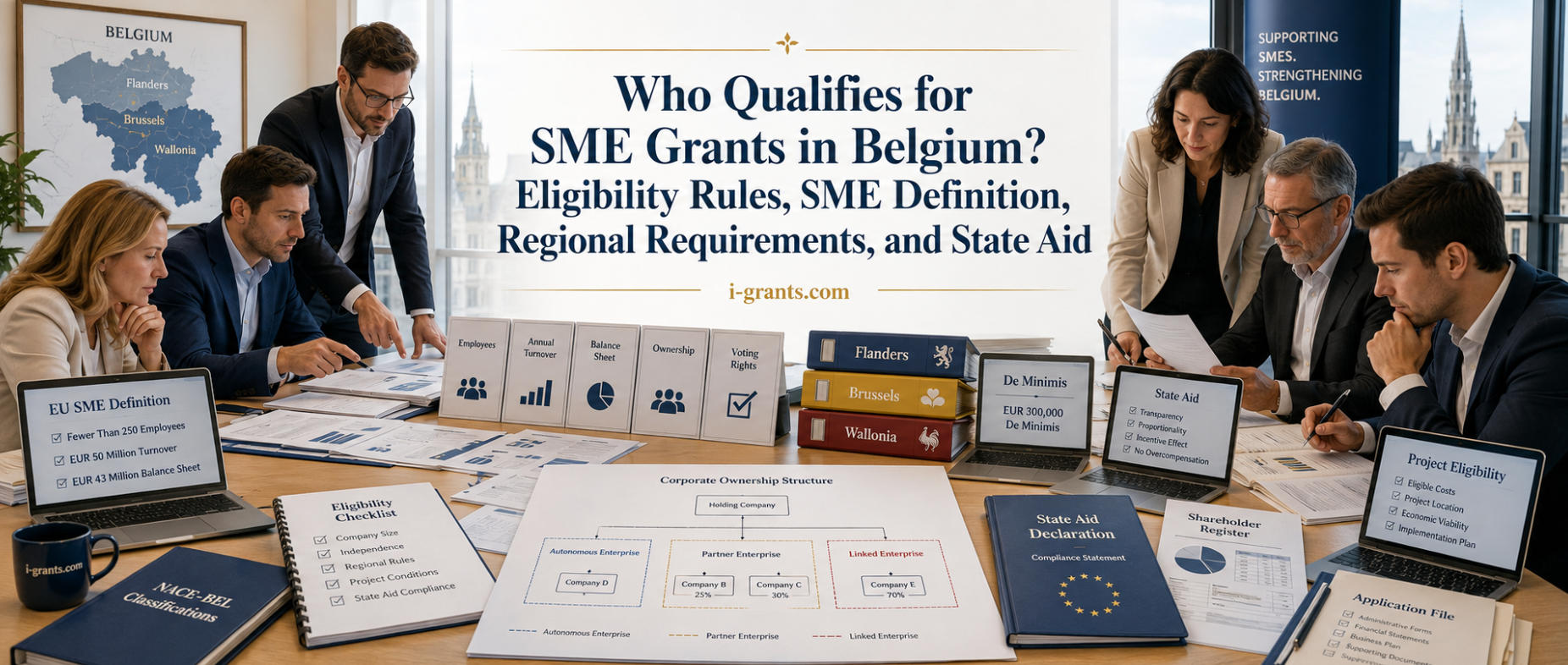
Belgium offers a wide range of grants, investment incentives, innovation support and other public funding for small and medium-sized enterprises. But being a relatively small business does not automatically make a company an SME for grant purposes.
For many Belgian and European funding programmes, SME status is determined under the EU SME definition. That assessment considers not only the company's own employees, turnover and balance sheet, but also its ownership structure and relationships with other enterprises.
This distinction can produce surprising results.
A Belgian technology company with only 15 employees may fail the SME test if it is controlled by a large corporate group. A company with annual turnover above €50 million may still qualify as an SME if it remains below the balance-sheet threshold and satisfies the employee criterion. A business that qualified as small last year may not immediately become medium-sized after one exceptional year of growth.
And even correct SME status is only the first eligibility test.
A company may still be excluded because it operates in the wrong region, has an ineligible NACE activity, belongs to an excluded sector, has already started the project, is considered to be in financial difficulty, has reached its State aid ceiling, or fails programme-specific requirements.
The right way to analyse a Belgian funding opportunity is therefore:
Is the company an SME? Is the company eligible for this programme? Is this particular project eligible for support?
Those are three different questions.
Why SME Status Matters for Belgian Grants
The European Commission describes SMEs as 99 percent of European businesses and notes that the SME definition is particularly important for access to finance and support programmes. Its 2025/2026 annual SME report estimates that the EU has around 34 million SMEs. In 2025, their real value added grew by 2.5 percent, employment by 1.0 percent and the number of SMEs by 1.8 percent.
Belgium itself had 1,187,819 VAT-registered enterprises at the end of 2024, illustrating the scale and fragmentation of its business population. Yet employment-size statistics and legal SME status are not the same thing. A statistical classification may count employees only, while an SME eligibility assessment can require group-level employee, turnover and balance-sheet data.
This matters because company size can determine much more than whether an application is accepted.
Depending on the programme, size may affect the aid rate, minimum investment, maximum subsidy, eligible legal basis and even the assessment methodology.
Brussels provides a clear example. Its material-and-works investment grant has different base rates and minimum investment levels for micro, small and medium-sized businesses. A qualifying starter may need an investment of at least €5,000, a micro-enterprise older than four years €7,500, a small enterprise €15,000 and a medium-sized enterprise €50,000.
Correctly determining size is therefore not a technical formality. It can change the economics of the entire funding application.
The EU SME Definition Used in Belgium
The core EU thresholds remain unchanged in 2026.
The European Commission states that enterprise size is determined using staff headcount and either annual turnover or annual balance-sheet total. A firm that belongs to a larger group may have to include data from other enterprises in the calculation.
Table 1. EU SME Definition Used for Belgian Business Grants
| Enterprise category | Staff headcount | Annual turnover | Annual balance-sheet total |
|---|---|---|---|
| Micro enterprise | Fewer than 10 | Up to €2 million | Up to €2 million |
| Small enterprise | Fewer than 50 | Up to €10 million | Up to €10 million |
| Medium-sized enterprise | Fewer than 250 | Up to €50 million | Up to €43 million |
The logic is important.
The employee threshold must be satisfied. For the financial test, however, the company can qualify using either the turnover threshold or the balance-sheet threshold.
For example, consider a company with:
120 employees, annual turnover of €55 million and a balance-sheet total of €35 million.
The turnover exceeds the €50 million SME threshold. But the balance-sheet total remains below €43 million. If the ownership and group calculations do not push the company above the limits, it may still satisfy the financial component of the SME definition.
By contrast, a company employing 260 people cannot qualify as an SME under the standard EU definition simply because its turnover is low.
Brussels Economy and Employment applies the same basic thresholds and explicitly states that an enterprise may satisfy either the turnover or balance-sheet test.
Employee Count Does Not Mean Simply Counting Names
Applicants should also be careful with the employee criterion.
Belgian regional guidance commonly expresses employee size through full-time equivalents, while the underlying European SME framework uses an annualised staff concept.
In practice, a company should not assume that ten people appearing on a payroll automatically means ten full-time employees for the SME calculation.
Part-time employment and the period during which a person worked for the company can affect the result.
Brussels Economy and Employment explicitly uses full-time equivalents when determining company size, and VLAIO also expresses the size criteria in FTE terms.
This becomes particularly important for startups and seasonal businesses whose workforce changes significantly during the year.
The Most Difficult Part: Ownership Relationships
The employee and financial thresholds are relatively straightforward.
Ownership is where many grant applicants make mistakes.
The SME assessment distinguishes between autonomous enterprises, partner enterprises and linked enterprises.
A company cannot automatically use only its own accounts just because the entity submitting the grant application is small.
If other businesses own significant shares in it, or if it owns shares in other businesses, additional figures may have to be included.
Table 2. How Ownership Relationships Affect SME Status
| Relationship | Typical situation | Effect on SME calculation |
|---|---|---|
| Autonomous enterprise | Generally no relevant ownership relationship of 25 percent or more | Use the enterprise's own figures |
| Partner enterprise | Ownership of 25 percent or more without a controlling relationship | Add a proportional share of the partner's figures |
| Linked enterprise | Majority ownership, voting control or another form of dominant influence | Add 100 percent of the linked enterprise's relevant figures |
Brussels guidance generally treats an enterprise as autonomous when relevant ownership remains below 25 percent. A partner relationship normally begins when an enterprise owns, or is owned by, 25 percent or more but the relationship does not amount to control. Linked enterprises exist where there is control, including majority voting rights, the right to appoint or remove most management-body members or the ability to exercise dominant influence.
VLAIO applies the same practical logic to subsidy calculations. Partner-company data are added according to the relevant ownership percentage, while figures from affiliated or linked enterprises are added in full.
A Practical Group Calculation
Suppose Belgian Company A has:
35 employees, €7 million turnover and a €5 million balance sheet.
It also owns:
40 percent of Company B and 80 percent of Company C.
If B is a partner enterprise and C is a linked enterprise, the group-level calculation is not based on A alone.
VLAIO gives precisely this type of example. The calculation becomes:
Company A + 40 percent of Company B + 100 percent of Company C.
That calculation must be performed for staff, turnover and balance-sheet total.
This can radically change a grant application.
A standalone company may appear comfortably below the small-enterprise thresholds while becoming medium-sized or even large after group data are included.
Why a Startup With 15 Employees May Not Be a Small Enterprise
Consider a startup with:
15 employees, €3 million annual turnover and a €2 million balance sheet.
Viewed alone, it clearly falls below the small-enterprise limits.
Now assume that 80 percent of the company is owned by a much larger industrial company.
The startup is no longer assessed as if the shareholder did not exist. The control relationship can make the companies linked, meaning the relevant data of the linked business must also be considered.
The startup may consequently fail the small-enterprise test.
This matters directly for programmes such as Scale-Ready in Flanders. VLAIO states that only companies meeting the European definition of a small enterprise are eligible for the 2026 Scale-Ready grant.
For founders, therefore, a cap table can be as important to grant eligibility as revenue or headcount.
A 25 Percent Investor Does Not Always Destroy Autonomous Status
The ownership rules contain important exceptions.
A company does not necessarily lose autonomous status merely because an investor owns between 25 and 50 percent.
VLAIO identifies categories that may benefit from an exception where the investor is not otherwise linked to the enterprise. These include public investment companies, venture-capital firms, qualifying business angels, institutional investors such as regional development funds, universities, non-profit research centres and certain small autonomous local authorities.
For business angels, VLAIO notes a specific investment ceiling of €1.25 million for the relevant exception under the SME framework.
This distinction is particularly important for venture-backed startups.
A founder should not conclude that receiving institutional investment automatically destroys SME status. The analysis depends on the type of investor, percentage held, voting rights and whether the investor can exercise control.
Control Can Matter More Than the Share Percentage
Ownership percentage is not the only test.
VLAIO explicitly notes that control must also be considered when the degree of control differs from the formal shareholding percentage.
A company may therefore be linked even if a simple cap-table analysis does not initially suggest majority ownership.
Control can arise through voting arrangements, contractual rights or dominant influence.
Similarly, Brussels considers companies linked where one enterprise can control most voting rights, appoint or remove most members of another company's management or supervisory body, or exercise dominant influence through contractual or constitutional rights.
For complex corporate groups, the eligibility review should therefore include not only shareholders but also shareholders' agreements and governance rights.
One Exceptional Year Does Not Always Change SME Status
A company can grow beyond a threshold without immediately changing category.
VLAIO and Brussels both explain that moving between enterprise-size categories generally requires the relevant threshold to be crossed for two consecutive financial years.
This prevents a temporary revenue spike or short-term change in employment from immediately changing SME status.
Suppose a small enterprise experiences one unusually strong financial year and its turnover rises above €10 million.
That single year does not necessarily make it a medium-sized company immediately.
But applicants should not apply this rule blindly to every corporate event.
Mergers and Acquisitions Can Change the Analysis Faster
VLAIO specifically distinguishes acquisitions and mergers from ordinary organic growth.
After an acquisition or merger, the group structure after the transaction must be assessed, using the latest completed financial year.
This creates a useful distinction:
Growth and acquisition do not necessarily affect SME status in the same way.
A company that organically crosses a threshold may benefit from the two-year rule.
A company acquired by a larger group may see its SME analysis change much more quickly because group relationships have changed.
Grant applicants involved in an acquisition, restructuring or merger should therefore recalculate SME status rather than relying on an earlier declaration.
The New Small Mid-Cap Category Does Not Replace the SME Definition
One of the most important recent developments is the creation of an EU definition for small mid-cap enterprises.
The European Commission adopted its recommendation on 21 May 2025. Under that definition, a small mid-cap is an enterprise that is not an SME, has fewer than 750 employees and has annual turnover not exceeding €150 million or an annual balance-sheet total not exceeding €129 million.
The distinction is crucial.
A business can be a small mid-cap and still be ineligible for a programme restricted to SMEs.
The new category does not raise the SME threshold from 250 employees to 750.
Instead, it creates a separate category for companies that have outgrown SME status but may still warrant more proportionate regulatory or funding treatment.
This distinction has already started appearing in EU law. Regulation (EU) 2026/562 contains a specific small mid-cap definition separate from the existing SME definition.
Belgian companies should therefore read programme wording carefully.
If a programme says SMEs only, being a small mid-cap is not enough.
If a programme explicitly accepts SMEs and small mid-caps, the broader category can matter.
SME Status Is Only the First Filter in Flanders
Once the company confirms its size, the analysis moves to programme-specific eligibility.
Flanders illustrates this clearly.
For Scale-Ready, the applicant must not merely be an SME. It must specifically qualify as a small enterprise, have an operational establishment in Flanders, have been active for at least one year and no more than five years at the time of the decision, and satisfy additional ownership and team requirements.
Founders and co-founders must retain at least 50.1 percent of the company. The business must also have at least two active partners and access to a multidisciplinary team of at least six FTE.
A particularly unusual rule concerns company age.
For Scale-Ready, VLAIO determines age using the oldest linked enterprise number. This can include linked economic activity carried out by a natural person. A newly incorporated entity can therefore fail the age test if it is linked to an older business.
This illustrates why simply creating a new legal entity does not necessarily reset grant eligibility.
Brussels: Location, Sector and Actual Activity Matter
In Brussels, SME status again represents only one part of eligibility.
The general Brussels grant framework requires the enterprise to conduct an economic activity in the Brussels-Capital Region. For many grants, this means having at least one establishment unit with a postcode between 1000 and 1210.
The enterprise must also operate in a supported sector.
Brussels Economy and Employment uses NACE information from the Crossroads Bank for Enterprises, but the assessment does not necessarily stop there. The administration can also examine the company's statutes, the NACE codes attached to the relevant operating establishment and the company's website to determine whether it genuinely performs an eligible activity.
This creates an important practical lesson.
Adding an attractive NACE code to a company record is not necessarily enough to make the enterprise eligible. The activity must be credible and consistent with the company's actual operations.
Brussels also states that its general SME grants are intended for enterprises with an economic purpose and excludes public enterprises under its general rules. De minimis limits apply to many of these grants.
NACE-BEL 2025 Creates an Additional 2026 Check
The transition from NACE-BEL 2008 to NACE-BEL 2025 is a particularly relevant eligibility issue in 2026.
Brussels grant pages now explicitly warn companies that the 2008 classification has been updated and provide conversion information for NACE-BEL 2025.
Wallonia is not necessarily at exactly the same implementation stage.
Its investment-aid guidance states that applications are currently analysed using NACEBEL 2008 codes and that these will be updated to NACEBEL 2025.
Applicants should therefore not assume that every Belgian authority is using the same NACE version for every programme at exactly the same time.
In 2026, verifying which NACE classification the specific grant actually uses should be part of the eligibility review.
Company Size Can Change the Brussels Grant Amount
Brussels provides another reason why the SME calculation must be precise.
Under the Digitalisation Grant, a qualifying SME can receive a base rate of 25 percent, with increases depending partly on company characteristics. Some bonuses differ between micro or small enterprises and medium-sized enterprises, while total support can reach 70 percent of eligible costs under the applicable conditions.
For investment in equipment or works, both base rates and maximum intervention rates vary by size. The minimum investment requirement also rises substantially from micro to small and then medium-sized enterprises.
Company size can therefore affect four things simultaneously:
whether the company qualifies, how large the project must be, the percentage of costs supported, and the maximum funding available.
Wallonia: SME Status Is Also Only the Beginning
Wallonia's standard SME Investment Allowance provides another useful eligibility example.
The company must qualify as an SME and have or create an establishment unit in Wallonia. But it must also operate in an eligible sector, present an eligible investment programme of at least €100,000, exceed the relevant historical depreciation benchmark, satisfy assessment criteria from at least two categories and obtain at least 30 points out of 100.
At least 25 percent of the investment programme must be financed through the company's own resources or external finance that does not benefit from public support.
The company must also not be considered an undertaking in financial difficulty.
So even a company that perfectly satisfies the EU medium-sized-enterprise definition may fail the Walloon investment-grant test because its project is too small, the sector is excluded, its financial condition is insufficient or another programme criterion is not satisfied.
Table 3. Typical Eligibility Requirements Across Belgian Regions
| Eligibility issue | Flanders | Brussels-Capital Region | Wallonia |
|---|---|---|---|
| EU SME definition | Frequently used | Frequently used | Frequently used |
| Regional establishment | Required by many regional programmes | Brussels establishment commonly required | Walloon establishment commonly required |
| Eligible NACE or sector | Programme-specific | Central eligibility test | Central eligibility test |
| Ownership and group calculation | Relevant | Relevant | Relevant |
| Financial health | Relevant for many State aid programmes | Required under important investment schemes | Explicit requirement for investment aid |
| De minimis check | Depends on programme | Common across many SME grants | Depends on programme |
| Application before project start | Common in innovation and investment aid | Programme-specific and often important | Critical for investment programmes |
| Additional project requirements | Can include age, ownership, team or innovation criteria | Can affect minimum project size and aid rate | Can include minimum investment, scoring and job creation |
Project Eligibility Can Be Much Narrower Than Company Eligibility
A strong example comes from Wallonia's ERDF/JTF co-financed investment scheme.
Being an SME is only the beginning.
The applicant must also have or create an establishment in Wallonia, conduct an eligible manufacturing activity, invest in a development area and satisfy qualitative programme criteria. The scheme additionally requires creation of at least four jobs for a small enterprise or six jobs for a medium-sized enterprise.
This demonstrates a distinction that every grant applicant should understand:
Company eligibility answers who may apply. Project eligibility answers what the public authority is willing to finance.
A company can pass the first test and fail the second.
Legal Form Is Not Universally Treated the Same Way
Applicants should also avoid assuming that every Belgian programme accepts the same legal forms.
Wallonia's standard investment-aid framework can include non-profit organisations carrying out economic activities.
Brussels states that its grants mainly concern self-employed persons and companies, while certain non-profit associations may qualify in specific cases.
Other programmes may impose a narrower beneficiary definition.
The practical conclusion is simple:
There is no universal Belgian list of legal forms that qualify for every business grant.
Eligibility must be checked programme by programme.
De Minimis Aid: The €300,000 Rule
Many Belgian SME grants operate under the EU de minimis framework.
Under Regulation (EU) 2023/2831, the total amount of general de minimis aid that one Member State may grant to a single undertaking cannot exceed €300,000 over any period of three years.
The phrase "single undertaking" is critical.
The limit is not automatically €300,000 for each separate company number.
For de minimis purposes, enterprises can be treated as one undertaking where one controls the majority of voting rights in another, can appoint or remove most members of its management or supervisory body, can exercise dominant influence, or controls a majority of voting rights through an agreement with other shareholders. Indirect relationships through other enterprises also count.
Creating a subsidiary therefore does not automatically create a fresh €300,000 de minimis allowance.
SME Group Rules and De Minimis Rules Are Not Exactly the Same Test
Ownership relationships need to be analysed twice.
First, they determine enterprise size under the SME definition.
Second, they can determine the single undertaking for State aid purposes.
The concepts overlap because both examine economic relationships and control, but they serve different legal purposes and should not be treated as a single calculation.
For practical grant work, the safer rule is:
Check ownership once for SME status, then check it again for de minimis and other State aid requirements.
A Major 2026 Change: The Central De Minimis Register
One of the most important State aid developments for grant applicants in 2026 concerns transparency.
From 1 January 2026, Member States must register de minimis aid in a central register at national or Union level.
The registered information includes the beneficiary, aid amount, granting date, granting authority, aid instrument and economic sector. As a rule, Member States must enter the information within 20 working days after the aid is granted. The register must also permit easy public access subject to applicable data-protection rules.
This makes de minimis monitoring considerably more systematic.
However, applicants should not assume that declarations have disappeared completely from 1 January 2026.
The Regulation contains transitional provisions. Until the register contains a complete three-year history, Member States may still need to obtain declarations regarding other de minimis aid received during the relevant period.
For companies, the practical lesson is to maintain their own State aid records even as the central register develops.
The Grant Date Is Not Necessarily the Payment Date
Another useful de minimis detail concerns timing.
Under the Regulation, aid is considered granted when the undertaking obtains the legal right to receive it, regardless of when the money is actually paid.
This can matter when calculating the rolling three-year ceiling.
The rules also address corporate restructuring. In mergers or acquisitions, previous de minimis aid received by the merging undertakings must be taken into account when determining whether further support would exceed the ceiling.
A corporate transaction therefore does not erase State aid history.
You Cannot Simply Stack Every Subsidy
Another eligibility issue is State aid accumulation.
A company may sometimes combine de minimis aid with another public support instrument, but the rules prevent aid from being combined for the same eligible costs where that combination would exceed the maximum permitted aid intensity or amount under the relevant State aid rules.
This means that a company cannot automatically assume:
regional grant + another public subsidy + de minimis aid = all amounts can be added together.
Applicants need to check:
which costs each instrument finances, the legal basis of each aid measure and the applicable maximum intensity.
This becomes particularly important in projects that combine regional grants, EU co-financing, subsidised loans and tax measures.
Financial Difficulty Can Block Eligibility
SME status does not protect a financially distressed company from exclusion.
Wallonia explicitly states that beneficiaries of its standard SME investment aid must not be undertakings in financial difficulty.
Important Brussels investment support also requires the enterprise not to be in financial difficulty or subject to recovery of unlawful aid.
These conditions reflect the broader State aid framework.
The financial-health test can therefore be just as relevant as size or location.
A company preparing for a major funding application should review not only its project budget but also its equity position, insolvency status, outstanding recovery orders and other financial indicators relevant to the programme.
Apply Before Starting the Project
Eligibility can also be lost because of timing.
Wallonia's investment rules are explicit: the company must request authorisation to begin the investment programme before entering into an initial binding commitment, such as placing a purchase order or signing a contract.
The same logic appears throughout State aid programmes because public support is often expected to create an incentive effect.
In practical terms, a company that orders machinery first and looks for a grant later may already have made the project ineligible.
This makes funding research part of pre-investment planning rather than a reimbursement exercise.
The Belgian SME Grant Eligibility Checklist
Before relying on an SME-only funding opportunity, an applicant should complete the following checks:
-
Calculate staff correctly. Use the relevant full-time-equivalent or annual staff methodology rather than a simple headcount.
-
Check turnover and balance-sheet total. Remember that the EU financial test normally allows turnover or balance sheet.
-
Map the ownership structure. Identify all significant shareholders, voting rights and control relationships.
-
Identify partner and linked enterprises. Add their data proportionally or fully where required.
-
Confirm the regional establishment and actual activity. Check the operating location, NACE classification and eligible sector.
-
Review programme-specific conditions. These can include company age, legal form, team size, minimum project value, job creation or scoring requirements.
-
Check State aid history. Review de minimis aid, other public support and possible accumulation restrictions.
-
Confirm financial health and project timing. Check difficulty rules and submit before any prohibited binding commitment.
Completing this assessment before preparing the full application can prevent a substantial amount of wasted work.
Common Eligibility Mistakes
Several errors are particularly dangerous:
-
classifying the company by its own employee count while ignoring parent, subsidiary or partner enterprises;
-
assuming that one year above a threshold immediately changes SME status, or assuming the opposite after an acquisition;
-
confusing the new small mid-cap category with SME status;
-
checking company eligibility but ignoring project eligibility;
-
relying on an outdated NACE classification or an inaccurate registered activity;
-
treating the €300,000 de minimis threshold as a separate allowance for every legal entity in a controlled group.
Most of these mistakes can be identified before an application is written.
Final Takeaway
Determining whether a Belgian business qualifies for an SME grant requires more than checking whether it has fewer than 250 employees.
The EU SME definition combines staff headcount with turnover or balance-sheet limits and then requires applicants to examine ownership and control relationships.
Partner enterprises may contribute a proportional share of their data.
Linked enterprises can contribute their figures in full.
One exceptional year above a threshold does not necessarily change company status immediately, while a merger or acquisition can require a new group-level analysis.
The new EU small mid-cap category does not replace the SME definition. A growing business can qualify as a small mid-cap while remaining ineligible for a grant reserved exclusively for SMEs.
After the size calculation comes a second layer of eligibility.
Flanders can impose requirements concerning establishment, age, ownership and team structure. Brussels checks regional presence, actual economic activity, NACE codes and programme-specific company size. Wallonia may combine SME status with minimum investment amounts, scoring criteria, eligible sectors, financing requirements and financial-health tests.
Then comes the third layer: State aid.
De minimis support is generally limited to €300,000 per single undertaking over three years, and from 1 January 2026 new de minimis awards must be entered into a central register. Public funding must also respect accumulation rules and programme-specific aid intensities.
The practical formula is therefore:
SME status first, company eligibility second, project eligibility third, State aid and timing checks before submission.
A company that passes all four stages has a credible basis for preparing a Belgian grant application.
A company that skips one of them may discover that even an excellent project was never eligible in the first place.