

 Français
  Deutsch
  Українська
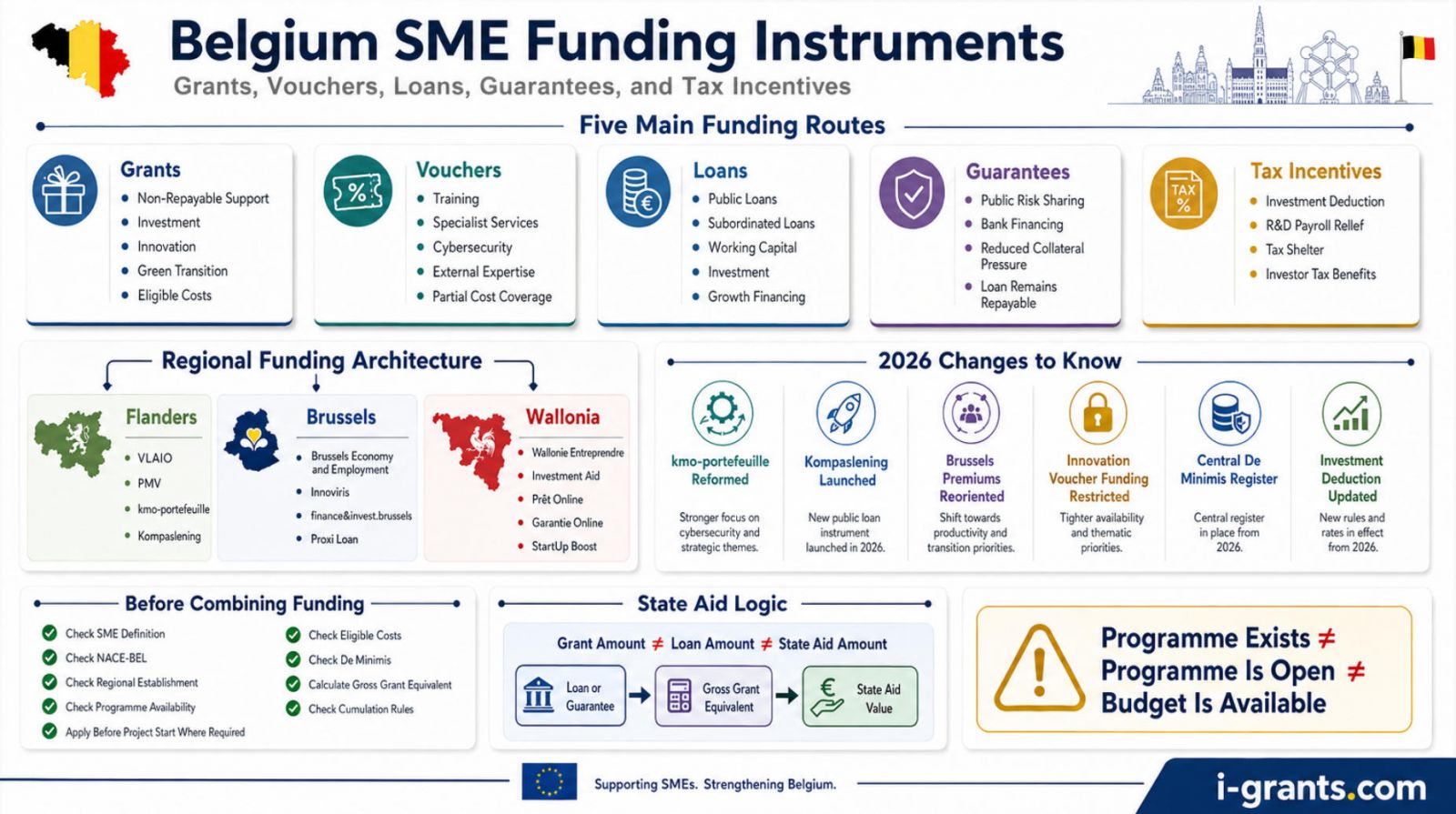
Belgian SMEs looking for public funding face a system that is both generous and unusually fragmented. A business may qualify for a regional grant, a subsidised training scheme, a public-backed loan, a guarantee that unlocks bank finance, or a federal tax incentive. In many cases, the strongest financing plan combines several of these instruments rather than relying on a single grant.
That distinction matters. A €50,000 grant, a €50,000 subordinated loan and a €50,000 loan covered partly by a public guarantee may all improve a company's ability to finance a project, but they have very different effects on cash flow, repayment obligations, State aid calculations and application procedures.
Belgium also has no single national SME grant system. Much direct business support is organised through Flanders, the Brussels-Capital Region and Wallonia, while important tax incentives operate federally. Eligibility can depend on the location of the establishment unit, the location of the investment, the company's NACE-BEL activity, SME status, ownership structure, financial condition and the exact State aid basis of the measure.
For applicants in 2026, another complication has become increasingly important: the existence of a programme does not necessarily mean that it is currently accepting or funding new applications. Brussels has announced a temporary reorientation of several business premiums from 12 August 2026, while Innoviris states that no new projects under its Innovation Voucher programmes can be funded in 2026.
Understanding the instrument first, and the programme second, is therefore one of the safest ways to build a Belgian SME funding strategy.
Belgium's SME funding system is broader than grants
For practical purposes, Belgian SME support can be divided into several financial families. Grants and subsidies reduce eligible project costs directly. Vouchers subsidise access to external expertise or training. Public loans supply capital that must normally be repaid. Guarantees reduce the risk carried by a lender rather than paying the company directly. Tax incentives reduce taxable income, tax liability or payroll-related tax payments. Some regional instruments also encourage private individuals to finance SMEs through tax-supported loans.
These instruments solve different business problems.
A company investing in machinery may primarily need an investment grant. A young company with weak collateral may benefit more from a subordinated public loan. An established SME with access to a bank but insufficient security may need a guarantee. An innovative employer with a substantial research team may receive more value from an R&D payroll tax incentive than from a small one-off subsidy.
Table 1. Main SME Funding Instruments in Belgium
| Funding instrument | What the SME receives | Repayment required? | Typical use | Belgian examples |
|---|---|---|---|---|
| Grant or investment subsidy | Public contribution to eligible expenditure | No, provided conditions remain satisfied | Investment, innovation, sustainability, digitalisation, employment | Walloon investment aid, VLAIO innovation support, Brussels investment premiums |
| Voucher or subsidised service | Reimbursement or co-financing of approved external services | No | Training, specialist advice, technical assessment, cybersecurity | kmo-portefeuille, Innoviris Innovation Vouchers |
| Public or public-backed loan | Capital provided under defined financing conditions | Yes | Startup costs, investment, working capital, acquisition, growth | Kompaslening, Wallonie Entreprendre Prêt Online |
| Subordinated or convertible finance | Debt ranking behind ordinary creditors, or financing capable of conversion into equity | Usually | Early-stage finance, growth, strengthening the financing structure | StartUp Boost and other regional financing products |
| Public guarantee | Public authority assumes part of the lender's risk | The underlying loan remains repayable | Access to bank or alternative finance where collateral is insufficient | Regional guarantee schemes |
| Tax incentive | Reduction of taxable profit, tax due or withholding obligations | No normal repayment if conditions are respected | Investment, digitalisation, R&D, innovation, startup equity | Investment deduction, R&D payroll withholding exemption, Tax Shelter |
| Tax-supported private finance | Private capital or debt encouraged by a tax advantage for the investor | Depends on structure | Startup and SME financing | Brussels Proxi Loan and comparable regional mechanisms |
The most important practical lesson is that businesses should not begin their funding search with the question, "Which grants are available?" A better question is: Which part of the financing problem should public support solve?
Grants and investment subsidies: the most visible form of support
Non-repayable grants remain the instrument most businesses associate with public funding. They are especially useful when the public authority wants to influence the type of investment being made, for example by encouraging innovation, energy efficiency, regional development, employment or environmentally beneficial capital expenditure.
Wallonia provides a clear example of how investment subsidies work. Its investment aid can support qualifying projects through different regimes. The official regional portal states that classical investment support can provide intervention rates between 4 and 18 percent, certain European co-financed projects between 15 and 35 percent, while GREEN investment support can reach 40 percent, depending on the applicable scheme and project.
Those headline rates do not mean that every Walloon SME receives that percentage. The actual result depends on the size of the business, project location, investment category, evaluation criteria and applicable aid regime. For classical investment aid, the business must also have or create an establishment unit in Wallonia, operate in an eligible sector, satisfy the applicable investment threshold and not qualify as an undertaking in financial difficulty. The company must finance at least 25 percent of the investment programme from resources that are themselves free of public support.
This illustrates an important distinction throughout Belgium:
company eligibility is not the same as project eligibility, and project eligibility is not the same as procedural compliance.
A perfectly eligible SME may still lose access to a subsidy if the investment itself is excluded, if the NACE-BEL activity falls outside the scheme, if the required financing structure is missing or if the company commits to the investment too early.
The apply-before-start problem
Walloon investment aid gives an unusually clear example of this risk. The business must submit its request for authorisation to begin the investment programme before the first firm commitments linked to the investment, such as a purchase order. The date on which the request reaches the administration establishes the date from which work connected with the programme may begin.
This principle extends beyond Wallonia. Under the EU General Block Exemption Regulation, aid that relies on the relevant incentive-effect rule generally requires a written aid application before work on the project or activity begins.
Applicants should nevertheless avoid assuming that every Belgian support scheme has an identical pre-start rule. The legal basis and application procedure of the specific programme always need to be checked.
Vouchers: smaller amounts, but often strategically useful
Voucher-style support is designed less around financing a major capital project and more around giving SMEs access to expertise, training, research facilities or specialist services they might otherwise postpone.
The Flemish kmo-portefeuille is one of Belgium's best-known examples, but its rules changed materially in 2026.
Since 1 February 2026, ordinary advisory services are no longer generally subsidised through the kmo-portefeuille. Advisory support remains available for cybersecurity, while eligible training continues under the scheme. Small enterprises receive a standard subsidy of 30 percent and medium-sized enterprises 20 percent, with a maximum of €7,500 of support per year. Higher support rates of 45 percent for small enterprises and 35 percent for medium-sized enterprises apply to qualifying cybersecurity services and specified energy-efficiency training.
This reform demonstrates why older guides to Belgian SME funding can quickly become misleading. A programme may retain the same name while the scope of eligible services changes substantially.
Brussels provides an even stronger example of the difference between programme design and programme availability. The standard Innoviris Innovation Voucher framework offers Brussels SMEs support of up to €10,000 per company per calendar year, covering up to 75 percent of eligible study expenditure excluding VAT.
However, Innoviris states for its 2026 voucher programmes that available resources do not allow new projects to be funded in 2026 and that no new calls will be launched during the year. Applications already submitted may continue to be processed and could potentially receive funding in 2027, subject to available resources.
This is a critical funding-search lesson: programme existence, an open application channel and available budget are three different things.
Loans: public support does not have to be non-repayable
For SMEs, loans can be more useful than grants when the financing gap is large, when the project generates future cash flow or when grant rules cover only a limited share of expenditure.
Belgian regional finance institutions offer products that can complement commercial bank finance or serve companies that struggle to obtain sufficient conventional credit.
A notable 2026 development in Flanders is the Kompaslening, launched by PMV and Hefboom on 23 June 2026. It targets micro-enterprises that have difficulty accessing bank credit. The subordinated loan ranges from €10,000 to €50,000, carries a fixed interest rate of 7.5 percent, and can run for three to ten years. It can finance investments and working capital. No minimum own contribution is formally required, although own financing can strengthen the assessment of the application.
Because the Kompaslening is subordinated, it can also have a different financing function from ordinary senior bank debt. Subordination means that, in the creditor hierarchy, the public loan ranks behind certain other creditors. From the perspective of another lender, that structure can make the company's financing package more robust than an equivalent amount of conventional senior debt.
Wallonia uses a complementary model through Prêt Online from Wallonie Entreprendre. Eligible independent workers and SMEs in Wallonia can obtain a subordinated loan of up to €75,000, alongside a bank loan. The Wallonie Entreprendre loan cannot exceed the amount of the joint bank credit. Its interest rate is the bank rate minus two percentage points, with a floor of 3 percent. The product can finance tangible and intangible investment, working capital and business acquisition.
This demonstrates why SMEs should compare the role of a financing instrument rather than only its price. A subordinated public loan may help close an equity-like financing gap, support a larger bank package or reduce the amount of capital that founders must contribute immediately.
Guarantees: public money can unlock private credit without becoming a grant
A public guarantee works differently again. Instead of transferring the guaranteed amount to the SME, a regional institution assumes part of the credit risk borne by the lender.
The SME still owes the underlying debt.
This distinction is particularly important for applicants who see a headline such as "75 percent guarantee" and assume that 75 percent of their loan has effectively become non-repayable. It has not. The guarantee principally protects the financing institution under specified conditions, which can make the lender more willing to approve the loan.
In Wallonia, Prêt Online can be combined with Garantie Online. Wallonie Entreprendre states that the combined structure can result in WE assuming risk of up to 87.5 percent of the financed project, depending on the structure.
Guarantee systems therefore become particularly relevant where the business model is sound but the SME lacks sufficient collateral, has a short financial history or needs more bank debt than a lender would normally accept on an unsecured basis.
The growing importance of these instruments is visible in Wallonie Entreprendre's own activity figures. In 2025, WE reported €613 million invested across 1,330 enterprises and projects, together with €208 million of guarantees granted to 1,588 enterprises. Its 2025-2029 roadmap targets €2.5 billion of investment and €1.25 billion of guarantees over five years.
These figures show why Belgian SME funding should not be analysed through grants alone.
Private money with a public incentive: the Brussels Proxi Loan
Some Belgian mechanisms sit between conventional private finance and public support.
The Proxi Loan in Brussels encourages private individuals to lend to Brussels businesses while offering the lender a regional tax advantage. A borrower can have up to €250,000 in Proxi Loans outstanding in aggregate. A qualifying individual lender may provide up to €50,000 per year and up to €200,000 across all such loans.
The lender can receive an annual tax advantage of 4 percent during the first three years and 2.5 percent during the remaining years. Under specified conditions, a one-off tax credit may also apply when principal is permanently lost.
The economic logic is important. Public authorities do not necessarily have to lend the money themselves. They can use tax policy to change the risk-return calculation for private investors and redirect household savings toward SMEs.
Convertible finance is becoming more relevant for startups
Traditional SME support articles often divide the market into grants and loans and stop there. That misses an increasingly relevant category for innovative startups: convertible finance.
In 2026, Wallonie Entreprendre introduced StartUp Boost, providing eligible early-stage Walloon startups with a convertible loan of up to €100,000. The published terms provide for a 20 percent discount if conversion occurs within 12 months and a 25 percent discount if conversion occurs later.
Convertible instruments are useful because the financing begins as debt but can convert into equity under defined circumstances. This can postpone difficult valuation negotiations while supplying capital during an early stage when conventional bank lending is often difficult to obtain.
For a startup founder, the key question is therefore not simply whether a non-repayable grant exists. The better financing structure may be a combination of R&D aid, founder equity, convertible public finance and later private investment.
Table 2. Selected Belgian SME Funding Instruments and 2026 Developments
| Region / level | Instrument | Main financial feature | Important 2026 point |
|---|---|---|---|
| Flanders | kmo-portefeuille | 30% standard support for small enterprises, 20% for medium-sized enterprises; max. €7,500/year | Since 1 February 2026, ordinary advice is generally excluded, except cybersecurity advice; eligible training continues |
| Flanders | Kompaslening | €10,000 to €50,000 subordinated loan at 7.5% | New microfinance instrument launched 23 June 2026 |
| Brussels | Business premiums | Multiple investment and operating-support schemes | From 12 August 2026, several operating premiums are scheduled for temporary suspension while investment support remains prioritised |
| Brussels | Innovation Voucher | Up to €10,000 and up to 75% of eligible study expenditure | No new projects can be funded in 2026 under the announced resource restrictions |
| Brussels | Proxi Loan | Private SME loan supported by lender tax benefits | Borrower may raise up to €250,000 in aggregate Proxi Loans |
| Wallonia | Investment aid | Classical aid 4-18%; certain EU-co-funded aid 15-35%; GREEN aid up to 40% | Request to start the investment programme must precede the first firm investment commitments |
| Wallonia | Prêt Online | Subordinated loan up to €75,000 alongside bank finance | Can finance investment, working capital or acquisition; bank introduces the request |
| Wallonia | StartUp Boost | Convertible loan up to €100,000 | New early-stage financing instrument in 2026 |
| Federal | Investment deduction | Deduction from taxable profit ranging from 10% to 40 |