

 Français
  Deutsch
  Українська
Germany's bakery sector is unusually well positioned for energy-efficiency funding because baking combines several energy-intensive processes under one roof. Ovens run for long production cycles, refrigeration continues around the clock, proofing requires controlled heat and humidity, hot water is essential for cleaning, and ventilation must remove heat and moisture from production areas. For many bakeries, the largest opportunity is no longer a generic small-business grant but a targeted investment in the equipment that consumes the most energy.
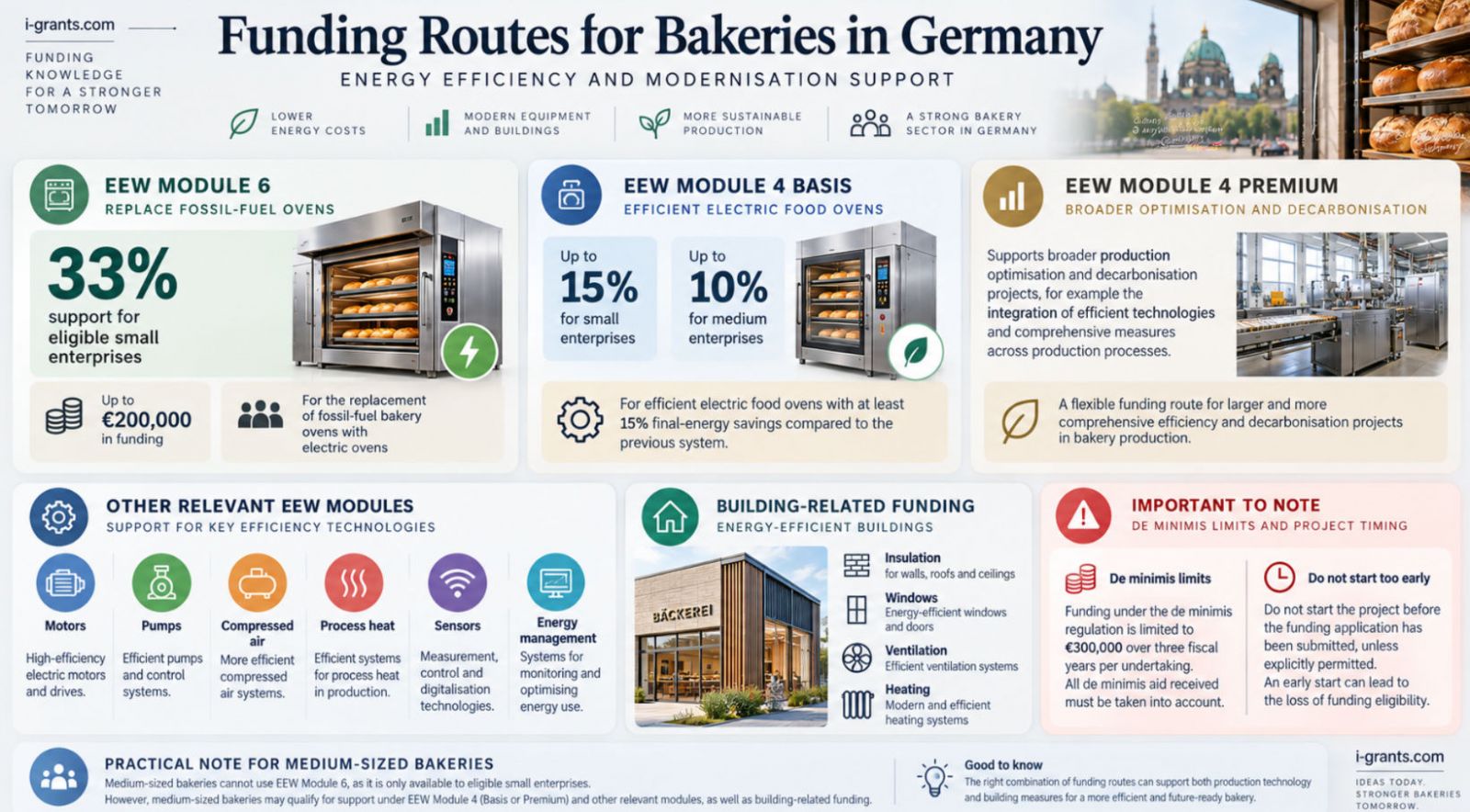
As of September 29, 2026, one federal programme is particularly relevant. Under Module 6 of Germany's Bundesförderung für Energie- und Ressourceneffizienz in der Wirtschaft, or EEW, a qualifying small bakery can receive support equal to 33 percent of eligible investment costs when replacing fossil-fuelled equipment with electrically operated equipment. Bakery ovens are explicitly cited as an example. The maximum support is €200,000 for technically, economically and administratively connected measures.
That does not mean every German bakery can receive €200,000 for a new oven. Module 6 is limited to small enterprises, the project must meet specific replacement or conversion conditions, de minimis limits apply, the project must not start too early, and ordinary building renovation belongs to different programmes. Medium-sized bakeries must usually look to other EEW modules instead.
The result is a funding landscape that can be highly attractive, but only if the bakery identifies the correct programme before ordering equipment.
Why energy investment matters for German bakeries
Germany still has one of Europe's most significant artisan bakery sectors. In 2025, the German bakery trade included approximately 8,659 artisan bakery businesses, around 35,000 branches and roughly 43,500 sales outlets. The sector employed about 232,000 people and generated approximately €18.14 billion in annual turnover. It also trained 11,389 apprentices and recorded 448 newly established bakery businesses.
The longer-term trend, however, shows consolidation. The number of artisan bakery businesses fell from more than 12,000 in 2015 to 8,659 in 2025. Rising labour costs, energy costs and competitive pressure are particularly important for smaller bakeries because production cannot simply stop consuming energy outside shop opening hours. Dough preparation often begins at night, refrigeration works continuously, and ovens must reach and maintain high process temperatures.
Sector guidance indicates that baking itself can account for roughly 50 to 70 percent of total energy consumption in a bakery, while refrigeration may represent another 10 to 20 percent. Ovens therefore deserve particular attention when a bakery prepares an investment plan.
Table 1. German bakery sector and energy profile
| Indicator | Latest relevant figure or benchmark | Practical significance |
|---|---|---|
| Artisan bakery businesses, 2025 | 8,659 | Large number of independent and SME operators |
| Annual sector turnover, 2025 | Approximately €18.14 billion | Economically important traditional SME sector |
| Employees, 2025 | Approximately 232,000 | Labour-intensive as well as energy-intensive industry |
| Trainees, 2025 | 11,389 | Significant vocational training role |
| Branches | Approximately 35,000 | Many operators have several production or retail locations |
| Total sales outlets | Approximately 43,500 | Broader figure than branches alone |
| New bakery businesses, 2025 | 448 | Highest level of new establishments in several years |
| Estimated annual sector investment | Approximately €500 million | Machinery and modernisation remain major cost categories |
| Typical share of energy used for baking | Approximately 50 to 70 percent | Ovens are normally the first major efficiency target |
| Typical share used for refrigeration | Approximately 10 to 20 percent | Cooling systems can create a second major investment opportunity |
These figures also show why there is no single "bakery grant". A small craft bakery replacing one gas oven has a different funding route from an industrial bakery replacing an automated production line, while a bakery renovating its roof and windows needs a building programme rather than a production-equipment programme.
EEW Module 6: the strongest grant route for a small bakery replacing a fossil-fuel oven
Module 6 is called "Electrification of Small Enterprises". It supports investment in existing businesses where equipment operated with fossil energy is replaced by equipment operated with electricity, or where existing machinery is converted so that it can operate electrically.
The official programme guidance specifically gives bakery ovens as an example of eligible equipment.
For a qualifying small enterprise, the support rate is 33 percent of eligible total investment costs. The maximum amount is €200,000 for connected measures under Module 6.
This is a genuine investment subsidy route when the application is made through the federal grant administration. An alternative route exists through KfW Programme 295, where financing is provided as a subsidised loan combined with a repayment subsidy. The KfW financing itself remains a loan and should not be described as a grant.
A bakery considering Module 6 should first establish whether it is legally a small enterprise under the EU SME definition. In general, a small enterprise employs fewer than 50 people and has annual turnover or an annual balance-sheet total not exceeding €10 million. Partner enterprises and linked enterprises can affect the calculation. A bakery with 30 employees may therefore fail the small-enterprise test if it belongs to a much larger corporate group.
Medium-sized enterprises are not eligible for Module 6. This is one of the most important limitations behind the €200,000 headline.
The programme is intended for existing equipment and facilities rather than a completely unrelated expansion. In a classic bakery case, an existing gas or oil oven is replaced by a new electrically operated oven. Conversion of existing machinery can also qualify where the relevant requirements are met.
The existing installation normally needs to be part of the operating assets and meet the programme's rules for existing equipment. Applicants should document the age, ownership, technical function and energy source of the old oven before applying. Replacing an existing functioning installation and buying equipment for a completely new production site are not automatically treated in the same way.
Module 6 also allows eligible ancillary expenditure associated with the supported equipment. Under the programme rules, eligible ancillary costs can generally be recognised up to 30 percent of the acquisition costs of the supported installation.
This can make directly necessary transport, connection, installation, commissioning and related technical work relevant to the grant calculation. It does not turn Module 6 into a general building-renovation grant. A bakery cannot use an oven project as a reason to include an unrelated roof replacement, complete shop renovation or general property upgrade.
How the €200,000 ceiling works
The headline maximum matters mainly for larger small-business projects. At a 33 percent rate, a bakery needs approximately €606,061 of qualifying Module 6 investment for the calculated subsidy to reach the €200,000 programme ceiling.
Table 2. Module 6 grant calculations for an eligible small bakery
| Eligible investment cost | Calculated support at 33 percent | Amount remaining before other non-eligible costs |
|---|---|---|
| €60,000 | €19,800 | €40,200 |
| €100,000 | €33,000 | €67,000 |
| €150,000 | €49,500 | €100,500 |
| €300,000 | €99,000 | €201,000 |
| €500,000 | €165,000 | €335,000 |
| Approximately €606,061 | €200,000 programme ceiling | Approximately €406,061 |
| €750,000 | €200,000 because of the cap | €550,000 |
The remaining amount should not automatically be described as a formal "own contribution". It is simply the part of eligible investment not covered by the calculated subsidy. The bakery may finance it through equity, bank financing or another permitted source. Its real financing requirement may also be higher because some project costs can be non-eligible.
VAT requires separate attention. Where a company is entitled to deduct input VAT, grant calculations are generally based on the relevant net expenditure rather than treating recoverable VAT as an eligible economic cost. Companies without a right to recover particular VAT should verify the treatment in their specific application.
The €200,000 ceiling also does not override de minimis rules.
Module 6 support is currently granted under the de minimis framework. Under the general EU de minimis regulation, a single undertaking can normally receive no more than €300,000 of covered de minimis aid over the relevant rolling three-year period.
This means a bakery with a theoretically eligible €200,000 Module 6 project may receive less if it has already consumed a substantial part of its de minimis capacity through other public support.
For example, if the relevant single undertaking has already received €180,000 of de minimis aid within the applicable period, the remaining capacity may be only €120,000. The oven project must therefore be checked against both the Module 6 project ceiling and the enterprise's remaining state-aid capacity.
Module 4 Basis: an important alternative for efficient electric ovens
Module 6 is not the only EEW route that can apply to bakery ovens.
EEW Module 4 covers energy and resource-related optimisation of installations and processes. The Basis funding route is particularly interesting when a bakery is replacing existing equipment with an energy-efficient eligible technology rather than specifically converting from fossil energy to electricity under Module 6.
For small enterprises, Module 4 Basis can provide up to 15 percent of eligible costs. Medium-sized enterprises can receive up to 10 percent. Large enterprises are not eligible for the Basis route.
A central requirement is that the investment must reduce final energy consumption by at least 15 percent compared with the relevant existing equipment.
Electrically operated food ovens are among the technologies that can qualify when the technical conditions are satisfied. This creates an important route for a bakery that already operates an electric oven but wants to replace it with a more efficient model.
It is also relevant to medium-sized bakeries because a medium enterprise cannot use Module 6.
The distinction can therefore be illustrated simply. A small bakery replacing a gas oven with an electric oven may have a strong Module 6 case at 33 percent. A medium-sized bakery making the same investment cannot use Module 6 and may instead need to examine Module 4 Basis or Premium, depending on the technical design.
Module 4 Basis should not be treated as a generic subsidy for every new oven. The existing installation, qualifying technology, calculated energy saving and project documentation must satisfy the programme requirements.
There is another technical distinction that matters for larger manufacturers. Individual electrically operated food ovens that fit the Basis specifications can use the Basis route, while certain industrial ovens integrated into larger production systems may instead fall under the Premium route.
Module 4 Premium: for more complex production modernisation
Module 4 Premium is designed for technology-open optimisation projects that reduce greenhouse-gas emissions and improve energy or resource efficiency.
This is more complex than Module 6 or Module 4 Basis. A Premium application normally requires an Einsparkonzept, a formal savings concept demonstrating the expected improvement.
The standard Premium route requires at least a 30 percent greenhouse-gas reduction under the applicable methodology.
Where support is calculated on total investment costs, current maximum rates are up to 20 percent for small enterprises, 15 percent for medium-sized enterprises and 10 percent for large enterprises.
Where support is calculated on eligible incremental investment costs, the maximum rates rise to 45 percent for small enterprises, 35 percent for medium-sized enterprises and 25 percent for large enterprises.
Additional decarbonisation bonuses may apply to defined measures such as certain electrification projects using renewable electricity, external waste-heat utilisation or qualifying renewable and low-carbon hydrogen projects. The exact eligible cost basis and state-aid treatment must be established before using a headline percentage in a business case.
A bakery should not assume that it can choose Premium simply because its percentage can be higher. Measures that qualify under the predefined Module 4 Basis route cannot simply be moved into Premium to obtain a better rate.
Premium becomes most relevant when the project is genuinely broader: an integrated production line, process refrigeration, process ventilation, complex waste-heat recovery, process heat and cold systems, or a production optimisation project where several technical systems interact.
Other EEW modules can matter almost as much as the oven grant
The federal EEW scheme contains several modules that can address different parts of a bakery's energy bill.
Table 3. Federal EEW routes that can be relevant to a bakery
| EEW module | Current support framework | Bakery applications |
|---|---|---|
| Module 1: Cross-cutting technologies | Up to 25 percent for small enterprises and 20 percent for medium enterprises, maximum €200,000 | Efficient motors, drives, pumps, fans, compressed-air systems and selected heat-recovery technology |
| Module 2: Renewable process heat | Up to 60 percent for small, 50 percent for medium and 40 percent for large enterprises for qualifying technologies | Process heat pumps, solar thermal and geothermal solutions where programme conditions are met |
| Module 3: Measurement, control, sensors and energy-management software | Up to 45 percent small, 35 percent medium and 25 percent large, maximum €20 million | Energy meters, sensors, control equipment, energy-management software and related qualifying training |
| Module 4 Basis | Up to 15 percent small and 10 percent medium, maximum €20 million | Listed efficient production technologies including qualifying electric food ovens |
| Module 4 Premium | Up to 45 percent of eligible incremental costs for small enterprises, 35 percent medium and 25 percent large, subject to methodology | Integrated production optimisation, refrigeration, process heat, process cooling and larger decarbonisation projects |
| Module 6: Electrification of Small Enterprises | 33 percent for qualifying small enterprises, maximum €200,000 | Replacement or conversion of fossil-fuelled production equipment, explicitly including bakery ovens |
Module 1 is relevant because not all bakery energy is consumed directly by ovens. Motors, pumps, fans and compressed-air installations may operate for long periods and can create measurable savings when replaced by efficient systems.
Module 2 becomes relevant when the bakery requires renewable process heat. This distinction is important. A heat pump supplying heat that is predominantly required for the production process may belong in an EEW process-heat route, while a heat pump primarily heating the building belongs to the building-funding system.
Module 3 is particularly useful when a bakery first needs visibility over its energy consumption. Installing meters, sensors, control technology and energy-management software can allow an operator to measure energy consumption by oven, refrigeration circuit, production area or operating period. Staff training directly associated with qualifying energy-management software can also be eligible under the appropriate conditions.
This kind of investment can be valuable before a much larger production upgrade because the bakery gains real consumption data instead of relying only on monthly electricity and gas bills.
Which bakery investments can realistically fit which programme?
The type of equipment alone does not determine eligibility. The existing energy source, company size, age and condition of the existing equipment, expected energy saving, installation design and intended use all matter.
Table 4. Funding map for common bakery investments
| Planned investment | Most relevant funding route | Key condition or limitation |
|---|---|---|
| Replace gas bakery oven with electric oven | EEW Module 6 | Small enterprise; qualifying fossil-to-electric replacement |
| Replace oil-fired oven with electric oven | EEW Module 6 | Same principle as other qualifying fossil-fuel replacement |
| Convert existing fossil-fuel oven for electric operation | EEW Module 6 | Conversion must satisfy technical programme requirements |
| Replace old electric oven with more efficient electric oven | EEW Module 4 Basis | At least 15 percent final-energy saving and Basis technology requirements |
| Replace automated industrial baking line | EEW Module 4 Premium may be relevant | Requires deeper technical assessment and savings concept |
| Efficient motors and drives | EEW Module 1 | Technology must meet programme specifications |
| Pumps and fans | EEW Module 1 | Technical eligibility criteria apply |
| Compressed-air system | EEW Module 1 | Efficiency specifications and project conditions apply |
| Process heat pump | EEW Module 2 | Must primarily serve qualifying process heat |
| Refrigeration system | Often EEW Module 4 | Production refrigeration must be distinguished from building cooling |
| Heat recovery from baking or refrigeration | Module 1 or Module 4 depending on design | Route depends on whether it is a standalone technology or integrated process optimisation |
| Energy meters and sensors | EEW Module 3 | Measurement and energy-management purpose required |
| Energy-management software | EEW Module 3 | Must fall within eligible software and management-system rules |
| Production control technology | Module 3 or Module 4 depending on function | Generic automation is not automatically energy funding |
| Building insulation, windows and doors | BEG building funding | Not a production-equipment measure |
| Building heat pump | BEG / KfW heating support | Must be separated from process heat |
| General bakery renovation | Normally not EEW production funding | Only directly eligible technical costs should be included |
A practical issue is ancillary work. Replacing a large gas oven with an electric model can require significantly more electrical capacity. The project may involve cabling, switchgear, connection work or even transformer-related expenditure.
Some directly necessary connection and installation costs can be eligible under Module 6 within the programme's ancillary-cost rules, but a bakery should not assume that every grid or building upgrade will automatically be covered. The cost needs a clear technical connection to the supported installation and must satisfy the programme rules.
This is one of the areas where supplier quotations should separate the oven itself, transport, installation, electrical connection, commissioning, planning and any structural work rather than presenting one undifferentiated total.
Do not order the oven too early
One of the easiest ways to lose a German investment subsidy is to start the project before the programme permits it.
For the BAFA EEW grant route, projects applied for under Modules 1 to 4 and 6 are generally not allowed to begin before the applicant receives the funding decision.
A legally binding supply or service contract associated with implementation can already constitute the beginning of the project. The danger therefore begins before physical installation starts.
For a bakery, this means obtaining quotations is not the same as placing an order. Planning and advisory work can generally be treated differently, but signing the binding oven purchase contract, paying a deposit, ordering installation or starting construction can jeopardise eligibility if done at the wrong time.
Applicants should therefore establish the funding route before making the equipment purchase legally binding.
The KfW loan route has its own process. The applicant normally applies through its financing partner before the project begins. In certain justified cases, an approved early-start request can permit implementation before final loan approval, but the company then proceeds at its own financial risk until the financing decision is completed.
The safest sequence for a bakery preparing a grant project is:
-
Define the equipment and business problem.
-
Obtain detailed non-binding quotations and technical data.
-
Identify the correct EEW or building programme.
-
Prepare the energy calculations and expert documentation required for that route.
-
Submit the application and respect the programme's project-start rules.
-
Only then make the investment legally binding when the relevant funding procedure permits it.
This sequencing matters more than the attractiveness of the headline percentage. A technically perfect €150,000 project can lose its grant value if the bakery orders the equipment too early.
Does a bakery need an energy consultant?
Not always.
Module 6 is deliberately simpler than Module 4 Premium. A bakery does not automatically need a full energy audit or an external energy consultant simply because it wants to apply for the 33 percent electrification support.
However, technical documentation about the existing equipment and the proposed electric installation is still necessary. For a major project, professional technical support may be useful even where it is not formally mandatory.
Module 4 Basis is more demanding because the bakery needs to demonstrate the required energy saving with appropriate expert confirmation.
Module 4 Premium goes further. It requires an Einsparkonzept that documents the current situation, the proposed investment and the expected greenhouse-gas reduction under the programme methodology.
Regional programmes can impose their own requirements. Brandenburg's current energy-efficiency programme, for example, requires a prior energy audit under the applicable standard or an accepted energy-management alternative.
Applicants should therefore avoid the generic assumption that "German energy grants require an energy audit". Some do. Some do not.
Building renovation must be separated from production equipment
A bakery can have two valid projects at the same time: modernising production machinery and modernising the building.
They should not be confused.
The Federal Funding for Efficient Buildings framework supports measures in non-residential buildings such as insulation, windows, exterior doors, certain ventilation systems, building control technology and heating optimisation.
For qualifying individual building measures, base support can reach 15 percent in several categories.
Climate-friendly replacement heating in an existing non-residential building can also be supported through a KfW grant route. KfW Programme 522 can provide a basic subsidy of 30 percent for qualifying heating investments, subject to the applicable rules.
This is a real grant programme, unlike a normal KfW investment loan.
Other KfW products, such as financing for comprehensive efficiency-building renovation, operate as loans that may include a repayment subsidy. They should be described as financing instruments, not as straightforward grants.
The distinction between production refrigeration and building cooling is also important. Refrigeration needed for dough, ingredients, finished products or manufacturing processes is production equipment. Room cooling for the building belongs to a different funding logic.
A bakery replacing an oven, insulating the roof and installing a building heat pump may therefore need several different funding routes rather than one application covering everything.
Regional bakery funding depends on the Land
Federal EEW support is available across Germany, but regional programmes can create additional opportunities. These programmes must always be presented as geographically limited.
In Brandenburg, Energieeffizienz Brandenburg 2026 supports qualifying energy-efficiency projects. The programme is scheduled to run from February 26, 2026 to June 30, 2027, subject to programme conditions and available funds. Small enterprises can receive a rate of up to 27.5 percent, while medium-sized enterprises can receive up to 22.5 percent. The minimum eligible project volume is €20,000.
The programme requires a substantial efficiency improvement and a prior energy audit or accepted management-system evidence. A simple one-for-one replacement investment is not automatically eligible, which means a bakery needs a genuine efficiency project rather than merely a newer version of the same machine. The same measure cannot simply be stacked with federal BAFA support where the regional rules prohibit such combination.
Rhineland-Palatinate offers EffInvest for significant efficiency investments. Support can reach up to 20 percent, with a minimum grant amount of €50,000. Because of the minimum subsidy size, the programme is generally more relevant to larger bakery modernisation projects than to a small €50,000 equipment purchase. A small enterprise seeking a €50,000 grant at a 20 percent rate would need approximately €250,000 of eligible investment before other conditions are considered.
In Hesse, PIUS-Invest has a 2026 application window running from August 24 to December 30. Support can range from 10 to 30 percent, with a maximum of €500,000 and a minimum project size of €100,000. However, ordinary replacement investment is not enough. The programme focuses on genuine process and organisational improvements that reduce environmental impacts or resource consumption.
These regional examples show why location matters. A bakery in Brandenburg, Mainz or Frankfurt can face different opportunities even if all three businesses buy similar equipment.
Regional funding should therefore be treated as an additional layer after federal eligibility has been checked, not as a national alternative available to every bakery in Germany.
Real German bakery modernisation cases
Real bakery projects illustrate what efficiency investment can achieve more effectively than theoretical savings percentages.
Müller & Egerer in Lower Saxony modernised its bakery with new thermal-oil ovens and waste-heat recovery. The company reported annual primary-energy savings of almost 650,000 kWh, natural-gas consumption falling by almost 30 percent and annual CO2 reductions of around 130 tonnes. Public financing information associated with the project included approximately €900,000 of KfW promotional financing and a €150,000 repayment subsidy.
This case is useful because it shows both the scale of energy consumption in a multi-site bakery and the difference between a subsidised KfW loan and a direct investment grant. It should not be presented as a Module 6 case because the investment occurred under an earlier funding framework.
Bäckerei und Konditorei Bolten in Duisburg provides another relevant example. Its approximately €600,000 modernisation included ovens, refrigeration and heat recovery. The financing package included a KfW energy-efficiency loan and regional support under a North Rhine-Westphalian programme. The heat-recovery system alone was reported to save approximately 166,846 kWh of natural gas per year and about 33.7 tonnes of CO2. The exact grant amount was not publicly disclosed, so it should not be invented.
Bernhard Werning Bäckerei Konditorei invested approximately €560,000 in efficient refrigeration and proofing technology, including heat recovery. Reported annual energy savings were approximately 190,000 kWh. One heat-recovery investment costing around €35,000 was associated with roughly €10,500 of annual energy-cost savings.
Using those published figures, the simple payback on that particular €35,000 component would be approximately 3.3 years before financing costs, taxes, maintenance and changing energy prices are considered.
Bäckerei Paul in Lörrach provides another technology case. Its refrigeration and heat-recovery improvements produced reported savings of approximately 108 MWh per year and around 32 tonnes of CO2. The case is valuable as evidence of technical savings potential, but it should not be converted into a claim about a specific grant amount where that amount has not been publicly documented.
Why heat recovery deserves special attention in a bakery
An oven does more than bake bread. It also produces heat that can leave the building through exhaust gases or ventilation unless the system captures and reuses it.
A bakery may be able to use recovered heat for hot water, cleaning, process applications or other suitable thermal loads. Refrigeration equipment can also provide recoverable heat.
This matters because reducing the amount of gas or electricity consumed by the oven is only one way to improve the energy balance. Recovering energy that is already being produced can sometimes create an additional efficiency project.
Operational factors also affect energy intensity. German bakery energy guidance has shown that under-loading ovens can significantly increase energy consumption per unit of product. A bakery operating at half loading can experience a material increase in specific energy consumption, while very low loading can be even less efficient.
Steam generation is another significant component of the baking process. Depending on production and oven design, generating steam can represent a substantial share of baking energy consumption.
For an applicant, this means the best grant project is not always "buy the most efficient oven". The best investment may combine production scheduling, oven selection, heat recovery, refrigeration optimisation and energy monitoring.
Electric does not automatically mean cheaper
Module 6 creates a strong incentive to replace fossil-fuelled equipment with electric equipment, but subsidy eligibility and commercial profitability are different questions.
A bakery should not assume that replacing a gas oven with an electric oven automatically reduces annual energy expenditure.
The result depends on the efficiency of the old and new ovens, annual production volume, loading patterns, operating hours, electricity tariffs, gas tariffs, peak demand, grid charges, connection capacity, heat recovery and maintenance.
A large electric oven may also require a substantial increase in electrical connection capacity. Where this requires new cables, distribution equipment or a transformer, the additional infrastructure can materially change the project's economics.
There is therefore no responsible universal statement such as "a German bakery saves 30 percent by switching from gas to electric". Reliable savings must be calculated for the individual installation.
The grant can improve the investment economics, but it does not replace a technical and financial comparison.
A realistic €150,000 oven project
Consider a small independent bakery that operates a functioning fossil-fuelled oven and plans to replace it with a qualifying electric oven.
Assume total eligible Module 6 investment costs of €150,000.
At a 33 percent support rate, the theoretical subsidy would be €49,500. The bakery would therefore need to finance €100,500 of the eligible project costs itself or through financing, before considering non-eligible expenditure and VAT treatment.
If the project also requires €25,000 of additional work that is not recognised as eligible, the actual financing requirement becomes €125,500 rather than €100,500.
Now assume the bakery has already received €275,000 of relevant de minimis aid during the applicable three-year period. Its remaining de minimis capacity could be only €25,000. In that situation, the mathematical Module 6 calculation of €49,500 does not mean €49,500 can actually be granted.
This illustrates the three separate ceilings that a bakery has to check: the programme percentage, the €200,000 Module 6 project maximum and the remaining state-aid capacity of the undertaking.
Cash flow can matter as much as the grant rate
An approved subsidy does not mean the government pays the oven supplier on the bakery's behalf.
Under the direct grant route, the bakery generally implements the approved investment and later submits the required proof of use, invoices and implementation documents. Payment follows the formal review of the completed project documentation.
This creates a financing gap.
A bakery may therefore need enough liquidity, bank financing or another permitted financing source to pay suppliers before the subsidy is received.
This is one reason KfW Programme 295 can still be relevant even when the business owner's first objective is "a grant". The KfW route can finance the investment through a loan while the repayment subsidy reduces part of the debt after the programme conditions are fulfilled.
The business should compare the direct BAFA grant route and the KfW financing route before starting the project.
It should not assume that both can simply be claimed for the same eligible expenditure. Cumulation rules, state-aid limits and the terms of any regional programme have to be checked before combining public support.
What documentation should a bakery prepare?
A strong application starts before the application form. The bakery should be able to document the existing installation, the proposed equipment, project costs, company size and the logic behind the investment.
For a Module 6 oven project, that usually means retaining supplier quotations, technical specifications of the existing and new oven, evidence of the current fuel source, company data needed for the SME test, information on linked companies where relevant, de minimis information and a clearly separated cost breakdown.
The cost schedule should distinguish equipment purchase, delivery, installation, electrical work, connection costs, commissioning, planning and other ancillary expenditure.
After implementation, invoices and evidence of proper implementation become important because the final subsidy is based on verified eligible expenditure. If actual eligible costs are lower than the approved budget, the final grant can also be lower than the maximum amount initially indicated.
Module 4 projects require additional technical evidence. Basis projects need evidence that the required final-energy reduction is achieved. Premium projects require the more extensive savings concept and calculation of greenhouse-gas reductions.
Choosing the right route before buying equipment
For a typical German bakery, the funding decision can often be narrowed down through a few practical questions.
If the business is a small enterprise and the existing oven burns gas, oil or another qualifying fossil fuel, Module 6 should be checked first.
If the existing oven is already electric and the bakery is replacing it with a significantly more efficient qualifying electric oven, Module 4 Basis may be more relevant.
If the project involves an automated industrial production line, process refrigeration, complex heat recovery or several integrated process systems, Module 4 Premium may need to be assessed.
If the project mainly concerns pumps, motors, fans or compressed air, Module 1 may provide the more appropriate route.
If the investment concerns process heat from qualifying renewable sources, Module 2 should be assessed.
If the business wants meters, sensors, energy controls or energy-management software, Module 3 may be relevant.
If the investment concerns insulation, windows, doors, building ventilation or space heating, the bakery has moved out of the production-equipment funding lane and into the federal building programme.
This classification exercise should happen before the purchase contract is signed.
The bottom line
Germany offers unusually concrete energy funding for bakeries in 2026, but the strongest opportunity is narrower than the headline may initially suggest.
A qualifying small bakery replacing fossil-fuelled equipment with electric equipment can receive 33 percent of eligible total investment costs under EEW Module 6, with support of up to €200,000 per connected project. Bakery ovens are explicitly recognised as an example of eligible equipment.
A €60,000 eligible project could therefore generate €19,800 of support. A €150,000 project could generate €49,500. A project needs roughly €606,061 of eligible costs before the 33 percent calculation reaches the €200,000 programme ceiling.
Medium-sized bakeries cannot use Module 6, but they are not excluded from energy funding. Module 4 Basis can support qualifying efficient electric food ovens at up to 10 percent for medium enterprises, while small enterprises can receive up to 15 percent. More comprehensive production decarbonisation projects may qualify under Module 4 Premium, and separate EEW modules can support motors, pumps, compressed air, process heat, sensors and energy-management systems.
Building renovation belongs to a different funding system. Insulation, windows, building ventilation and heating should not be mixed into an oven application merely because they occur at the same bakery.
Regional programmes in Brandenburg, Rhineland-Palatinate, Hesse and other Länder can add further options, but their geography, application windows, project thresholds and technical requirements differ significantly. They should never be presented as nationwide grants.
The most important practical rule is also the simplest: determine the funding route before ordering the equipment. A binding purchase contract, deposit or early project start can destroy an otherwise strong grant application.
For a German bakery facing a six-figure oven replacement, refrigeration upgrade or process-efficiency project, funding can materially change the economics of modernisation. But the subsidy works best when the investment is designed around real operational needs first and matched to the correct programme second, rather than buying equipment first and searching for a grant afterwards.