

 Français
  Deutsch
  Українська
An auto repair business in Slovakia rarely needs only one type of investment. A workshop may need a new vehicle lift, diagnostic equipment or tyre machinery, but the same business may also be paying too much for heating an old building, operating an inefficient compressor system, considering rooftop solar panels or struggling to finance another mechanic.
For body repair and paint shops, the investment challenge can be even larger. Spray booths, extraction and ventilation systems, compressed air, heating, lighting and workshop buildings can create substantial energy demand. A modernisation project can therefore combine ordinary business equipment with energy-efficiency measures and renewable-energy investment.
Slovakia does not currently have one nationwide grant designed exclusively for auto repair shops. Instead, a garage owner has to match each planned expenditure with the correct support mechanism. Solar panels may fit a renewable-energy programme. A large building renovation may qualify under an enterprise energy-efficiency scheme. Vehicle lifts or digital diagnostic systems may require a business-investment instrument. Hiring a mechanic can be supported through labour-market measures.
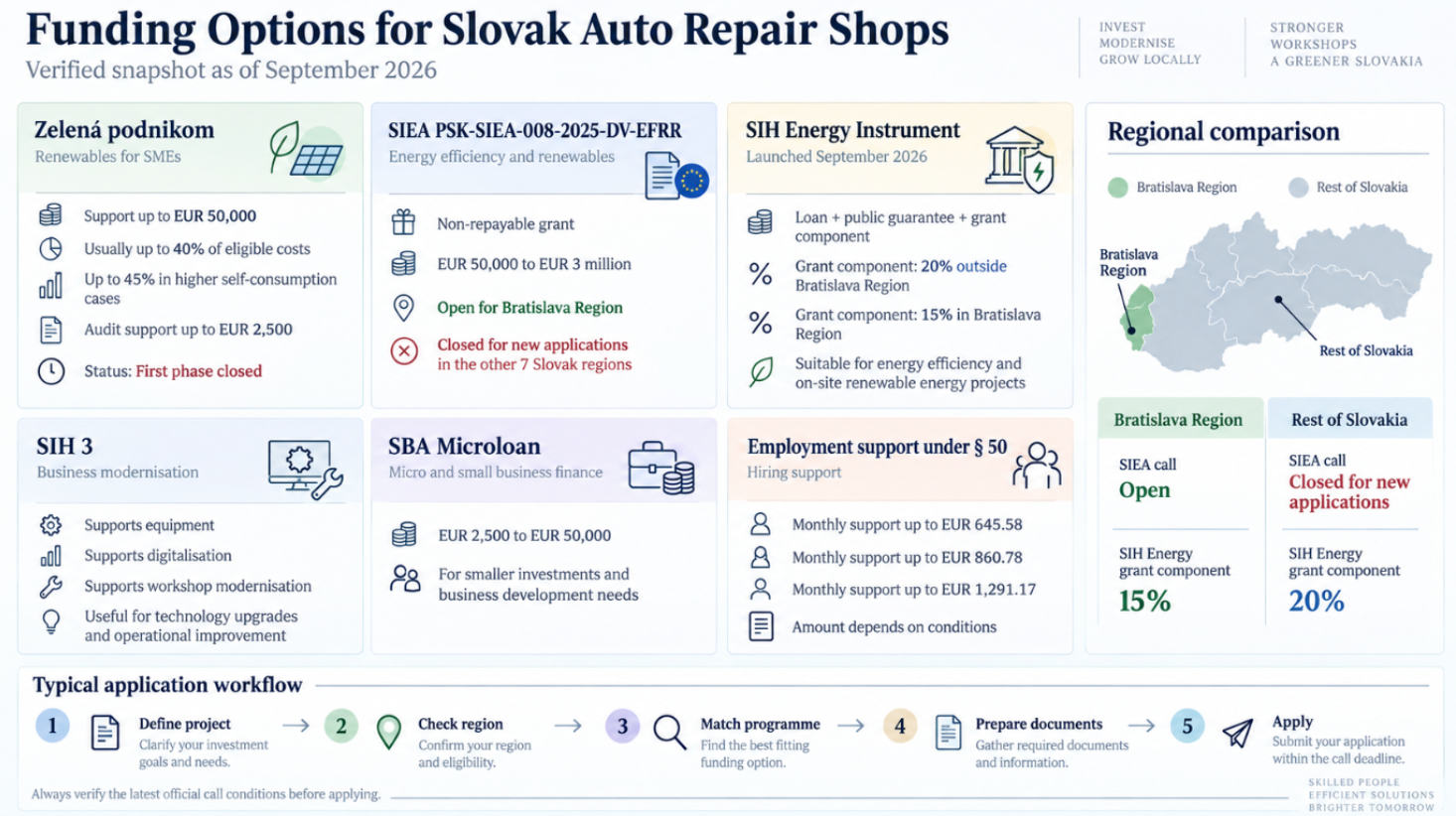
The situation is also highly dependent on geography and timing. A major direct energy-efficiency grant remains available for new projects in the Bratislava Region, while the corresponding opportunity in the other seven Slovak regions was closed to new applications after demand exceeded available resources. Zelená podnikom, one of the most relevant programmes for small businesses considering renewable energy, completed its first application phase and has announced further support, but the next confirmed application window had not yet been published when this article was prepared. At the same time, a new Slovak Investment Holding financial instrument for energy efficiency and renewable energy was launched in September 2026.
For a workshop owner, the practical question is therefore not simply "What grants exist in Slovakia?" The better question is: what exactly do I want to finance, where is the workshop located, how much will the project cost and which funding mechanism currently accepts that type of investment?
Funding status in this article was reviewed in September 2026. Application windows, allocations and detailed programme conditions can change. Businesses should confirm current conditions before signing contracts, ordering equipment or starting works.
What Can an Auto Repair Shop Actually Finance?
A garage modernisation should first be divided into investment categories.
A photovoltaic system and heat pump belong to a different funding category from a wheel alignment machine. Replacing an inefficient roof or heating system is different again. Workshop-management software may qualify as digitalisation, while recruiting a long-term unemployed mechanic is covered by employment policy rather than investment aid.
This separation is important because Slovak funding instruments use very different financial models.
Table 1. Main Funding Routes for Auto Repair and Related Workshop Businesses in Slovakia
| Funding route | Potential use for a workshop | Type of support | Current position |
|---|---|---|---|
| Zelená podnikom | Photovoltaics, heat pumps, solar thermal systems, supported wind systems and eligible storage | Non-repayable voucher | First phase closed; a new phase was announced, but a confirmed reopening date had not yet been published |
| SIEA PSK-SIEA-008-2025-DV-EFRR | Major building energy renovation and renewable energy | Non-repayable grant of €50,000 to €3 million | Open for the Bratislava Region; closed to new applications in the other seven regions |
| New SIH energy instrument | Energy efficiency and renewable energy | Bank loan, public guarantee and grant component | Launched in September 2026 |
| SIH 3 | Machinery, workshop modernisation, digitalisation, automation and eligible investment | Bank financing with public guarantee and possible grant component | Available through participating banks, depending on component and allocation |
| SBA Microloan Programme | Smaller machinery, reconstruction and business equipment | Repayable loan of €2,500 to €50,000 | Available subject to assessment |
| Employment support under § 50 | Hiring an eligible disadvantaged jobseeker | Contribution toward labour costs | Available under 2026 labour-market rules |
These instruments should not be described as interchangeable.
A €50,000 voucher is not equivalent to a €50,000 loan. A 20 percent grant component attached to a bank loan is not the same as receiving 20 percent of the project cost in cash before implementation. A state guarantee protects part of the lender's risk but does not eliminate the company's obligation to repay its debt.
For an owner planning a substantial modernisation, understanding the funding structure can be as important as the headline amount.
Zelená podnikom: One of the Most Relevant Programmes for a Small Garage
Zelená podnikom is particularly important for smaller workshops because it is designed for micro, small and medium-sized enterprises rather than exclusively for large industrial companies.
An ordinary auto repair business does not need to be transformed into an artificial "innovation project" to fit the programme. SIEA has previously used businesses such as auto repair shops and small bakeries when explaining the types of commercial premises that may potentially participate, provided the programme conditions are satisfied.
For a garage, the most obvious investment would be rooftop photovoltaics. A workshop that operates mainly during daylight hours can have a useful electricity-consumption profile because compressors, lifts, lighting, ventilation, diagnostics, office equipment and other systems may run while solar electricity is being generated.
Heat pumps can also be relevant, particularly where the workshop operates from a building that currently relies on an inefficient heating system.
The maximum support available under Zelená podnikom can reach €50,000 per enterprise, including eligible assistance for the required energy audit.
However, the €50,000 figure is a ceiling, not an automatic award.
The programme normally supports a percentage of eligible expenditure. It also uses technical calculations and technology-specific limits. A business cannot simply install equipment costing €50,000 and expect the programme to pay the entire amount.
Table 2. Important Zelená podnikom Funding Parameters
| Parameter | Main rule |
|---|---|
| Standard support rate | Up to 40 percent of eligible expenditure |
| Higher rate | Up to 45 percent where the higher self-consumption condition is met |
| Minimum required self-consumption | At least 50 percent of generated energy under the programme methodology |
| Higher self-consumption threshold | At least 80 percent for the additional 5 percentage points |
| Maximum support per SME | €50,000 including eligible audit support |
| Energy audit | 45 percent of eligible audit costs, maximum contribution €2,500 |
| Photovoltaic and wind capacity | Up to 250 kW, subject to the detailed programme rules |
A simplified example shows how different the real support can be from the headline maximum.
If an eligible photovoltaic project has a supportable expenditure base of €40,000 and receives the standard 40 percent contribution, the corresponding support would be €16,000. The business would finance the remainder itself, subject to the programme's detailed treatment of VAT and other eligible or non-eligible costs.
If the same project met the conditions for a 45 percent contribution, the simplified amount would rise to €18,000.
These examples illustrate the percentage mechanism only. Actual voucher calculations depend on technology, installed capacity, audit results and the applicable eligible-expenditure methodology.
Why the Energy Audit Can Change the Project
The energy audit should not be treated as paperwork that is prepared after the business has already chosen a photovoltaic system.
Its purpose is to examine the company's actual energy use and identify an appropriate solution.
Suppose a workshop owner initially wants a very large photovoltaic array because the roof has sufficient space. If the workshop consumes much less electricity during production hours than the system would generate, the installation may be poorly matched to the programme's self-consumption requirements.
Conversely, a garage with compressors, ventilation, several lifts, diagnostic systems and continuous daytime activity may be able to justify a larger system because its electricity is consumed while it is being produced.
The same logic applies to body shops. A paint and body repair facility can have substantial electricity demand from compressors, extraction equipment and ventilation. The relevant question is not whether a body shop "sounds energy intensive", but what the meter data and energy audit demonstrate.
An audit can also show that the first investment should be energy efficiency rather than renewable generation. An old workshop losing large quantities of heat through an uninsulated roof or poorly sealed doors may benefit more from reducing demand before installing a larger heating system.
Zelená podnikom Is Not a General Equipment Grant
A common misunderstanding is that once a workshop qualifies as an SME, the €50,000 voucher can be used for any modernisation.
It cannot.
The programme is designed around specified renewable-energy technologies and related eligible costs. A vehicle lift, paint booth, tyre machine, wheel alignment system or ordinary diagnostic scanner does not become eligible simply because a newer model may consume less energy.
Those investments need to be analysed under different funding mechanisms.
The same caution applies to battery storage. Storage may form part of an eligible new photovoltaic project under programme rules, but it should not be interpreted as an independent grant for purchasing a battery without the corresponding supported system.
The Application Window Matters as Much as Eligibility
The first Zelená podnikom phase ended on 16 December 2025.
SIEA indicated that support would continue and that another application opportunity was expected during 2026. However, when the programme status was checked for this article, a confirmed date for the next application phase had not yet been identified.
That creates an important distinction.
An auto repair business can be theoretically suitable for Zelená podnikom and still be unable to submit a new application today.
A business preparing for the next phase can nevertheless collect electricity bills, clarify ownership or lease arrangements, discuss the project with an energy auditor and obtain preliminary technical proposals.
What it should not do is assume that the future voucher has already been secured.
What if the Garage Rents Its Building?
Many independent repair businesses operate from rented commercial premises.
This does not necessarily exclude them from renewable-energy support, but it creates practical issues.
The property owner's written consent may be required. The applicant's legal right to use the premises must be compatible with the investment. Electricity connection arrangements should also be examined because the programme needs to establish that the supported system serves the applicant's business consumption.
The length of the lease matters as well.
A garage should be cautious about investing a substantial amount in solar panels or a heat pump fixed to somebody else's property if the remaining lease term is short or the ownership of improvements is unclear.
Grant eligibility and commercial risk should be considered together.
The Larger SIEA Energy Grant Can Support a Much Deeper Renovation
For businesses planning a large building-level project, the SIEA call PSK-SIEA-008-2025-DV-EFRR is more important than Zelená podnikom.
The scheme supports energy-efficiency improvements and renewable energy in enterprises and offers a non-repayable contribution from €50,000 to €3 million.
The fact that €50,000 is the minimum grant contribution is important. It means the programme is fundamentally different from a small voucher scheme.
A modest solar installation or a single heating replacement may be too small. A larger package combining several energy measures is more consistent with the programme's scale.
For an automotive business, such a project could involve insulation of the roof and external walls, replacement of inefficient windows and doors, heating-system upgrades, ventilation improvements, more efficient technical systems and renewable-energy generation where permitted by the programme.
For a body repair and paint shop, this type of comprehensive project can be particularly relevant because heating, ventilation, extraction and building performance can have a direct effect on operating costs.
The final eligible measures must still follow the energy audit and programme documentation. Calling a project "green modernisation" does not automatically make every expenditure eligible.
Bratislava and the Rest of Slovakia Currently Face Different Rules
This is one of the most important facts in the entire funding roadmap.
The SIEA call remains open for new applications in the Bratislava Region under the latest official status reviewed.
For the other seven Slovak regions, new applications were stopped from 4 July 2025 because available resources were insufficient relative to demand.
Table 3. Regional Access to the SIEA Enterprise Energy-Efficiency Call
| Location of the investment | Status for new applications | Practical consequence |
|---|---|---|
| Bratislava Region | Open | A new eligible workshop project can still investigate the direct grant |
| Trnava Region | Closed | New projects need another route unless the call is reopened |
| Nitra Region | Closed | Same restriction |
| Trenčín Region | Closed | Same restriction |
| Žilina Region | Closed | Same restriction |
| Banská Bystrica Region | Closed | Same restriction |
| Prešov Region | Closed | Same restriction |
| Košice Region | Closed | Same restriction |
A national article that simply says "Slovak businesses can apply for grants of up to €3 million" would therefore be misleading.
An auto repair shop in Bratislava and an otherwise identical garage in Košice do not currently have the same access to this call.
This also explains why a new grant contract for a company outside Bratislava may appear in the public register even though new applications are closed there. The company may have submitted its application during an earlier open period and reached contracting later.
A Real Automotive Service Project: AC Autocentrum
One of the strongest examples identified during the research is AC Autocentrum s.r.o. in Brzotín in the Košice Region.
This is particularly valuable because it provides documented evidence that funding under the SIEA energy-efficiency call can reach an automotive service property rather than only factories.
Project documentation describes premises containing automotive sales, service and workshop functions.
The company's contract provides for a €680,222.36 non-repayable contribution.
Total eligible expenditure is €1,055,295.78.
Table 4. Financial Structure of the AC Autocentrum Project
| Indicator | Amount |
|---|---|
| Total eligible expenditure | €1,055,295.78 |
| Contracted grant | €680,222.36 |
| Remaining eligible financing | €375,073.42 |
| Grant share of eligible expenditure | Approximately 64.46 percent |
The project includes building-related energy measures rather than ordinary car repair equipment. Documentation refers to interventions affecting insulation, building openings, heating, cooling, ventilation and hot-water systems.
This is exactly why the case is useful.
It demonstrates that an automotive-service building can qualify for a major energy modernisation project when the technical and financial conditions are met.
It does not demonstrate that an independent two-lift garage can automatically obtain more than €680,000.
The project scale, eligible costs and aid intensity belong to one specific beneficiary.
The timing is equally important. AC Autocentrum is in the Košice Region, but its contract becoming effective in 2026 does not mean the Košice application window reopened. It reflects an application processed under the previous availability of the call.
Body Repair and Paint Shops May Have an Even Stronger Energy Case
A useful extension of the auto repair roadmap is the body repair and paint business.
The funding programmes discussed here do not create a separate automatic grant specifically for body shops. However, the structure of their energy consumption can make energy modernisation particularly relevant.
A body shop may operate compressed-air systems, extraction, ventilation, curing and drying equipment, specialist lighting and space heating. Older paint facilities may also operate in buildings with weak insulation or inefficient heating.
A modernisation project can therefore be larger and more integrated than the project of a purely mechanical garage.
For example, replacing an old heating system without improving building insulation may deliver less benefit than a coordinated renovation. Similarly, a modern paint booth may reduce operating costs, but the booth itself cannot automatically be inserted into an energy grant merely because it is newer.
If the investment is fundamentally production or service equipment, it should be assessed under a business-investment instrument. If the project concerns the building's measurable energy performance, the energy-efficiency route is more relevant.
This distinction allows a body shop to combine different financing sources legitimately without trying to classify every expenditure under one programme.
A New SIH Energy Instrument Became Important in September 2026
The financing landscape changed again in September 2026 when Slovak Investment Holding launched a new instrument for energy efficiency and renewable energy.
This is particularly relevant for businesses outside Bratislava because the large direct SIEA grant window is currently closed there.
The SIH instrument uses a different model from a traditional grant.
The investment is financed through a participating bank. The programme combines the loan with a public guarantee and a grant component. Once the business successfully implements the investment and meets the programme conditions, the grant component can be used to repay part of the principal.
The owner therefore needs to understand the difference between receiving a grant and having part of a loan reduced after implementation.
For enterprise energy-efficiency projects outside the Bratislava Region, the grant component can reach 20 percent of the relevant loan principal. In the Bratislava Region, the corresponding rate is 15 percent.
The same regional distinction applies to the relevant enterprise renewable-energy components.
Table 5. SIH Energy Financing for Enterprises
| Project | Region | Grant component |
|---|---|---|
| Energy-efficiency investment | Outside Bratislava Region | 20 percent |
| Energy-efficiency investment | Bratislava Region | 15 percent |
| Renewable-energy investment | Outside Bratislava Region | 20 percent |
| Renewable-energy investment | Bratislava Region | 15 percent |
Consider a simplified example.
An eligible auto body shop outside Bratislava finances €250,000 of a qualifying energy project with the relevant SIH loan. If the entire amount forms the relevant basis and all conditions for the 20 percent grant component are ultimately satisfied, the grant component would correspond to €50,000 of principal reduction.
The company does not simply receive €50,000 before starting construction.
It first needs approved financing, must implement the eligible investment and then satisfy the conditions for the grant component.
Loan Capacity Still Matters
The programme can support substantial financing. Published conditions for the relevant enterprise energy components allow loans up to €5 million, with maturities that can extend to ten years under the applicable product conditions.
That does not mean every SME can borrow €5 million.
The bank still assesses creditworthiness.
A garage with modest turnover, existing debt and limited collateral cannot assume that a public guarantee removes the need for financial analysis.
The company needs to demonstrate that it can finance the investment and service the debt.
For many small workshops, the realistic project may be €50,000, €100,000 or €300,000 rather than several million euros.
The New SIH Instrument Can Be More Relevant Than Waiting for a Perfect Grant
Consider a workshop in Prešov with an old roof, high heating costs and a technically justified €180,000 renovation.
The large direct SIEA grant is currently closed to new applications in that region.
The owner can wait in the hope that another direct-grant window will open, but there is no guarantee about the timing or future conditions.
The SIH energy instrument offers another possibility.
The business can compare the cost of borrowing against expected energy savings and the value of the grant component.
If postponing the renovation for two years means another two winters of high energy bills, a partially subsidised financing instrument may be economically more attractive than waiting for a hypothetical larger grant.
This is why grant planning should be connected to investment economics rather than based solely on the percentage of public support.
Workshop Machinery Needs a Different Funding Route
A business may have a much simpler problem: its lifts are old, its wheel alignment system is outdated or its diagnostic technology cannot properly service newer vehicles.
Those are legitimate investment needs, but they are not normally renewable-energy projects.
For machinery, digitalisation and broader workshop modernisation, SIH 3 can be more relevant.
The programme is implemented through participating banks and combines financing with a public guarantee and, under certain components, a grant element.
Several components are geographically differentiated.
Table 6. SIH 3 Components Relevant to Workshop Modernisation
| Component | Geographic scope | Main potential use | Published grant component |
|---|---|---|---|
| A | Outside Bratislava Region | Digitalisation and automation | 2.5 to 25 percent |
| B | Outside Bratislava Region | Broader business investment, modernisation, automation and eligible circular-economy projects | 10 to 25 percent |
| C | Bratislava Region | Eligible investment and digitalisation | 0 to 5 percent |
| D | Eligible Just Transition Fund territories | Business transformation investment | 15 to 25 percent |
For a normal garage outside Bratislava, Component B may be the more natural starting point when the business wants general workshop equipment rather than a narrowly defined digital project.
A vehicle lift, compressor, workshop reconstruction or another item may potentially fall within a broader investment project if the programme and bank accept the expenditure.
The final decision depends on the current product conditions, aid rules, region and individual credit assessment.
Digitalisation Should Be a Real Business Change
Digitalisation is another area in which exaggerated descriptions should be avoided.
Buying one new office computer does not necessarily amount to digital transformation.
A more credible auto repair digitalisation project might connect online booking, customer management, vehicle service records, work orders, technician scheduling, parts inventory, invoicing and diagnostic data.
A larger workshop could also integrate digital workflow tools between reception, mechanics and parts management.
For a body repair shop, software could support job planning, insurance documentation, photographic evidence, parts ordering and progress tracking.
The point is not to use the word "digital" as often as possible in the application. The project should demonstrate a meaningful operational change.
A €50,000 SBA Microloan May Be Enough for a Smaller Garage
Not every business needs a large subsidised bank instrument.
The Slovak Business Agency Microloan Programme provides financing from €2,500 to €50,000 for eligible micro and small businesses.
The repayment period ranges from six months to four years.
For a small independent garage, that scale can be highly practical.
A business may need €18,000 for a lift and tyre equipment, €25,000 for diagnostics and workshop improvements or €40,000 for a broader equipment replacement. In these cases, a microloan can be easier to match to the actual investment than a large energy call.
The programme can support machinery, equipment, reconstruction and other eligible business expenditure.
However, it is a loan.
It must be repaid, and the applicant must demonstrate that the business is economically capable of repayment.
That distinction should be clear because entrepreneurs searching for "grants" often encounter microfinance programmes and assume that part of the loan is automatically non-repayable.
When a Loan Can Be Better Than a Grant
Non-repayable support sounds preferable by definition, but the administrative and timing costs of a grant can be significant.
A business may need an energy audit, project documentation, supplier quotations, procurement procedures, financing evidence and months of evaluation before implementation can begin safely.
If a workshop urgently needs a €12,000 machine because the current one has failed, delaying the purchase for an uncertain grant may cost more in lost work than the potential subsidy.
The right financing instrument is therefore the one that makes the investment economically viable, not necessarily the one with the largest subsidy percentage.
Hiring Another Mechanic Creates a Separate Funding Opportunity
Investment in a garage is not limited to machinery.
A workshop may purchase new equipment but still be unable to increase turnover without another mechanic.
Slovak labour-market policy includes support for employers hiring eligible disadvantaged jobseekers under § 50.
For 2026, the maximum monthly contribution varies according to the district and category of the employee.
In districts where the relevant unemployment indicator does not exceed the national average, the contribution can equal 30 percent of total labour costs up to €645.58 per month.
In districts above the national average, the contribution can equal 40 percent up to €860.78 per month.
For certain eligible categories of disadvantaged jobseekers or qualifying persons under 30, the calculation can reach the higher statutory level, with a maximum of €1,291.17 per month in 2026.
Support can generally run for up to 12 months. For certain candidates registered as unemployed for at least 24 months, the support period can extend to 24 months.
This can make a meaningful difference to the first-year cost of expanding a small garage.
However, it is not a universal wage subsidy.
The candidate must meet the relevant conditions, and the employer needs to follow the procedure with the competent labour office.
A business planning to rely on this contribution should verify the candidate's status before treating the subsidy as part of the employment budget.
What if the Garage Wants to Modernise Everything at Once?
Consider a medium-sized independent workshop outside Bratislava planning the following project:
€45,000 for rooftop solar and heating improvements, €60,000 for lifts and diagnostic equipment, €20,000 for workshop-management software and €15,000 for building improvements that do not qualify under the energy measure.
The total investment is €140,000.
Trying to place all €140,000 into one "green grant" would be a weak strategy.
The energy component can be analysed under the SIH energy instrument or a future Zelená podnikom phase.
The workshop equipment can be examined under SIH 3.
The software can potentially form part of a digitalisation investment if it satisfies the relevant criteria.
The remaining construction costs may need to be financed from the company's own resources or ordinary credit if they do not fit an eligible measure.
This type of funding structure is more complicated than receiving one cheque, but it is also more realistic.
State-Aid Rules Matter When Several Instruments Are Combined
A company cannot simply receive public support twice for the same eligible invoice.
If a €30,000 machine is already funded as an eligible cost under one programme, the business cannot normally submit the same expenditure under another scheme and collect a second subsidy.
Different programmes may sometimes be combined when they cover different costs or when the accumulation remains within permitted aid limits.
For de minimis support, the current general EU ceiling is €300,000 for a single undertaking over a rolling three-year period, subject to the applicable legal rules.
The concept of aid is broader than cash grants. A subsidised guarantee or financial instrument can also contain a calculated aid element.
Companies that have already received public support should therefore review previous de minimis and state-aid records before structuring a new project.
SME Status Is Not Always as Simple as Counting Workshop Employees
A repair business may have eight employees and appear to be a microenterprise.
That does not always settle the issue.
EU SME rules also examine ownership and relationships with partner or linked enterprises. If the garage belongs to a larger corporate group or the owner controls several connected companies, employee and financial data may need to be combined.
This can affect access to schemes reserved for micro, small and medium-sized enterprises.
An applicant should therefore confirm its SME status rather than relying only on the headcount of one company.
Financial Condition Can Decide the Application
A technically strong investment does not automatically compensate for financial problems.
Grant providers and banks may examine whether the company has outstanding obligations, insolvency issues or other financial difficulties.
Bank-financed SIH instruments also require the company to demonstrate repayment capacity.
For a garage, this means that clean accounting, realistic financial forecasts and an affordable own-financing requirement are part of project preparation.
A €200,000 subsidised investment can still be too large for a business if the unsupported portion or repayment schedule puts excessive pressure on cash flow.
Cash Flow Can Be More Important Than the Grant Percentage
Owners often calculate only the final percentage of support.
They should also calculate when the money becomes available.
A reimbursement programme may require the company to pay suppliers before claiming support.
A bank instrument provides financing earlier but requires debt servicing.
A direct grant contract may allow a particular pre-financing or payment method, but that depends on the programme and individual agreement.
Consider a project with €100,000 of eligible expenditure and a hypothetical 40 percent reimbursement.
The eventual public contribution might be €40,000.
But if the company must initially pay most or all invoices before reimbursement, it may still need access to nearly €100,000 of temporary financing.
A project can therefore be profitable on paper but impossible to execute without liquidity planning.
Do Not Sign the Supplier Contract Too Early
This is one of the easiest ways to damage an otherwise eligible project.
Funding programmes can define the start of works differently. Signing a binding contract, making a deposit, starting construction or ordering equipment may count as commencement of the investment.
If the aid rules require an application before the project begins, an early purchase can eliminate eligibility.
Before ordering solar panels, machinery or construction services, the applicant should therefore verify the exact programme rule.
A supplier's statement that "you can apply for the grant afterward" should never substitute for the official funding conditions.
Procurement and Price Evidence May Be Required
Publicly supported investment also does not mean a private business is free to purchase anything from any supplier without documentation.
The programme may require quotations, market comparisons, procurement procedures or other evidence that the cost is reasonable.
Larger construction and equipment contracts deserve particular attention.
A grant writer or project manager should determine the required procedure before the applicant commits to a supplier.
Changing the purchasing process after contracts have been signed can be difficult or impossible.
VAT Can Change the Real Project Budget
VAT treatment also matters.
If a VAT-registered business can recover input VAT, the recoverable tax may not form part of the eligible expenditure base under the relevant scheme.
The garage may nevertheless have to pay the VAT temporarily when settling supplier invoices.
The grant budget, accounting budget and cash-flow budget can therefore show different numbers for the same investment.
This is another reason not to plan only from the advertised grant percentage.
A Practical Funding Map for Different Workshop Sizes
Table 7. Examples of Funding Strategies by Project Type
| Workshop situation | Approximate investment | Most relevant routes to investigate |
|---|---|---|
| Small garage purchasing one lift and diagnostic equipment | €15,000 to €30,000 | SBA microloan, own funds or SIH 3 where suitable |
| Garage installing rooftop solar | €20,000 to €60,000 | Zelená podnikom when open, SIH energy instrument |
| Workshop replacing heating and adding photovoltaics | €50,000 to €150,000 | Zelená podnikom for a suitable smaller project or SIH energy financing |
| Large workshop building renovation in Bratislava | €150,000 or more | Direct SIEA energy-efficiency grant and SIH energy instrument |
| Large workshop renovation outside Bratislava | €150,000 or more | SIH energy instrument while direct SIEA regional applications remain closed |
| Body and paint shop modernising ventilation, heating and building envelope | Potentially €100,000 or more | Energy audit followed by SIEA or SIH route depending on region |
| Garage modernising equipment and digital workflow | €30,000 to €150,000 | SIH 3, possibly combined with own financing |
| Garage expanding staff | Labour cost rather than capital cost | § 50 and other appropriate labour-office measures |
These figures describe project scenarios, not guaranteed funding thresholds.
The actual programme match must be established from current conditions.
What Documents Should the Owner Start Collecting?
A workshop can prepare much of the underlying information before the funding window opens.
The business should have access to recent financial statements, company registration documents, information on owners and linked businesses, tax and public-obligation records, property documents or a lease agreement, preliminary supplier quotations and a realistic investment budget.
For energy projects, electricity and heating consumption data is particularly important. The auditor may need information about the building, equipment, operating hours and existing technical systems.
For digitalisation or machinery projects, the company should be able to explain why the investment is necessary and how it affects productivity or service capacity.
For bank financing, cash flow and repayment capacity will also be central.
This preparation does not mean the project should be started before eligibility is confirmed.
How Should a Bratislava Garage Approach Funding?
A workshop in the Bratislava Region currently has an opportunity that businesses in the rest of the country do not have: it can still investigate a new application under the large direct SIEA energy-efficiency call.
For a small photovoltaic project, however, that may still be unnecessarily complex. A future Zelená podnikom application or the new SIH energy instrument may be more proportionate.
For a major building renovation, the direct SIEA grant becomes more relevant because the potential contribution starts at €50,000 and can reach several million euros.
Machinery and digitalisation should be separated from the energy application and examined under SIH 3 or another financing route.
The lower published SIH 3 grant component in Bratislava also means that geography influences funding even outside the direct energy call.
How Should a Garage in Košice or Prešov Approach Funding?
A new applicant in Košice or Prešov cannot currently rely on the closed regional part of the direct SIEA energy-efficiency call.
The AC Autocentrum contract does not change this.
For renewable energy, the business can monitor Zelená podnikom and examine the new SIH energy instrument.
For machinery and digitalisation, SIH 3 may provide a relevant route.
For a smaller purchase, the SBA microloan may be simpler.
For hiring, labour-market contributions should be investigated separately.
This creates a different funding strategy from Bratislava, but not an absence of funding options.
What Should a Body Repair and Paint Shop Do Differently?
A body shop should begin with an energy profile of its building and technical systems.
Ventilation, extraction, compressed air and heating may represent a significant share of operating costs.
If the building is old, a comprehensive audit can identify whether the highest-return investment is insulation, heating, air handling, renewable energy or a combination.
The paint booth itself requires careful classification.
If a new booth is primarily service equipment, it may need to be funded as ordinary business investment. If certain technical parts form part of a broader verifiable energy-efficiency project, only the eligible elements should be included under the applicable energy rules.
This distinction should be confirmed before the company prepares its budget.
A body shop can therefore be an excellent candidate for an integrated funding plan, but it should not assume that all workshop technology automatically belongs in the energy grant.
Why Research and Innovation Grants Usually Do Not Belong in This Roadmap
Slovakia and the EU operate substantial research and innovation programmes.
A normal repair shop should not be pushed into them simply to make the article contain more opportunities.
Installing standard diagnostic equipment, software or commercially available machinery is normally business modernisation, not experimental research.
An automotive service business could potentially become relevant to innovation programmes if it genuinely develops new diagnostic technology, remanufacturing processes, software, testing systems or another innovation.
That would require a different project and different evidence.
For a traditional garage, energy, SME investment and workforce support are the more realistic areas.
The Same Caution Applies to Circular Economy Funding
Repair businesses contribute to extending the life of vehicles and components, but that fact alone does not automatically make every garage eligible for specialised circular-economy grants.
A normal repair service and a project establishing systematic component remanufacturing are not the same activity.
If an auto business creates a genuine reuse, remanufacturing or recycling process, additional programmes may become relevant.
But an ordinary workshop should not describe standard vehicle repair as a sophisticated circular-economy project simply to gain access to another grant.
The funding application should reflect what the company actually does.
Funding Success Cannot Be Predicted From the Number of Applications
SIEA reported hundreds of applications under the enterprise energy-efficiency call. Zelená podnikom also attracted substantial demand in its first phase.
Those numbers demonstrate interest in the programmes.
They do not reveal the probability that an individual auto repair shop will receive funding.
Submitted applications, approved applications, contracted grants and actual payments are different statistics.
The AC Autocentrum project provides evidence of a contracted grant. It does not provide a general success rate for the automotive service sector.
Unless an authority publishes reliable sector-specific competition statistics, it is better not to estimate the odds.
A Realistic Funding Roadmap
For a Slovak garage, the best funding strategy begins with four facts: the physical location of the workshop, the precise investment, the project cost and the company's ability to finance its own share.
If the priority is renewable energy, Zelená podnikom should be monitored and the SIH energy instrument compared with it.
If the project is a major building renovation in Bratislava, the direct SIEA call deserves detailed analysis.
If the same renovation is outside Bratislava, SIH financing is currently more immediately relevant while the direct call remains closed to new regional applications.
If the business needs lifts, diagnostic systems or other ordinary machinery, SIH 3 and SBA financing are more appropriate places to look.
If the business needs another mechanic, employment support is a separate workstream.
And if the owner operates a body repair or paint shop, an energy audit can be especially valuable because building systems, compressed air, ventilation and heating may create a strong case for a broader energy-efficiency investment.
The key is not to force everything into one grant.
A large modernisation may legitimately involve several funding routes, with different costs allocated to each one and the necessary state-aid rules checked before implementation.
Final Takeaway
A Slovak auto repair shop can access meaningful public and supported financing, but there is no universal garage grant that pays for every type of modernisation.
For smaller renewable-energy projects, Zelená podnikom can provide support of up to €50,000 when an application phase is open and the project satisfies the programme's energy and self-consumption conditions.
For major energy renovation, the SIEA enterprise call offers non-repayable contributions from €50,000 to €3 million, but regional availability is crucial. New applications currently remain possible in the Bratislava Region, while the corresponding allocation in the other seven regions is closed.
AC Autocentrum's contracted €680,222.36 project provides a documented example of an automotive-service property receiving substantial energy-efficiency support. It demonstrates that the sector can qualify, but the scale and aid intensity of that project cannot be transferred automatically to another garage.
For businesses outside Bratislava, the SIH energy instrument launched in September 2026 creates another route based on bank financing, a public guarantee and a 20 percent grant component for the relevant enterprise energy-efficiency and renewable-energy components. The corresponding rate in Bratislava is 15 percent.
For workshop machinery, diagnostic systems, reconstruction, automation and digitalisation, SIH 3 can be more appropriate than an energy grant. For smaller investments, an SBA microloan of up to €50,000 may provide a simpler financing solution. Labour-market support can reduce the cost of hiring an eligible employee.
Body repair and paint shops can use the same funding roadmap, but their energy profile may make comprehensive energy renovation especially important. Ventilation, extraction, compressed air, heating and the building envelope should be examined together instead of treating each machine as an isolated grant purchase.
The strongest funding application is therefore not the one that lists the largest number of programmes. It is the one that correctly matches the business's real investment to a currently available financial instrument, calculates the unsupported costs and cash-flow requirements, respects regional and state-aid rules and begins implementation only when expenditure eligibility is clear.
For business owners who need help analysing these conditions, i-grants.com connects applicants with professional grant writers who can review eligibility, structure the investment, prepare funding documentation and help distinguish realistic funding opportunities from programmes that do not fit the project. i-grants.com does not guarantee that funding will be awarded, but professional preparation can help the applicant avoid costly eligibility mistakes and build a more coherent financing strategy.