

 Français
  Deutsch
  Українська
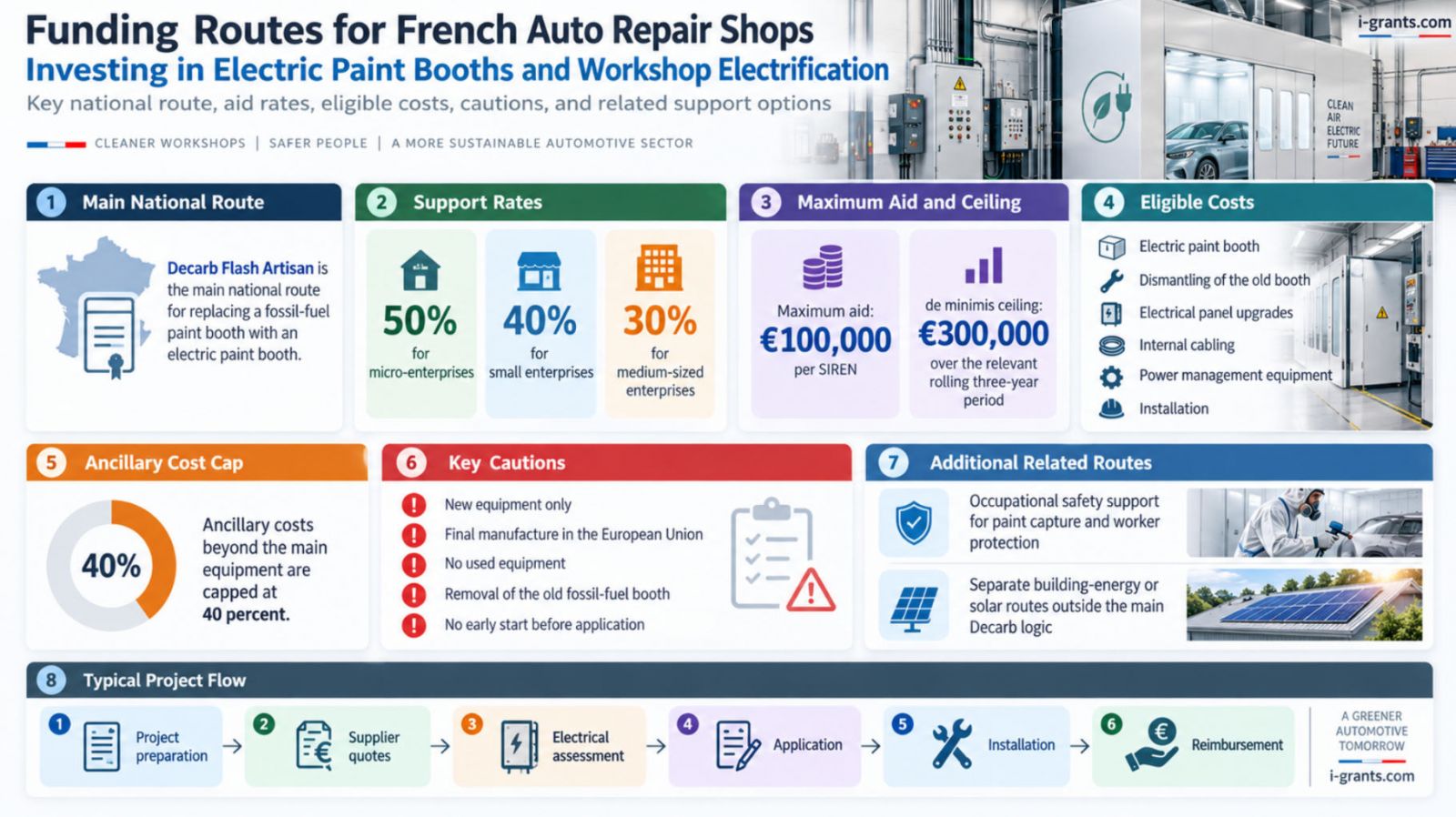
France has created a particularly relevant funding opportunity for auto repair businesses and body shops that still rely on fossil fuels for paint operations. Under the Decarb Flash Artisan programme, an eligible workshop can receive public support to replace an existing gas, fuel-oil or LPG paint booth with an electric system. The programme is especially interesting because it does not stop at the cost of the new booth itself. Certain expenses required to make the electrification technically possible, including internal electrical work, cabling, distribution-board adaptation, load-management equipment, dismantling and installation, can also enter the eligible cost base when the programme conditions are met.
The headline maximum is significant. A micro-enterprise can receive support equal to 50 percent of eligible expenditure, a small enterprise can receive 40 percent, and a medium-sized enterprise can receive 30 percent. The total Decarb aid is capped at €100,000 per SIREN. However, this does not mean that every French garage can apply for €100,000 to modernise its workshop. For automotive businesses, Decarb Flash Artisan is a targeted decarbonisation mechanism rather than a general equipment subsidy. Its strongest use case is the replacement of fossil-fuel paint equipment with an electric alternative. A conventional vehicle lift, diagnostic computer, tyre changer, compressor, set of tools, solar array or workshop-management system is not automatically eligible simply because it improves the garage.
This distinction is particularly important in the French repair market. Vehicle maintenance and repair is a large economic sector composed mainly of relatively small businesses. INSEE has recorded more than 63,000 enterprises in vehicle maintenance and repair, with annual turnover exceeding €28 billion excluding tax and more than 125,000 salaried full-time-equivalent jobs. The body repair and paint segment alone includes roughly 13,000 workshops and around 24,500 qualified employees. For many of these businesses, replacing a paint booth is not a minor operating expense but a major capital decision that can affect cash flow for years.
The investment pressure is increasing at the same time as the French vehicle fleet changes. France has around 40 million passenger cars in circulation, and the average vehicle is now close to 12 years old. Petrol and diesel cars continue to represent the overwhelming majority of vehicles already on the road, which means traditional maintenance and collision repair remain essential. At the same time, battery-electric and plug-in hybrid vehicles are gradually increasing their share, creating new requirements for high-voltage safety, diagnostics, charging, workshop electrical capacity and technician skills. French garages therefore have to maintain an ageing conventional fleet while simultaneously preparing for a more electrified automotive economy.
Decarb Flash Artisan addresses only one part of that transition, but it addresses it in a very concrete way. For the right body shop, a fossil-to-electric paint booth conversion can qualify for tens of thousands of euros in public support. For the wrong type of investment, however, the €100,000 headline may be almost irrelevant. Understanding that boundary is the starting point for a realistic funding strategy.
Decarb Flash Artisan: The Main National Grant for Paint Booth Electrification
Decarb Flash Artisan forms part of the wider France 2030 decarbonisation framework and is administered by ADEME. The programme has a €16 million budget dedicated to helping artisan and SME businesses electrify eligible fossil-fuel processes. Automotive maintenance, repair and bodywork activities are among the sectors explicitly recognised by the programme, which makes this one of the clearest nationwide grant opportunities currently available to French body shops.
The current call opened on 30 September 2026 and is scheduled to run until 15 June 2027. Businesses should nevertheless avoid treating the closing date as a guarantee that money will remain available until the final day. ADEME can close a funding call before its nominal deadline if the available budget is exhausted. A workshop that already knows it intends to replace a fossil-fuel paint booth therefore has a practical reason to prepare early rather than wait until 2027.
There is also a small discrepancy in the official documentation regarding the exact closing time on the final day. One ADEME source gives 3:00 p.m., while the detailed programme specifications give 7:00 p.m. Paris time. This inconsistency should not materially affect a well-managed application because a serious applicant should not plan to submit during the last few hours of the call. The safer approach is to prepare and file the application well before the deadline.
For the automotive sector, the core eligible investment is the replacement of an existing paint booth powered by fossil fuel with a new electric paint booth. Gas, fuel oil and LPG are specifically relevant fuel types, while the programme also uses broader language referring to fossil-fuel equipment. The purpose is therefore clear: ADEME wants the public money to remove an existing fossil-fuel use and replace it with electricity, not merely subsidise capacity expansion.
Table 1. Key Decarb Flash Artisan Rules for French Auto Repair and Body Shops
| Rule | Requirement |
|---|---|
| Main automotive investment | Replacement of an existing fossil-fuel paint booth with an electric paint booth |
| Fossil fuels specifically relevant | Gas, fuel oil and LPG |
| Minimum paint booth investment | €40,000 |
| Maximum amount shown for the paint booth action | €200,000 |
| Micro-enterprise support rate | 50 percent of eligible expenditure |
| Small-enterprise support rate | 40 percent |
| Medium-sized-enterprise support rate | 30 percent |
| Maximum Decarb aid | €100,000 per SIREN |
| Equipment condition | New equipment only |
| Manufacturing requirement | Final manufacture must take place in the European Union |
| Existing fossil-fuel equipment | Must be removed as part of the replacement |
| Used equipment | Not eligible |
| Inflatable paint booths | Not eligible |
| Standard implementation period | Normally 12 months from the financing decision |
| Main aid framework | Primarily EU de minimis |
| De minimis ceiling | €300,000 over the relevant rolling three-year period |
| Maximum combined public support | Generally 60 percent of eligible investment |
| Scheduled closing date | 15 June 2027, subject to earlier closure if funds are exhausted |
One important technical issue concerns the upper project boundary. The programme's general conditions state that the total investment should be below €200,000 excluding tax, while the specific table for the electric paint booth action shows an investment range extending to €200,000. A business preparing a project exactly at €200,000 should therefore obtain confirmation from ADEME rather than assuming that the boundary amount is automatically acceptable. In practice, this inconsistency is most relevant to micro-enterprises attempting to approach the €100,000 maximum grant.
Which French Garages and Body Shops Can Qualify?
A workshop cannot determine eligibility simply by looking at the equipment it wants to buy. The applicant itself must satisfy the programme rules. The company needs a valid French business registration, an eligible establishment and an activity falling within the accepted automotive categories. Relevant activities include maintenance and repair of light motor vehicles, body repair and related automotive repair operations.
The business must also qualify as an SME. Under the European SME definition, a micro-enterprise generally has fewer than 10 employees and annual turnover or an annual balance-sheet total not exceeding €2 million. A small enterprise generally has fewer than 50 employees and turnover or balance-sheet total not exceeding €10 million. A medium-sized enterprise generally has fewer than 250 employees and annual turnover not exceeding €50 million or an annual balance-sheet total not exceeding €43 million. These thresholds can become more complicated when the garage is linked to other companies because partner and linked enterprises may have to be included in the calculation.
This is not merely an administrative detail. Company size directly changes the grant rate. A workshop classified as a micro-enterprise could receive 50 percent of an eligible investment, while another business carrying out exactly the same project may receive only 40 percent or 30 percent because it belongs to a larger SME category.
Decarb Flash Artisan also contains conditions relating to artisan status and company history. The business must satisfy the relevant registration requirements and must have been created before the programme's specified cut-off date. A recently established body shop may therefore find that its technical investment fits the programme perfectly but the legal applicant does not yet meet the historical eligibility conditions.
For applicants, the practical lesson is that there are always two separate eligibility tests. The first asks whether the business itself qualifies. The second asks whether the investment qualifies. A positive answer to only one of those questions is not enough.
What an Eligible Paint Booth Replacement Actually Looks Like
The programme is relatively precise about what it expects from an automotive project. An existing fossil-fuel paint booth must be replaced by a new electric system used for the same operational purpose. The supported logic is not "buy newer equipment". It is "remove fossil-fuel equipment and electrify the process".
The new booth must be new rather than second-hand, and the final manufacture of the funded equipment must take place in the European Union. This manufacturing condition deserves particular attention because a body shop may find competitive equipment from outside the EU that looks technically suitable but does not satisfy the grant rules. A supplier should therefore be able to document the place of final manufacture clearly enough for the applicant to demonstrate compliance.
The replacement booth also has to meet normal professional requirements concerning ventilation, filtration, safety, worker protection and explosive atmospheres where relevant. A grant does not remove the need for technical compliance. Inflatable paint booths are excluded, and equipment that does not meet the required professional standards should not be assumed to qualify.
The old fossil-fuel booth must also be removed. This requirement prevents a business from using the programme to add electric capacity while keeping the fossil-fuel system permanently available as a parallel production line. The programme is intended to create an actual reduction in fossil-fuel use. Evidence of dismantling, removal, recycling or destruction can therefore become important when the company later requests grant payment.
This has a direct impact on project planning. A workshop should include the practical cost of removing the existing booth from the beginning. Disconnecting gas or fuel lines, dismantling the unit, moving heavy equipment, transporting waste and obtaining disposal evidence can all require professional contractors.
The Paint Booth May Be Only Half of the Electrification Problem
For many garages, the most difficult part of electrification will not be choosing the booth but supplying enough electricity to operate it. A conventional gas-fired paint booth may already use electricity for lighting, ventilation, fans and controls while relying on gas for process heat. When that heat source is replaced with electricity, the site's peak electrical demand can increase sharply.
A small body shop that has operated for years on its existing connection may discover that the current electrical panel, cabling or contracted capacity cannot support the new equipment. A technically straightforward booth replacement can therefore develop into a larger infrastructure project involving internal distribution, protective equipment, new cable runs, connection modifications or power-management technology.
Decarb Flash Artisan is particularly useful because it recognises this reality. Certain electrical infrastructure costs can be included when they are directly necessary for the eligible electrification project. This is one of the most valuable aspects of the scheme and one that a simple headline about "up to €100,000" does not explain.
The programme does not, however, provide an unrestricted budget for renovating the whole workshop. The applicant must be able to show a direct connection between the electrical work and the funded equipment. If an owner decides to rewire offices, storage rooms, reception areas and unrelated workshop circuits at the same time, those general improvements cannot automatically be transferred into the Decarb budget.
Table 2. Paint Booth and Electrical Upgrade Costs That May Be Eligible
| Cost | Likely treatment | Main condition |
|---|---|---|
| New electric paint booth | Eligible | Must satisfy programme and technical requirements |
| Removal of existing gas, fuel-oil or LPG booth | Eligible | Must relate directly to replacement |
| Disposal or destruction of old equipment | Eligible | Evidence may be required |
| Neutralisation of fossil-fuel supply serving old booth | Eligible | Must relate to the equipment being replaced |
| Electrical panel adaptation | Eligible | Must be necessary for the electric conversion |
| New internal cabling | Eligible | Must directly serve the funded equipment |
| Electrical protection equipment | Eligible | Must be part of the necessary installation |
| Reinforcement of internal electrical infrastructure | Eligible | Must be technically justified |
| On-site connection work | Potentially eligible | Eligibility depends on the exact scope of the work |
| Load-management equipment | Eligible | Must manage or optimise electrical power |
| Battery used for peak-demand management | Potentially eligible | Must support power management rather than renewable-energy storage |
| Battery mainly used to store solar electricity | Not eligible under this Decarb category | Different funding logic applies |
| Installation by an external contractor | Eligible | Must relate to the funded equipment |
| General workshop rewiring | Not automatically eligible | Must be directly connected to the eligible action |
| Internal employee labour | Not eligible | Internal labour is excluded |
| Unrelated garage equipment | Not eligible | Must be financed or supported through another route |
The battery rule is particularly interesting. A body shop may need a local battery because a high-power electric booth creates short periods of very high demand. If a battery can smooth those peaks and reduce the need for expensive grid reinforcement, it may form part of the power-management solution. A battery installed mainly to store electricity produced by photovoltaic panels, however, falls into a different category and should not automatically be treated as an eligible Decarb expense.
This illustrates a broader principle of grant eligibility: the same physical equipment can be treated differently depending on the role it plays in the project. The purpose and technical justification matter as much as the equipment name.
Transformers, Three-Phase Power and Connection Upgrades
A larger electric paint booth may create requirements that go beyond ordinary internal wiring. Some workshops may need stronger three-phase capacity, a new connection arrangement or even transformer-related work. These cases need more careful analysis because the boundary between eligible on-site electrification and wider network infrastructure can become less clear.
The programme recognises certain internal reinforcement and connection-related costs, but a business should not assume that every network intervention is automatically eligible. If an electricity network operator requires substantial works outside the site boundary, those expenses may receive different treatment from an internal switchboard upgrade.
A workshop facing this situation should obtain a proper electrical study before submitting the grant application. The study should identify existing contracted power, current peak demand, expected demand from the electric booth, required connection capacity and the technical measures that could reduce reinforcement costs. In some cases, load management or peak-shaving storage may be economically preferable to a major network upgrade.
This analysis should not be left until after the booth has been ordered. If the business learns too late that the selected equipment requires an additional €30,000 or €50,000 of electrical infrastructure, the investment case can change dramatically.
The 40 Percent Limit on Ancillary Costs
One of the most important rules in Decarb Flash Artisan is the limitation on supporting expenditure. Eligible costs other than the main equipment are capped at 40 percent of the eligible equipment cost. This rule can significantly reduce the grant base for projects that require major infrastructure work.
Suppose an electric paint booth costs €100,000. Forty percent of that amount is €40,000. The combined eligible value of dismantling, installation, internal cabling, electrical panel work, load-management equipment and other qualifying ancillary expenses can therefore reach no more than €40,000 for the purpose of the eligible cost base.
If those supporting works actually cost €55,000, the business may still need to carry them out, but the extra amount does not automatically increase the Decarb base. The real project cost and the eligible grant cost therefore begin to diverge.
If the booth costs €120,000, the corresponding 40 percent ancillary ceiling becomes €48,000. For a €150,000 booth, it becomes €60,000. The rule does not guarantee that all costs up to those amounts will be accepted. Each expense still has to be necessary and eligible. The calculation merely establishes the maximum permitted relationship between core equipment and supporting expenditure.
This is why every serious application should contain two budgets. The first is the total cash project budget showing everything the business will actually need to pay. The second is the Decarb eligible-cost budget showing only the expenses that meet programme rules and remain within the applicable caps.
How Much Can a Garage Really Receive?
The support rate depends on enterprise size. A micro-enterprise can receive 50 percent of eligible expenditure, a small enterprise 40 percent and a medium-sized enterprise 30 percent. The programme sets an overall maximum aid of €100,000 per SIREN.
The headline maximum is therefore much easier for a micro-enterprise to approach than for a larger SME. A small business with almost €200,000 of eligible expenditure would still generate a grant of only around €80,000 at the 40 percent rate. A medium-sized business would generate around €60,000.
Table 3. Indicative Decarb Grant Calculations by Company Size
| Accepted eligible expenditure | Micro-enterprise at 50 percent | Small enterprise at 40 percent | Medium-sized enterprise at 30 percent |
|---|---|---|---|
| €40,000 | €20,000 | €16,000 | €12,000 |
| €60,000 | €30,000 | €24,000 | €18,000 |
| €80,000 | €40,000 | €32,000 | €24,000 |
| €100,000 | €50,000 | €40,000 | €30,000 |
| €120,000 | €60,000 | €48,000 | €36,000 |
| €150,000 | €75,000 | €60,000 | €45,000 |
| €180,000 | €90,000 | €72,000 | €54,000 |
| €199,999 | €99,999.50 | €79,999.60 | €59,999.70 |
The final row uses €199,999 rather than exactly €200,000 because of the inconsistency between the general programme rule and the paint booth action table. A micro-enterprise can therefore theoretically approach €100,000 very closely, but a project built exactly around the upper boundary should be checked before submission.
The table also shows why the phrase "up to €100,000" needs context. For a €100,000 eligible project, the micro-enterprise grant is €50,000, not €100,000. The €100,000 maximum becomes relevant only when both the eligible project value and the applicable aid rate are high enough.
A Realistic €165,000 Body Shop Electrification Scenario
Consider a small body shop that operates an older gas-fired paint booth and decides to replace it with a modern electric system. The booth itself costs €110,000 excluding tax. The supplier confirms that the equipment is new, professionally certified and finally manufactured in the European Union.
Removing the old gas booth and neutralising the dedicated gas connection costs €6,000. The existing electrical board cannot handle the new load, so an electrical contractor quotes €14,000 for reinforcement and distribution work. New cabling and protection devices cost another €8,000. Installation and commissioning by the booth supplier cost €8,000, while a load-management system designed to control peak electrical demand costs €4,000.
The candidate eligible project therefore totals €150,000. The supporting costs outside the €110,000 core equipment amount to €40,000. Because 40 percent of €110,000 is €44,000, these ancillary costs remain within the programme's maximum ratio.
Now assume that the electricity connection assessment identifies another €15,000 of work that the business ultimately has to pay but which is not accepted in the Decarb eligible base. The full cash project rises to €165,000, while the eligible base remains €150,000.
If the business is a micro-enterprise, a 50 percent grant on €150,000 would equal €75,000. The portion of accepted eligible expenditure not covered by the grant is therefore €75,000. In addition, the €15,000 outside the grant base must also be financed. The final cost to the business after receiving the grant becomes €90,000, before considering VAT timing and financing costs.
If the same business is classified as a small enterprise, the grant would be €60,000. The final cost of the €165,000 project after the grant would therefore be €105,000. For a medium-sized enterprise, a 30 percent grant would equal €45,000, leaving €120,000 to be financed from the company's own resources, borrowing or other compatible sources.
This example illustrates one of the most important practical lessons of the programme. The grant percentage should never be applied directly to the total invoice package without first determining which costs are eligible.
The Cash-Flow Problem Is Larger Than the Final Grant Calculation
A business can have an excellent grant project and still face a serious financing problem. Decarb support is generally paid after the funded equipment has been installed and commissioned. The workshop therefore needs enough liquidity to carry the project during implementation.
This can be significant because paint booth suppliers often require staged payments. A business may have to pay a deposit after the grant decision, another amount before shipment, further payments during installation and the remaining balance at commissioning. Electrical contractors may also invoice separately.
A workshop eventually receiving €75,000 in grant support might therefore need temporary access to most of a €150,000 or €165,000 project cost before reimbursement. Recoverable VAT can further increase the temporary cash requirement because the business may have to pay VAT to suppliers before later recovering it through its normal tax process.
This is where financing becomes part of the funding strategy. Bpifrance and commercial lenders can potentially provide loans for electrification or investment, and such financing can be combined with the grant when the applicable rules are respected. However, a loan must always be described separately from a grant. The loan helps finance the project but has to be repaid. The grant permanently reduces the cost of the eligible investment.
For many small garages, the most realistic financing structure may therefore involve three components: the Decarb grant, company cash and external borrowing.
Grant Payment Requires Evidence of a Completed Project
Receiving a financing decision is not the end of the process. The workshop has to implement the project and later prove that it completed the approved investment.
The general implementation period is normally 12 months from the financing decision, although more complex projects involving connection work may qualify for additional time under the relevant conditions. The company should not assume that an award can remain unused indefinitely.
At the final payment stage, ADEME can require paid invoices, evidence that the company actually paid suppliers, accounting certification, photographs, proof that the old fossil-fuel equipment was removed and documentation concerning disposal, recycling or destruction where relevant. The business must also be able to show that the new equipment has been installed and commissioned.
This makes recordkeeping a practical part of the project rather than an administrative afterthought. A company should preserve supplier quotations, final invoices, bank payment evidence, photographs of the old installation, photographs of dismantling and photographs of the completed electric installation. If the supplier provides a commissioning certificate or certificate of origin, those documents should also be retained.
Do Not Place a Binding Order Too Early
Project timing is one of the easiest ways to damage eligibility. The programme requires the application to be submitted before the project has effectively started. A legally binding order placed too early can therefore create a serious problem.
A business may request quotations, compare suppliers, perform an electrical study and prepare its financing plan before submitting the application. Those preparation activities are different from making an irreversible investment commitment.
The risk begins when the company signs a binding purchase order, starts installation or otherwise commits itself in a way that makes the project irreversible. Paying a deposit can also create a problem if the payment forms part of a binding equipment order.
There is also an important difference between submitting the application and receiving the final grant decision. Filing before the investment starts helps satisfy the programme's timing requirement, but submission does not guarantee approval. A risk-averse company may therefore choose to wait for the signed financing decision before placing the final order.
The safest sequence is to complete the project design, obtain detailed quotations, submit the complete application, receive the financing decision and only then make the project irreversible.
Building a Strong Application File
A good application should make it easy for the funding authority to understand exactly what is being replaced, why the conversion is eligible and how each project cost relates to the electrification objective.
The applicant should first document the existing fossil-fuel equipment. Photographs, technical plates, supplier documentation and recent gas, LPG or fuel-oil invoices can help establish the current energy source and the existence of the equipment being replaced.
The quotation for the new booth should be detailed rather than generic. It should identify the model, technical characteristics, electrical power, manufacturer, supplier, installation work and place of final manufacture. If dismantling is included in the supplier's contract, that should be clearly stated.
Electrical works should also be documented separately where possible. A quotation for the distribution-board upgrade should describe what is being changed and why. Cabling should be linked to the new equipment. If a load-management system or battery is proposed, the technical purpose should be explained. If a connection upgrade is necessary, supporting information should show how the new booth changes site demand.
This level of detail is useful not only during grant assessment but also during reimbursement. The easier it is to trace the final invoice back to the approved project, the lower the risk of disputes over eligible expenditure.
De Minimis Rules Can Affect the Final Award
Decarb Flash Artisan is primarily granted under the European de minimis framework. Under the current general rules, a single undertaking can normally receive up to €300,000 in de minimis aid over the relevant rolling three-year period.
For a small independent workshop that has received little public funding, this ceiling may never become a practical limitation. For a company belonging to a larger group, operating several sites or receiving multiple grants, it can become important.
The calculation is also not always made solely at the level of one legal company. Businesses that are linked through ownership or control can form a single undertaking for state-aid purposes. A workshop belonging to a wider group should therefore review previous de minimis support at the appropriate level before assuming that the full ceiling remains available.
Combining Decarb With Other Public Support
A body shop modernisation can involve several different public-policy objectives, and that creates opportunities to use more than one support mechanism. However, applicants should not simply add different grant percentages together.
Decarb requires relevant public support connected with the same investment to be declared, and the overall public aid for the eligible investment is generally limited to 60 percent. This means that a micro-enterprise receiving 50 percent Decarb support for a specific cost cannot simply add another 30 percent grant to the same expenditure and assume it will receive 80 percent public funding.
A stronger approach is to identify genuinely different investment components. Paint booth electrification can belong to Decarb. Worker-exposure controls can potentially belong to an Assurance Maladie scheme. Building insulation may belong to CEE. Solar generation follows photovoltaic rules. Digital management software may fall under a local digital programme.
The purpose is not to split one invoice artificially. It is to match each real investment with the support mechanism designed for that objective.
Assurance Maladie: A Second Important Route for Body Shops
Body shops should also examine the Captage cabine de peinture support available through Assurance Maladie - Risques professionnels. Unlike Decarb, this scheme focuses on occupational health and the reduction of worker exposure to paints, solvents, aerosols and other hazardous substances.
Eligible businesses with fewer than 50 employees can potentially receive support equal to 70 percent of qualifying expenditure excluding tax, subject to a maximum subsidy of €25,000 under the scheme.
This creates a useful distinction. Decarb addresses the energy source by helping replace fossil-fuel equipment with electricity. Assurance Maladie can address extraction, capture, ventilation and worker-protection measures where the relevant conditions are met.
A company should not assume that the same cost can receive both rates in full. Cumulation rules still apply, and the technical scope of each programme is different. Nevertheless, a body shop planning a substantial paint-area renovation would be unwise to check only the Decarb programme and ignore occupational-safety funding.
What If the Workshop Needs a New Compressor?
Compressed air is an important energy user in many repair businesses. It powers tools, tyre equipment, paint processes and other workshop systems. Older compressed-air networks can also lose substantial amounts of energy through leakage or poor controls.
Despite that, Decarb Flash Artisan does not provide a general grant for replacing an ordinary compressor in an automotive workshop. Buying a new compressor because the old one is inefficient or unreliable is not automatically an eligible Decarb action.
That does not mean compressed-air investment can never receive support. Specific energy-saving measures can interact with CEE or other programmes if the project satisfies their technical requirements. Local investment support may also be available in some territories. The business therefore needs to distinguish between a normal equipment replacement and a formally eligible energy-efficiency operation.
This distinction is important across the entire grant market. A more efficient machine is not automatically a grant project simply because it saves electricity.
Solar Panels Require a Separate Funding Strategy
Solar photovoltaics may be economically attractive after paint booth electrification because the workshop's electricity demand can increase substantially. A body shop with a large roof may therefore consider combining electrification with rooftop solar generation.
The projects are related operationally but remain separate from a grant perspective. Solar panels are not automatically an eligible Decarb paint booth cost. Photovoltaic systems follow their own national support framework, self-consumption rules, electricity-sale arrangements and possible local or regional incentives.
The same logic applies to batteries. A battery used specifically to manage peak demand from the new equipment may potentially enter the Decarb project under the relevant conditions. A battery used primarily to store solar electricity should not automatically be included.
A company planning both investments should therefore create two linked but distinct business cases: one for process electrification and one for electricity generation.
Building Insulation and Heating Belong to Different Mechanisms
Some garages have several energy problems at the same time. An owner may operate a gas paint booth in a poorly insulated building with an inefficient heating system. Decarb Flash Artisan is not intended to solve every one of those problems through a single application.
Building-energy investments often belong more naturally to the Certificats d'économies d'énergie system. CEE support covers defined energy-saving operations in buildings and can include eligible insulation, heating, controls and other efficiency measures.
CEE is not the same as an ADEME investment grant. The mechanism is linked to certified energy savings and involves energy suppliers and other obligated or authorised market participants. Nevertheless, from the workshop's perspective, it can reduce the cost of certain building-energy investments.
If a garage wants to insulate its roof, replace eligible heating equipment or install qualifying energy controls, it should investigate the CEE route instead of trying to force those expenses into a paint booth application.
EV Charging Support Has Changed
Electric vehicle charging infrastructure is becoming increasingly relevant for garages. Workshops may need chargers for customer vehicles, diagnostics, service operations, employee fleets or company cars. However, businesses should be careful with older online information about national charging grants.
The dedicated Advenir premiums previously available to automotive service professionals ended at the end of 2025. New applications under those specific categories have not been accepted since 1 January 2026.
A garage may still find local, regional or future charging support, and other charging programmes may apply in particular situations. The important point is that the former nationwide automotive-services Advenir premium should not be presented as a currently open grant.
This is a good example of why grant information must be checked against current programme status rather than copied from older funding guides.
Diagnostic Equipment, Vehicle Lifts and Ordinary Workshop Tools
Many workshop owners are more interested in diagnostics, lifts and tools than in a paint booth. These investments can be important, especially as modern vehicles require ADAS calibration, battery testing, advanced diagnostics and high-voltage equipment.
However, ordinary diagnostic machines do not automatically qualify for Decarb Flash Artisan. The same applies to general vehicle lifts, tyre changers, wheel balancers, standard workshop tools and other routine garage equipment.
There can still be exceptions under other programmes. Assurance Maladie may support specified equipment designed to reduce ergonomic or occupational risks. Regional or local authorities may operate investment schemes for small businesses. Some territories may provide modernisation support for local commerce and artisan businesses.
These opportunities are highly dependent on location and programme design. A grant available to a garage in one intermunicipal area cannot be described as a national French programme.
Digitalisation Also Depends Heavily on Location
Workshop-management software, online booking systems, inventory platforms, digital customer records and websites can improve productivity, but they do not fall under the Decarb paint booth action.
Digital support in France is often regional or local. France Num catalogues programmes that can help small businesses finance eligible digital projects, but the rules vary considerably by territory.
One local authority may offer a percentage of website or software costs while a neighbouring territory has no comparable programme. This means the postcode of the workshop can be as important as the nature of the digital investment.
For a business planning software rather than energy equipment, the correct funding search should therefore begin with the region, département, intermunicipal authority and France Num listings rather than with Decarb Flash Artisan.
Vehicle Lifts Can Have an Occupational-Safety Angle
A standard vehicle lift purchased simply because the garage needs more workshop capacity is not a Decarb investment. However, some equipment associated with vehicle handling, wheel handling and tyre operations can qualify for occupational-risk prevention support when it meets the relevant technical criteria.
This does not transform all lifts into grant-eligible equipment. The funding objective is worker protection rather than general modernisation.
A workshop should therefore ask a different question: does the equipment meet the specification of a current prevention subsidy? If the answer is yes, occupational-safety support may be possible. If the equipment is simply an ordinary capacity upgrade, direct grant support may be much harder to find.
Table 4. Funding Map for Common Auto Repair Investments in France
| Planned investment | Most relevant route | Practical conclusion |
|---|---|---|
| Replace gas paint booth with electric booth | Decarb Flash Artisan | Strong direct-grant opportunity if all conditions are met |
| Replace fuel-oil or LPG paint booth with electric booth | Decarb Flash Artisan | Same fossil-to-electric logic |
| Electrical panel required for the new booth | Decarb Flash Artisan | Potentially eligible when directly necessary |
| Cabling for the electric booth | Decarb Flash Artisan | Potentially eligible subject to programme limits |
| Peak-demand management system | Decarb Flash Artisan | Relevant when required to manage electrical load |
| Paint capture and worker-exposure controls | Assurance Maladie | Separate occupational-safety subsidy |
| Standard compressor | CEE, local support or financing depending on project | No automatic Decarb grant |
| Roof or wall insulation | CEE and possible local support | Building-energy route rather than paint booth grant |
| Workshop heating renovation | CEE and related energy programmes | Separate investment category |
| Solar panels | Photovoltaic support framework | Separate from Decarb |
| EV chargers | Current local or other charging support | Former dedicated Advenir automotive-services premium is closed |
| Diagnostic equipment | Local investment programmes or financing | No general Decarb grant |
| Workshop-management software | Local digital support | Availability depends heavily on location |
| Ordinary vehicle lift | Usually not Decarb | Some occupational-risk equipment may qualify elsewhere |
| General workshop tools | Usually commercial financing or self-funding | No general national Decarb grant |
| Cash required before grant reimbursement | Bpifrance or bank financing | Loan, not grant |
Real French Examples of Public Support for Automotive Investment
Decarb Flash Artisan is too new to have a meaningful portfolio of completed automotive beneficiaries. The programme has only recently opened, so there is no reason to expect a mature database of body shops that have already completed their projects and received final reimbursement.
That does not mean paint booth investment has never received public support in France. Earlier funding programmes provide useful examples.
Up Car, a body repair company near Strasbourg, publicly reported receiving €47,800 in FEDER support for the installation of a WEINMANN One Day Repair paint booth. The available public information does not provide enough detail to calculate the complete aid intensity or verified energy savings, so those figures should not be invented. The value of the case is more limited but still important: a real French body repair SME has previously received public support for a paint booth investment.
Garage Brugère in Le Vigean provides another useful example. Local authority documentation described a paint booth project costing €28,500 as part of the development of body repair activity. The financing plan included potential European and local support. This example illustrates how territorial and European funding can contribute to automotive investment, but a proposed financing plan should not be confused with proof that every planned contribution was ultimately paid.
A broader decarbonisation example comes from CARFAR in Neufchâteau. The automotive SME carried out an investment project involving LED lighting, replacement of a combustion-engine utility vehicle with an electric vehicle and equipment designed to reduce waste transport. The project cost was around €39,570 and received €13,300 in ADEME support. It was not a Decarb Flash Artisan garage project, but it demonstrates the wider history of public support for automotive SME decarbonisation.
These examples also reinforce an important funding principle. A national grant may be the main opportunity, but it is rarely the entire funding landscape. European, regional, local, occupational-safety and energy mechanisms can all become relevant depending on the exact investment.
Why Energy Modernisation Matters in the French Repair Sector
The French repair sector combines several structural characteristics that make energy investment particularly important. It is fragmented, dominated by relatively small businesses, and often operates from premises developed long before current electrification requirements were anticipated.
Many workshops use substantial amounts of energy for heating, paint operations, compressed air, ventilation and lighting. ADEME energy-efficiency benchmarking indicates that vehicle maintenance and repair collectively account for several thousand gigawatt-hours of annual energy consumption. The benchmark data also show that energy can represent a meaningful operating cost for individual businesses.
However, the sector is extremely heterogeneous. A small mechanical garage without a paint booth will have a very different energy profile from a high-volume collision repair centre. A workshop in northern France may also have different heating requirements from one in a milder region.
This is why universal claims about energy savings should be treated cautiously. There is no reliable rule that every workshop switching from a gas booth to an electric booth will reduce its total energy consumption by the same percentage. Results depend on the old technology, new technology, working hours, drying cycles, ventilation design, insulation, electricity tariffs, gas prices and production volume.
The business case should therefore be based on project-specific energy modelling rather than generic marketing claims.
Choosing an Electric Booth Before Choosing the Grant
A funding programme should not determine the technical specification of the workshop. The company should first identify the equipment that makes operational sense and then determine which part of that investment qualifies for support.
The required booth capacity depends on throughput. A small body shop handling occasional collision work does not need the same system as a large operation processing multiple vehicles every day. Drying technology, ventilation design and temperature control can affect both productivity and electrical demand.
Peak power is particularly important. Two systems with similar annual energy consumption can create very different connection requirements if one has a much higher peak load. The electrical study should therefore consider not only annual kilowatt-hours but also maximum simultaneous demand.
Maintenance and after-sales support also matter. A grant can reduce acquisition cost, but a poorly supported system can become expensive over its working life. Availability of spare parts, warranty terms, technician response times and compatibility with existing workshop processes should all influence the final procurement decision.
Finally, the European manufacturing requirement should be confirmed before the business becomes committed to a specific supplier.
Build the Investment in Three Financial Layers
One of the clearest ways to prepare a realistic project is to divide the budget into three layers.
The first is the core eligible equipment. For the main Decarb scenario, this is the new electric paint booth.
The second is directly related supporting expenditure. This can include dismantling, installation, internal electrical adaptation, cabling, power management and other qualifying work, subject to the 40 percent ancillary-cost rule.
The third is the wider project cost that is uncertain or clearly outside Decarb. This might include solar panels, general building renovation, unrelated electrical work, external infrastructure not accepted by the programme or other workshop equipment purchased at the same time.
Once the budget is separated in this way, the company can calculate the probable grant much more accurately. It can also see the true amount that must be financed outside the programme.
A Practical Roadmap From Idea to Reimbursement
A body shop should begin by confirming the legal applicant's eligibility, including the correct activity code, SME classification, registration status, creation date and available de minimis capacity. The company should then document the existing fossil-fuel booth and collect evidence of its current fuel source and technical characteristics.
The next stage is technical planning. The workshop should obtain a detailed quotation for a compliant electric booth and commission an assessment of existing electrical capacity. If the project requires new cabling, switchboard reinforcement, connection modification or load management, those costs should be identified before the grant budget is finalised.
The business should then calculate the eligible cost base, apply the 40 percent ancillary-cost limitation and estimate the likely grant using the appropriate company-size rate. At the same time, it should prepare a full cash-flow plan covering the portion not financed by the grant, non-eligible costs, recoverable VAT timing and the period before reimbursement.
Only after these elements are clear should the company submit the funding application. A binding equipment order should not have been placed before the application. Businesses seeking the lowest possible risk can wait for the formal financing decision before making the project irreversible.
During implementation, every invoice, bank transfer, commissioning document and dismantling record should be preserved. When the project is completed, the company can then provide the evidence required for final payment.
The €100,000 Headline Is Real, but It Is Not the Real Story
Decarb Flash Artisan is one of the strongest nationwide grant opportunities currently available to a French body shop planning genuine process electrification. The automotive sector is explicitly covered, the aid rates are substantial, and the programme recognises that an electric paint booth can require more than simply purchasing a new machine.
For an eligible micro-enterprise, 50 percent support can reduce a large investment by tens of thousands of euros. A small enterprise can receive 40 percent and a medium-sized enterprise 30 percent. The maximum aid reaches €100,000 per SIREN.
Yet the value of the programme lies less in the headline ceiling than in how well it fits the project. A workshop replacing an existing gas, fuel-oil or LPG booth with a compliant electric system may have a strong case. A mechanical garage buying diagnostic equipment does not have the same case. A company installing solar panels follows another support route. A workshop renovating insulation should examine CEE. A business improving paint capture and worker protection should investigate Assurance Maladie. A garage buying management software should search local digital support.
The correct strategy is therefore not to look for one grant and force every investment into it. The stronger approach is to create a funding map around the actual modernisation plan.
For body shops considering electrification, that map should start with the paint booth itself, continue through the electrical infrastructure needed to operate it and then separate every additional investment according to its real purpose. Only then can the owner see which costs belong to Decarb, which may fit another programme and which must be financed commercially.
For the right French auto repair business, Decarb Flash Artisan can turn a difficult capital project into a significantly more manageable investment. But success depends on understanding the programme before placing the order, designing the electrical conversion properly, separating eligible from non-eligible expenditure and preparing enough financing to complete the project before reimbursement.
The most useful question is therefore not simply, "How can my garage get €100,000?"
It is: "Which part of my workshop modernisation is genuinely eligible, what will the complete conversion really cost, and which funding mechanism should finance each part?"
That is the difference between chasing a grant headline and building a workable investment plan.