

 Français
  Deutsch
  Українська
ADEME is one of the most important public funding bodies for companies undertaking environmental and energy transition projects in France. Its support can help a small or medium-sized enterprise finance an energy audit, assess a decarbonisation investment, install renewable heat equipment, recover waste heat, redesign a product, develop reusable packaging, expand repair activities, or introduce recycled materials into production.
However, there is no single universal “ADEME grant” available to every French small business. ADEME operates a layered system of national programmes, regional aid schemes, competitive calls, feasibility study support, investment subsidies and repayable assistance. Eligibility depends on the location, sector, environmental benefit, technical readiness and timing of the project.
A company may therefore qualify for support at one stage of its transition but not at another. An audit can be eligible even when the eventual equipment investment is not. A circular economy programme may operate in one French region but remain unavailable in another. A project may meet the technical conditions yet lose eligibility because the company ordered the equipment before submitting its application.
This article explains how ADEME funding works for French SMEs in 2026, what types of projects can receive support, how much aid may be available and why applicants must start with the correct funding route rather than searching for one general green grant.
What ADEME funding means for French SMEs
ADEME, the French Agency for Ecological Transition, supports companies through financial aid, technical methods, training, specialist guidance and partnerships with regional authorities, chambers of commerce, professional organisations and other public institutions.
The agency’s support can cover different stages of an environmental project, from the first diagnosis to the installation and monitoring of new equipment.
Five principles define the system:
-
ADEME funding is divided among many separate schemes rather than one general grant for all SMEs.
-
Some schemes are available throughout France, while others operate only in participating regions.
-
A company may receive aid for an audit, a feasibility study, an experiment or an investment, depending on the programme.
-
Maximum aid rates are not guaranteed rates and may apply only to eligible additional costs rather than the full project budget.
-
Applications normally have to be submitted before the company makes an irreversible commitment to the project.
ADEME’s financial catalogue changes during the year. Calls may open, close, receive additional funding or become unavailable when their budgets are exhausted. SMEs should therefore verify the current scheme, region and submission conditions before beginning procurement.
Why there is no single ADEME grant
The expression “ADEME grant” is commonly used as though it referred to one national subsidy. In practice, ADEME separates projects according to environmental objective, technology, project stage and public aid rules.
A manufacturing company planning to reduce gas consumption may begin with an energy audit, continue with a feasibility study and later apply for investment aid. A retailer introducing reusable packaging may use a circular economy scheme. A food producer installing a biomass boiler may apply through the Fonds Chaleur. A recycling company purchasing additional sorting equipment may consider ORMAT.
These are not different application sections within one grant. They are separate funding routes with their own eligibility rules, documents and assessment methods.
Table 1. Main ADEME Funding Routes for French SMEs in 2026
| Funding route | What it can support | Typical applicant | Availability |
|---|---|---|---|
| Voluntary industrial energy audit | Analysis of energy use, identification of savings and preparation of an action plan | Industrial SME not subject to the mandatory regulatory audit | All French regions, subject to the 2026 conditions |
| Energy and decarbonisation feasibility studies | Technical and economic assessment before an industrial investment | Industrial business preparing an efficiency, electrification or decarbonisation project | Generally national, with regional administration |
| PACTE Industrie support | Energy management, energy mix studies, waste heat, electrification and low-carbon strategy | Eligible industrial companies | Depends on eligible activities and approved service providers |
| Energy renovation engineering for service-sector buildings | Design studies, project management and preparation of energy performance contracts | SMEs and other eligible businesses using service-sector buildings | National programme under its 2026 conditions |
| Fonds Chaleur | Renewable heat, waste heat recovery, heat and cooling networks | Companies, local authorities and associations | National, with technology-specific conditions |
| Eco-design investment aid | Equipment, prototypes, pre-production and lower-impact product or service models | Manufacturers and other companies redesigning products or processes | Regional availability must be checked |
| Reuse, repair and second-life activities | Studies, collection, traceability, cleaning, repair and refurbishment equipment | SMEs, social economy operators and specialised businesses | Available only in participating regions |
| Reusable packaging | Studies, trials and investments for industrial and commercial packaging reuse | Producers, retailers, packaging operators and industry organisations | Available in selected regions |
| ORMAT 2026 | Additional sorting, recycled material production, incorporation of recycled materials and battery refurbishment | Companies throughout the recycling value chain | Broad territorial coverage, with specific exclusions |
| Short-term calls for projects | Targeted research, mobility, low-carbon industry or technology deployment projects | Applicants matching a specific competitive call | Dates and conditions change during the year |
The correct route depends on what the company is trying to achieve. Replacing an inefficient boiler, redesigning packaging and developing an innovative recycling process may all contribute to the ecological transition, but they do not belong in the same application.
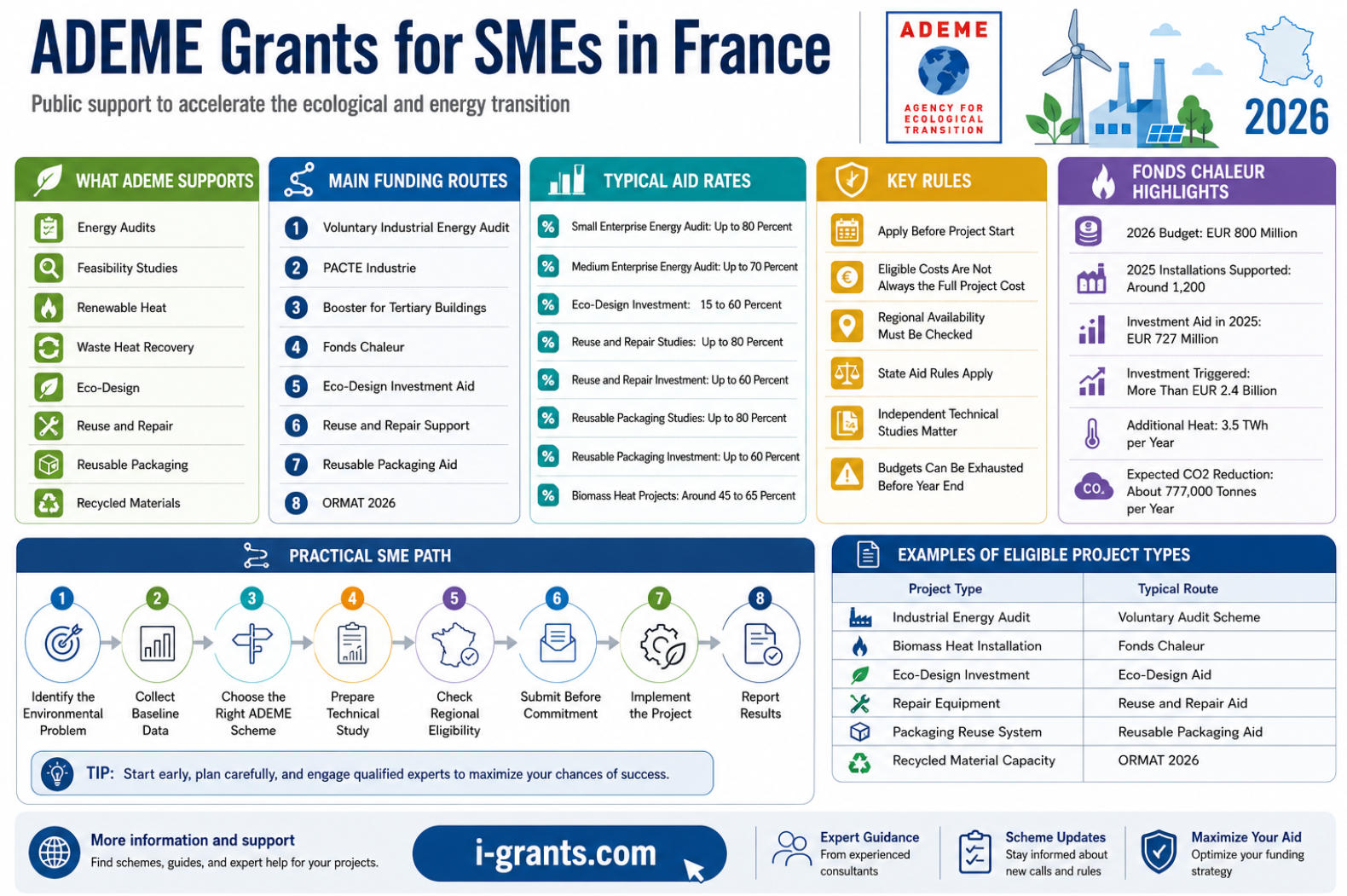
A funding journey from diagnosis to investment
ADEME’s system often works most effectively when a company treats environmental transition as a sequence rather than a single equipment purchase.
The first stage is usually a diagnosis or audit. This establishes the baseline, identifies the main sources of energy use, emissions, waste or material consumption, and measures the potential benefits of intervention.
The second stage is a feasibility study. It compares technical options, investment costs, operating savings, regulatory requirements and environmental performance.
The third stage may involve testing, experimentation or prototype development. This is particularly relevant to eco-design, packaging reuse and circular economy projects.
The fourth stage is the investment itself. At this point, ADEME may support eligible equipment, installations and associated works under a specific programme.
The final stage is monitoring. The company may have to demonstrate that it completed the project, paid the eligible costs and achieved the technical results described in the approved application.
A business that begins by selecting a supplier and ordering equipment can weaken its funding position. ADEME expects the environmental problem, baseline and choice of solution to be justified before the project becomes irreversible.
Energy audits for industrial SMEs
ADEME’s 2026 voluntary industrial energy audit scheme helps eligible industrial companies analyse their energy consumption and identify opportunities for reducing costs and emissions.
The scheme is intended for voluntary audits. Companies that must complete a regulatory energy audit cannot generally receive this aid merely to fulfil that legal obligation. Premises used exclusively for service-sector activities are also excluded from the industrial audit route.
The maximum support rates in 2026 are:
-
80 percent of eligible audit costs for a small enterprise;
-
70 percent for a medium-sized enterprise;
-
60 percent for a large enterprise.
ADEME states that industrial energy audits identify potential energy savings of approximately 10 to 20 percent per site on average. This should be understood as an average potential identified through audits, not a guaranteed reduction for every business.
An audit should examine energy expenditure, technical systems, production processes and the expected return period of possible measures. Its purpose is not simply to produce an energy report. It should establish a prioritised action plan that distinguishes quick operational improvements from major investments.
The 2026 scheme is open from 1 January to 31 December 2026. Applications are administered through ADEME’s regional offices, and prior contact with the relevant office is recommended.
Feasibility studies and PACTE Industrie
An energy audit identifies where improvements may be possible. A feasibility study determines whether a particular investment is technically and economically credible.
ADEME can support feasibility studies for industrial energy efficiency or decarbonisation projects. Depending on the project, the study may assess process optimisation, equipment replacement, electrification, renewable energy, heat recovery, changes to the site’s energy mix or other emissions reduction measures.
The study should normally be carried out by an independent and technically competent service provider. The consultant must be capable of giving objective advice rather than simply recommending equipment that the consultant or an affiliated company intends to sell.
PACTE Industrie provides a wider framework for industrial energy and decarbonisation support. It can include energy management, analysis of changes to the energy mix, waste heat recovery, electrification, renewable energy and preparation of a low-carbon transition strategy.
Eligibility depends on the company’s activity classification and the precise service requested. Certain assignments must be carried out by service providers recognised under PACTE Industrie or the ACT methodology.
Companies should not sign a binding service order before submitting the relevant aid request. Even when the project concerns a study rather than equipment, starting the assignment too early can make the costs ineligible.
Energy renovation of service-sector buildings
Industrial programmes are not the only route available to businesses. SMEs using offices, shops, hotels, warehouses or other service-sector buildings may need engineering support before undertaking a major energy renovation.
The 2026 Mon parcours économies d’énergie Booster scheme supports project design, project management assistance and preparation of energy performance contracts. It does not simply provide a general subsidy for all renovation works.
For an SME, the proposed renovation should normally be designed to achieve at least the 2030 objective under the French Éco Énergie Tertiaire framework. The support is therefore aimed at substantial and structured improvements rather than isolated minor works.
The scheme is available throughout France under the 2026 conditions and is scheduled to remain open until 31 December 2026.
Renewable heat through the Fonds Chaleur
The Fonds Chaleur is one of ADEME’s largest and most established financial mechanisms. Created in 2009, it supports renewable and recovered heat production, heat and cooling networks, and waste heat recovery.
For an SME, this can be relevant where a site uses significant quantities of natural gas, fuel oil or another fossil energy source for heating, hot water, drying, industrial processes or steam production.
Eligible technology routes can include:
-
biomass and wood energy;
-
solar thermal installations;
-
surface and deep geothermal energy;
-
aerothermal systems;
-
industrial waste heat recovery;
-
renewable heat and cooling networks;
-
groups of smaller projects supported through a Renewable Heat Contract.
The Fonds Chaleur does not simply fund the replacement of one boiler with another. ADEME applies an energy choice hierarchy known as EnR’Choix.
Before installing new renewable heat capacity, the applicant should consider reducing demand through energy efficiency, sharing production through a heat network, using locally available waste heat, assessing geothermal or solar thermal potential and then determining whether biomass or another technology is appropriate.
This sequence has become particularly important because biomass is renewable but limited. ADEME increasingly prioritises local recovered heat, geothermal solutions and a diversified renewable heat mix where technically feasible.
Biomass projects
In 2026, Fonds Chaleur aid for biomass installations may reach approximately 45 to 65 percent depending on the type and status of the applicant. The final level depends on technical characteristics, project economics, environmental performance and the applicable State aid basis.
For industrial sites, the standard biomass route generally covers installations producing between 1,200 and 12,000 MWh of useful biomass heat annually.
Projects below 1,200 MWh per year are normally considered through Renewable Heat Contracts. Larger industrial biomass projects above 12,000 MWh per year are generally directed towards dedicated competitive calls such as BCIAT.
Applicants must also provide a credible biomass supply plan and meet air quality, efficiency and certification requirements.
Renewable Heat Contracts
A Renewable Heat Contract can combine several smaller projects that might not qualify individually under the ordinary Fonds Chaleur thresholds.
A single-property contract can support studies and investments across an organisation’s own sites for up to six years. A territorial contract generally lasts four years and can aggregate projects from different owners within one territory.
This route can be useful for a company with several small facilities, an industrial property owner or a territorial operator coordinating multiple renewable heat investments.
Fonds Chaleur results and 2026 priorities
The scale of the Fonds Chaleur demonstrates that ADEME funding is not limited to experimental or very small environmental projects.
Table 2. Fonds Chaleur Results for 2025 and Priorities for 2026
| Indicator | Result or target |
|---|---|
| Fonds Chaleur budget in 2025 | EUR 801 million |
| Share of 2025 budget committed | 100 percent |
| Installations supported in 2025 | Approximately 1,200 |
| Investment aid awarded in 2025 | EUR 727 million |
| Investment generated by that aid | More than EUR 2.4 billion |
| Investment leverage ratio | 3.3 |
| Additional renewable and recovered heat expected | 3.5 TWh per year |
| Expected annual emissions avoided | Approximately 777,000 tonnes of CO₂ |
| Average public aid per tonne of CO₂ avoided | EUR 51.5 |
| Heat network support in 2025 | EUR 298 million |
| Biomass installation support in 2025 | EUR 155 million |
| Geothermal support in 2025 | EUR 85 million |
| Industrial waste heat recovery support in 2025 | EUR 21 million |
| Fonds Chaleur budget for 2026 | EUR 800 million |
Since its creation, the Fonds Chaleur has supported approximately 11,200 installations and 5,200 kilometres of heat distribution networks. ADEME reports EUR 5.9 billion in aid generating close to EUR 18 billion in investment and approximately 52.5 TWh of additional renewable and recovered heat production per year.
These figures are programme results, not forecasts for an individual SME. A small business should not infer that receiving a high aid rate is automatic.
Demand in 2026 is particularly strong. ADEME reports that the value of aid requested by projects in the pipeline is approximately twice the available EUR 800 million budget. Projects may therefore have to compete on environmental efficiency, technical readiness and the amount of public funding required per tonne of emissions avoided.
Waste heat recovery
Industrial processes often release heat through ovens, compressors, cooling systems, data centres, wastewater, exhaust gases or refrigeration equipment.
Waste heat recovery projects can capture this energy and reuse it on the same site, supply another nearby user or feed a heat network. ADEME can support studies and investments relating to heat exchangers, recovery systems, storage, distribution and associated equipment.
The value of a project depends on more than the theoretical quantity of available heat. The company must establish the temperature, continuity and location of the heat source, as well as the timing and technical requirements of the heat demand.
A technically large heat source may have limited economic value if demand is seasonal, distant or requires a much higher temperature. A good feasibility study must therefore compare the available heat profile with actual use.
Waste heat recovery can be particularly attractive because it uses energy that is already being produced and would otherwise be lost. Under ADEME’s current energy hierarchy, locally available recovered heat should normally be assessed before the installation of additional renewable production capacity.
Eco-design support
Eco-design means reducing the environmental impact of a product or service throughout its life cycle. It is not limited to replacing one packaging material or adding an environmental statement to a product.
A genuine eco-design project may examine raw material extraction, manufacturing, energy use, durability, repairability, transport, packaging, use by the customer and end-of-life treatment.
ADEME’s 2026 investment support can cover proven technologies for producing a lower-impact product, prototype development, testing, preparation for pre-production, innovative manufacturing processes and certain changes to the business model.
Depending on the nature of the project, company size and State aid basis, support can reach between 15 and 60 percent of eligible investment costs.
The eligible base may be calculated from the additional environmental cost compared with a credible conventional investment. This means that a company purchasing a EUR 1 million production line should not automatically apply the maximum percentage to the entire EUR 1 million.
If de minimis rules are used, the total de minimis aid granted to a single undertaking cannot exceed EUR 300,000 over three years.
Applications are processed as they arrive. The 2026 scheme is scheduled to remain open until the budget is exhausted and no later than 31 December 2026. A formal year-end closing date therefore does not mean funding will necessarily remain available until December.
Reuse, repair and product life extension
ADEME supports projects that extend the useful life of products and materials through reuse, refurbishment and repair.
A feasibility study can examine the availability of product flows, collection arrangements, expected demand, technical repair processes, logistics and the commercial sustainability of a second-life activity.
In participating regions, support for studies and diagnostics may reach 80 percent of eligible study costs.
Investment aid can cover equipment for protected collection, traceability, inspection, cleaning, testing, repair and refurbishment. The maximum support rate for investment may reach 60 percent of eligible costs.
ADEME reports that more than one million tonnes of products are reused in France each year. However, this national figure does not guarantee that every local repair or reuse project will be financially viable. Applicants need to show a stable supply of suitable products, realistic demand and an operational model that can continue after the grant period.
Regional coverage must be checked carefully. The 2026 study and investment schemes do not operate uniformly in every region.
Reusable industrial and commercial packaging
A separate 2026 scheme supports the reuse of industrial and commercial packaging.
Eligible projects may involve feasibility studies, experiments, collection systems, washing equipment, logistics, traceability, standardisation or investment in reusable packaging systems.
Studies and experiments may receive aid of up to 80 percent, while investment aid may reach 60 percent.
The programme is linked to France’s objective of achieving 10 percent reusable packaging by 2027. Nevertheless, it is not available throughout the entire country. In 2026, the scheme is offered in ten participating mainland regions.
A company must examine the whole reuse system rather than only the package itself. The environmental and financial outcome depends on the number of reuse cycles, return distances, loss rates, cleaning requirements, customer participation and whether the packaging can be shared or standardised across users.
ORMAT 2026 and recycled materials
ORMAT, Objectif Recyclage MATières, is part of ADEME’s Circular Economy Fund. It supports projects that increase the preparation, production and use of recycled raw materials.
The 2026 scheme covers plastics, textiles, metals and batteries, wood, paper and cardboard, glass and mineral materials.
It supports two main types of activity. The first includes diagnostics, studies, performance testing and experiments. The second includes investment in new capacity, higher recycling rates, improved recycled material quality and greater incorporation of recycled materials into products.
Possible applicants include waste preparation companies, recyclers, manufacturers incorporating recycled material and contracting companies that work through manufacturing subcontractors.
ORMAT 2026 also covers certain battery repurposing, remanufacturing and refurbishment operations.
The scheme opened on 24 April 2026 and is scheduled to close on 31 December 2026. It has broad geographic coverage, but it is not directly open for projects located in Provence-Alpes-Côte d’Azur, where applicants are directed to the regional authority for a separate assessment.
Typical ADEME aid rates
Maximum rates can help an SME identify relevant programmes, but they should never be used as a guaranteed financing forecast.
Table 3. Examples of ADEME Aid Rates in 2026
| Scheme or project type | Indicative maximum support | Main condition or limitation |
|---|---|---|
| Voluntary industrial energy audit for a small enterprise | Up to 80 percent | The audit must not merely fulfil a mandatory regulatory obligation |
| Voluntary industrial energy audit for a medium-sized enterprise | Up to 70 percent | The project must follow ADEME’s technical conditions |
| Voluntary industrial energy audit for a large enterprise | Up to 60 percent | Large companies remain excluded if the audit is legally mandatory |
| Eco-design investment | Between 15 and 60 percent | Rate and eligible base depend on company size, project type and State aid rules |
| Reuse and repair feasibility study | Up to 80 percent | Available only in participating regions |
| Reuse and repair investment | Up to 60 percent | Aid is limited to eligible equipment and project costs |
| Reusable packaging study or experiment | Up to 80 percent | Mainly targets industrial and commercial packaging systems |
| Reusable packaging investment | Up to 60 percent | Regional availability must be confirmed |
| Biomass heat installation | Approximately 45 to 65 percent | Actual support depends on applicant status and technical and economic assessment |
| De minimis aid | Up to EUR 300,000 over three years | The limit applies to the single undertaking, including linked companies |
A maximum aid percentage does not necessarily apply to the full invoice value. ADEME may calculate the grant from environmental additional costs, eligible study costs, specified equipment categories or another basis permitted by State aid rules.
The amount can also be reduced to account for other public funding, the company’s size, the expected environmental return and budget availability.
National programmes and regional differences
Some ADEME mechanisms operate in all French regions, but regional offices still play an important role in project assessment and award decisions.
Other schemes are available only in regions that have chosen to participate or allocated the necessary resources. This is particularly common in circular economy aid, reuse, repair, packaging and certain local investment schemes.
Two companies proposing similar projects can therefore receive different answers because their projects are located in different regions.
The applicant should verify three geographic questions:
-
whether the scheme is open in the project region;
-
whether the application is submitted to ADEME or to the regional authority;
-
whether local co-financing or additional regional conditions apply.
A company with several establishments should use the location where the investment will be implemented, not merely the registered office, when checking territorial eligibility.
Contacting the relevant ADEME regional office before preparing a complex application can prevent the company from using the wrong scheme or commissioning an ineligible study.
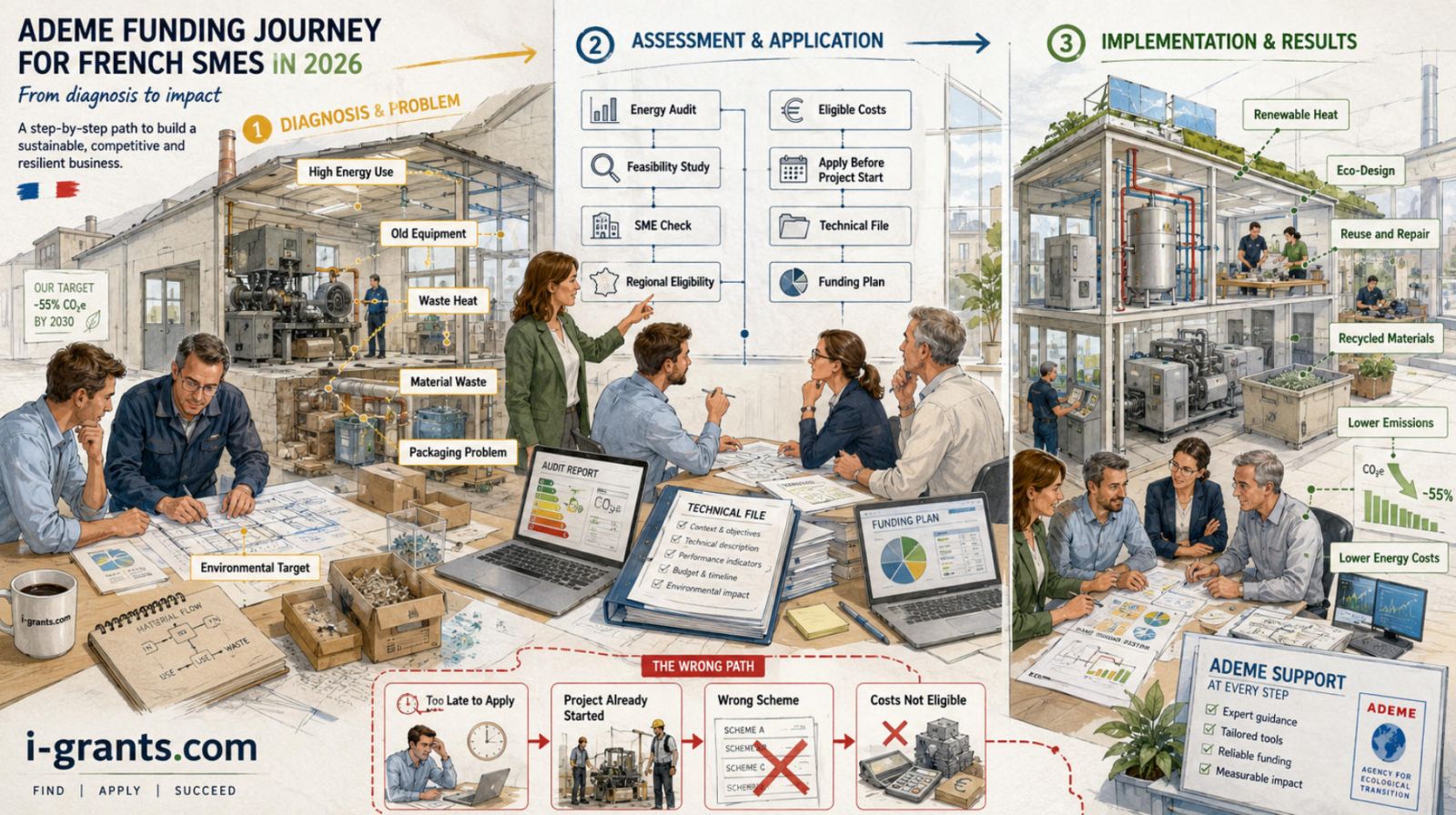
Apply before starting the project
The timing rule is one of the most important conditions in ADEME funding.
An application normally must be submitted before the applicant makes an irreversible commitment to the project. Signing a binding supply contract, placing an equipment order or beginning construction can make the corresponding costs ineligible.
The purpose of this rule is to demonstrate that public aid has an incentive effect. If the company has already made the final investment decision and committed the funds, the authorities may conclude that the project would proceed without assistance.
Preliminary planning does not necessarily count as project commencement. A company may normally analyse options, obtain non-binding quotations, carry out an earlier feasibility study or apply for permits. However, the exact rules of the selected programme must be checked.
The safest approach is to submit the application and obtain written confirmation of the relevant starting date before signing a binding purchase or works agreement.
Submitting an application is not the same as receiving approval. The company remains responsible for the commercial risk if it begins the project before the funding decision.
Which costs can be eligible?
Eligible expenditure depends on the programme. It may include technical studies, independent consultancy, equipment, installation, construction work, measurement systems, testing, prototypes and specified project management costs.
Recoverable value-added tax is generally excluded. If the applicant cannot recover value-added tax, different treatment may be possible under the relevant conditions.
Ordinary operating expenditure, general overhead, costs unrelated to the environmental objective and expenses incurred before the eligible starting date are commonly excluded.
For investment aid, ADEME may compare the proposed environmental investment with a conventional reference scenario. Only the additional cost needed to achieve the environmental improvement may be used as the aid base.
For example, if a company must replace a production asset in any event, the grant may be calculated from the additional cost of choosing a significantly more efficient or circular solution, not from the entire replacement cost.
State aid and combination with other funding
ADEME support must comply with French and European State aid rules. Depending on the programme, the legal basis may be the General Block Exemption Regulation, de minimis rules or another authorised aid framework.
An SME can sometimes combine ADEME funding with regional aid, European funding, energy saving certificates, tax incentives or other public support. However, the total support cannot exceed the maximum aid intensity permitted for the same eligible costs.
The company’s financing plan should distinguish:
-
total project expenditure;
-
expenditure eligible under each programme;
-
ADEME aid requested;
-
other public grants or repayable assistance;
-
private financing, bank debt and the company’s own contribution;
-
expenditure remaining unsupported.
This prevents double counting and allows the company to demonstrate that the project remains adequately financed.
The de minimis limit applies to the single undertaking rather than only one legal entity. Linked enterprises may therefore need to aggregate their de minimis aid.
How ADEME evaluates projects
The precise assessment method varies, but several factors appear repeatedly across programmes.
ADEME considers whether the project matches the environmental objective of the scheme, whether the proposed technology is appropriate, whether the environmental gains are measurable and whether the amount of public aid is proportionate.
Technical readiness matters. A poorly defined project with no credible baseline, supplier information or implementation plan is less likely to receive support than a project supported by an independent study.
Environmental efficiency also matters. In heavily subscribed programmes, ADEME may prioritise projects that achieve greater energy savings, emissions reductions, renewable heat production or material savings for each euro of public aid.
The company’s financial capacity is also relevant. A grant rarely covers the full investment, and payment may depend on completed expenditure and evidence. The applicant must show that it can finance the project and manage delays between spending and reimbursement.
The assessment can also consider compliance with environmental regulation, permits, supply security, air emissions, resource availability and the sustainability of the proposed business model.
How aid is paid and monitored
An ADEME award may include an initial payment, intermediate payments and a final balance, but the structure depends on the agreement.
Payments can be linked to technical milestones, expenditure statements, invoices, proof of payment and final reports. The grant may be reduced if the company spends less than the approved eligible budget or fails to complete part of the project.
A company should therefore establish a separate internal project code and maintain a clear audit trail from the approved budget to the accounting records.
Material changes to equipment, suppliers, location, timetable or expected environmental performance may require prior approval. A company should not assume that it can freely replace the approved solution after receiving the award.
ADEME may also require performance data after completion. This can include energy consumption, renewable heat production, recovered material volumes, avoided waste or emissions reductions.
Documents required for a strong application
The exact file depends on the programme, but a well-prepared SME application will usually need the following:
-
a description of the company, group structure, SME status and project location;
-
a technical baseline covering existing equipment, energy use, materials, waste or emissions;
-
a comparison between the conventional reference option and the proposed environmental solution;
-
quantified estimates of energy, carbon, material, water or waste savings;
-
supplier quotations, an eligible cost schedule, implementation timetable and financing plan;
-
details of other public aid already received or requested for the same project.
The environmental calculations must be consistent with the financial assumptions. If the production forecast in the technical file differs from the forecast used in the business plan, the credibility of the application can be weakened.
Table 4. Key Application Documents and Their Purpose
| Document | Why ADEME needs it | Common weakness |
|---|---|---|
| Company and group information | Confirms applicant identity, size and State aid status | Linked enterprises are omitted |
| Project baseline | Establishes the starting environmental performance | Existing consumption or waste data are incomplete |
| Technical study | Shows that the proposed solution is feasible | Study is prepared by a supplier without sufficient independence |
| Reference scenario | Identifies what the company would do without the aid | No realistic conventional alternative is provided |
| Environmental benefit calculation | Measures energy, carbon, waste or material savings | Claims are not supported by calculations |
| Supplier quotations | Supports the eligible cost estimate | Quotation was accepted before application |
| Financing plan | Demonstrates that the project can be completed | The company assumes the maximum grant without a fallback plan |
| State aid declaration | Prevents excessive or duplicated public support | Earlier de minimis or regional aid is not disclosed |
| Implementation timetable | Confirms readiness and the eligible starting date | Works appear to have started before submission |
| Monitoring plan | Explains how results will be measured | No meter, data source or responsible person is identified |
Common reasons ADEME projects fail
A project may fail before its environmental merits are fully considered if the applicant has already ordered equipment or signed an irreversible contract.
Another common problem is choosing a programme based only on its headline aid rate. The company may later discover that the rate applies only to a limited eligible base, that the scheme is unavailable in its region or that the technology falls under another route.
Weak technical preparation is also a major risk. An application that contains broad claims about sustainability but no reliable baseline, measurements or comparison with alternative solutions is unlikely to demonstrate value for public money.
Companies also underestimate the importance of an independent feasibility study. A supplier’s commercial proposal may be useful, but it does not always provide the objective technical and economic analysis required by ADEME.
Other projects fail because the applicant cannot finance its share, has not included all public aid in the calculation, or assumes that the subsidy will be paid in full before expenditure begins.
Finally, companies may wait until the official closing date. Schemes processed in order of arrival can run out of budget earlier, while competitive calls may require substantial preparation long before the deadline.
A practical application process
An SME considering ADEME support in 2026 should follow this order:
-
define the environmental problem and collect reliable baseline data;
-
identify whether the project requires an audit, feasibility study, experiment or investment route;
-
check the current programme, regional availability, eligible applicant type and closing date;
-
contact the relevant ADEME regional office for a significant or technically complex project;
-
prepare the technical case, environmental calculations, quotations and financing plan;
-
submit the application before making an irreversible commitment.
The company should also prepare a funding scenario without the maximum grant. This helps demonstrate financial resilience and prevents the project from collapsing if ADEME offers a lower amount than requested.
The scale of ADEME support to French companies
ADEME’s support for companies is substantial, but published figures must be interpreted according to their scope.
In 2024, ADEME reported EUR 2.5 billion in aid to companies, representing 78 percent of its budget. ADEME and its partners supported approximately 9,500 companies in projects with a combined value of EUR 7.5 billion.
ADEME directly provided financial support to 4,883 companies in 2024, approximately two-thirds of which were SMEs. Of the aid distributed to companies, 52 percent supported investment, while 48 percent financed research, innovation and studies.
Small enterprises received 18 percent of the published aid amount, medium-sized enterprises received 7 percent and large enterprises received 66 percent. The remaining share was not classified by company size in the published breakdown.
These figures do not mean that most small businesses receive large direct grants. Major industrial and infrastructure investments account for a significant share of the funding value, while SME support may involve smaller audits, studies, advisory programmes and investment awards.
The 2025 Fonds Chaleur results provide a more specific example of one programme’s performance. They should not be combined with the overall 2024 company statistics as though both measured the same population or type of aid.
Is ADEME funding suitable for a small business?
ADEME funding is most relevant when a small business has a measurable environmental project rather than a general intention to become more sustainable.
A suitable project usually has a defined baseline, an identified technical problem, quantifiable environmental benefits, a realistic investment plan and enough financial capacity to cover the unsupported share.
Very small businesses may find that a direct national investment programme is too complex or that their project falls below the usual technical threshold. In that case, a regional scheme, collective operation, Renewable Heat Contract, chamber of commerce programme or subsidised diagnosis may be more appropriate.
An SME should not begin by asking, “How much grant can we receive?” It should first ask which environmental outcome is being financed, what evidence is required and whether the planned project belongs to a national, regional or competitive route.
Final assessment
ADEME offers one of France’s broadest systems of public support for business transition projects. In 2026, French SMEs can find funding routes for industrial energy audits, feasibility studies, renewable heat, waste heat recovery, eco-design, reuse, repair, reusable packaging and recycled materials.
The system is valuable but fragmented. There is no universal ADEME green grant, no single aid rate and no guarantee that a technically eligible project will receive funding.
The strongest applications begin before equipment has been selected and before a binding order has been signed. They use reliable baseline data, an independent technical assessment, a credible reference scenario and measurable environmental results.
Fonds Chaleur remains a particularly significant route for renewable and recovered heat, with a budget of EUR 800 million in 2026. However, demand is around twice the available budget, reinforcing the importance of project efficiency and readiness.
For circular economy and eco-design projects, regional availability and the eligible cost calculation are often as important as the technology itself. An advertised rate of 60 or 80 percent may apply only to a study, a specific equipment category or the environmental additional cost of the investment.
For most SMEs, the best ADEME strategy is a staged one: diagnose the problem, examine the technical options, confirm the correct funding route, submit the application before project commencement and then invest with a clear system for measuring results.