

 Français
  Deutsch
  Українська
A grant is rarely just a sum of money.
A €250,000 opportunity may require a project worth more than €800,000. A €1.5 million research grant may be impossible to apply for without first winning an internal university competition. A global corporate brand may offer funding in only five countries. A programme described as a grant may actually combine non-dilutive funding with equity investment. And an unsuccessful application may have been rejected not because the idea was weak, but because the programme was funding fewer than one in ten applicants.
For Grantologic’s 100th article, we looked across 100 grant and funding programmes spanning European Union funding, government research schemes, corporate foundations, innovation programmes, philanthropic funds, fellowships, prizes and blended-finance instruments.
The purpose was not to rank the 100 programmes or create another grant directory. Instead, we asked a more useful question: what patterns keep appearing when very different funders decide who receives money?
The answer is that grantmaking is becoming more specialised, more structured and, in many cases, more demanding. Large amounts of funding are still available, but applicants increasingly need to understand the architecture behind the money. Legal status, funding rates, institutional nomination, co-financing, geography, partner structure, reporting capacity and long-term impact can matter just as much as the quality of the underlying idea.
The analysis below is an editorial benchmark rather than a statistically representative study of every grant programme in the world. Nevertheless, comparing 100 different funding mechanisms reveals several recurring lessons that applicants, grant writers, researchers and organisations can use across very different sectors.
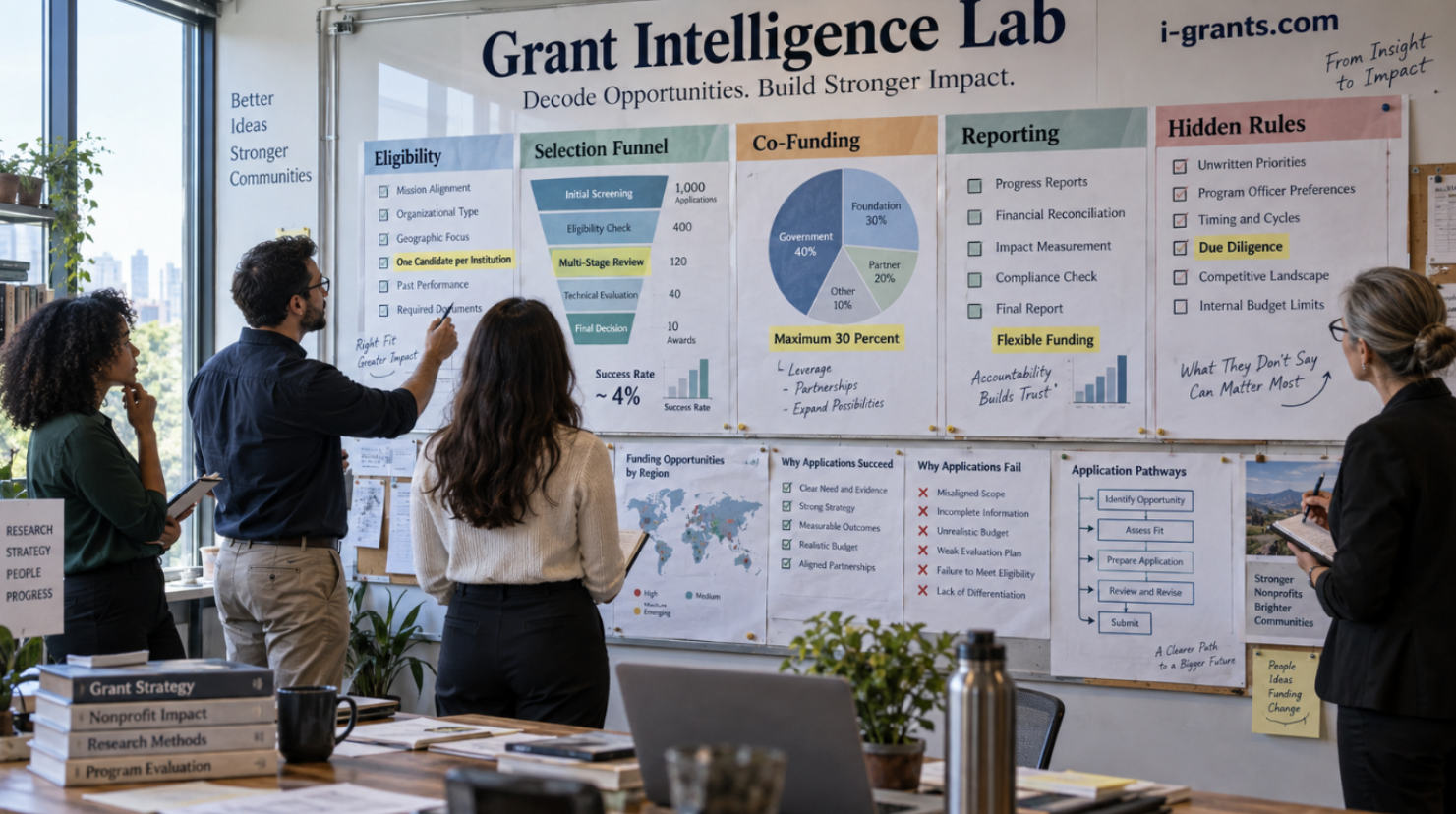
1. The grant market is not simply growing or shrinking. Money is moving
The first lesson appears before an applicant even opens a funding call.
There is no single global "grant market". Public development aid, private foundations, corporate philanthropy, research programmes and innovation finance can move in different directions at the same time.
In the United States, charitable giving reached an estimated $592.5 billion in 2024, the highest nominal level recorded by Giving USA. Foundation giving reached $109.81 billion, while corporate giving reached $44.4 billion. Corporate giving rose by 9.1 percent in current dollars and 6 percent after adjustment for inflation.
At the same time, international public aid moved sharply in the opposite direction. Preliminary OECD figures show that official development assistance from Development Assistance Committee members and associated providers fell to $174.3 billion in 2025, a real decline of 23.1 percent from 2024 and the largest annual contraction on record. ODA had stood at $215.1 billion in 2024.
Meanwhile, major European research and innovation programmes remain enormous. Horizon Europe was established with a budget of €95.5 billion for 2021-2027. The European Innovation Council alone opened more than €1.4 billion of opportunities for 2026 across its various instruments.
Table 1. The Funding Landscape Behind the 100-Program Analysis
| Funding ecosystem | Recent scale | What it means for applicants |
|---|---|---|
| U.S. charitable giving, 2024 | $592.5 billion | Private philanthropy remains extremely large |
| U.S. foundation giving, 2024 | $109.81 billion | Foundations continue to be a major source of nonprofit funding |
| U.S. corporate giving, 2024 | $44.4 billion | Corporate philanthropy is expanding |
| OECD official development assistance, 2025 | $174.3 billion | Traditional international aid is under severe pressure |
| Horizon Europe, 2021-2027 | €95.5 billion | Research and innovation remain major public priorities |
| EIC funding opportunities, 2026 | More than €1.4 billion | Public innovation funding increasingly combines grants with investment |
This creates an important strategic conclusion.
The funding environment is not becoming uniformly poorer. It is becoming more fragmented. An NGO that previously depended heavily on bilateral aid may face a much tighter environment, while a technology nonprofit, climate innovator or research consortium may find entirely different funding channels expanding.
Diversification is therefore becoming more important than simply finding more calls.
The organisations most exposed to funding shocks are often not those with the smallest budgets. They are those whose income depends on one type of donor.
2. The maximum grant is usually not the real maximum
Funding pages naturally highlight large numbers. "Up to €250,000", "up to €1.5 million" or "up to $3 million" attracts attention.
But the real value of a grant is determined by the rules underneath that number.
The L’Oréal Fund for Women illustrates this perfectly. Its latest published criteria allow requests from €50,000 to €250,000, but L’Oréal can finance no more than 30 percent of the relevant project or organisational budget. A project requesting the full €250,000 therefore needs a total budget of approximately €833,333.
Under the Allianz Foundation Grants Program 2025, the Foundation could finance up to 75 percent of project costs. Applicants therefore needed at least 25 percent from other sources, and that external funding had to be confirmed before implementation began.
The logic is different again in Horizon Europe. Some actions can receive funding equivalent to 100 percent of eligible costs, while other innovation-oriented schemes use lower funding rates. The EIC Pre-Accelerator, for example, explicitly bases EU support on up to 70 percent of total project costs.
A maximum award should therefore never be read without asking what percentage of the underlying activity the donor is actually willing to finance.
Table 2. What a €100,000 Contribution Can Mean Under Different Funding Models
| Funding model | What a €100,000 contribution means in practice |
|---|---|
| L’Oréal at a 30 percent maximum share | The relevant project or organisational budget would need to be at least approximately €333,333 |
| A programme funding up to 75 percent | A €100,000 contribution corresponds to a project worth at least approximately €133,333 |
| A 70 percent EU funding rate | A €100,000 EU contribution corresponds to about €142,857 in eligible project costs |
| A 100 percent funding rate | In principle, €100,000 may cover €100,000 of eligible costs |
| Unrestricted organisational funding | The recipient may have substantially more freedom over how the money is used |
| Equity investment | The €100,000 is not a grant at all and may affect ownership or investor rights |
This is why two apparently identical €100,000 opportunities can have completely different economic value.
A smaller unrestricted award can sometimes be more useful than a much larger restricted grant. Flexible funding can pay for management, systems, staff retention or organisational infrastructure that traditional project grants often exclude.
For applicants, the correct question is therefore not "How large is the grant?" It is "What must exist around the grant for us to use it?"
3. Eligibility can matter more than excellence
One of the most expensive mistakes in grant writing is assuming that a brilliant project can overcome a weak eligibility fit.
Usually it cannot.
Many programmes use rules that can eliminate an applicant before reviewers seriously consider the intellectual quality of the proposal.
L’Oréal’s latest Fund for Women criteria, for example, expect an organisation to directly support at least 200 beneficiaries per year. This creates an implicit scale threshold. A small organisation may produce exceptional outcomes for 80 women and still be too small for the programme.
AXA Chairs create a completely different barrier. The researcher is central to the proposal but does not apply independently. An eligible host academic institution or public research organisation submits the application, and the current model allows only one lead candidate from an institution in a campaign.
The result is that a scientist may lose the opportunity before AXA ever reviews the research. The decisive competition may take place inside the university.
The AWS Imagine Grant demonstrates another common trap. AWS is a global company, but its 2026-2027 grant programme is available to eligible nonprofits based in only five countries: the United States, Canada, the United Kingdom, Australia and New Zealand. Since launching the programme in 2018, AWS has supported organisations internationally, but current geography still determines who can submit.
And Cartier Women’s Initiative candidates face requirements beyond the business itself. Its formal terms include due diligence and participation obligations for candidates who progress through the selection process.
Table 3. Eligibility Rules That Can Matter More Than the Project Idea
| Programme | Less obvious barrier | Practical consequence |
|---|---|---|
| L’Oréal Fund for Women | Organisation should directly support at least 200 beneficiaries annually under the latest criteria | Very small specialist nonprofits may not fit |
| AXA Chair | Researcher does not apply independently | University backing is essential |
| AXA Chair | One lead candidate per institution under the current model | Internal selection precedes donor selection |
| AWS Imagine Grant | Current programme is restricted to eligible nonprofits in five countries | Global corporate presence does not equal global grant eligibility |
| Cartier Women’s Initiative | Due diligence forms part of the selection process | Governance and credibility matter alongside the business idea |
| ERC main grants | Resubmission restrictions may depend on the result of a previous application | A weak previous score can affect when an applicant may return |
The broader lesson is simple: eligibility is not administrative paperwork added after proposal development.
It is part of grant strategy.
Before writing a narrative, applicants should establish whether the legal entity, geography, turnover, age, institutional status, partner structure and previous participation history all fit the programme.
An hour spent disproving eligibility can save weeks of writing.
4. Large programmes can still fund fewer than one in ten applicants
Big budgets create another illusion.
A programme worth hundreds of millions of euros can still be extraordinarily difficult to win.
The ERC Advanced Grant 2025 call received 3,329 proposals and selected 319, producing a success rate of approximately 9.6 percent.
Competition in the EIC Accelerator can be even more severe. At one highly competitive round, 1,211 full proposals resulted in 71 selected companies. In the final 2025 cut-off, 923 companies submitted full proposals requesting almost €7 billion. Only 121 reached the interview stage, and 61 companies were ultimately selected in February 2026.
NIH data show a similar problem at enormous scale. In 2025, there were 38,557 applications for new R01-equivalent research project grants and 4,399 awards, resulting in an 11 percent success rate. In 2024 the comparable success rate had been 17 percent.
Table 4. What Real Success Rates Reveal About Grant Competition
| Programme | Applications | Selected or funded | Approximate success rate |
|---|---|---|---|
| ERC Advanced Grants 2025 | 3,329 | 319 | 9.6 percent |
| EIC Accelerator, final 2025 full-application cut-off | 923 | 61 ultimately selected | 6.6 percent |
| NIH new R01-equivalent grants, 2025 | 38,557 | 4,399 | 11 percent |
These figures are useful because they change how rejection should be interpreted.
If a programme funds approximately one in ten proposals, rejection does not automatically mean the project was poor. There may simply have been more excellent proposals than available money.
ERC data provide an especially useful perspective. The ERC states that resubmitted applications have, on average, a success rate about 1.5 times higher than first submissions.
That does not mean applicants should mechanically resubmit an unchanged proposal. It means a rejection can generate information.
Applicants learn where reviewers misunderstood the idea, where evidence was insufficient, whether the scope was too broad, whether the work plan was credible and whether the project was actually positioned for the correct programme.
In highly competitive schemes, the ability to improve and return may be a funding skill in itself.
5. The modern grant is increasingly more than money
One of the clearest patterns across corporate and innovation programmes is that funders are adding other forms of value to the financial award.
Cartier Women’s Initiative illustrates the model particularly clearly. Depending on ranking, awardees can receive $100,000, $60,000 or $30,000. But the programme also includes individual training, executive leadership coaching, the INSEAD Women’s Impact Entrepreneurship Programme, mentoring, international visibility and access to a community of more than 500 members.
H&M Foundation’s Global Change Award now selects ten winners annually. Each receives €200,000 and joins a year-long Changemaker Programme built around systems thinking, expert support and industry connections. Since 2015, the programme has supported 66 teams.
Google.org has taken the same principle into technology philanthropy. Across 46 Impact Challenges, it reports $310 million in support, more than 550 organisations and 100,000 hours of pro bono technical expertise.
AWS Imagine Grant follows a similar structure. AWS reports more than $21 million in support to more than 180 nonprofit organisations since 2018, combining unrestricted funding with cloud-computing credits and technical expertise.
Table 5. Why the Best Grant Is Not Always the Biggest Cheque
| Programme | Financial support | Additional value |
|---|---|---|
| Cartier Women’s Initiative | $30,000 to $100,000 depending on ranking | INSEAD programme, individual training, executive coaching, mentorship and global community |
| H&M Global Change Award | €200,000 per winner | Year-long Changemaker Programme, systems thinking, experts and industry access |
| Google.org Impact Challenges | Varies by challenge | Technical expertise, specialist support and technology resources |
| AWS Imagine Grant | Varies by award category | Unrestricted support, AWS credits and technical expertise |
| EIC programmes | Grants, investments or both depending on instrument | Business Acceleration Services, investors, corporate connections and specialist expertise |
This changes how applicants should compare opportunities.
Suppose one programme offers $150,000 with no further support, while another provides $80,000 plus access to technical specialists, customers, investors and mentors. For a young organisation or startup, the second package may produce more long-term value.
A grant should therefore be evaluated as a bundle of capital.
That capital can be financial, technical, reputational, social or institutional.
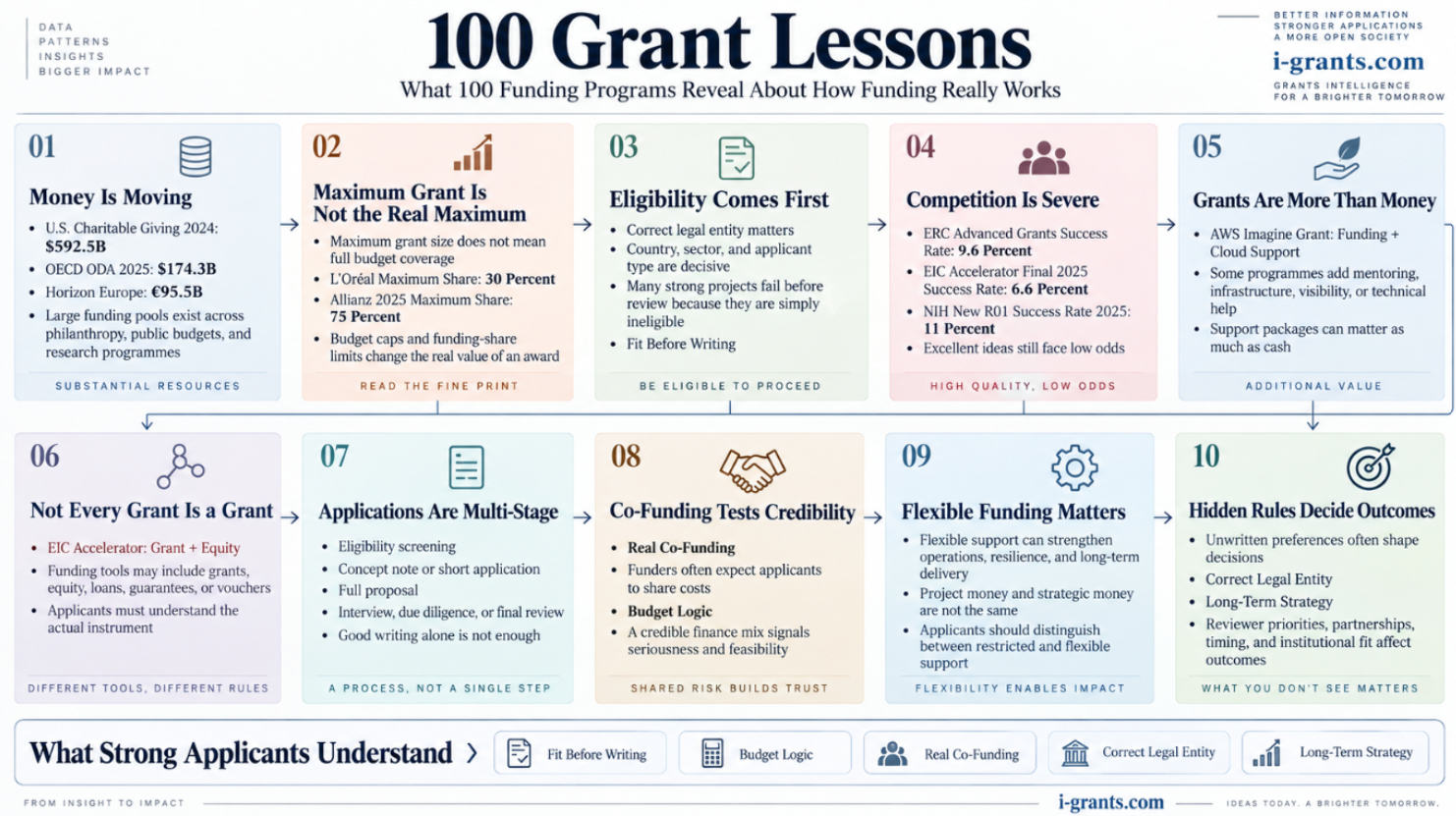
6. A grant is no longer always a grant
The vocabulary of funding is becoming increasingly important because programmes that look similar in a search result may create very different legal and financial relationships.
A traditional project grant usually provides non-repayable money for agreed activities.
A prize or award may reward achievement rather than reimburse a defined future work plan.
A fellowship may fund an individual while also creating obligations around participation, training or mobility.
Institutional research funding may be associated with a named scientist but legally awarded to the host university.
And blended finance can combine grants with investment.
The European Innovation Council makes the distinction especially visible. Under its recent Accelerator structure, startups and SMEs can receive grant support alongside equity investment. In the 2025 work programme, grants were below €2.5 million and investments could range from €0.5 million to €10 million. STEP Scale Up, meanwhile, was designed around equity investments from €10 million to €30 million rather than ordinary grant funding.
In the latest EIC Accelerator round announced in February 2026, 85 percent of the 61 selected companies were set to receive blended finance combining grants with equity investment.
AXA Chairs show another version of the distinction. Up to €1.5 million may be associated with one senior researcher and a five-year programme, but the formal funding relationship is with the academic host institution.
Allianz Foundation adds another model. Its current strategy states that the Foundation primarily identifies partners through proactive outreach while also developing an expression-of-interest route. Its priorities are Sustainable Cities, Trustworthy Information and Socially Engaged Arts.
Applicants therefore need to understand not only how much money is available, but what they are entering into.
Is it a grant agreement, investment relationship, fellowship, prize, framework partnership or institutionally administered award?
That question affects ownership, reporting, governance, risk and sometimes even control of the organisation.
7. The application is becoming a funnel, not a form
Older grantmaking is often imagined as a simple process: download the form, complete the questions, submit, wait for a decision.
Many high-value programmes now work differently.
The application itself is becoming a sequence of filters.
A funder may begin with a short concept, expression of interest or initial application. A smaller number of applicants then submit a full technical proposal. Some reach interviews, pitches or rebuttal stages. The final candidates may undergo legal, financial or reputational checks before an award is confirmed.
The EIC Accelerator illustrates this particularly clearly. A short application can provide access to the full-application stage. Full proposals are evaluated before leading candidates appear before a jury of investors and business experts.
AXA Chairs use an institutional expression of interest, followed by a detailed application and external scientific review. The process can include a rebuttal to reviewer comments and interaction with the scientific committee.
Cartier Women’s Initiative combines application assessment with presentations, jury interaction and due diligence.
Allianz Foundation’s previous broad grant programme similarly used a staged process, with an initial project outline followed by a full application for shortlisted organisations.
For applicants, this has an important operational consequence.
One proposal now needs several forms.
A strong team may need a two-page concept, a 20-page technical application, a detailed budget, a three-minute explanation, an investor-style pitch, a due-diligence package and concise answers for a jury. The underlying project remains the same, but the communication task changes at every stage.
Grant readiness increasingly means being able to explain the same idea at multiple levels of detail without changing its logic.
8. Co-financing is not only about money. It is a test of credibility
Co-financing is usually described as a budget rule. In practice, it can also function as evidence.
If one donor will cover only 30 percent or 60 percent of a project, the applicant must demonstrate where the rest will come from. That often means showing that another institution, donor, investor, government body or the applicant itself also believes the project is credible enough to support.
The L’Oréal Fund for Women provides a clear example. Under its latest published application model, its support cannot exceed 30 percent of the relevant budget. This means applicants need a much broader financing structure around the L’Oréal contribution.
The previous Allianz Foundation broad call also required external financing. Allianz could provide up to 75 percent, while the remaining share had to be secured elsewhere. Importantly, third-party funding needed to be confirmed before implementation. Volunteer work or other in-kind contributions did not replace the required financing.
This creates a deeper distinction between theoretical and bankable projects.
A theoretical project may have an excellent narrative and a logical budget.
A bankable project can also show who else will pay, who will participate, what resources already exist and why the applicant can realistically mobilise the remaining money.
For many large funders, the second project is safer.
9. Flexible money can be more valuable than a larger restricted grant
Another lesson from comparing programmes is that restrictions matter almost as much as size.
Traditional project grants frequently finance approved activities, staff time, travel and project-specific costs but provide limited support for the organisation behind the project.
That creates a familiar nonprofit paradox. A donor may finance a new service but not enough of the accounting, management, fundraising, cybersecurity, human resources or office systems required to deliver it safely.
Flexible funding can therefore be unusually valuable.
L’Oréal’s model allows structural support in certain cases, particularly for organisations whose mission is directly and exclusively focused on vulnerable women and girls.
AWS describes the cash component of the Imagine Grant as unrestricted support, alongside technology credits and expertise.
Allianz Foundation’s 2025 grant framework permitted administrative costs of up to 20 percent.
H&M Foundation gives Global Change Award winners substantial discretion to use their €200,000 award for developing their idea or related work.
The lesson is not that unrestricted money is always better.
The lesson is that grant size should be compared together with grant flexibility.
A €300,000 grant that can pay only narrowly defined delivery costs may strengthen one programme while leaving the organisation financially fragile. A smaller award that improves systems, staff capacity and unrestricted reserves may have a more durable effect.
10. Reporting is changing, but accountability is not disappearing
Grant administration is also evolving.
The European Commission has expanded the use of lump-sum funding within Horizon Europe specifically to reduce administrative burden and financial errors.
Under the lump-sum model, beneficiaries do not report actual costs in the traditional way. The funding amount is agreed in advance and payments are connected to completion of activities within work packages.
That sounds much simpler, and in many ways it is.
But simplified cost reporting does not mean that applicants can stop planning costs carefully.
During proposal preparation, applicants still need to construct and justify a credible budget. The European Commission provides detailed budget tables precisely because evaluators need to determine whether the proposed lump sum is reasonable.
The administrative emphasis therefore moves.
Under a traditional model, a large share of attention may be placed on whether each reported cost is eligible.
Under lump-sum funding, the emphasis moves toward whether the agreed work package has actually been implemented as planned.
The paperwork can become simpler while accountability remains strict.
This trend matters for smaller organisations. Simplification can lower barriers to participation, but it also increases the importance of realistic work planning. If the work package is poorly designed at application stage, simplified reporting will not rescue the project later.
Hidden rules: the conditions that rarely make the headline
The most useful information in a funding call is often not the information presented in the promotional headline.
"Up to €1.5 million" is easy to understand.
"One candidate per institution" is much easier to miss.
"Global programme" sounds attractive.
"Applicants must be legally established in one of five countries" can change everything.
These smaller rules frequently determine whether the opportunity is real for a particular applicant.
Table 6. Hidden Rules That Can Matter More Than the Headline Grant
| Programme | Hidden or easily missed rule | Why it matters |
|---|---|---|
| L’Oréal Fund for Women | Latest criteria expect at least 200 direct beneficiaries annually | Small organisations may fail on scale |
| L’Oréal Fund for Women | Maximum contribution is 30 percent of the relevant budget | The headline €250,000 ceiling requires a much larger underlying budget |
| AXA Chair | Researcher cannot submit independently | Institutional backing is mandatory |
| AXA Chair | One lead candidate per institution in the current model | Internal competition may eliminate applicants before donor review |
| AXA Chair | Significant stakeholder engagement is built into the programme design | A purely academic budget may fit poorly |
| AWS Imagine Grant | Current cycle is limited to eligible nonprofits in five countries | Corporate reach and programme geography are different things |
| Cartier Women’s Initiative | Shortlisted candidates face due diligence | Governance and reputation matter alongside business impact |
| EIC Accelerator | Funding may combine grants and equity | Founders must understand both grant and investment consequences |
| ERC | Resubmission rules can depend on the previous evaluation result | A previous application can affect future eligibility |
| Horizon Europe lump sums | Actual-cost reporting is reduced, but detailed budget justification remains at proposal stage | Simplification does not remove planning responsibility |
For grant writers, this is where high-value research begins.
Programme pages tell applicants what a donor wants to promote.
Rules, guidance documents, model agreements, frequently asked questions and previous winner data show how the funding mechanism actually works.
What winners increasingly have in common
There is no universal formula for winning a grant. A €200,000 textile innovation award, a European research grant and funding for a women’s shelter obviously evaluate different things.
But several patterns appear repeatedly.
Successful applicants tend to fit the funding mechanism, not merely the funder’s broad mission. They ask for an amount that makes sense within the financing rate. They use the correct applicant entity. They understand whether partnerships are optional or structural. And they can show that the project will operate within the legal and administrative environment of the grant.
They also increasingly demonstrate what happens after the money.
H&M Foundation describes the Global Change Award as an instrument for system-level change in the textile industry, not incremental adjustment. Its 2026 winners each receive €200,000 and development support designed to help move early ideas into real-world solutions.
Google.org describes its Impact Challenges around ideas with the potential to deepen and scale social impact rather than simply complete isolated activities.
Allianz Foundation’s new priorities emphasise transformation, collaboration and lasting change across sustainable cities, trustworthy information and socially engaged arts.
AXA’s research model similarly places emphasis on networks, disciplines and societal partners rather than funding one researcher in isolation. The AXA Research Fund has now supported more than 800 projects in 39 countries for a total of €300 million. More than 43 percent of supported projects have been led by women.
The recurring question is moving from "What will you produce?" toward "What will change because this project existed?"
That change can be scientific, organisational, commercial, social or systemic.
The strongest programmes build ecosystems, not only portfolios
Long-running funding programmes also reveal another pattern: many donors increasingly see themselves as ecosystem builders.
Google.org reports not only the amount distributed through its Impact Challenges, but also the technical expertise provided to recipients.
AWS links funding with cloud infrastructure and technical experts.
Cartier combines financial awards with executive development and a long-term entrepreneurial community.
H&M Foundation connects innovators to industry and systems expertise.
The EIC links financial support with Business Acceleration Services, investors, companies and other ecosystem actors. Its funding structure itself can follow an innovation from research through commercialisation and company scaling.
The most advanced funders are therefore not necessarily asking, "Which project should we pay for?"
They are asking, "Which people, organisations and networks could create change if we give them capital, expertise and access at the same time?"
Table 7. Financial and Non-Financial Value in Modern Funding Programs
| Programme | Financial component | Ecosystem component |
|---|---|---|
| Cartier Women’s Initiative | Awards of $30,000, $60,000 or $100,000 | INSEAD, individual training, leadership coaching, mentors and long-term community |
| H&M Global Change Award | €200,000 for each of ten annual winners | One-year Changemaker Programme and industry connections |
| Google.org Impact Challenges | Challenge-specific funding | Technical expertise and technology resources |
| AWS Imagine Grant | Unrestricted financial support | AWS credits, technical specialists and cloud expertise |
| EIC | Grants, equity or blended finance depending on instrument | Business acceleration, investors, corporate links and specialist networks |
| AXA Research Fund | Research funding through academic institutions | Long-term research networks and collaboration with societal partners |
For applicants, this changes how programmes should be valued.
The question is no longer simply how many euros or dollars are offered.
It is what the programme makes possible that the applicant could not easily buy alone.
Longevity matters more than urgency
Another recurring mistake is choosing funding opportunities solely because the deadline is close.
A programme can be urgent but strategically weak. Another programme can be closed today but worth preparing for because it has existed for years and is likely to return.
The difference matters.
L’Oréal renewed its Fund for Women with an additional €50 million for 2026-2030 after already supporting more than 500 grassroots organisations and more than 6 million women and girls since the Fund’s creation.
Its 2025 reporting provides even more detailed figures: more than €72.4 million allocated to more than 560 structures in over 110 countries, contributing to direct support for more than 6.6 million women and girls.
The AXA Research Fund has operated since 2008 and has committed €300 million across more than 800 projects.
AWS Imagine Grant has operated since 2018 and has already provided more than $21 million in support to more than 180 nonprofits.
H&M’s Global Change Award has backed 66 teams since 2015 and now plans to recognise ten winners annually going forward.
Allianz Foundation has a €100 million endowment and receives an additional annual €5 million donation from Allianz SE from 2022 through 2031.
Table 8. Long-Term Track Records Behind Selected Funding Programs
| Programme or funder | Evidence of continuity |
|---|---|
| L’Oréal Fund for Women | Renewed with €50 million for 2026-2030; more than 500 organisations supported since launch |
| AXA Research Fund | More than 800 projects in 39 countries and €300 million since 2008 |
| H&M Global Change Award | 66 teams backed since 2015; ten winners annually under the current model |
| AWS Imagine Grant | More than $21 million and 180+ nonprofit recipients since 2018 |
| Google.org Impact Challenges | 46 challenges and more than 550 organisations supported |
| Allianz Foundation | €100 million endowment and €5 million annual Allianz SE contribution through 2031 |
For applicants, a recurring programme can be more valuable than a larger one-off call.
A stable programme allows an organisation to prepare before the deadline, develop partnerships, strengthen evidence, improve financial systems and return after rejection.
That is a fundamentally different strategy from chasing whatever happens to be open this month.
A changing public funding environment makes diversification more important
The contrast between falling public development aid and expanding private philanthropy deserves careful interpretation.
Corporate foundations cannot replace bilateral aid agencies, multilateral institutions or governments. Their budgets, mandates and accountability structures are fundamentally different.
A $44.4 billion U.S. corporate-giving market cannot simply be compared with $174.3 billion in official development assistance as though one can substitute for the other. Corporate philanthropy may prioritise innovation, technology, brand-aligned themes or selected geographies that do not correspond to the areas of greatest humanitarian need.
Nevertheless, the direction of travel matters for organisations.
When one major funding channel contracts, reliance on a single donor type becomes more dangerous.
A mature funding strategy may therefore combine government grants, European programmes, foundations, corporate philanthropy, research partnerships, service revenue, individual giving or investment depending on the organisation.
The objective is not to apply everywhere.
It is to avoid a situation in which one policy decision by one donor can remove most of the organisation’s income.
What 100 programs suggest about the next generation of grants
The next generation of funding is unlikely to look simpler.
Several trends point toward programmes that are more specialised but also potentially more useful.
More funders are mixing financial and non-financial support. More innovation programmes are combining grants with investment. More research funders require institutional or societal partnerships. More foundations are using staged applications instead of requesting complete proposals from everyone. And more public programmes are experimenting with simplified financial mechanisms such as lump sums.
Artificial intelligence is also increasingly visible not merely as a tool for grant applicants but as an explicit funding theme. AWS reported that 87 percent of Imagine Grant applicants in its 2025 cycle were exploring AI use cases. Its winning portfolio included applications in cancer research, humanitarian response, education, health and nonprofit data infrastructure.
At the same time, funders are increasingly interested in systemic effects rather than isolated outputs.
A new material is stronger if it can influence an industrial value chain.
A journalism project is stronger if it builds a sustainable information model.
A research chair is stronger if it changes how disciplines and public actors work together.
A nonprofit technology project is stronger if it can be reused beyond one organisation.
This does not mean every grant now requires global scale.
It means applicants increasingly need to show a credible connection between the funded activity and the larger change they claim to pursue.
Ten rules grantmakers rarely put in the headline
After comparing 100 funding programmes, perhaps the most useful conclusion is that applicants should read opportunities in a different order.
The promotional page tells you why the grant is exciting. The detailed rules tell you whether the grant is real for you.
The recurring lessons can be reduced to ten principles: the maximum award is often not the amount your organisation can realistically request; "global" does not always mean globally eligible; the wrong legal entity can eliminate an excellent project; co-financing is often a credibility test as well as a budget rule; internal nomination can matter before external evaluation begins; a grant may contain investment, training or technology alongside cash; flexible funding can be more valuable than a larger restricted award; due diligence can eliminate applicants after substantive selection; reporting may become simpler without accountability becoming weaker; and repeated, improved applications can outperform first attempts.
None of these principles replaces reading the official rules.
Their value is that they tell applicants where to look.
Final lesson: grant writing starts before the writing
After 100 programmes, one conclusion stands above the rest.
Winning funding is not primarily a writing exercise.
Writing matters enormously. Clear logic, evidence, budgets, outcomes and persuasive language can change an evaluation.
But the strongest prose cannot repair a fundamentally wrong funding fit.
An NGO with 80 annual beneficiaries cannot write its way around a 200-beneficiary requirement. A researcher cannot compensate with a brilliant abstract if the university has nominated someone else. A €100,000 funding request cannot solve a financing structure that requires a €333,333 project. A startup seeking only non-dilutive money should understand the implications before entering a blended grant-and-equity programme.
The real work starts earlier.
It starts with understanding who is legally applying, what the donor can finance, which costs remain uncovered, how competitors are selected, what happens after the grant, and whether the programme is likely to exist long enough to justify investment in the relationship.
That is why the most successful applicants do not simply search for grants.
They build funding strategies.
They know which programmes are worth following before they open. They understand which opportunities are too small, too restrictive or too competitive for the organisation’s current stage. They know when to build a consortium, when to seek co-financing, when to return after rejection and when not to apply at all.
The first 100 Grantologic articles examined funding one programme, country, company and instrument at a time.
Taken together, they point to a broader lesson.
The best funding opportunity is rarely the one with the biggest number in the headline.
It is the one whose rules, resources and long-term logic fit what the applicant is actually capable of building.